Data Analysis and Other Calculations - AP Chemistry
Card 1 of 224

3.2 g Zn and 8.1 g HCl are placed in an open beaker. As the reaction proceeds, the hydrogen gas is allowed to escape, causing the reaction to go to completion.
Which reactant (if either) is in excess, and how many grams of it remain?
3.2 g Zn and 8.1 g HCl are placed in an open beaker. As the reaction proceeds, the hydrogen gas is allowed to escape, causing the reaction to go to completion.
Which reactant (if either) is in excess, and how many grams of it remain?
Tap to reveal answer
First calculate the number of mols of each reactant:


The ratio of  to
to  is 1:2. So, given that we have 0.048945 mol
  , we only need 0.09789 mol
  . Since we have more
  than is needed,
  is in excess. How much is in excess?

Now convert mols of  to grams:

First calculate the number of mols of each reactant:
The ratio of
Now convert mols of
← Didn't Know|Knew It →
25 mL of water at room temperature is vaporized and heated to 515 degrees Celsius in an open system.

What will the volume of the resulting gas be? Round your answer to the nearest liter.
25 mL of water at room temperature is vaporized and heated to 515 degrees Celsius in an open system.
What will the volume of the resulting gas be? Round your answer to the nearest liter.
Tap to reveal answer
The system is open, so the pressure can be assumed atmospheric, e.g. 1 atm.
Using the ideal gas law,


We need to convert  to kelvin.

The density of water at room temperature is approximately 1 g/mL, so we have 25 g of water. Convert to mols:

Plugging everything in:

The system is open, so the pressure can be assumed atmospheric, e.g. 1 atm.
Using the ideal gas law,
We need to convert
The density of water at room temperature is approximately 1 g/mL, so we have 25 g of water. Convert to mols:
Plugging everything in:
← Didn't Know|Knew It →
A cylindrical metal wire, initially at 100 degrees Celsius, is immersed into a bomb calorimeter containing 100 mL of water at 25 degrees Celsius. After some time, the temperature of the system is homogenous at 35 degrees Celsius.
The wire is 135 cm long with a diameter of 0.1 cm.


What is the heat capacity of the metal? Round your answer to the nearest  .
.
A cylindrical metal wire, initially at 100 degrees Celsius, is immersed into a bomb calorimeter containing 100 mL of water at 25 degrees Celsius. After some time, the temperature of the system is homogenous at 35 degrees Celsius.
The wire is 135 cm long with a diameter of 0.1 cm.
What is the heat capacity of the metal? Round your answer to the nearest
Tap to reveal answer
First we need to calculate the mass of the wire. We will do this by calculating its volume then multiplying by the density.

Next we need to find out how much energy the water gained from the metal wire.

The energy the water gained is equal to the energy the wire lost. This allows us to calculate the heat capacity for the metal:


First we need to calculate the mass of the wire. We will do this by calculating its volume then multiplying by the density.
Next we need to find out how much energy the water gained from the metal wire.
The energy the water gained is equal to the energy the wire lost. This allows us to calculate the heat capacity for the metal:
← Didn't Know|Knew It →
A chemistry student is trying to determine the identity of an unknown gas. If the gas has a molar mass of  at
at  and
and  , what is the density of this unknown gas under these conditions?
A chemistry student is trying to determine the identity of an unknown gas. If the gas has a molar mass of
Tap to reveal answer
We are given the pressure, temperature, and molar mass of the gas in the question stem and are asked to determine the density. To do this, we will need to make use of a manipulated form of the ideal gas equation.

To find density, we will need a way to relate the variables given in the question stem to other parameters, namely mass and volume. Since we already have the volume,  , contained in the ideal gas equation, we just need a way to find the mass,
  . We can do this by noting that the number of moles,
  , can also be written as the mass divided by the molar mass,
  . Substituting this in gives us:

And rearranging, we obtain the density:

But we're not done yet! Remember, we also have to convert the units given for pressure and temperature in the question stem into their proper form. Since we need pressure in terms of atmospheres, and there are  in
in  of gas, we can find that:

Furthermore, we need to convert degrees Celsius into Kelvins.

Now that we have all the units in their correct form, we're finally ready to plug our values into the equation for density:

We are given the pressure, temperature, and molar mass of the gas in the question stem and are asked to determine the density. To do this, we will need to make use of a manipulated form of the ideal gas equation.
To find density, we will need a way to relate the variables given in the question stem to other parameters, namely mass and volume. Since we already have the volume,
And rearranging, we obtain the density:
But we're not done yet! Remember, we also have to convert the units given for pressure and temperature in the question stem into their proper form. Since we need pressure in terms of atmospheres, and there are
Furthermore, we need to convert degrees Celsius into Kelvins.
Now that we have all the units in their correct form, we're finally ready to plug our values into the equation for density:
← Didn't Know|Knew It →
The hospital carries 0.9%  solution of sodium chloride in purified
  . The professor asked his student to prepare 500mL of 0.45% percent
 solution sodium chloride in purified
  . What volumes of the original solution and purified
  , respectively, are needed to make the new solution?
The hospital carries 0.9%
Tap to reveal answer
This is a typical dilution problem. The first step is to recognize that this is a dilution question. Whenever figuring out how to go from a higher concentrated solution to a lower concentrated solution, it is a dilution problem. The main equation to use here is:


or

or

When plugging in the numbers, make sure to assign the correct volumes and concentrations. Think of one side of the equation describing the 0.9%  solution of sodium chloride and the other side describing the 0.45% solution of sodium chloride.


 is the amount of the original solution needed to make the new 0.45% solution. However, we need to add water to the solution to dilute it. To find how much water is needed, subtract:
 of water.
This is a typical dilution problem. The first step is to recognize that this is a dilution question. Whenever figuring out how to go from a higher concentrated solution to a lower concentrated solution, it is a dilution problem. The main equation to use here is:
or
or
When plugging in the numbers, make sure to assign the correct volumes and concentrations. Think of one side of the equation describing the 0.9%
← Didn't Know|Knew It →
How many significant figures does the number 42,000,000 have?
How many significant figures does the number 42,000,000 have?
Tap to reveal answer
42,000,000 has two significant figures because of the rule that states that trailing zeroes are never significant unless there is a decimal point. For example, if the number given was "42,000,000." it would be eight significant figures.
42,000,000 has two significant figures because of the rule that states that trailing zeroes are never significant unless there is a decimal point. For example, if the number given was "42,000,000." it would be eight significant figures.
← Didn't Know|Knew It →
Write the number 42,000,000 in scientific notation using the correct number of significant figures.
Write the number 42,000,000 in scientific notation using the correct number of significant figures.
Tap to reveal answer
The correct answer is  . This is found by moving the decimal place to the left 7 times in order to get one digit to the left of the decimal, and the rest of the digits to the right. The answer just has two significant figures because that is the number of significant figures in the original number.
The correct answer is
← Didn't Know|Knew It →
Convert the number  into standard notation, with the correct number of significant figures.
Convert the number
Tap to reveal answer
To convert into standard notation we must move the decimal two places to the right because of the exponent of "2" above the 10. Then we re-write the number with the decimal in the new space. All of the digits that were in the original scientific notation must be accounted for. Thus, our answer must have six significant figures.
To convert into standard notation we must move the decimal two places to the right because of the exponent of "2" above the 10. Then we re-write the number with the decimal in the new space. All of the digits that were in the original scientific notation must be accounted for. Thus, our answer must have six significant figures.
← Didn't Know|Knew It →
Solve. Account for significant figures.
Calculate using the correct number of significant figures:

Solve. Account for significant figures.
Calculate using the correct number of significant figures:
Tap to reveal answer
The answer is 500 because our rules of significant figures state that when two numbers are multiplied our answer can only have as many significant figures as our number with the fewest significant figures. In this case 5.02 has three significant figures, but 100 only has 1 significant figure. Therefore our answer can only have 1 significant figure.
The answer is 500 because our rules of significant figures state that when two numbers are multiplied our answer can only have as many significant figures as our number with the fewest significant figures. In this case 5.02 has three significant figures, but 100 only has 1 significant figure. Therefore our answer can only have 1 significant figure.
← Didn't Know|Knew It →
Solve and account for significant figures.
Calculate using the correct number of significant figures:

Solve and account for significant figures.
Calculate using the correct number of significant figures:
Tap to reveal answer
The answer is 13.18 because the rules for adding and subtracting significant figures state that the answer can only be precise up to the least precise digit from the numbers that were added/subtracted. In this case 2.12 is only precise to the hundredth place, and therefore our answer can only go to the hundredth place.
The answer is 13.18 because the rules for adding and subtracting significant figures state that the answer can only be precise up to the least precise digit from the numbers that were added/subtracted. In this case 2.12 is only precise to the hundredth place, and therefore our answer can only go to the hundredth place.
← Didn't Know|Knew It →
Find the volume that  of carbon dioxide will occupy if it's density is
  .
.
Find the volume that
Tap to reveal answer
Remember: 
Rearrange the equation to solve for volume:

Plug in the values given in the problem:

However, we must take into account significant figures. Because both our given values have 3 significant figures, our answer must have 3 significant figures.
Therefore after rounding the correct answer is: 
Remember:
Rearrange the equation to solve for volume:
Plug in the values given in the problem:
However, we must take into account significant figures. Because both our given values have 3 significant figures, our answer must have 3 significant figures.
Therefore after rounding the correct answer is:
← Didn't Know|Knew It →
Working in the laboratory, a student finds the density of pure aluminum to be  . The accepted value for the density of aluminum is
  . What was the student's percent error?
Working in the laboratory, a student finds the density of pure aluminum to be
Tap to reveal answer
To find the percent error, the formula is:

Therefore we plug in the values given:

Therefore, the correct answer including significant figures is 
To find the percent error, the formula is:
Therefore we plug in the values given:
Therefore, the correct answer including significant figures is
← Didn't Know|Knew It →
A student experimentally determines the specific heat of water to be  . He then looks up the accepted value and finds that it is
  . What was the student's percent error?
A student experimentally determines the specific heat of water to be
Tap to reveal answer
The formula for percent error is:

Plug in the given values and solve:
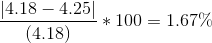
Therefore, after accounting for significant figures the correct answer is 
The formula for percent error is:
Plug in the given values and solve:
Therefore, after accounting for significant figures the correct answer is
← Didn't Know|Knew It →
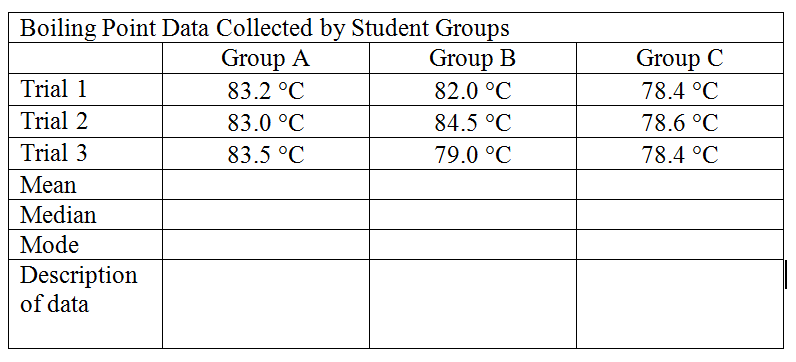
The table shows the data obtained by three groups when finding the boiling point of methanol. The accepted value is  . Is group A precise, accurate or both?
The table shows the data obtained by three groups when finding the boiling point of methanol. The accepted value is
Tap to reveal answer
Group A's values are precise because the data values are all close to each other, but it is not accurate because it none of them is near the accepted value.
Group A's values are precise because the data values are all close to each other, but it is not accurate because it none of them is near the accepted value.
← Didn't Know|Knew It →
The table shows the data obtained by three groups when attempting to find the boiling point of methanol. The accepted value is  . Is group C precise, accurate, both, or neither?
The table shows the data obtained by three groups when attempting to find the boiling point of methanol. The accepted value is
Tap to reveal answer
Group C is precise because all of their values are close to one another. Their data is also accurate because their values are all near the accepted value. Therefore group C is both accurate and precise.
Group C is precise because all of their values are close to one another. Their data is also accurate because their values are all near the accepted value. Therefore group C is both accurate and precise.
← Didn't Know|Knew It →
Place the following metric prefixes in order from smallest to largest:
k, M, m, n
Place the following metric prefixes in order from smallest to largest:
k, M, m, n
Tap to reveal answer
Remember the saying "King Henry Died by Drinking Chocolate Milk". This is referencing the order of metric prefixes: kilo, hecto, deca, deci, centi, milli. Or in their abbreviations: k, h, da, d, c, m.
You also need to know nano (n) which is  .
.
The final one you need to know for this question is Mega (M) which is  .
.
Therefore the correct answer is: n, m, k, M (nano, milli, kilo, Mega).
Remember the saying "King Henry Died by Drinking Chocolate Milk". This is referencing the order of metric prefixes: kilo, hecto, deca, deci, centi, milli. Or in their abbreviations: k, h, da, d, c, m.
You also need to know nano (n) which is
The final one you need to know for this question is Mega (M) which is
Therefore the correct answer is: n, m, k, M (nano, milli, kilo, Mega).
← Didn't Know|Knew It →
3.2 g Zn and 8.1 g HCl are placed in an open beaker. As the reaction proceeds, the hydrogen gas is allowed to escape, causing the reaction to go to completion.
Which reactant (if either) is in excess, and how many grams of it remain?
3.2 g Zn and 8.1 g HCl are placed in an open beaker. As the reaction proceeds, the hydrogen gas is allowed to escape, causing the reaction to go to completion.
Which reactant (if either) is in excess, and how many grams of it remain?
Tap to reveal answer
First calculate the number of mols of each reactant:
The ratio of to is 1:2. So, given that we have 0.048945 mol , we only need 0.09789 mol . Since we have more than is needed, is in excess. How much is in excess?
Now convert mols of to grams:
First calculate the number of mols of each reactant:
The ratio of
Now convert mols of
← Didn't Know|Knew It →
25 mL of water at room temperature is vaporized and heated to 515 degrees Celsius in an open system.
What will the volume of the resulting gas be? Round your answer to the nearest liter.
25 mL of water at room temperature is vaporized and heated to 515 degrees Celsius in an open system.
What will the volume of the resulting gas be? Round your answer to the nearest liter.
Tap to reveal answer
The system is open, so the pressure can be assumed atmospheric, e.g. 1 atm.
Using the ideal gas law,
We need to convert to kelvin.
The density of water at room temperature is approximately 1 g/mL, so we have 25 g of water. Convert to mols:
Plugging everything in:
The system is open, so the pressure can be assumed atmospheric, e.g. 1 atm.
Using the ideal gas law,
We need to convert
The density of water at room temperature is approximately 1 g/mL, so we have 25 g of water. Convert to mols:
Plugging everything in:
← Didn't Know|Knew It →
A cylindrical metal wire, initially at 100 degrees Celsius, is immersed into a bomb calorimeter containing 100 mL of water at 25 degrees Celsius. After some time, the temperature of the system is homogenous at 35 degrees Celsius.
The wire is 135 cm long with a diameter of 0.1 cm.
What is the heat capacity of the metal? Round your answer to the nearest .
A cylindrical metal wire, initially at 100 degrees Celsius, is immersed into a bomb calorimeter containing 100 mL of water at 25 degrees Celsius. After some time, the temperature of the system is homogenous at 35 degrees Celsius.
The wire is 135 cm long with a diameter of 0.1 cm.
What is the heat capacity of the metal? Round your answer to the nearest
Tap to reveal answer
First we need to calculate the mass of the wire. We will do this by calculating its volume then multiplying by the density.
Next we need to find out how much energy the water gained from the metal wire.
The energy the water gained is equal to the energy the wire lost. This allows us to calculate the heat capacity for the metal:
First we need to calculate the mass of the wire. We will do this by calculating its volume then multiplying by the density.
Next we need to find out how much energy the water gained from the metal wire.
The energy the water gained is equal to the energy the wire lost. This allows us to calculate the heat capacity for the metal:
← Didn't Know|Knew It →
A chemistry student is trying to determine the identity of an unknown gas. If the gas has a molar mass of at and , what is the density of this unknown gas under these conditions?
A chemistry student is trying to determine the identity of an unknown gas. If the gas has a molar mass of
Tap to reveal answer
We are given the pressure, temperature, and molar mass of the gas in the question stem and are asked to determine the density. To do this, we will need to make use of a manipulated form of the ideal gas equation.
To find density, we will need a way to relate the variables given in the question stem to other parameters, namely mass and volume. Since we already have the volume, , contained in the ideal gas equation, we just need a way to find the mass, . We can do this by noting that the number of moles, , can also be written as the mass divided by the molar mass, . Substituting this in gives us:
And rearranging, we obtain the density:
But we're not done yet! Remember, we also have to convert the units given for pressure and temperature in the question stem into their proper form. Since we need pressure in terms of atmospheres, and there are in of gas, we can find that:
Furthermore, we need to convert degrees Celsius into Kelvins.
Now that we have all the units in their correct form, we're finally ready to plug our values into the equation for density:
We are given the pressure, temperature, and molar mass of the gas in the question stem and are asked to determine the density. To do this, we will need to make use of a manipulated form of the ideal gas equation.
To find density, we will need a way to relate the variables given in the question stem to other parameters, namely mass and volume. Since we already have the volume,
And rearranging, we obtain the density:
But we're not done yet! Remember, we also have to convert the units given for pressure and temperature in the question stem into their proper form. Since we need pressure in terms of atmospheres, and there are
Furthermore, we need to convert degrees Celsius into Kelvins.
Now that we have all the units in their correct form, we're finally ready to plug our values into the equation for density:
← Didn't Know|Knew It →