Balancing Oxidation-Reduction Reactions - AP Chemistry
Card 1 of 84
The following ReDox reaction takes place in acidic solution:
Fe2+ + Cr2O72– → Fe3+ + Cr3+
What is the sum of coefficients in this redox reaction?
The following ReDox reaction takes place in acidic solution:
Fe2+ + Cr2O72– → Fe3+ + Cr3+
What is the sum of coefficients in this redox reaction?
Tap to reveal answer
When you balance the redox reaction in acidic conditons, there are 6Fe2+, 1 Cr2O72–, 14 H+, 6 Fe3+, 2 Cr3+, and 7 H2O. Don't forget to add the 1 in front of the Cr2O72–
When you balance the redox reaction in acidic conditons, there are 6Fe2+, 1 Cr2O72–, 14 H+, 6 Fe3+, 2 Cr3+, and 7 H2O. Don't forget to add the 1 in front of the Cr2O72–
← Didn't Know|Knew It →
For the following unbalanced redox reaction, how many electrons are transferred and which chemical species is being oxidized?

For the following unbalanced redox reaction, how many electrons are transferred and which chemical species is being oxidized?
Tap to reveal answer
To begin, we will need to separate the given reaction into the two half-reactions by identifying changes in oxidation number. In this case, mercury (Hg) and phosphorus (P) show a change in oxidation number. Mercury begins with an oxidation number of zero, and ends with an oxidation number of  . Phosphorus begins with an oxidation number of
  and ends with an oxidation number of
  . Note that the oxidation numbers for fluorine and iodine reamain constant at
  for each.
Now we can begin to look at the half-reactions.


Balance the atoms.


Now balance the electrons. We know that each mercury atom loses one electron and each fluorine atom gains one electron.


We can see that two electrons are tranferred. To identify the element being oxidized, we must find the element that is losing electrons. In this case, mercury is being oxidized.
To begin, we will need to separate the given reaction into the two half-reactions by identifying changes in oxidation number. In this case, mercury (Hg) and phosphorus (P) show a change in oxidation number. Mercury begins with an oxidation number of zero, and ends with an oxidation number of
Now we can begin to look at the half-reactions.
Balance the atoms.
Now balance the electrons. We know that each mercury atom loses one electron and each fluorine atom gains one electron.
We can see that two electrons are tranferred. To identify the element being oxidized, we must find the element that is losing electrons. In this case, mercury is being oxidized.
← Didn't Know|Knew It →
How many electrons are involved in the following reaction?

How many electrons are involved in the following reaction?
Tap to reveal answer

The common factor between 2 e- and 5 e- is 10. Therefore the number of electrons involved is 10 e-.
The common factor between 2 e- and 5 e- is 10. Therefore the number of electrons involved is 10 e-.
← Didn't Know|Knew It →
How many electrons are involved in the following reaction?

How many electrons are involved in the following reaction?
Tap to reveal answer
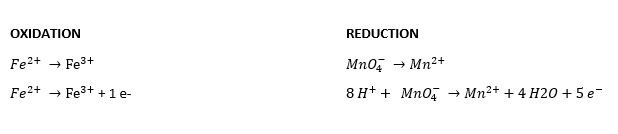
The common factor between 1 e- and 5 e- is 5. Therefore the number of electrons involved is 5 e-.
The common factor between 1 e- and 5 e- is 5. Therefore the number of electrons involved is 5 e-.
← Didn't Know|Knew It →
What is the balanced coefficient on OH- for the following reaction:
 (under basic conditions)
What is the balanced coefficient on OH- for the following reaction:
Tap to reveal answer
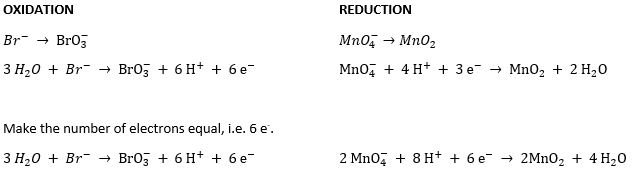
Add them together:

Simplify:

Add Hydroxides to each side to counter H+.

Simplify:

Add them together:
Simplify:
Add Hydroxides to each side to counter H+.
Simplify:
← Didn't Know|Knew It →
What is the sum of all the balanced coefficients in the following reaction:
 (basic conditions)
What is the sum of all the balanced coefficients in the following reaction:
Tap to reveal answer
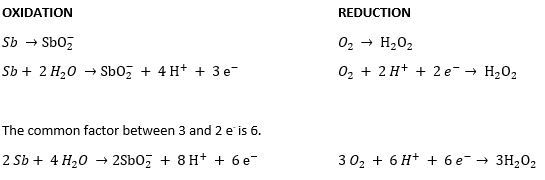
Add the equations together

Simplify

Add 2 OH- to each side to cancel out the H+.

Simplify:

Add the equations together
Simplify
Add 2 OH- to each side to cancel out the H+.
Simplify:
← Didn't Know|Knew It →
The following ReDox reaction takes place in acidic solution:
Fe2+ + Cr2O72– → Fe3+ + Cr3+
What is the sum of coefficients in this redox reaction?
The following ReDox reaction takes place in acidic solution:
Fe2+ + Cr2O72– → Fe3+ + Cr3+
What is the sum of coefficients in this redox reaction?
Tap to reveal answer
When you balance the redox reaction in acidic conditons, there are 6Fe2+, 1 Cr2O72–, 14 H+, 6 Fe3+, 2 Cr3+, and 7 H2O. Don't forget to add the 1 in front of the Cr2O72–
When you balance the redox reaction in acidic conditons, there are 6Fe2+, 1 Cr2O72–, 14 H+, 6 Fe3+, 2 Cr3+, and 7 H2O. Don't forget to add the 1 in front of the Cr2O72–
← Didn't Know|Knew It →
For the following unbalanced redox reaction, how many electrons are transferred and which chemical species is being oxidized?
For the following unbalanced redox reaction, how many electrons are transferred and which chemical species is being oxidized?
Tap to reveal answer
To begin, we will need to separate the given reaction into the two half-reactions by identifying changes in oxidation number. In this case, mercury (Hg) and phosphorus (P) show a change in oxidation number. Mercury begins with an oxidation number of zero, and ends with an oxidation number of . Phosphorus begins with an oxidation number of and ends with an oxidation number of . Note that the oxidation numbers for fluorine and iodine reamain constant at for each.
Now we can begin to look at the half-reactions.
Balance the atoms.
Now balance the electrons. We know that each mercury atom loses one electron and each fluorine atom gains one electron.
We can see that two electrons are tranferred. To identify the element being oxidized, we must find the element that is losing electrons. In this case, mercury is being oxidized.
To begin, we will need to separate the given reaction into the two half-reactions by identifying changes in oxidation number. In this case, mercury (Hg) and phosphorus (P) show a change in oxidation number. Mercury begins with an oxidation number of zero, and ends with an oxidation number of
Now we can begin to look at the half-reactions.
Balance the atoms.
Now balance the electrons. We know that each mercury atom loses one electron and each fluorine atom gains one electron.
We can see that two electrons are tranferred. To identify the element being oxidized, we must find the element that is losing electrons. In this case, mercury is being oxidized.
← Didn't Know|Knew It →
How many electrons are involved in the following reaction?
How many electrons are involved in the following reaction?
Tap to reveal answer
The common factor between 2 e- and 5 e- is 10. Therefore the number of electrons involved is 10 e-.
The common factor between 2 e- and 5 e- is 10. Therefore the number of electrons involved is 10 e-.
← Didn't Know|Knew It →
How many electrons are involved in the following reaction?
How many electrons are involved in the following reaction?
Tap to reveal answer
The common factor between 1 e- and 5 e- is 5. Therefore the number of electrons involved is 5 e-.
The common factor between 1 e- and 5 e- is 5. Therefore the number of electrons involved is 5 e-.
← Didn't Know|Knew It →
What is the balanced coefficient on OH- for the following reaction:
(under basic conditions)
What is the balanced coefficient on OH- for the following reaction:
Tap to reveal answer
Add them together:
Simplify:
Add Hydroxides to each side to counter H+.
Simplify:
Add them together:
Simplify:
Add Hydroxides to each side to counter H+.
Simplify:
← Didn't Know|Knew It →
What is the sum of all the balanced coefficients in the following reaction:
(basic conditions)
What is the sum of all the balanced coefficients in the following reaction:
Tap to reveal answer
Add the equations together
Simplify
Add 2 OH- to each side to cancel out the H+.
Simplify:
Add the equations together
Simplify
Add 2 OH- to each side to cancel out the H+.
Simplify:
← Didn't Know|Knew It →
The following ReDox reaction takes place in acidic solution:
Fe2+ + Cr2O72– → Fe3+ + Cr3+
What is the sum of coefficients in this redox reaction?
The following ReDox reaction takes place in acidic solution:
Fe2+ + Cr2O72– → Fe3+ + Cr3+
What is the sum of coefficients in this redox reaction?
Tap to reveal answer
When you balance the redox reaction in acidic conditons, there are 6Fe2+, 1 Cr2O72–, 14 H+, 6 Fe3+, 2 Cr3+, and 7 H2O. Don't forget to add the 1 in front of the Cr2O72–
When you balance the redox reaction in acidic conditons, there are 6Fe2+, 1 Cr2O72–, 14 H+, 6 Fe3+, 2 Cr3+, and 7 H2O. Don't forget to add the 1 in front of the Cr2O72–
← Didn't Know|Knew It →
For the following unbalanced redox reaction, how many electrons are transferred and which chemical species is being oxidized?
For the following unbalanced redox reaction, how many electrons are transferred and which chemical species is being oxidized?
Tap to reveal answer
To begin, we will need to separate the given reaction into the two half-reactions by identifying changes in oxidation number. In this case, mercury (Hg) and phosphorus (P) show a change in oxidation number. Mercury begins with an oxidation number of zero, and ends with an oxidation number of . Phosphorus begins with an oxidation number of and ends with an oxidation number of . Note that the oxidation numbers for fluorine and iodine reamain constant at for each.
Now we can begin to look at the half-reactions.
Balance the atoms.
Now balance the electrons. We know that each mercury atom loses one electron and each fluorine atom gains one electron.
We can see that two electrons are tranferred. To identify the element being oxidized, we must find the element that is losing electrons. In this case, mercury is being oxidized.
To begin, we will need to separate the given reaction into the two half-reactions by identifying changes in oxidation number. In this case, mercury (Hg) and phosphorus (P) show a change in oxidation number. Mercury begins with an oxidation number of zero, and ends with an oxidation number of
Now we can begin to look at the half-reactions.
Balance the atoms.
Now balance the electrons. We know that each mercury atom loses one electron and each fluorine atom gains one electron.
We can see that two electrons are tranferred. To identify the element being oxidized, we must find the element that is losing electrons. In this case, mercury is being oxidized.
← Didn't Know|Knew It →
How many electrons are involved in the following reaction?
How many electrons are involved in the following reaction?
Tap to reveal answer
The common factor between 2 e- and 5 e- is 10. Therefore the number of electrons involved is 10 e-.
The common factor between 2 e- and 5 e- is 10. Therefore the number of electrons involved is 10 e-.
← Didn't Know|Knew It →
How many electrons are involved in the following reaction?
How many electrons are involved in the following reaction?
Tap to reveal answer
The common factor between 1 e- and 5 e- is 5. Therefore the number of electrons involved is 5 e-.
The common factor between 1 e- and 5 e- is 5. Therefore the number of electrons involved is 5 e-.
← Didn't Know|Knew It →
What is the balanced coefficient on OH- for the following reaction:
(under basic conditions)
What is the balanced coefficient on OH- for the following reaction:
Tap to reveal answer
Add them together:
Simplify:
Add Hydroxides to each side to counter H+.
Simplify:
Add them together:
Simplify:
Add Hydroxides to each side to counter H+.
Simplify:
← Didn't Know|Knew It →
What is the sum of all the balanced coefficients in the following reaction:
(basic conditions)
What is the sum of all the balanced coefficients in the following reaction:
Tap to reveal answer
Add the equations together
Simplify
Add 2 OH- to each side to cancel out the H+.
Simplify:
Add the equations together
Simplify
Add 2 OH- to each side to cancel out the H+.
Simplify:
← Didn't Know|Knew It →
The following ReDox reaction takes place in acidic solution:
Fe2+ + Cr2O72– → Fe3+ + Cr3+
What is the sum of coefficients in this redox reaction?
The following ReDox reaction takes place in acidic solution:
Fe2+ + Cr2O72– → Fe3+ + Cr3+
What is the sum of coefficients in this redox reaction?
Tap to reveal answer
When you balance the redox reaction in acidic conditons, there are 6Fe2+, 1 Cr2O72–, 14 H+, 6 Fe3+, 2 Cr3+, and 7 H2O. Don't forget to add the 1 in front of the Cr2O72–
When you balance the redox reaction in acidic conditons, there are 6Fe2+, 1 Cr2O72–, 14 H+, 6 Fe3+, 2 Cr3+, and 7 H2O. Don't forget to add the 1 in front of the Cr2O72–
← Didn't Know|Knew It →
For the following unbalanced redox reaction, how many electrons are transferred and which chemical species is being oxidized?
For the following unbalanced redox reaction, how many electrons are transferred and which chemical species is being oxidized?
Tap to reveal answer
To begin, we will need to separate the given reaction into the two half-reactions by identifying changes in oxidation number. In this case, mercury (Hg) and phosphorus (P) show a change in oxidation number. Mercury begins with an oxidation number of zero, and ends with an oxidation number of . Phosphorus begins with an oxidation number of and ends with an oxidation number of . Note that the oxidation numbers for fluorine and iodine reamain constant at for each.
Now we can begin to look at the half-reactions.
Balance the atoms.
Now balance the electrons. We know that each mercury atom loses one electron and each fluorine atom gains one electron.
We can see that two electrons are tranferred. To identify the element being oxidized, we must find the element that is losing electrons. In this case, mercury is being oxidized.
To begin, we will need to separate the given reaction into the two half-reactions by identifying changes in oxidation number. In this case, mercury (Hg) and phosphorus (P) show a change in oxidation number. Mercury begins with an oxidation number of zero, and ends with an oxidation number of
Now we can begin to look at the half-reactions.
Balance the atoms.
Now balance the electrons. We know that each mercury atom loses one electron and each fluorine atom gains one electron.
We can see that two electrons are tranferred. To identify the element being oxidized, we must find the element that is losing electrons. In this case, mercury is being oxidized.
← Didn't Know|Knew It →