Understanding the limiting process. - AP Calculus AB
Card 1 of 385
Find the derivative.
y = sec (5x3)
Find the derivative.
y = sec (5x3)
Tap to reveal answer
The derivative of the function y = sec(x) is sec(x)tan(x). First take the derivative of the outside of the function: y = sec(4x3) : y' = sec(5x3)tan(5x3). Then take the derivative of the inside of the function: 5x3 becomes 15x2. So your final answer is: y' = ec(5x3)tan(5x3)15x2
The derivative of the function y = sec(x) is sec(x)tan(x). First take the derivative of the outside of the function: y = sec(4x3) : y' = sec(5x3)tan(5x3). Then take the derivative of the inside of the function: 5x3 becomes 15x2. So your final answer is: y' = ec(5x3)tan(5x3)15x2
← Didn't Know|Knew It →
Find the slope of the tangent line to the graph of f at x = 9, given that f(x) = –x2 + 5√(x)
Find the slope of the tangent line to the graph of f at x = 9, given that f(x) = –x2 + 5√(x)
Tap to reveal answer
First find the derivative of the function.
f(x) = –x2 + 5√(x)
f'(x) = –2x + 5(1/2)x–1/2
Simplify the problem
f'(x) = –2x + (5/2x1/2)
Plug in 9.
f'(3) = –2(9) + (5/2(9)1/2)
= –18 + 5/(6)
First find the derivative of the function.
f(x) = –x2 + 5√(x)
f'(x) = –2x + 5(1/2)x–1/2
Simplify the problem
f'(x) = –2x + (5/2x1/2)
Plug in 9.
f'(3) = –2(9) + (5/2(9)1/2)
= –18 + 5/(6)
← Didn't Know|Knew It →
Find the derivative
(x + 1)/(x – 1)
Find the derivative
(x + 1)/(x – 1)
Tap to reveal answer
Rewrite problem.
(x + 1)/(x – 1)
Use quotient rule to solve this derivative.
((x – 1)(1) – (x + 1)(1))/(x – 1)2
(x – 1) – x – 1)/(x – 1)2
–2/(x – 1)2
Rewrite problem.
(x + 1)/(x – 1)
Use quotient rule to solve this derivative.
((x – 1)(1) – (x + 1)(1))/(x – 1)2
(x – 1) – x – 1)/(x – 1)2
–2/(x – 1)2
← Didn't Know|Knew It →
What is the derivative of $(2+3cos(3x))^pi$?
What is the derivative of $(2+3cos(3x))^pi$?
Tap to reveal answer
Need to use the power rule which states: $$\frac{d}{dx}$u^n$$=nu^{n-1}$$\frac{du}{dx}$
In our problem $\frac{du}{dx}$=-3sin(3x)
Need to use the power rule which states: $$\frac{d}{dx}$u^n$$=nu^{n-1}$$\frac{du}{dx}$
In our problem $\frac{du}{dx}$=-3sin(3x)
← Didn't Know|Knew It →
Find the derivative of

Find the derivative of
Tap to reveal answer
The answer is  . It is easy to solve if we multiply everything together first before taking the derivative.




The answer is
← Didn't Know|Knew It →
If  , then
If
Tap to reveal answer
The correct answer is  .
.
We must use the product rule to solve. Remember that the derivative of  is
is  .
.


The correct answer is
We must use the product rule to solve. Remember that the derivative of
← Didn't Know|Knew It →

Tap to reveal answer
This question is asking to evaluate a one-sided equation of a function. Specifically, the limit of the function to the left of  . When
  is substituted into the function the result is indeterminate. This means it is in the form zero over zero.
Since the question is looking for a one-sided limit, let us substitute in a value that is slightly less than  .
.


This question is asking to evaluate a one-sided equation of a function. Specifically, the limit of the function to the left of
Since the question is looking for a one-sided limit, let us substitute in a value that is slightly less than
← Didn't Know|Knew It →

Tap to reveal answer
Use the chain rule and the formula
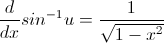
Use the chain rule and the formula
← Didn't Know|Knew It →
Find  if
if  .
.
Find
Tap to reveal answer
We will have to find the first derivative of  with respect to
  using implicit differentiation. Then, we can find
  , which is the second derivative of
  with respect to
  .
.

We will apply the chain rule on the left side.


We now solve for the first derivative with respect to  .
.

In order to get the second derivative, we will differentiate  with respect to
  . This will require us to employ the Quotient Rule.

We will replace  with
with  .
.

But, from the original equation,  . Also, if we solve for
  , we obtain
  .
.

The answer is  .
.
We will have to find the first derivative of
We will apply the chain rule on the left side.
We now solve for the first derivative with respect to
In order to get the second derivative, we will differentiate
We will replace
But, from the original equation,
The answer is
← Didn't Know|Knew It →
Differentiate  .
.
Differentiate
Tap to reveal answer
The derivative of  is equal to
  therefore the first part of the equation remains the same.
The second part requires regular differential rules.

Therefore when differentiating  you get
  .
.
Combining the first and second part we get the final derivative:
 .
.
The derivative of
The second part requires regular differential rules.
Therefore when differentiating
Combining the first and second part we get the final derivative:
← Didn't Know|Knew It →
Differentiate  .
.
Differentiate
Tap to reveal answer
The rule for taking the derivative of  .
.
For this problem we need to remember to use the Chain Rule.
Since we are taking the derivative of,
 we need to take the derivative of the outside piece
  keeping the inside piece the same
  , and then multiply the whole thing by the derivative of the inside piece
  .
.
Therefore the solution becomes:
 ,
,
 .
.
The rule for taking the derivative of
For this problem we need to remember to use the Chain Rule.
Since we are taking the derivative of,
Therefore the solution becomes:
← Didn't Know|Knew It →
Evaluate:
 .
.
Evaluate:
Tap to reveal answer
The derivative of  is
is  .
.
Therefore the integral of
 where C is some constant.
The derivative of
Therefore the integral of
← Didn't Know|Knew It →
If  what is
  ?
?
If
Tap to reveal answer
The derivative of,
 .
.
The derivative of

Therefore, using the Chain Rule the derivative of the function will become the derivative of the outside piece keeping the original inside piece. Then multiplying that by the derivative of the inside piece.

The derivative of,
The derivative of
Therefore, using the Chain Rule the derivative of the function will become the derivative of the outside piece keeping the original inside piece. Then multiplying that by the derivative of the inside piece.
← Didn't Know|Knew It →
Differentiate  .
.
Differentiate
Tap to reveal answer
Using the power rule, multiply the coefficient by the power and subtract the power by 1.



Using the power rule, multiply the coefficient by the power and subtract the power by 1.
← Didn't Know|Knew It →
Differentiate  .
.
Differentiate
Tap to reveal answer
Use the product rule:
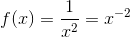

Use the product rule:
← Didn't Know|Knew It →
Differentiate: 
Differentiate:
Tap to reveal answer
Use the product rule to find the derivative of the function.



Use the product rule to find the derivative of the function.
← Didn't Know|Knew It →
Differentiate: 
Differentiate:
Tap to reveal answer
The derivative of any function of e to any exponent is equal to the function multiplied by the derivative of the exponent.

The derivative of any function of e to any exponent is equal to the function multiplied by the derivative of the exponent.
← Didn't Know|Knew It →
Find the second derivative of 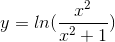 .
.
Find the second derivative of
Tap to reveal answer



Factoring out an x gives you  .
.

Factoring out an x gives you
← Didn't Know|Knew It →
Consider:

The 99th derivative of  is:
is:
Consider:
The 99th derivative of
Tap to reveal answer
For  , the nth derivative is
  . As an example, consider
  . The first derivative is
  , the second derivative is
  , and the third derivative is
  . For the question being asked, the 99th derivative of
  would be
  . The 66th derivative of
  would be
  , and any higher derivative would be zero, since the derivative of any constant is zero. Thus, for the given function, the 99th derivative is
  .
.
For
← Didn't Know|Knew It →
Consider the function  .
.
Which of the following is true when  ?
?
Consider the function
Which of the following is true when
Tap to reveal answer

 , meaning
  is increasing when
 .
.
 , meaning
  is concave up when
 .
.
← Didn't Know|Knew It →