Physics
Help Questions
ACT Science › Physics
Experiment 1
A scientist develops the following setup, shown in Figure 1 below, to study the charges of radioactive particles. A radioactive sample is placed into a lead box that has an open column such that the particles can only exit from one direction. A detector is placed in front of the opening. A metric ruler (centimeters (cm)), is aligned on the detector such that zero is directly in front of the opening of the column, with the positive values extending to the left and the negative values to the right. On the left side of the experimental setup, there is a device that generates a magnetic field that attracts positively charged particles and repels negatively charged particles.
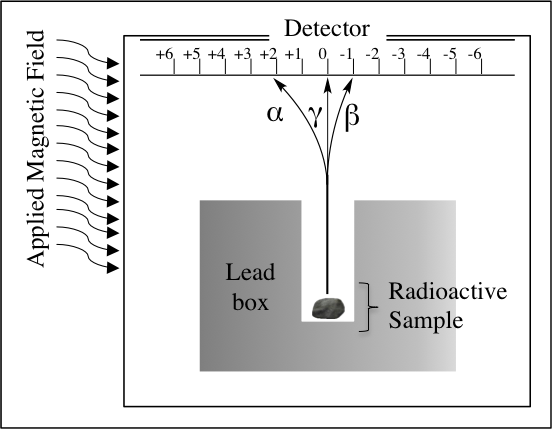
Figure 1.
The device detects particles in three different places: alpha, α; beta, β; and gamma, γ; as labeled in Figure 1. The paths these particles take from the source of radioactivity are shown.
Experiment 2
A different scientist finds the following data, shown in Table 1, about the energies of the α, β, and γ particles by observing what kinds of materials through which the particles can pass. This scientist assumes that the ability of particles to pass through thicker and denser barriers is indicative of higher energy. Table 1 summarizes whether or not each type of particle was detected when each of the following barriers is placed between the radioactivity source and the detector. The paper and aluminum foil are both 1 millimeters thick, and the concrete wall is 1 meter thick.
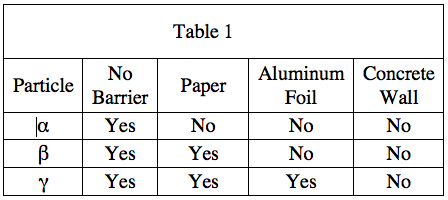
It is discovered that a certain element in the Earth's crust emits beta particles, and furthermore, that beta particles can cause cancer. Should architects building houses in the areas where this phenomenon is found in high abundance be mandated to build basements with concrete walls with a minimum thickness of one meter?
No, because beta particles are not energetic enough to pass through an aluminum foil sheet.
Yes, because there will be very large numbers of beta particles emitted from the Earth's crust in these areas.
Yes, because beta particles are only stopped by concrete walls at least one meter thick.
No, because beta particles are negatively charged, and thus will bounce off the basement's external walls.
Explanation
Table 1 shows that a simple sheet of aluminum foil can deflect beta particles. Thus, we know that any basement walls will be sufficient to deflect beta particles, and extra measures to build thick walls would be a waste of materials.
A student was interested in determining the relationship between the current, voltage, and resistance in a direct circuit, such as those exemplified by batteries connected to light bulbs. The student built the circuit presented in Figure 1 using a 2 ohm resistor.
Figure 1:
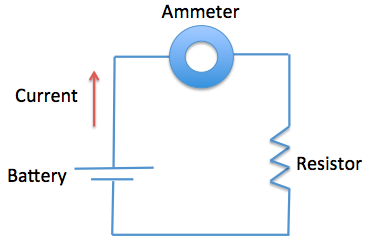
The current that flows through the circuit can be calculated using the equation 


The student used a 2 ohm resistor and batteries of various voltages to obtain the results in Table 1. The currents shown in the table are NOT calculated using the formula 

The passage and Table 1 present results with ideal batteries that do not have any internal resistance. If the batteries used were a real batteries that had internal resistance, how would the measured currents of the system change?
It would decrease.
It would increase.
It would remain the same.
It cannot be determined how current would change.
Explanation
If the batteries used in the circuit were to have additional resistance, then the overall resistance of the circuit would increase. Because we know that current and resistance are inversely related by 

In a physics class, students conducted a series of experiments by placing different objects into a beaker of water. They conducted twenty trials for each object. For each trial, they recorded whether or not the object floated.
First, they placed a steel paper clip into the water. They observed that the paper clip usually sank; however, they also saw that occasionally, the paper clip stayed afloat if it was placed very gently on top of the water. Next, they repeated the the same procedure using a cork, a toy boat made of aluminum, and a glass marble. They observed that both the cork and the toy boat always stayed afloat in the water, but that the glass marble always sank.
Below, three students give their explanations for these observations.
Student 1:
Objects float when they are less dense than the liquid in which they are immersed. For example, when immiscible liquids of varying densities are mixed together in a container, the most dense liquid will sink to the bottom of the container, while the least dense liquid will rise to the top. This same principle applies to solid objects. Because the cork and the aluminum toy boat always float, cork and the aluminum of the boat must be less dense than water. Because the glass marble always sinks, the glass of the marble must be more dense than water.
Objects that are more dense than water can also float due to surface tension. Surface tension occurs because molecules of a liquid are more attracted to each other more than they are to other objects. Molecules on the surface of water are attracted to the molecules around them and below them. This attraction causes a liquid's surface to behave if it were covered by a thin film, which resists penetration by other objects. Therefore, small objects such as paper clips can sometimes float on water when the upward force of water's surface tension exceeds the force of gravity pulling such objects down. Because the paper clips often sink and only float sometimes, we can conclude that they are indeed more dense than water, and that their floating is due to surface tension.
Student 2:
Objects float in two different cases: when they are buoyed by a liquid's surface tension or when their average density is less than that of the liquid in which they are immersed. The average density of cork is less than that of water. This is why the cork floats. In contrast, the density of glass is more than that of water. This is why the glass marble sinks.
However, the densities of aluminum and of steel are greater than that of water. Thus, density cannot be used to explain why the aluminum toy boat and the paper clip float. Both of these objects float because of surface tension. Because the paper clip does not have much mass, the normal upward force created by water's surface tension can be enough to allow it to float. Other objects with greater mass, like the toy boat, employ a particular shape to magnify the force of surface tension. The curved shape of the boat's bottom both stabilizes the boat and increases the amount of the boat's surface area that touches the water, maximizing the force due to surface tension that the boat receives.
Student 3:
In this experiment, the paper clip floats because of surface tension; however, the cork, toy boat, and marble float or sink because of their relationship to a buoyant force. All objects immersed in a liquid experience a buoyant force, which pushes them upward. The strength of this force is equal to the weight of the liquid displaced, or pushed aside, by an object. Every object also experiences a downward force due to gravity, which is measured as the object's weight, and which is directly proportional to the object's mass. When the buoyant force acting on an object is greater than the downward force due to gravity, the object floats. However, when the buoyant force is less than the force due to gravity, the object sinks. Both the cork and the aluminum toy boat are able to displace enough water to create a buoyant force that exceeds the force due to gravity, so they float. However, the glass marble does not displace enough water to create a sufficient buoyant force, so it sinks.
A surfactant is a substance that reduces the surface tension of the liquid to which it is added. Laundry detergent is a surfactant. If Student 3's explanation is correct, how likely will a paper clip placed in water with laundry detergent be to float, compared to a paper clip placed in water without laundry detergent? The paper clip in water with laundry detergent is .
less likely to float, because it experiences less upward force due to surface tension
less likely to float, because it experiences less buoyant force
more likely to float, because it experiences a greater upward force due to surface tension
more likely to float, because it experiences a greater buoyant force
Explanation
According to Student 3, the paper clip floats due to water's surface tension. We also know from this question that laundry detergent reduces surface tension. So, if laundry detergent is added to water, this water will have a lower surface tension. The upward force generated by surface tension will be lower, so the paper clip will be less likely to float.
As part of an engineering competition, a group of students are asked to design a flying robot that simulates the way real birds fly. Below, three of the students give their explanations for how bird flight occurs.
Student 1:
Birds are able to fly due to the shape of their wings. Bird wings are convex on their upper sides, while their lower sides are usually concave. This type of shape is called an airfoil. When a wing travels through the air, air passing over the top of the wing must travel a greater distance than air passing under the wing. The stream of air passing over the wing and the stream of air passing under the wing meet together at the tail end of the wing. In order for both streams of air to meet at the same point behind the wing, the air above the wing, which travels a greater distance, must travel faster than the air below the wing.
When a volume of air travels more quickly over a distance, its molecules are spread out over a greater distance. As a result, the air traveling over the top of a wing has a lower pressure than the air traveling under the wing. Because the wing has a region of low pressure above it and a region of relative high pressure below it, it experiences a net upward force. When this upward force is greater than or equal to the bird's weight, or the force exerted on a bird by gravity, the bird is able to fly.
The magnitude of the upward force depends on the speed at which air flows across the wing and on the corresponding difference in pressure over and under the wing. When birds flap their wings, they increase the speed of air flowing across their wings, thus producing a greater upward force.
Student 2:
There are two components to bird flight: lift and thrust. "Lift" refers to the upward force that allows a bird to stay aloft in the air despite its weight, while "thrust" refers to the horizontal force that allows a bird to move forward through the air. Birds are able to fly because they do not hold their wings perfectly horizontally. Instead, their wings are angled slightly upward. The angle at which a wing is inclined upward, with respect to the horizontal, is called its "angle of attack."
Air is not an ideal gas; instead, it has viscosity. This means that the air flowing close to a solid object tends to follow the curves of that object. When air encounters a bird's wing, it follows the incline of the wing. Because of the wing's angle of attack, the air is directed downward and back. The air continues to move downward, even after it has left the wing. This movement of the air creates an opposing force that pushes the bird upward and forward.
Thus, the angle of attack of a bird's wings accounts for both the lift and thrust components of a bird's flight.
Student 3:
Birds are able to fly because the way in which they move their wings allows them to create a net movement of air downward and backward. The flapping of a bird's wings can be understood as being composed of two parts: a downstroke, during which the bird moves its wings down, and an upstroke, during which the bird moves its wings up. During a downstroke, a bird displaces a quantity of air downward and behind it. During an upstroke, however, the bird's wings are angled upward in a way that displaces less air, and its wing feathers rotate to allow air to pass through them. Thus, on the upstroke, the bird much exerts less force on the air than it does on the downstroke.
Suppose that, in designing a hovercraft, engineers position a fan so that it blows out air straight down from the bottom of the hovercraft. Given that Student 2's explanation is correct, this would generate which of the following?
Lift
Thrust
Both lift and thrust
Neither lift nor thrust
Explanation
Student 2 states that the movement of air creates and equal and opposing force which pushes a bird (or any other flying object) in the opposite direction. So, if the fan on the hovercraft blows air downward, this would generate an upward force which acts on the hovercraft. Student 2 states that the upward force experienced by a flying object is called lift.
A company developed new prototype car and wanted to test the new car. The car's acceleration time from 0mph to 60mph and stopping time from 60mph to 0mph were measured. An obstacle course involving a lot of turns was also constructed to determine how well the car can handle turning. The main concern of the company is the safety of the car and therefore all of the tests were performed on dry concrete, concrete after simulated rain, concrete that was covered with snow and in sand.
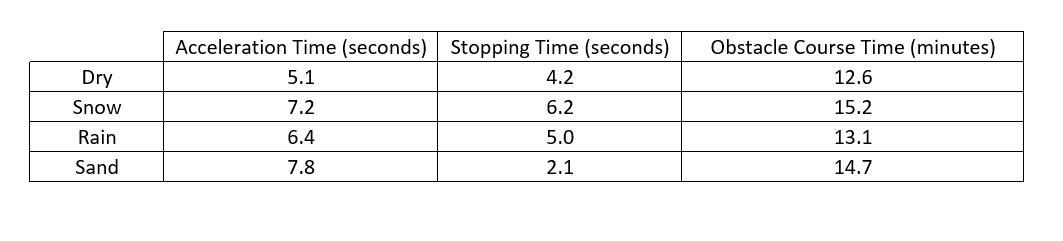
In order for the car to be safe on the roads, it is necessary for the car to have a stopping time of 4.5 seconds. What surfaces would the car not be safe on?
Rain and snow
All surfaces
Sand, snow and rain
Sand and rain
Explanation
The necessary stopping time is 4.5 seconds. When it comes to stopping time, the shorter the time the better for avoiding any hazards. Therefore the stopping times that are longer than 4.5 seconds are not safe. The rainy condition has a stopping time of 5.0 seconds and the snowy condition has a stopping time of 6.2 seconds. These two conditions are not safe when using this car.
Scientist 1: Scientist 1 believes that light displays particle behavior. This means that rays of light have their own associated momentum. Furthermore, Scientist 1 does not believe that light will exhibit wave behavior.
Scientist 2: Scientist 2 disagrees with Scientist 1 and believes that light can exhibit wave behavior, but does not display particle behavior. In other words, this scientist believes that light does not have any momentum.
Experiment: To settle their disagreement, the scientists setup the following experiment. The scientist take dark metallic material. This material is attached to pole and the metallic material can spin if it is subjected to a force; similar to a watermill or wind turbine. This setup is then placed outside and exposed to sunlight.
Assuming that sunlight displays particle behavior, what is the best way to design a device to absorb solar energy and turn it into electrical energy?
Cannot be determined from the given information
A flat solar panel facing the sun
Solar cells placed on the surface of a wind turbine
Solar cells placed in the shade, but with reflected sunlight aimed at the solar cells
Use solar cells placed underwater to collect refracted sunlight
Explanation
It is assumed that light exhibits particle behavior with momentum, but there is no information on how this affects the amount of sunlight absorbed. In addition, there is no information given on how to effectively build a device to absorb sunlight that can be converted into electrical energy so the answer cannot be determined.
In a physics class, students conducted a series of experiments by placing different objects into a beaker of water. They conducted twenty trials for each object. For each trial, they recorded whether or not the object floated.
First, they placed a steel paper clip into the water. They observed that the paper clip usually sank; however, they also saw that occasionally, the paper clip stayed afloat if it was placed very gently on top of the water. Next, they repeated the the same procedure using a cork, a toy boat made of aluminum, and a glass marble. They observed that both the cork and the toy boat always stayed afloat in the water, but that the glass marble always sank.
Below, three students give their explanations for these observations.
Student 1:
Objects float when they are less dense than the liquid in which they are immersed. For example, when immiscible liquids of varying densities are mixed together in a container, the most dense liquid will sink to the bottom of the container, while the least dense liquid will rise to the top. This same principle applies to solid objects. Because the cork and the aluminum toy boat always float, cork and the aluminum of the boat must be less dense than water. Because the glass marble always sinks, the glass of the marble must be more dense than water.
Objects that are more dense than water can also float due to surface tension. Surface tension occurs because molecules of a liquid are more attracted to each other more than they are to other objects. Molecules on the surface of water are attracted to the molecules around them and below them. This attraction causes a liquid's surface to behave if it were covered by a thin film, which resists penetration by other objects. Therefore, small objects such as paper clips can sometimes float on water when the upward force of water's surface tension exceeds the force of gravity pulling such objects down. Because the paper clips often sink and only float sometimes, we can conclude that they are indeed more dense than water, and that their floating is due to surface tension.
Student 2:
Objects float in two different cases: when they are buoyed by a liquid's surface tension or when their average density is less than that of the liquid in which they are immersed. The average density of cork is less than that of water. This is why the cork floats. In contrast, the density of glass is more than that of water. This is why the glass marble sinks.
However, the densities of aluminum and of steel are greater than that of water. Thus, density cannot be used to explain why the aluminum toy boat and the paper clip float. Both of these objects float because of surface tension. Because the paper clip does not have much mass, the normal upward force created by water's surface tension can be enough to allow it to float. Other objects with greater mass, like the toy boat, employ a particular shape to magnify the force of surface tension. The curved shape of the boat's bottom both stabilizes the boat and increases the amount of the boat's surface area that touches the water, maximizing the force due to surface tension that the boat receives.
Student 3:
In this experiment, the paper clip floats because of surface tension; however, the cork, toy boat, and marble float or sink because of their relationship to a buoyant force. All objects immersed in a liquid experience a buoyant force, which pushes them upward. The strength of this force is equal to the weight of the liquid displaced, or pushed aside, by an object. Every object also experiences a downward force due to gravity, which is measured as the object's weight, and which is directly proportional to the object's mass. When the buoyant force acting on an object is greater than the downward force due to gravity, the object floats. However, when the buoyant force is less than the force due to gravity, the object sinks. Both the cork and the aluminum toy boat are able to displace enough water to create a buoyant force that exceeds the force due to gravity, so they float. However, the glass marble does not displace enough water to create a sufficient buoyant force, so it sinks.
A surfactant is a substance that reduces the surface tension of the liquid to which it is added. Laundry detergent is a surfactant. If Student 3's explanation is correct, how likely will a paper clip placed in water with laundry detergent be to float, compared to a paper clip placed in water without laundry detergent? The paper clip in water with laundry detergent is .
less likely to float, because it experiences less upward force due to surface tension
less likely to float, because it experiences less buoyant force
more likely to float, because it experiences a greater upward force due to surface tension
more likely to float, because it experiences a greater buoyant force
Explanation
According to Student 3, the paper clip floats due to water's surface tension. We also know from this question that laundry detergent reduces surface tension. So, if laundry detergent is added to water, this water will have a lower surface tension. The upward force generated by surface tension will be lower, so the paper clip will be less likely to float.
Magnets and electric charges show certain similarities. For example, both magnets and electric charges can exert a force on their surroundings. This force, when produced by a magnet, is called a magnetic field. When it is produced by an electric charge, the force is called an electric field. It has been observed that the strength of both magnetic fields and electric fields is inversely proportional to the square of the distance between a magnet or an electric charge and the objects that they affect.
Below, three scientists debate the relationship between electricity and magnetism.
Scientist 1:
Electricity and magnetism are two different phenomena. Materials such as iron, cobalt, and nickel contain magnetic domains: tiny regions of magnetism, each with two poles. Normally, the domains have a random orientation and are not aligned, so the magnetism of some domains cancels out that of other domains; however, in magnets, domains line up in the same direction, creating the two poles of the magnet and causing magnetic behavior.
In contrast, electricity is a moving electric charge which is caused by the flow of electrons through a material. Electrons flow through a material from a region of higher potential (more negative charge) to a region of lower potential (more positive charge). We can measure this flow of electrons as current, which refers to the amount of charge transferred over a period of time.
Scientist 2:
Electricity and magnetism are similar phenomena; however, one cannot be reduced to the other. Electricity involves two types of charges: positive and negative charge. Though electricity can occur in a moving form (in the form of current, or an electric charge moving through a wire), it can also occur in a static form. Static electricity involves no moving charge. Instead, objects can have a net excess of positive charge or a net excess of negative charge—because of having lost or gained electrons, respectively. When two static positive electric charges or two static negative electric charges are brought close together, they repel each other. However, when a positive and a negative static charge are brought together, they attract each other.
Similarly, all magnets have two poles. Magnetic poles that are alike repel each other, while dissimilar magnetic poles attract each other. Magnets and static electric charges are alike in that they both show attraction and repulsion in similar circumstances. However, while isolated static electric charges occur in nature, there are no single, isolated magnetic poles. All magnets have two poles, which cannot be dissociated from each other.
Scientist 3:
Electricity and magnetism are two aspects of the same phenomenon. A moving flow of electrons creates a magnetic field around it. Thus, wherever an electric current exists, a magnetic field will also exist. The magnetic field created by an electric current is perpendicular to the electric current's direction of flow.
Additionally, a magnetic field can induce an electric current. This can happen when a wire is moved across a magnetic field, or when a magnetic field is moved near a conductive wire. Because magnetic fields can produce electric fields and electric fields can produce magnetic fields, we can understand electricity and magnetism as parts of one phenomenon: electromagnetism.
In an experiment, an iron bar that showed no magnetism was heated and allowed to cool while aligned North-South with the Earth's magnetic field. After it cooled, the iron bar was found to be magnetic. Scientist 1 would most likely explain this result by saying which of the following?
The experiment allowed the magnetic domains of the bar to line up, causing the bar to become magnetic.
The experiment induced an electric current in the bar, causing the bar to become magnetic.
The experiment caused the magnetic domains of the bar to move out of alignment with each other.
The experiment caused the two magnetic poles of the bar to move so that they were aligned with the Earth's magnetic field.
Interference occurred between the electric field of the bar and the magnetic field of the Earth, causing the bar to become magnetic.
Explanation
Scientist 1 states that magnetism occurs when the magnetic domains in a material align. Since the iron bar initially showed no magnetism, we can assume that its magnetic domains were initially oriented randomly, and that it had no magnetic poles. Since the iron bar became magnetic after it was heated and cooled, the heating and cooling process likely reoriented the magnetic domains in the iron so that they became more aligned, creating two magnetic poles.
Magnets and electric charges show certain similarities. For example, both magnets and electric charges can exert a force on their surroundings. This force, when produced by a magnet, is called a magnetic field. When it is produced by an electric charge, the force is called an electric field. It has been observed that the strength of both magnetic fields and electric fields is inversely proportional to the square of the distance between a magnet or an electric charge and the objects that they affect.
Below, three scientists debate the relationship between electricity and magnetism.
Scientist 1:
Electricity and magnetism are two different phenomena. Materials such as iron, cobalt, and nickel contain magnetic domains: tiny regions of magnetism, each with two poles. Normally, the domains have a random orientation and are not aligned, so the magnetism of some domains cancels out that of other domains; however, in magnets, domains line up in the same direction, creating the two poles of the magnet and causing magnetic behavior.
In contrast, electricity is a moving electric charge which is caused by the flow of electrons through a material. Electrons flow through a material from a region of higher potential (more negative charge) to a region of lower potential (more positive charge). We can measure this flow of electrons as current, which refers to the amount of charge transferred over a period of time.
Scientist 2:
Electricity and magnetism are similar phenomena; however, one cannot be reduced to the other. Electricity involves two types of charges: positive and negative charge. Though electricity can occur in a moving form (in the form of current, or an electric charge moving through a wire), it can also occur in a static form. Static electricity involves no moving charge. Instead, objects can have a net excess of positive charge or a net excess of negative charge—because of having lost or gained electrons, respectively. When two static positive electric charges or two static negative electric charges are brought close together, they repel each other. However, when a positive and a negative static charge are brought together, they attract each other.
Similarly, all magnets have two poles. Magnetic poles that are alike repel each other, while dissimilar magnetic poles attract each other. Magnets and static electric charges are alike in that they both show attraction and repulsion in similar circumstances. However, while isolated static electric charges occur in nature, there are no single, isolated magnetic poles. All magnets have two poles, which cannot be dissociated from each other.
Scientist 3:
Electricity and magnetism are two aspects of the same phenomenon. A moving flow of electrons creates a magnetic field around it. Thus, wherever an electric current exists, a magnetic field will also exist. The magnetic field created by an electric current is perpendicular to the electric current's direction of flow.
Additionally, a magnetic field can induce an electric current. This can happen when a wire is moved across a magnetic field, or when a magnetic field is moved near a conductive wire. Because magnetic fields can produce electric fields and electric fields can produce magnetic fields, we can understand electricity and magnetism as parts of one phenomenon: electromagnetism.
According to Scientist 2, which of the following would be an example of a static electric charge?
A balloon that has been rubbed against hair so that it has picked up excess electrons
A wire that carries charge from the negative to the positive terminal of a battery
A bar magnet placed in an electric field
A ring of a conductive material, such copper, that has not lost or gained electrons
A conductive material, such as copper, that is placed in an magnetic field
Explanation
Scientist 2 states that static electric charges occur when an object has a net excess of positive or negative charge. According to Scientist 2, static electric charges also don't involve a moving charge. So, one example of a static electric charge is a balloon that has picked up excess electrons: it has an excess of negative charge, but the charge is not moving.
Magnets and electric charges show certain similarities. For example, both magnets and electric charges can exert a force on their surroundings. This force, when produced by a magnet, is called a magnetic field. When it is produced by an electric charge, the force is called an electric field. It has been observed that the strength of both magnetic fields and electric fields is inversely proportional to the square of the distance between a magnet or an electric charge and the objects that they affect.
Below, three scientists debate the relationship between electricity and magnetism.
Scientist 1:
Electricity and magnetism are two different phenomena. Materials such as iron, cobalt, and nickel contain magnetic domains: tiny regions of magnetism, each with two poles. Normally, the domains have a random orientation and are not aligned, so the magnetism of some domains cancels out that of other domains; however, in magnets, domains line up in the same direction, creating the two poles of the magnet and causing magnetic behavior.
In contrast, electricity is a moving electric charge which is caused by the flow of electrons through a material. Electrons flow through a material from a region of higher potential (more negative charge) to a region of lower potential (more positive charge). We can measure this flow of electrons as current, which refers to the amount of charge transferred over a period of time.
Scientist 2:
Electricity and magnetism are similar phenomena; however, one cannot be reduced to the other. Electricity involves two types of charges: positive and negative charge. Though electricity can occur in a moving form (in the form of current, or an electric charge moving through a wire), it can also occur in a static form. Static electricity involves no moving charge. Instead, objects can have a net excess of positive charge or a net excess of negative charge—because of having lost or gained electrons, respectively. When two static positive electric charges or two static negative electric charges are brought close together, they repel each other. However, when a positive and a negative static charge are brought together, they attract each other.
Similarly, all magnets have two poles. Magnetic poles that are alike repel each other, while dissimilar magnetic poles attract each other. Magnets and static electric charges are alike in that they both show attraction and repulsion in similar circumstances. However, while isolated static electric charges occur in nature, there are no single, isolated magnetic poles. All magnets have two poles, which cannot be dissociated from each other.
Scientist 3:
Electricity and magnetism are two aspects of the same phenomenon. A moving flow of electrons creates a magnetic field around it. Thus, wherever an electric current exists, a magnetic field will also exist. The magnetic field created by an electric current is perpendicular to the electric current's direction of flow.
Additionally, a magnetic field can induce an electric current. This can happen when a wire is moved across a magnetic field, or when a magnetic field is moved near a conductive wire. Because magnetic fields can produce electric fields and electric fields can produce magnetic fields, we can understand electricity and magnetism as parts of one phenomenon: electromagnetism.
Given that all of the following are true, which of the following, if found, provides the strongest evidence against Scientist 1's hypothesis?
When one pole of a magnet is placed near a wire carrying a current, the magnet is attracted to the wire. When the other pole of the magnet is placed in the same position, the magnet is repelled.
Running an electric current through a magnet does not cause a change in the strength of the magnetic field around the magnet.
A magnetic field affects the position of iron filings. However, an electric field has no effect on the position of iron filings.
The magnetic domains of a material are partially created by the spin and electric charge of the electrons within the material.
Explanation
Scientist 1 states that electricity and magnetism are completely separate phenomena; however, if a wire carrying an electric current exerts an attractive force on one pole of a magnet and a repulsive force on the other pole of the magnet, there must be an interaction between the electricity flowing through the wire and the magnet. Specifically, it seems like the electricity flowing through the wire is creating its own magnetic field, which attracts one pole of the magnet and repels the other pole.