Evaluating Trends & Making Predictions
Help Questions
ACT Science › Evaluating Trends & Making Predictions
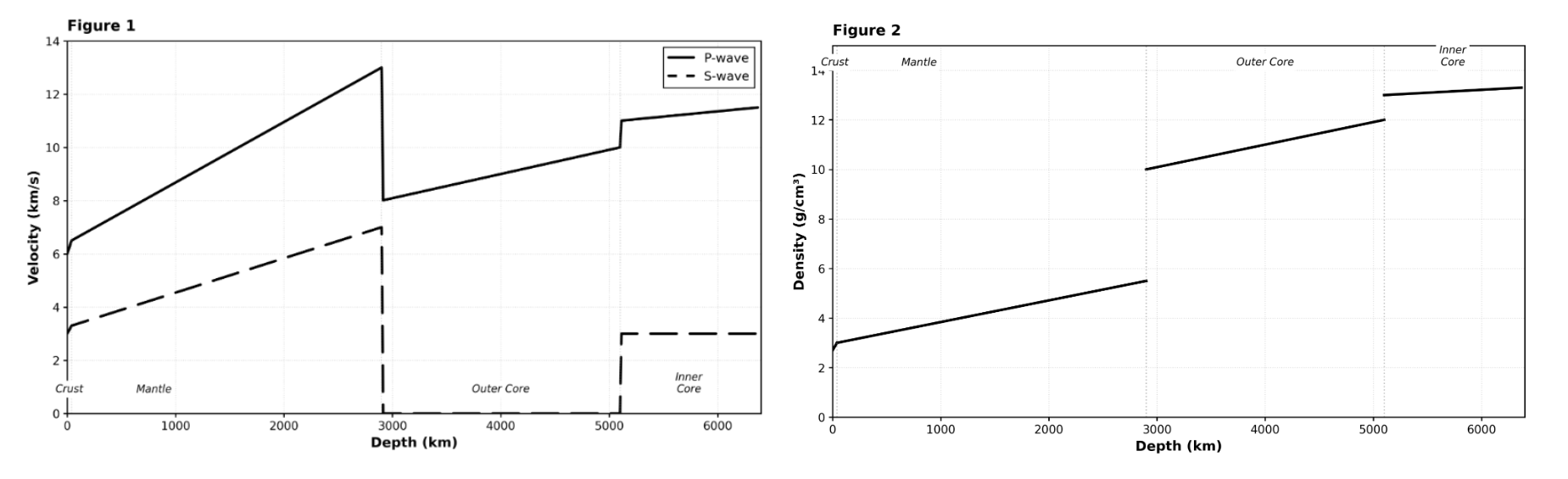
Which of the following statements best describes the relationship between depth and density within the Mantle (0-2,900 km), according to Figure 2?
As depth increases, density increases.
As depth increases, density decreases linearly.
As depth increases, density remains constant.
As depth increases, density fluctuates randomly.
Explanation
This is a trend description question. Figure 2 shows that within the Mantle region (from the surface to 2,900 km), density increases from approximately 3.0 g/cm³ to 5.5 g/cm³. This is a steady upward trend. Choice B (density increases) correctly describes this relationship. Choice A (decreases) is opposite of the actual trend. Choice C (constant) would require a flat horizontal line. Choice D (fluctuates) would require up-and-down variation not present in the data. Pro tip: For relationship questions, focus on the overall direction of change within the specified range.
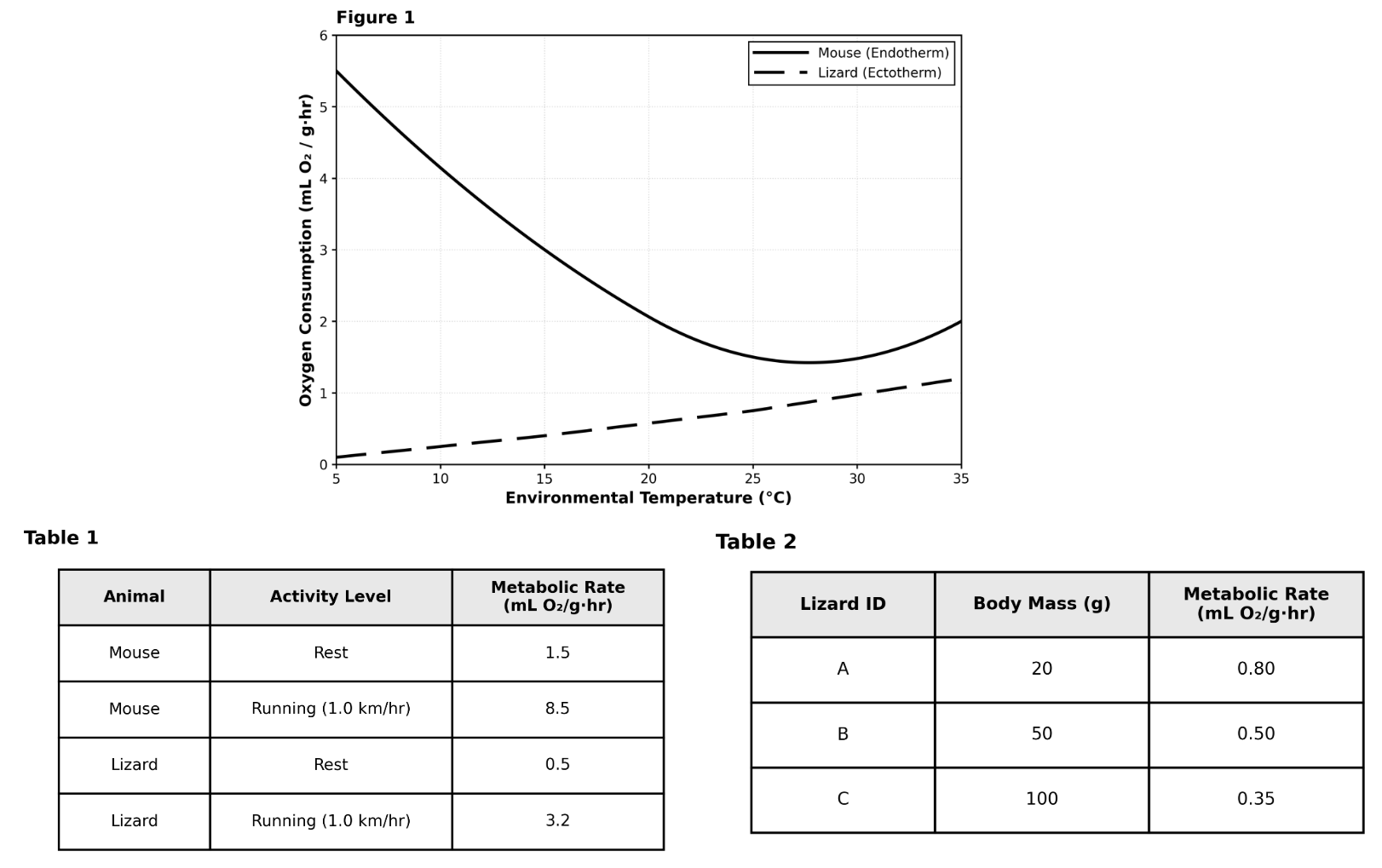
Consider the data for the Mouse at 35°C in Figure 1. If the temperature were increased further to 45°C, which of the following predictions is most biologically likely?
The metabolic rate would drop to 0.
The metabolic rate would increase as the mouse pants or sweats to cool down.
The metabolic rate would continue to decrease.
The metabolic rate would become identical to the Lizard's rate.
Explanation
This is an extrapolation/prediction question requiring biological reasoning. Figure 1 shows the Mouse's metabolic rate decreases from 5°C to a minimum at 25°C, then slightly increases at 35°C (from 1.5 to 2.0). This upturn suggests the beginning of heat stress. At 45°C (well above normal), the mouse would experience severe heat stress and need to activate cooling mechanisms (panting, increased blood flow to extremities for heat dissipation). These cooling processes require energy, increasing metabolic rate. Choice C correctly predicts this biologically realistic response. Choice A (drop to 0) would mean death, not a gradual response. Choice B (continue decreasing) ignores the upturn already visible at 35°C. Choice D (identical to Lizard) is unrealistic—endotherms and ectotherms have fundamentally different metabolic strategies. Pro tip: When extrapolating trends, consider biological limits and stress responses, not just mathematical continuation.
A student monitored the number of bacteria in a culture at the end of each hour. The data suggest a consistent multiplicative pattern. If the trend continues, what would be the predicted bacteria count at Hour 5?
Caption (49 words): Counts were taken from the same culture under constant conditions. The number of bacteria increases by the same factor each hour, indicating exponential growth over the measured period. The next value can be predicted by applying the same ratio observed between consecutive hours.
240 bacteria
320 bacteria
360 bacteria
480 bacteria
Explanation
The data reveal exponential growth in the bacteria count, with the number multiplying by a consistent factor each hour. The counts are 30 bacteria at the end of Hour 1, 60 at Hour 2, 120 at Hour 3, and 240 at Hour 4, doubling each time (multiplicative factor of 2). This quantifies the pattern as exponential growth where the count multiplies by 2 every hour. To predict the count at Hour 5, multiply the Hour 4 value by 2: 240 × 2 = 480 bacteria. One might incorrectly assume additive increases, such as adding 60 each time to get 300, but the data support multiplication.
A student measured the brightness of a lamp at different distances. If the trend shown continues, what brightness would most likely be recorded at 50 cm?
Caption (64 words): Brightness was measured in arbitrary units with the same sensor while moving it away from the lamp in 10 cm steps. The values decrease by a constant amount for each 10 cm increase in distance in this dataset. Although real light often follows a different physical law, this question asks you to extend the pattern shown by the measurements.
40 units
35 units
30 units
45 units
Explanation
The data reveal a linear decrease in lamp brightness with increasing distance. The brightness values are 55 units at 10 cm, 50 at 20 cm, 45 at 30 cm, and 40 at 40 cm, decreasing by 5 units per 10 cm increase. This quantifies the pattern as a constant decrement of 5 units for each 10 cm step, despite real light typically following inverse square law. To predict at 50 cm, subtract 5 from the 40 cm value: 40 - 5 = 35 units. A distractor could apply inverse square incorrectly to get 25 units, but extend the shown linear pattern.
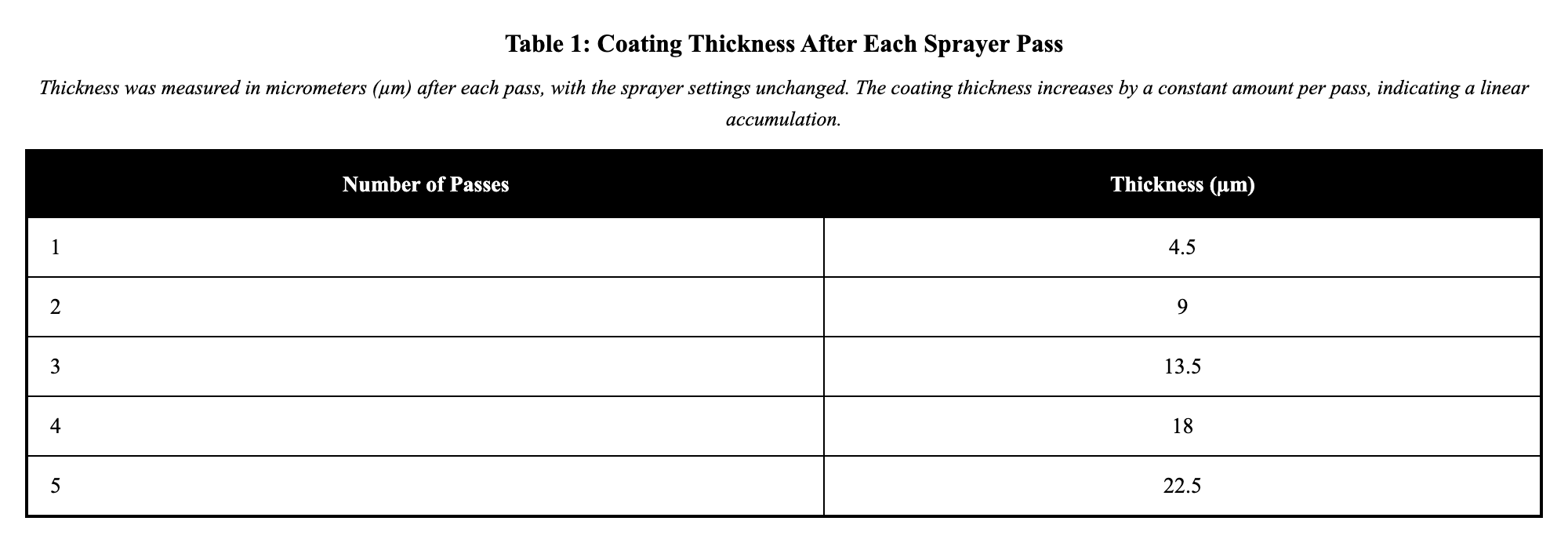
A materials scientist measured the thickness of a coating after each pass of a sprayer. Based on the pattern in the table, what thickness would most likely be measured after 6 passes?
21 µm
30 µm
27 µm
24 µm
Explanation
The data show a linear accumulation in coating thickness with each sprayer pass. The thicknesses are 4.5 µm after 1 pass, 9 µm after 2, 13.5 µm after 3, 18 µm after 4, and 22.5 µm after 5, increasing by 4.5 µm per pass. This quantifies the pattern as a constant addition of 4.5 µm each pass. To predict the thickness after 6 passes, add 4.5 µm to the 5-pass value: 22.5 + 4.5 = 27 µm. Some might assume doubling instead, leading to 45 µm, but the data confirm additive growth.
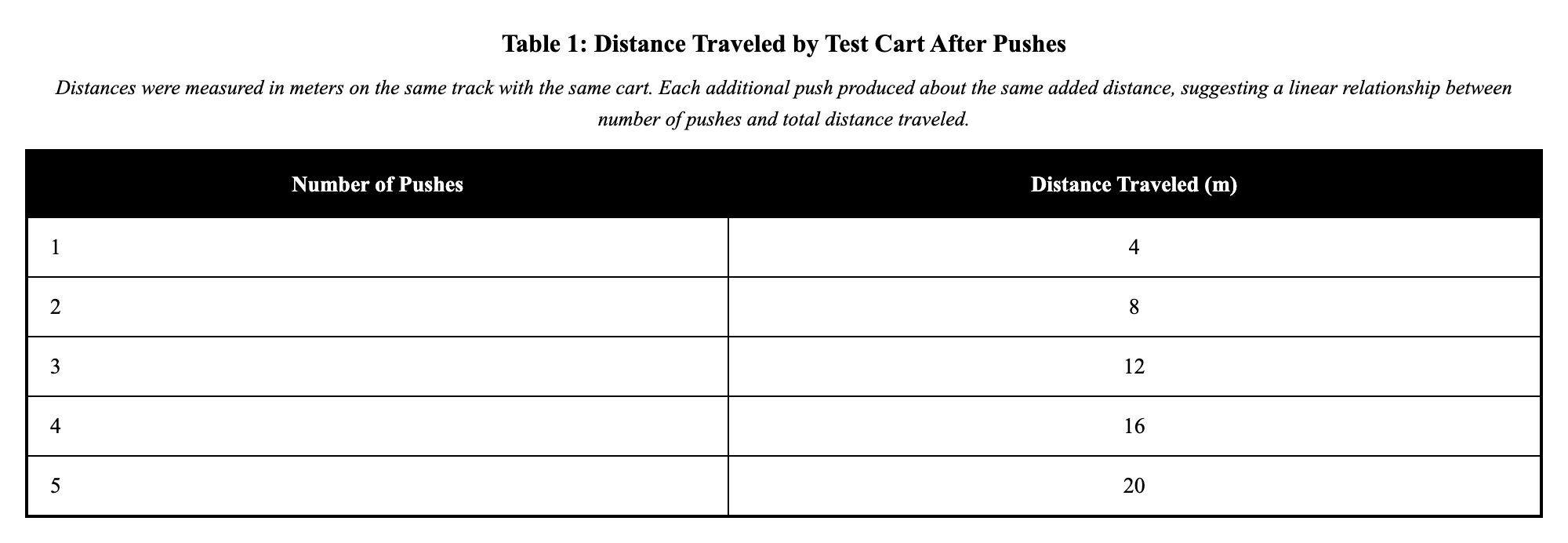
An engineer recorded the distance a test cart traveled after different numbers of identical pushes on a smooth track. Based on the pattern in the table, what distance would most likely be traveled after 6 pushes?
18 m
28 m
21 m
24 m
Explanation
The data indicate a linear increase in the distance traveled by the cart with each additional push. The distances are 4 m after 1 push, 8 m after 2 pushes, 12 m after 3, 16 m after 4, and 20 m after 5, with a consistent addition of 4 m per push. This quantifies the pattern as a linear relationship where each push adds 4 m to the total distance. To predict the distance after 6 pushes, add 4 m to the 5-push distance: 20 + 4 = 24 m. One might mistakenly assume a multiplicative pattern, such as doubling, which would incorrectly predict 40 m, but the data show additive increases.
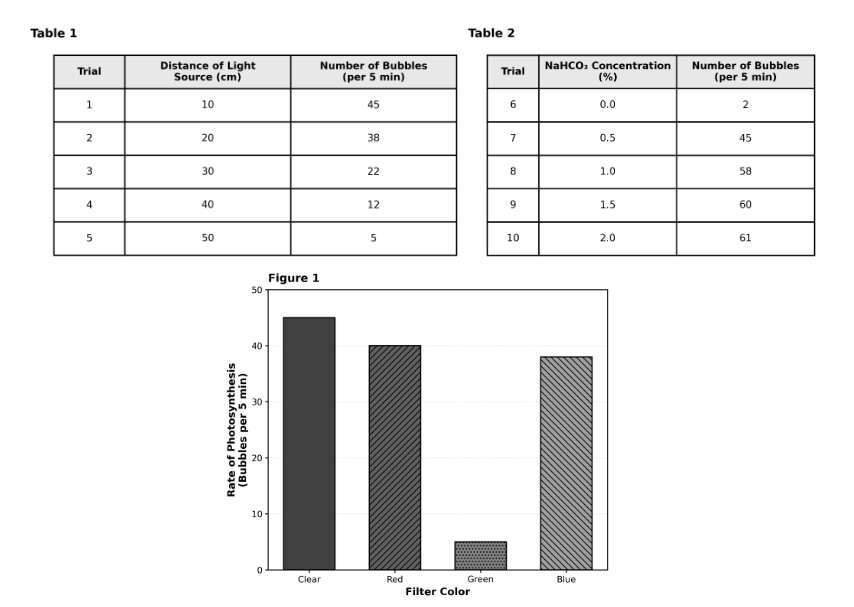
Based on Table 1, as the distance of the light source from the plant increases, the rate of photosynthesis:
increases linearly.
decreases only.
decreases, then increases.
remains constant.
Explanation
This is a trend identification question. Table 1 shows that as distance increases from 10 cm to 50 cm, the number of bubbles decreases from 45 to 5. This is a clear, consistent downward trend with no reversals or plateaus. Choice B (decreases only) is correct. Choice A (increases) is opposite of the data. Choice C (decreases then increases) would require the trend to reverse, which doesn't happen. Choice D (constant) would require the same value at all distances. Pro tip: For trend questions, look at the overall pattern from first to last data point.
Based on Table 2, what is the relationship between body mass and metabolic rate per gram for lizards?
Metabolic rate per gram is independent of body mass.
Metabolic rate per gram doubles for every 50 g increase in mass.
As body mass increases, metabolic rate per gram decreases.
As body mass increases, metabolic rate per gram increases.
Explanation
This is a trend identification question. Table 2 shows three lizards: as mass increases from 20 g to 50 g to 100 g, the metabolic rate per gram decreases from 0.80 to 0.50 to 0.35 mL O₂/g·hr. This is a clear inverse relationship—larger lizards have lower mass-specific metabolic rates. Choice B correctly describes this inverse trend. Choice A (increases) is opposite. Choice C (independent) would show no pattern. Choice D (doubles) is factually wrong and describes an increase, not decrease. Pro tip: This inverse relationship reflects a biological principle (Kleiber's Law)—larger animals have lower per-gram metabolic rates due to surface area to volume ratios.
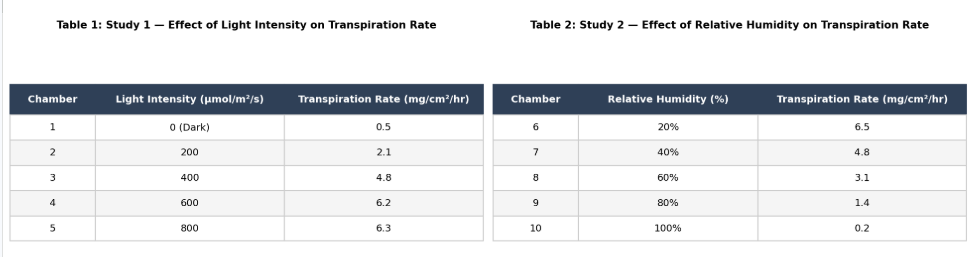
Suppose the botanist conducted a third study where a Spathiphyllum plant was exposed to a relative humidity of 50% and a light intensity of 400 μmol/m²/s. Based on Table 2, the transpiration rate for this plant would most likely be:
greater than 6.5 mg/cm²/hr.
between 3.1 and 4.8 mg/cm²/hr.
between 4.8 and 6.5 mg/cm²/hr.
less than 3.1 mg/cm²/hr.
Explanation
The correct answer is B. Table 2 shows that at 40% humidity the transpiration rate is 4.8 mg/cm²/hr, and at 60% humidity it is 3.1 mg/cm²/hr. Since 50% falls exactly between 40% and 60%, the transpiration rate must fall between 3.1 and 4.8 mg/cm²/hr. A is wrong — a rate less than 3.1 would require humidity higher than 60%. C is wrong — a rate between 4.8 and 6.5 would require humidity lower than 40%. D is wrong — a rate above 6.5 would require humidity below 20%. Pro tip: Interpolation questions test whether a value between two known data points produces a result between those data points. Always identify your bracketing values first.
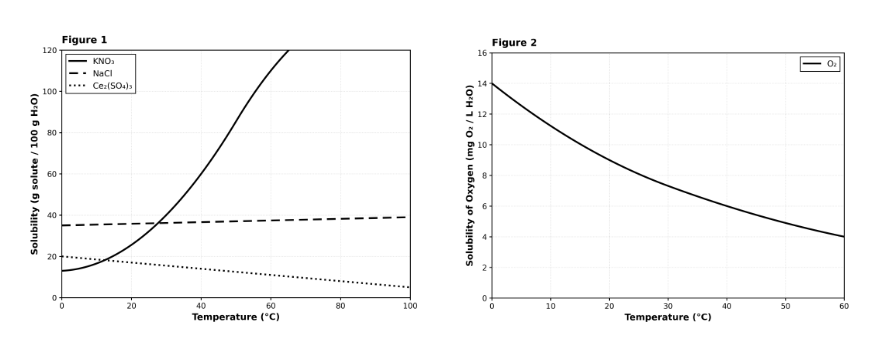
Suppose the student wants to dissolve 10 g of Ce₂(SO₄)₃ in 100 g of water. According to Figure 1, to ensure all the solid dissolves, the temperature of the water must be:
less than 70°C.
kept exactly at 100°C.
less than 20°C.
greater than 80°C.
Explanation
This is a threshold reading question with an inverse relationship. Ce₂(SO₄)₃ has unusual retrograde solubility (decreases with temperature). According to Figure 1, at 0°C the solubility is 20 g, and it decreases to about 10 g somewhere around 60-70°C. To dissolve 10 g, you need the solubility to be at least 10 g. Since solubility DECREASES as temperature increases for this substance, higher temperatures mean LESS dissolves. Therefore, to dissolve 10 g, you need to be at or below the temperature where solubility equals 10 g (approximately 65°C). Choice D (less than 70°C) is correct. Choice A (less than 20°C) is overly restrictive—any temp below ~65°C works. Choice B (greater than 80°C) is wrong—at 80°C solubility is only about 8 g. Choice C (exactly 100°C) is wrong—at 100°C solubility is only 5 g. Pro tip: For inverse relationships, remember that higher temperature = lower solubility.