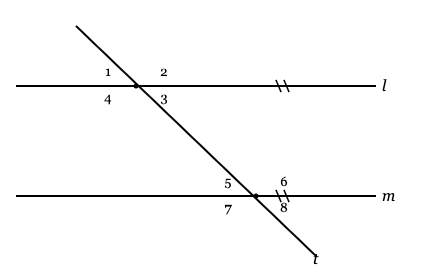
Study Lines And Angles in ACT Math with focused flashcards that help you recognize the idea, recall the key rule, and apply it in practice-style prompts.
All flashcards
Flashcard 1: What is the definition of complementary angles?
Answer: Two angles summing to 90°. Together they form a right angle.
Flashcard 2: What is the definition of adjacent angles?
Answer: Two angles sharing a vertex and a side with nonoverlapping interiors. Next to each other but don't overlap inside.
Flashcard 3: In a triangle, angles are 50∘ and 65∘; what is the third angle?
Answer: 65∘. Triangle angles sum to 180∘.
Flashcard 4: What is the measure of an angle that is supplementary to 45°?
Answer: 135°. Supplementary angles sum to 180°, so 180°−45°=135°.
Flashcard 5: When a transversal cuts parallel lines, what is true about alternate interior angles?
Answer: Alternate interior angles are congruent. Interior angles on opposite sides are equal.
Flashcard 6: When a transversal cuts parallel lines, what is true about corresponding angles?
Answer: Corresponding angles are congruent. Same position angles are equal.
Flashcard 7: What is the relationship between vertical angles formed by two intersecting lines?
Answer: Vertical angles are congruent (equal in measure). Fundamental property of intersecting lines.
Flashcard 8: What is the property of angles on a straight line?
Answer: They sum to 180°. Linear pair angles are supplementary.
Flashcard 9: Identify the angle that forms a linear pair with 130°.
Answer: 50°. Linear pair angles are supplementary, so 180°−130°=50°.
Flashcard 10: How many degrees are in each angle of an equilateral triangle?
Answer: 60°. All angles in an equilateral triangle are equal.
Flashcard 11: Find the measure of an angle in a regular pentagon.
Answer: 108°. Using formula: 5(5−2)×180°=108°.
Flashcard 12: Which condition proves two lines are parallel using alternate interior angles?
Answer: If alternate interior angles are congruent, the lines are parallel. Converse of alternate interior angles theorem.
Flashcard 13: What is the measure of each interior angle in a regular heptagon?
Answer: 128.57∘. Using formula: 7(7−2)×180∘≈128.57∘.
Flashcard 14: What is each interior angle of a regular n-gon?
Answer: n(n−2)⋅180∘. Total interior sum divided by number of sides.
Flashcard 15: What is the sum of the interior angles of a pentagon (n=5)?
Answer: 540∘. Using (n−2)⋅180∘ with n=5.
Flashcard 16: What is the definition of supplementary angles?
Answer: Two angles summing to 180°. Together they form a straight line.
Flashcard 17: What is a transversal?
Answer: A line that intersects two or more other lines. Cuts across multiple lines.
Flashcard 18: What is the formula for the sum of interior angles in an n-sided polygon?
Answer: (n−2)×180°. Derived from dividing a polygon into triangles.
Flashcard 19: When a transversal cuts parallel lines, what is true about same-side interior angles?
Answer: Same-side interior angles are supplementary. Interior angles on same side add to 180∘.
Flashcard 20: Define corresponding angles in parallel lines.
Answer: Angles in matching corners equal to each other. They're in the same relative position at each intersection.
Flashcard 21: What is the definition of supplementary angles in degrees?
Answer: Two angles whose measures sum to 180∘. Together they form a straight angle.
Flashcard 22: Find the measure of an angle in a regular pentagon.
Answer: 108°. Using formula: 5(5−2)×180°=108°.
Flashcard 23: If corresponding angles measure (3x+10)∘ and (5x−30)∘, what is x?
Answer: 20. Set corresponding angles equal and solve.
Flashcard 24: If two angles form a linear pair, what equation relates their measures?
Answer: m∠1+m∠2=180∘. Linear pairs always sum to a straight angle.
Flashcard 25: Define alternate exterior angles in parallel lines.
Answer: Non-adjacent and equal angles outside parallel lines. They're on opposite sides of the transversal.
Flashcard 26: Find the measure of each angle in a regular triangle.
Answer: 60°. Regular triangle means equilateral triangle.
Flashcard 27: Find the measure of the missing angle if two angles are 90° and 30° in a triangle.
Answer: 60°. Triangle angles sum to 180°, so 180°−90°−30°=60°.
Flashcard 28: Identify the vertical angle to 60° in an intersecting lines scenario.
Answer: 60°. Vertical angles are always equal.
Flashcard 29: What is the measure of each exterior angle of a regular decagon?
Answer: 36°. Exterior angle = 10360°=36° for a decagon.
Flashcard 30: Identify the type of angles if one is 110° and another is 70°.
Answer: Supplementary angles. Since 110°+70°=180°.
Flashcard 31: What is the definition of complementary angles in degrees?
Answer: Two angles whose measures sum to 90∘. Together they form a right angle.
Flashcard 32: What is the measure of a straight angle?
Answer: 180∘. Half a complete rotation.
Flashcard 33: Identify the type of angles if one is 110° and another is 70°.
Answer: Supplementary angles. Since 110°+70°=180°.
Flashcard 34: What is the measure of a full rotation (one complete turn)?
Answer: 360∘. Complete circle rotation.
Flashcard 35: If two angles are supplementary, what equation relates their measures?
Answer: m∠1+m∠2=180∘. Definition of supplementary angles.
Flashcard 36: What is the measure of a full rotation (one complete turn)?
Answer: 360∘. Complete circle rotation.
Flashcard 37: If two lines are perpendicular, what is the measure of the angles formed?
Answer: All four angles measure 90∘. Perpendicular lines form right angles.
Flashcard 38: If two angles form a linear pair and one measures 112∘, what is the other?
Answer: 68∘. Linear pairs sum to 180∘.
Flashcard 39: Identify the angle that forms a linear pair with 130°.
Answer: 50°. Linear pair angles are supplementary, so 180°−130°=50°.
Flashcard 40: What is the sum of the interior angles of an n-gon?
Answer: (n−2)⋅180∘. General polygon angle sum formula.
Flashcard 41: What is the definition of adjacent angles?
Answer: Two angles with a common side and vertex. They share a vertex and one side between them.
Flashcard 42: What is the measure of an angle that is complementary to 30°?
Answer: 60°. Complementary angles sum to 90°, so 90°−30°=60°.
Flashcard 43: What is the property of angles on a straight line?
Answer: They sum to 180°. Linear pair angles are supplementary.
Flashcard 44: What is the definition of adjacent angles?
Answer: Two angles with a common side and vertex. They share a vertex and one side between them.
Flashcard 45: Which condition proves two lines are parallel using corresponding angles?
Answer: If corresponding angles are congruent, the lines are parallel. Converse of corresponding angles theorem.
Flashcard 46: What is the measure of an angle in a regular dodecagon?
Answer: 150°. Using formula: 12(12−2)×180°=150°.
Flashcard 47: In a triangle, an exterior angle is 120∘ and one remote interior angle is 50∘; what is the other?
Answer: 70∘. Exterior angle theorem: 120∘=50∘+x.
Flashcard 48: If a regular polygon has each exterior angle 24∘, how many sides does it have?
Answer: 15. Using n=24∘360∘.
Flashcard 49: What is the definition of complementary angles?
Answer: Two angles summing to 90°. Together they form a right angle.
Flashcard 50: What is the measure of an angle that is supplementary to 125°?
Answer: 55°. Supplementary angles sum to 180°, so 180°−125°=55°.
Flashcard 51: What is each interior angle of a regular n-gon?
Answer: n(n−2)⋅180∘. Total interior sum divided by number of sides.
Flashcard 52: What is the definition of supplementary angles in degrees?
Answer: Two angles whose measures sum to 180∘. Together they form a straight angle.
Flashcard 53: What is the sum of the interior angles of a quadrilateral?
Answer: 360°. Sum of interior angles increases by 180° for each additional side.
Flashcard 54: Find the measure of an angle in an equilateral triangle.
Answer: 60°. All angles are equal in an equilateral triangle.
Flashcard 55: What is the formula for the sum of interior angles in an n-sided polygon?
Answer: (n−2)×180°. Derived from dividing a polygon into triangles.
Flashcard 56: What is the sum of the interior angles of a triangle?
Answer: 180°. This is a fundamental property of all triangles.
Flashcard 57: When a transversal cuts parallel lines, what is true about alternate exterior angles?
Answer: Alternate exterior angles are congruent. Exterior angles on opposite sides are equal.
Flashcard 58: When a transversal cuts parallel lines, what is true about same-side interior angles?
Answer: Same-side interior angles are supplementary. Interior angles on same side add to 180∘.
Flashcard 59: What is the angle sum of a triangle in degrees?
Answer: 180∘. Fundamental triangle angle property.
Flashcard 60: What is the measure of the exterior angle of a regular nonagon?
Answer: 40°. Exterior angle = 9360°=40° for a nonagon.
Flashcard 61: Which condition proves two lines are parallel using same-side interior angles?
Answer: If same-side interior angles are supplementary, the lines are parallel. Converse of same-side interior theorem.
Flashcard 62: What is each interior angle of a regular hexagon (n=6)?
Answer: 120∘. Using n(n−2)⋅180∘ with n=6.
Flashcard 63: Find the measure of the missing angle if two angles are 90° and 30° in a triangle.
Answer: 60°. Triangle angles sum to 180°, so 180°−90°−30°=60°.
Flashcard 64: What is the property of vertically opposite angles?
Answer: They are equal. Formed by intersecting lines, they're always equal.
Flashcard 65: State the formula to calculate the measure of each interior angle of a regular polygon.
Answer: n(n−2)×180. Uses the sum of interior angles divided by number of sides.
Flashcard 66: If two angles form a linear pair, what equation relates their measures?
Answer: m∠1+m∠2=180∘. Linear pairs always sum to a straight angle.
Flashcard 67: How many degrees are in each angle of an equilateral triangle?
Answer: 60°. All angles in an equilateral triangle are equal.
Flashcard 68: If two angles are supplementary and one measures 145∘, what is the other?
Answer: 35∘. Supplementary angles sum to 180∘.
Flashcard 69: Find the missing angle if two angles are 70° and 20° in a triangle.
Answer: 90°. Triangle angles sum to 180°, so 180°−70°−20°=90°.
Flashcard 70: What is the relationship between alternate interior angles?
Answer: They are equal. When parallel lines are cut by a transversal.
Flashcard 71: Which condition proves two lines are parallel using alternate interior angles?
Answer: If alternate interior angles are congruent, the lines are parallel. Converse of alternate interior angles theorem.
Flashcard 72: What is the measure of each interior angle in a regular heptagon?
Answer: 128.57°. Using formula: 7(7−2)×180°≈128.57°.
Flashcard 73: Which condition proves two lines are parallel using corresponding angles?
Answer: If corresponding angles are congruent, the lines are parallel. Converse of corresponding angles theorem.
Flashcard 74: What is the definition of parallel lines in a plane?
Answer: Coplanar lines that never intersect. Same plane, same direction, never meet.
Flashcard 75: Define a linear pair of angles.
Answer: Adjacent angles that form a straight line. They share a side and their sum is 180°.
Flashcard 76: If two angles form a linear pair and one measures 112∘, what is the other?
Answer: 68∘. Linear pairs sum to 180∘.
Flashcard 77: What is the sum of the exterior angles of any polygon?
Answer: 360°. This holds for any polygon regardless of number of sides.
Flashcard 78: What is the property of angles around a point?
Answer: They sum to 360°. Full rotation around any point equals 360°.
Flashcard 79: What is the measure of each angle in a regular decagon?
Answer: 144°. Using formula: 10(10−2)×180°=144°.
Flashcard 80: If two angles are vertical and one measures 37∘, what is the other?
Answer: 37∘. Vertical angles are always congruent.
Flashcard 81: What is the definition of vertical angles?
Answer: Opposite angles formed by intersecting lines; they are congruent. They have equal measures when lines cross.
Flashcard 82: If a regular polygon has each exterior angle 24∘, how many sides does it have?
Answer: 15. Using n=24∘360∘.
Flashcard 83: Find the measure of each angle in a regular triangle.
Answer: 60°. Regular triangle means equilateral triangle.
Flashcard 84: State the formula to calculate the measure of each interior angle of a regular polygon.
Answer: n(n−2)×180. Uses the sum of interior angles divided by number of sides.
Flashcard 85: Find the measure of an angle in an equilateral triangle.
Answer: 60°. All angles are equal in an equilateral triangle.
Flashcard 86: What is the measure of a straight angle?
Answer: 180∘. Half a complete rotation.
Flashcard 87: What is the definition of complementary angles in degrees?
Answer: Two angles whose measures sum to 90∘. Together they form a right angle.
Flashcard 88: If corresponding angles measure (3x+10)∘ and (5x−30)∘, what is x?
Answer: 20. Set corresponding angles equal and solve.
Flashcard 89: What is the sum of the exterior angles of any polygon?
Answer: 360°. This holds for any polygon regardless of number of sides.
Flashcard 90: What is the measure of an angle that is complementary to 65°?
Answer: 25°. Complementary angles sum to 90°, so 90°−65°=25°.
Flashcard 91: If two angles are supplementary, what equation relates their measures?
Answer: m∠1+m∠2=180∘. Definition of supplementary angles.
Flashcard 92: Define an angle bisector.
Answer: A ray dividing an angle into two equal parts. It creates two congruent angles.
Flashcard 93: What is the exterior angle theorem for a triangle?
Answer: An exterior angle equals the sum of the two remote interior angles. Exterior equals sum of non-adjacent interior angles.
Flashcard 94: Find the measure of an angle in a regular nonagon.
Answer: 140°. Using formula: 9(9−2)×180°=140°.
Flashcard 95: What is the sum of the interior angles of a pentagon (n=5)?
Answer: 540∘. Using (n−2)⋅180∘ with n=5.
Flashcard 96: What is the definition of supplementary angles?
Answer: Two angles summing to 180°. Together they form a straight line.
Flashcard 97: What is the exterior angle theorem for a triangle?
Answer: An exterior angle equals the sum of the two remote interior angles. Exterior equals sum of non-adjacent interior angles.
Flashcard 98: What is the definition of vertical angles?
Answer: Opposite angles formed by intersecting lines; they are congruent. They have equal measures when lines cross.
Flashcard 99: Define corresponding angles in parallel lines.
Answer: Angles in matching corners equal to each other. They're in the same relative position at each intersection.
Flashcard 100: What is a transversal?
Answer: A line that intersects two or more other lines. Cuts across multiple lines.