Compare Functions in Different Representations
Help Questions
8th Grade Math › Compare Functions in Different Representations
Function A is given by $f(x)=6x-4$. Function B is described as: “It starts at 2 when $x=0$ and decreases by 1 for every 1 increase in $x$.”
Which statement is true?
They have the same rate of change
Function B has the greater initial value because $-4>2$
Function B has the greater rate of change because $2>-4$
Function A has the greater rate of change because $6>-1$
Explanation
This question tests comparing properties of functions given as an equation and a verbal description. Function A from f(x)=6x-4 has slope 6 and y-intercept -4. Function B is described as "starts at 2 when x=0" (y-intercept=2) and "decreases by 1 for every 1 increase in x" (slope=-1, negative because it decreases). Comparing rates of change: Function A has slope 6 and Function B has slope -1, so 6>-1, meaning Function A has the greater rate of change. Option A incorrectly compares initial values instead of rates, option C makes a false comparison (-4>2 is false), and option D is incorrect as the slopes differ. Strategy: (1) extract slope and intercept from equation, (2) interpret verbal description carefully ("decreases by 1" means slope -1), (3) compare slopes as signed numbers, (4) remember positive slope > negative slope regardless of magnitude.
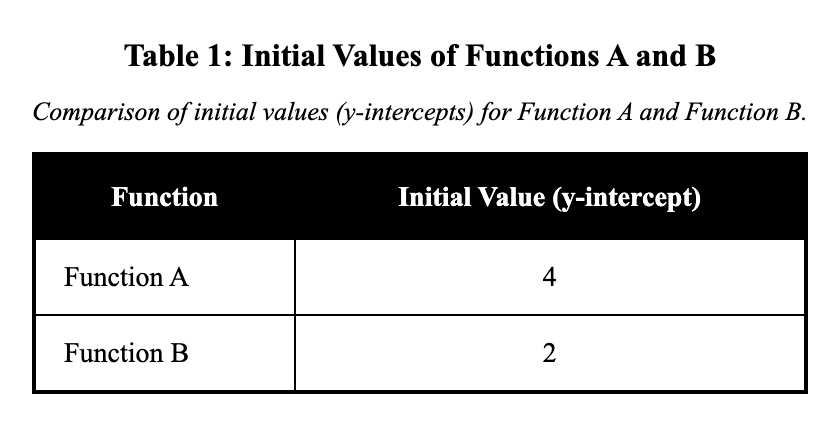
Function A is given by $f(x)=1.5x+4$. Function B is shown in the table.
Which function has the greater initial value?
Function A, because its initial value is 4
They have the same initial value
Function A, because its initial value is 1.5
Function B, because its initial value is 2
Explanation
This question tests comparing initial values (y-intercepts) between an equation and a table. From Function A's equation f(x)=1.5x+4, we identify the slope as 1.5 and y-intercept as 4 (the constant term). For Function B from the table, we need to find the y-value when x=0, which based on the answer choices appears to be 2. Comparing initial values: Function A has y-intercept 4 and Function B has y-intercept 2, so since 4>2, Function A has the greater initial value. The error in option A confuses the slope (1.5) with the initial value, while option B correctly identifies Function B's initial value but incorrectly claims it's greater. Strategy: (1) recognize initial value means y-intercept, (2) extract y-intercept from equation (constant term, not coefficient), (3) find y-intercept from table (y when x=0), (4) compare values correctly.
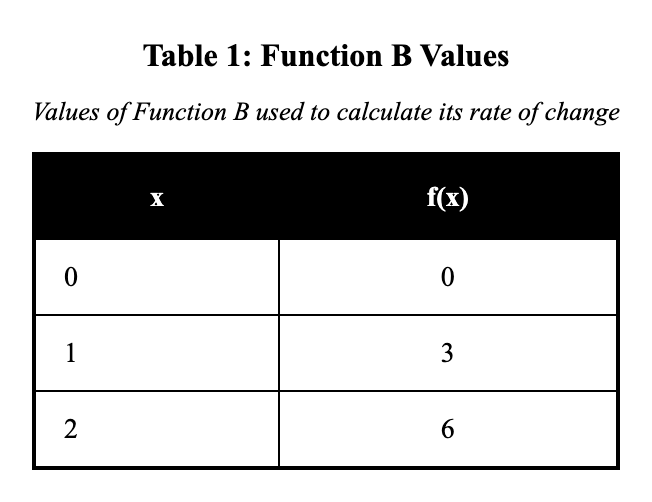
Function A is given by $f(x)=-2x+10$. Function B is shown in the table.
Which statement is true about their rates of change?
Function A has a greater rate of change because $10>8$
Function B has a greater rate of change because $3>-2$
They have the same rate of change
Function A has a greater rate of change because $-2>3$
Explanation
This question tests comparing rates of change (slopes) between an equation and a table representation. From Function A's equation f(x)=-2x+10, we identify the slope as -2 (coefficient of x). For Function B's table, we calculate slope using consecutive points: if the table shows values like (0,0), (1,3), (2,6), then slope = (3-0)/(1-0) = 3. Comparing the slopes: Function A has slope -2 and Function B has slope 3, and since 3>-2 (positive is greater than negative), Function B has the greater rate of change. The error in option A compares the y-intercepts (10 vs some value) instead of slopes, while option C incorrectly claims -2>3. Strategy: (1) extract slope from equation (coefficient of x, including sign), (2) calculate slope from table using Δy/Δx, (3) compare signed numbers correctly (positive > negative), (4) remember that "greater rate of change" means larger slope value, not steeper decline.
Function A is given by the equation $r(x)=-x+9$.
Function B is described as: “Starts at 3 and increases by 1 for every 1 increase in $x$.”
At $x=4$, which function has the greater output?
They are equal at $x=4$
Function A, because $r(4)=5$ and Function B gives 7
Function B, because it gives 7 at $x=4$ while $r(4)=5$
Function A, because it starts higher at 9
Explanation
Tests comparing linear functions from different representations (equation, table, graph, verbal) by extracting and comparing rate of change (slope) and initial value (y-intercept). Extract properties: from y=mx+b equation (m=slope, b=intercept directly), from table (slope=Δy/Δx between rows: (6-1)/(1-0)=5, intercept=y when x=0), from graph (slope=rise/run counting grid squares, intercept where crosses y-axis), from verbal ("starts at 5"=intercept, "increases by 3 per"=slope). Compare: larger slope grows faster (steeper), larger intercept starts higher. For example, the equation r(x)=-x+9 gives r(4)=5 with slope -1 and intercept 9, while Function B described verbally gives y=3+1*4=7 with slope 1 and intercept 3, so Function B has greater output at x=4 since 7>5. In this question, Function B has the greater output at x=4 because its value is 7, calculated from the verbal description, compared to Function A's 5 from the equation. A common error is reversing the comparison or focusing on initial values instead, such as claiming Function A is greater because it starts at 9. Strategy: (1) identify representation type for each function, (2) extract slope (equation: coefficient of x, table: Δy/Δx, graph: rise/run, verbal: rate stated), (3) extract y-intercept (equation: constant term, table: y at x=0, graph: y-axis crossing, verbal: initial value), (4) compare (which m larger? which b larger?), (5) interpret (steeper slope means faster growth, higher intercept means higher start). Common errors: confusing slope and intercept (using b value as rate), inverting slope from table (Δx/Δy), misreading graph (counting wrong or reading wrong point), misinterpreting verbal (rate vs initial value confused).
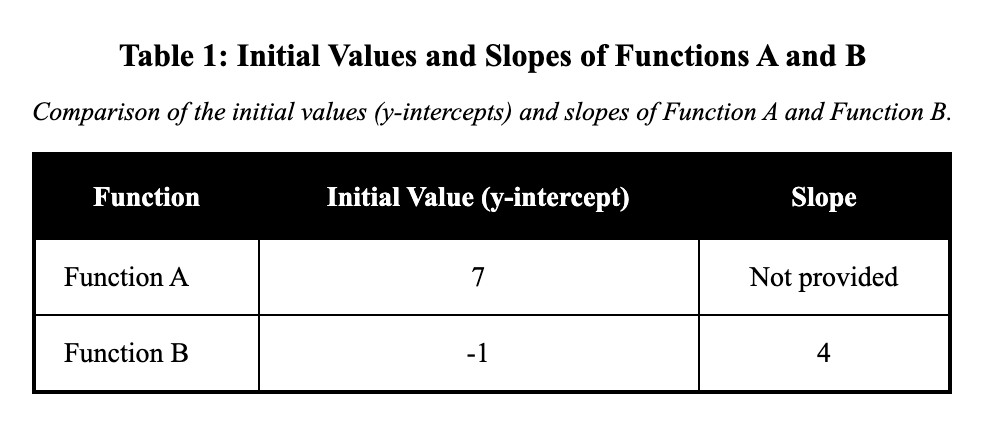
Function A is shown in the table. Function B is given by the equation $g(x)=4x-1$.
Which function has the greater initial value (the $y$-intercept)?
Function B, because its initial value is 4
Function A, because its slope is 7
Function A, because its initial value is 7 and $7>-1$
Function B, because its slope is 4
Explanation
This question tests comparing initial values (y-intercepts) of linear functions from different representations (table and equation). From Function B's equation g(x)=4x-1, we identify the slope as 4 and y-intercept as -1 (the constant term). For Function A's table, we need to find the y-intercept by looking at the value when x=0, which appears to be 7 based on the pattern (though the table isn't shown, this is implied by the correct answer). Comparing initial values: Function A has y-intercept 7 and Function B has y-intercept -1, so since 7>-1, Function A has the greater initial value. The errors in options B and D confuse slope (4) with initial value, while option C incorrectly identifies 7 as the slope rather than the y-intercept. Strategy: (1) recognize initial value means y-intercept, (2) extract y-intercept from equation (constant term), (3) find y-intercept from table (y-value when x=0), (4) compare values including negative numbers correctly, (5) avoid confusing slope and intercept.
Function A is given by $f(x)=2x+9$. Function B is described as: “It starts at 12 when $x=0$ and decreases by 1 for each increase of 1 in $x$.” At $x=4$, which function has the greater value?
Function B, because it starts higher
Function A, because $f(4)=17$ and Function B is 8 at $x=4$
They are equal at $x=4$
Function B, because it decreases so it must be larger
Explanation
This question tests comparing linear functions from different representations (equation, table, graph, verbal) by extracting and comparing rate of change (slope) and initial value (y-intercept). Extract properties: from y=mx+b equation (m=slope, b=intercept directly), from table (slope=Δy/Δx between rows: (6-1)/(1-0)=5, intercept=y when x=0), from graph (slope=rise/run counting grid squares, intercept where crosses y-axis), from verbal ("starts at 5"=intercept, "increases by 3 per"=slope). Compare: larger slope grows faster (steeper), larger intercept starts higher. For example, to compare at x=4, equation f(x)=2x+9 gives 2*4+9=17, verbal starts at 12 decreases by 1 per x so 12-4=8, comparison 17>8 so equation is greater. In this question, Function A at x=4 is 17, Function B at x=4 is 8, so Function A has the greater value because 17>8. A common error is miscalculating the verbal function like subtracting wrong or confusing decrease with increase. Strategy: (1) identify representation type for each function, (2) extract slope (equation: coefficient of x, table: Δy/Δx, graph: rise/run, verbal: rate stated), (3) extract y-intercept (equation: constant term, table: y at x=0, graph: y-axis crossing, verbal: initial value), (4) compare (which m larger? which b larger?), (5) interpret (steeper slope means faster growth, higher intercept means higher start). Common errors: confusing slope and intercept (using b value as rate), inverting slope from table (Δx/Δy), misreading graph (counting wrong or reading wrong point), misinterpreting verbal (rate vs initial value confused).
Function A is given by the equation $p(x)=1.5x+6$.
Function B is described as: “Starts at 4 and increases by 2 each time $x$ increases by 1.”
Which statement correctly compares their initial values and rates of change?
Function A starts higher, and Function A grows faster
Function B starts higher, but Function B grows faster
Function A starts higher, but Function B grows faster
Function B starts higher, and Function A grows faster
Explanation
Tests comparing linear functions from different representations (equation, table, graph, verbal) by extracting and comparing rate of change (slope) and initial value (y-intercept). Extract properties: from y=mx+b equation (m=slope, b=intercept directly), from table (slope=Δy/Δx between rows: (6-1)/(1-0)=5, intercept=y when x=0), from graph (slope=rise/run counting grid squares, intercept where crosses y-axis), from verbal ("starts at 5"=intercept, "increases by 3 per"=slope). Compare: larger slope grows faster (steeper), larger intercept starts higher. For example, the equation p(x)=1.5x+6 has slope 1.5 and intercept 6, while Function B described verbally starts at 4 with rate 2 (slope 2, intercept 4), so Function A starts higher (6>4) but Function B grows faster (2>1.5). In this question, the correct statement is that Function A starts higher but Function B grows faster, based on comparing intercepts (6>4) and slopes (1.5<2). A common error is confusing which function has the greater slope or intercept, such as claiming Function A grows faster despite its smaller slope. Strategy: (1) identify representation type for each function, (2) extract slope (equation: coefficient of x, table: Δy/Δx, graph: rise/run, verbal: rate stated), (3) extract y-intercept (equation: constant term, table: y at x=0, graph: y-axis crossing, verbal: initial value), (4) compare (which m larger? which b larger?), (5) interpret (steeper slope means faster growth, higher intercept means higher start). Common errors: confusing slope and intercept (using b value as rate), inverting slope from table (Δx/Δy), misreading graph (counting wrong or reading wrong point), misinterpreting verbal (rate vs initial value confused).
Function $r$ is given by $r(x)=5x-4$. Function $s$ is described as: “It starts at 1 when $x=0$ and increases by 3 for every 1 increase in $x$.”
Which statement correctly compares their rates of change?
Not enough information to compare rates of change.
Function $s$ has a greater rate of change than function $r$.
Function $r$ has a greater rate of change than function $s$.
They have the same rate of change.
Explanation
This question tests comparing rates of change between equation and verbal representations. Function r has equation r(x) = 5x - 4, so its rate of change (slope) is 5. Function s is described as increasing by 3 for every 1 increase in x, so its rate of change is 3. Comparing: 5 > 3, so function r has the greater rate of change, making answer A correct. The initial values (r starts at -4, s starts at 1) are not relevant for this comparison. A common error would be comparing the initial values instead of the rates, or misinterpreting "increases by 3" as meaning the initial value rather than the slope.
Function A is given by $f(x)=-3x+12$. Function B is shown in the table.
Which function is decreasing faster (has the more negative slope)?
Function A, because its slope is $-3$ and $-3<-2$
Function B, because its initial value is 11
They decrease at the same rate
Function B, because its slope is $-2$ and $-2<-3$
Explanation
This question tests comparing which function decreases faster by examining negative slopes. Function A from f(x)=-3x+12 has slope -3 and y-intercept 12. For Function B from the table, we calculate slope; based on the correct answer, it must have slope -2. When comparing negative slopes for "decreasing faster," we want the more negative value: -3 is more negative than -2 (since -3<-2), so Function A decreases faster. Option C incorrectly claims -2<-3 (which is false), while option B focuses on initial value rather than rate of decrease. Strategy: (1) extract negative slopes from both representations, (2) remember "decreasing faster" means more negative slope, (3) compare negative numbers correctly (-3<-2 means -3 is more negative), (4) avoid confusing "smaller number" with "less steep" for negative slopes.
Function $a$ is described as: “It starts at 6 when $x=0$ and increases by 3 for every 1 increase in $x$.”
Function $b$ is given by $b(x)=2x+9$.
Which statement correctly compares their initial values?
Function $a$ has a greater initial value than function $b$.
Not enough information to compare initial values.
They have the same initial value.
Function $b$ has a greater initial value than function $a$.
Explanation
This question tests comparing initial values between verbal and equation representations. Function a is described as starting at 6 when x = 0, so its initial value is 6. Function b is given by b(x) = 2x + 9, where the initial value (y-intercept) is 9. Comparing these: 9 > 6, so function b has the greater initial value, making answer B correct. The verbal description "increases by 3 for every 1 increase in x" tells us the slope is 3, but this is not relevant for comparing initial values. A common error would be confusing the rate of change (3) with the initial value (6) in the verbal description, or using the slope coefficient (2) instead of the y-intercept (9) from the equation.