Measure and Sketch Angles
Help Questions
4th Grade Math › Measure and Sketch Angles
Lisa is practicing angle measurement and sketching. She measures an angle as $$84°$$, then sketches an angle that is $$96°$$. What is the difference between the angle she sketched and the angle she measured?
$$12°$$ with the sketched angle being smaller
$$18°$$ with the sketched angle being larger
$$12°$$ with the sketched angle being larger
$$18°$$ with the sketched angle being smaller
Explanation
Lisa measured $$84°$$ and sketched $$96°$$. The difference is $$96° - 84° = 12°$$, and since $$96° > 84°$$, the sketched angle is larger. Choice A has the correct difference but wrong comparison. Choices C and D use $$18°$$, which might result from calculation errors like $$96 - 84 = 18$$ (incorrect arithmetic).
Maya uses a protractor to measure an angle and finds it is $$72°$$. She needs to sketch an angle that is $$18°$$ larger than the angle she measured. What should be the measure of the angle Maya sketches?
$$90°$$
$$108°$$
$$54°$$
$$126°$$
Explanation
Maya measured $$72°$$ and needs to sketch an angle $$18°$$ larger. $$72° + 18° = 90°$$. Choice A ($$54°$$) results from subtracting instead of adding. Choice C ($$108°$$) comes from adding $$72° + 36°$$ (doubling the $$18°$$). Choice D ($$126°$$) comes from adding $$72° + 54°$$ (tripling the $$18°$$).
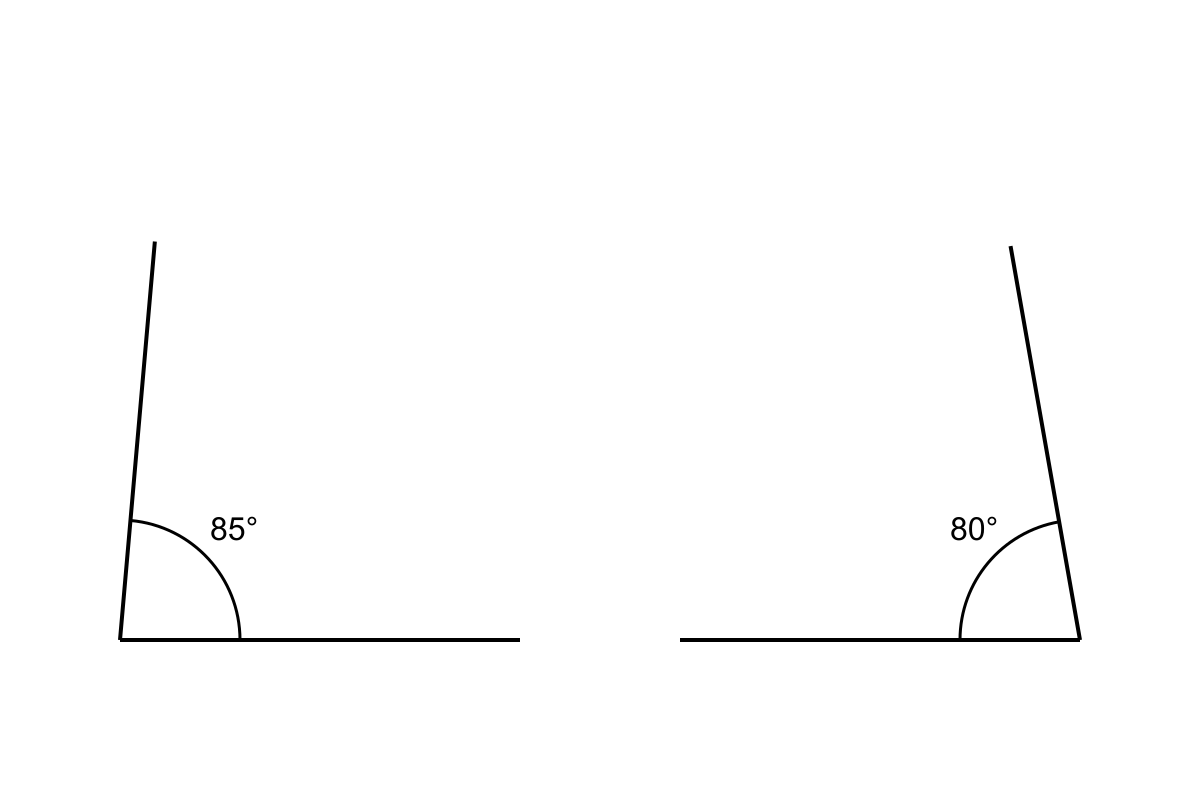
Examine the two angles shown in the diagram. If these angles were placed adjacent to each other (sharing a common ray), what would be the measure of the combined angle?
$$175°$$
$$155°$$
$$165°$$
$$185°$$
Explanation
The diagram shows two separate angles: one measuring $$85°$$ and another measuring $$80°$$. When placed adjacent to each other, the combined angle would measure $$85° + 80° = 165°$$. Choice A incorrectly adds $$85° + 70°$$. Choice C incorrectly adds $$85° + 90°$$. Choice D incorrectly adds $$85° + 100°$$.
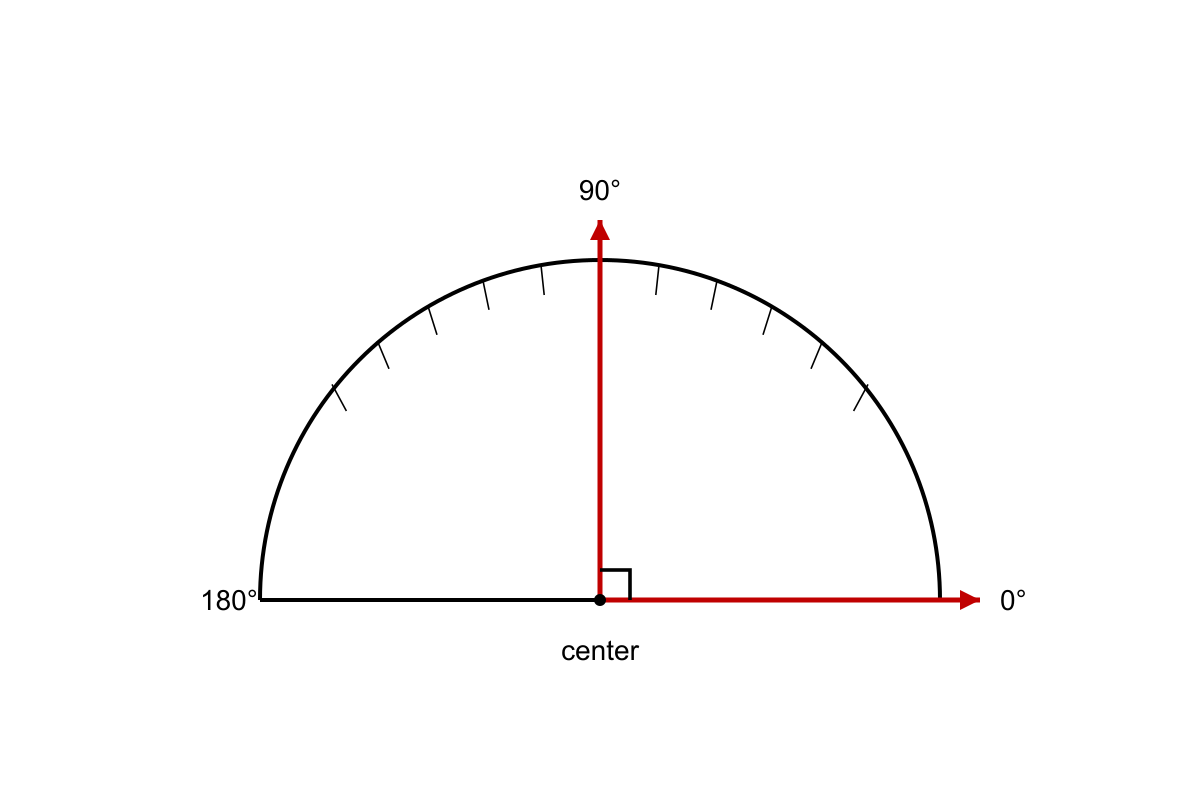
Look at the protractor measurement shown below. Carlos needs to sketch an angle that is $$25°$$ less than twice the measured angle. What should be the measure of Carlos's angle?
$$145°$$
$$155°$$
$$165°$$
$$135°$$
Explanation
The protractor shows an angle measuring $$90°$$. Twice this angle is $$90° × 2 = 180°$$. An angle that is $$25°$$ less than this would be $$180° - 25° = 155°$$. Choice A incorrectly calculates $$90° × 2 - 45°$$. Choice B incorrectly calculates $$90° × 2 - 35°$$. Choice D incorrectly calculates $$90° × 2 - 15°$$.
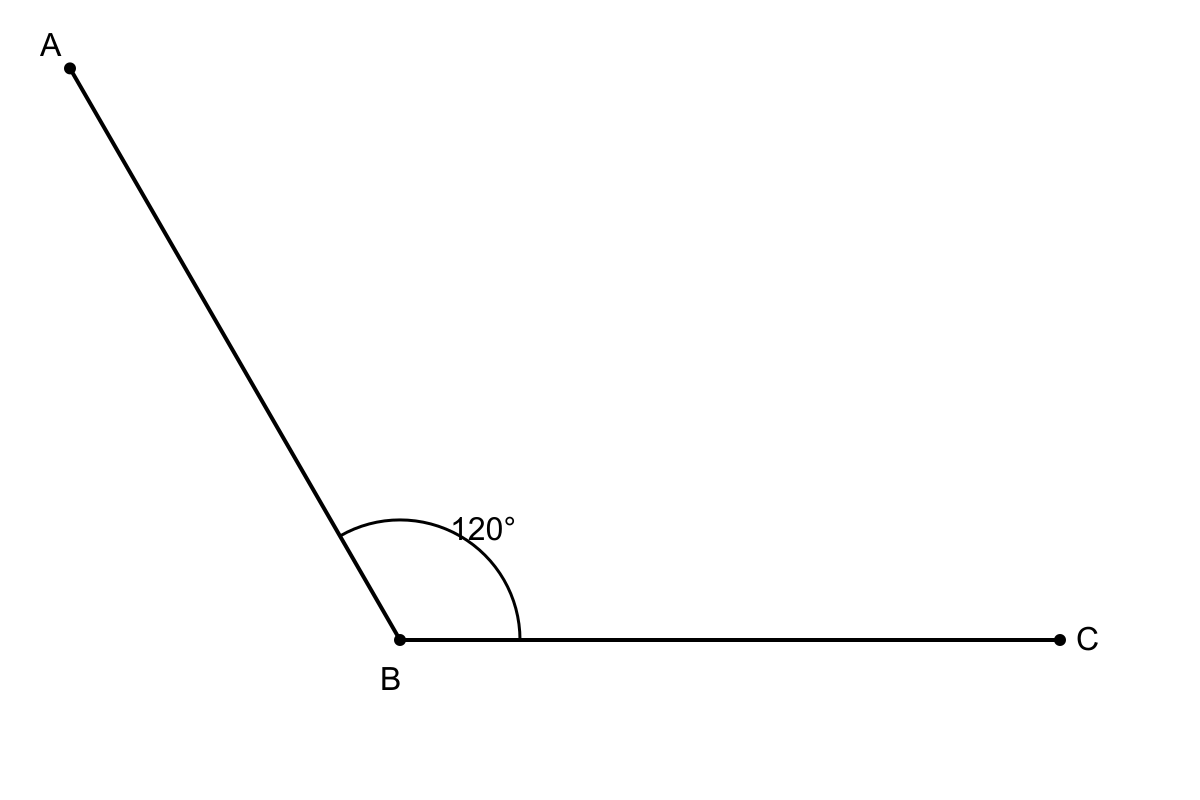
Examine the angle shown in the diagram below. Lisa wants to divide this angle into three equal parts. What would be the measure of each smaller angle?
$$40°$$
$$50°$$
$$35°$$
$$45°$$
Explanation
The angle shown measures $$120°$$. Dividing this into three equal parts: $$120° ÷ 3 = 40°$$. Choice A incorrectly calculates $$105° ÷ 3$$. Choice C incorrectly calculates $$135° ÷ 3$$. Choice D incorrectly calculates $$150° ÷ 3$$.
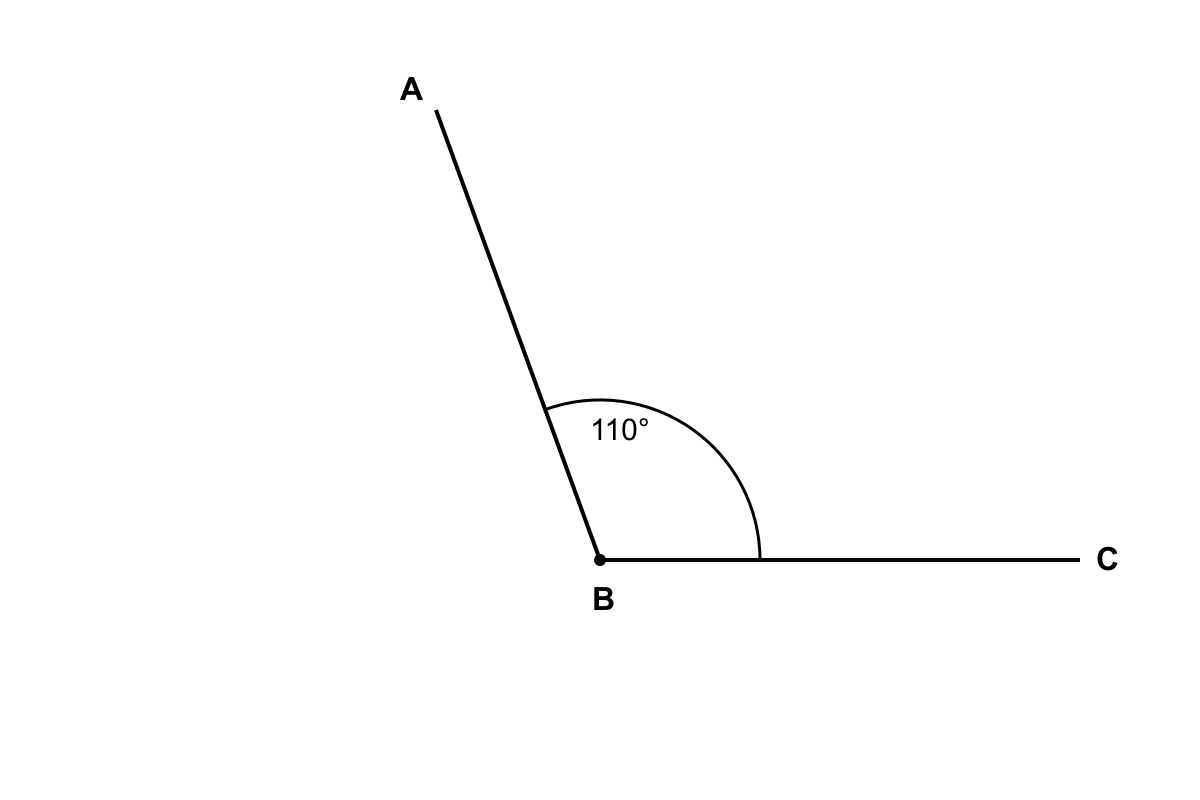
Study the angle shown in the figure. Emma measures this angle with her protractor but accidentally reads the wrong scale. If the correct measurement is $$110°$$ and Emma read $$70°$$, what is the difference between what she read and the actual measure?
$$35°$$
$$50°$$
$$40°$$
$$45°$$
Explanation
The actual angle measures $$110°$$, but Emma incorrectly read $$70°$$. The difference between her reading and the actual measure is $$110° - 70° = 40°$$. Choice A incorrectly calculates $$105° - 70°$$. Choice C incorrectly calculates $$115° - 70°$$. Choice D incorrectly calculates $$120° - 70°$$.