Understand Area as Square Units
Help Questions
3rd Grade Math › Understand Area as Square Units
Maya draws a rectangle on grid paper. She counts $$8$$ unit squares along one side and $$5$$ unit squares along the other side. Then she draws a line across the middle that divides the rectangle into two equal parts. What is the area of one of the parts?
$$13$$ square units
$$40$$ square units
$$26$$ square units
$$20$$ square units
Explanation
The total area of the rectangle is $$8 \times 5 = 40$$ square units. When divided into two equal parts, each part has an area of $$40 \div 2 = 20$$ square units. Choice B gives the total area before dividing. Choice C incorrectly adds the dimensions and divides by 2. Choice D incorrectly adds the dimensions.
A square playground is covered with $$7$$ rows of square tiles and $$7$$ columns of square tiles. Each tile is $$1$$ square unit. If $$9$$ tiles break and are removed, what is the area that is still covered by tiles?
$$58$$ square units
$$49$$ square units
$$16$$ square units
$$40$$ square units
Explanation
The total area of the playground is $$7 \times 7 = 49$$ square units. After $$9$$ tiles are removed, the covered area is $$49 - 9 = 40$$ square units. Choice A gives the original total area. Choice C incorrectly adds the broken tiles to the total. Choice D only accounts for some of the remaining tiles.
Two rectangles each have an area of $$24$$ square units. The first rectangle is $$4$$ units wide and $$6$$ units long. If the second rectangle is $$3$$ units wide, how many unit squares would be in each row of the second rectangle?
$$6$$ unit squares per row
$$3$$ unit squares per row
$$8$$ unit squares per row
$$24$$ unit squares per row
Explanation
The second rectangle has area $$24$$ square units and is $$3$$ units wide, so it must be $$24 \div 3 = 8$$ units long. Each row contains $$3$$ unit squares (the width). Choice A gives the length instead of the width. Choice C gives the total area. Choice D uses the width of the first rectangle.
Kim draws a rectangle with area $$30$$ square units. She then draws a line to split it into two parts: one part has $$18$$ square units and the other part has $$12$$ square units. She claims both parts are rectangles. Is this possible?
No, because you cannot split a rectangle into parts with different areas
No, because $$18$$ and $$12$$ are not equal halves of $$30$$
Yes, because $$18 + 12 = 30$$ and any split creates rectangles
Yes, because the areas add correctly and rectangles can be split into smaller rectangles
Explanation
It is possible to split a rectangle into two smaller rectangles with different areas. For example, a $$5 \times 6$$ rectangle could be split into a $$3 \times 6$$ part (18 square units) and a $$2 \times 6$$ part (12 square units). Choice A incorrectly assumes any split creates rectangles. Choice B incorrectly thinks parts must be equal. Choice D incorrectly claims rectangles cannot be split unequally.
Lisa has two rectangles made of unit squares. Rectangle A has $$3$$ rows and $$6$$ columns. Rectangle B has $$2$$ rows and $$9$$ columns. She wants to cut pieces from both rectangles to make a new rectangle with an area of $$25$$ square units. What is the total area of both original rectangles?
$$18$$ square units
$$36$$ square units
$$43$$ square units
$$25$$ square units
Explanation
When you see a problem about rectangles made of unit squares, you need to find the area by multiplying rows times columns. The question asks for the total area of both original rectangles, not the area of the new rectangle Lisa wants to make.
Let's find the area of each rectangle. Rectangle A has $$3$$ rows and $$6$$ columns, so its area is $$3 \times 6 = 18$$ square units. Rectangle B has $$2$$ rows and $$9$$ columns, so its area is $$2 \times 9 = 18$$ square units. The total area of both rectangles is $$18 + 18 = 36$$ square units.
Now let's check why each wrong answer is incorrect. Choice A ($$18$$ square units) only gives you the area of one rectangle - either Rectangle A or Rectangle B alone. Choice B ($$25$$ square units) is the area of the new rectangle Lisa wants to make, but the question asks for the total area of the original rectangles. Choice C ($$43$$ square units) might come from incorrectly adding $$18 + 25 = 43$$, mixing the area of one original rectangle with the target area.
The correct answer is D ($$36$$ square units) because this represents the combined area of both original rectangles: $$18 + 18 = 36$$.
Remember to read word problems carefully and identify exactly what the question is asking for. Here, the information about the $$25$$ square unit target is extra details - you just needed to find the total area of the two starting rectangles.
Look at the two shapes shown in the diagram. Shape A can be covered by $$8$$ unit squares without gaps or overlaps. Shape B can be covered by $$9$$ unit squares without gaps or overlaps. What is the total area of both shapes combined?
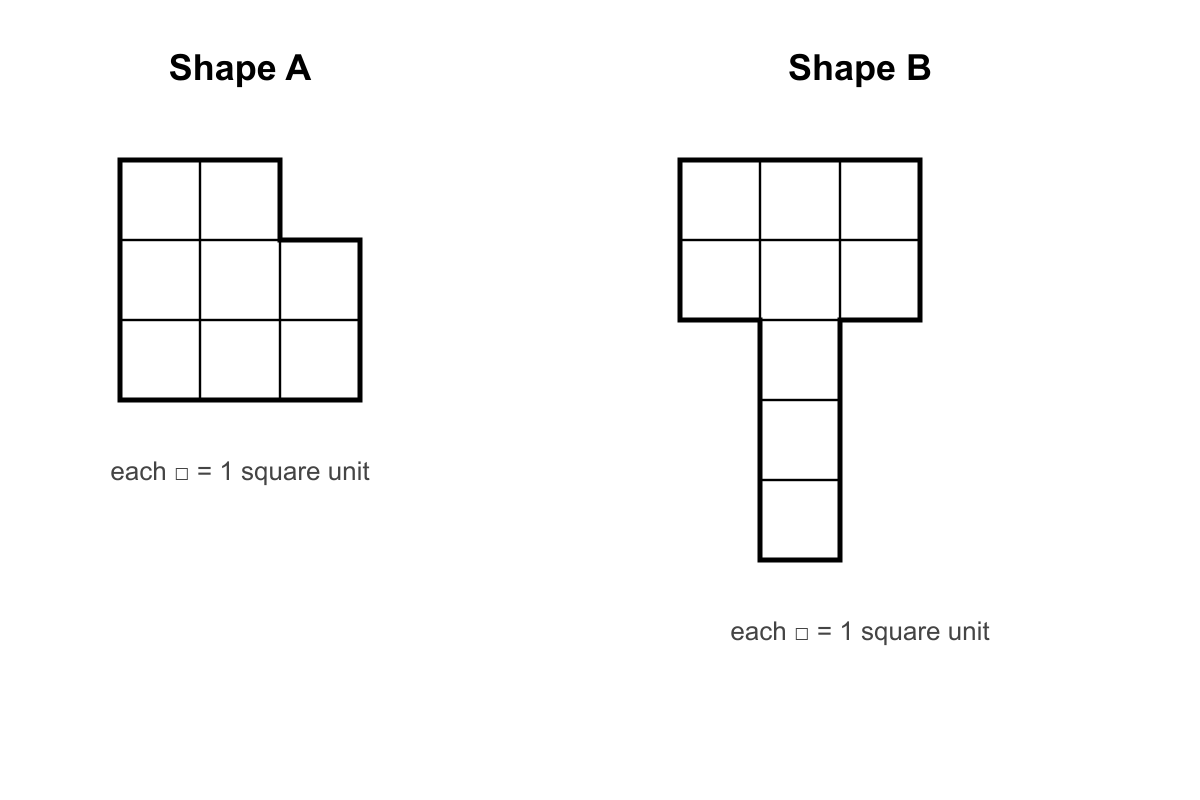
15 square units
16 square units
17 square units
14 square units
Explanation
Area is measured in square units. Shape A has area 8 square units and Shape B has area 9 square units. Total area = 8 + 9 = 17 square units.
Use the diagram below to answer this question. Two identical rectangles overlap to form the shape shown. Each rectangle has an area of $$12$$ square units. The overlapping region has an area of $$3$$ square units. What is the total area covered by both rectangles?
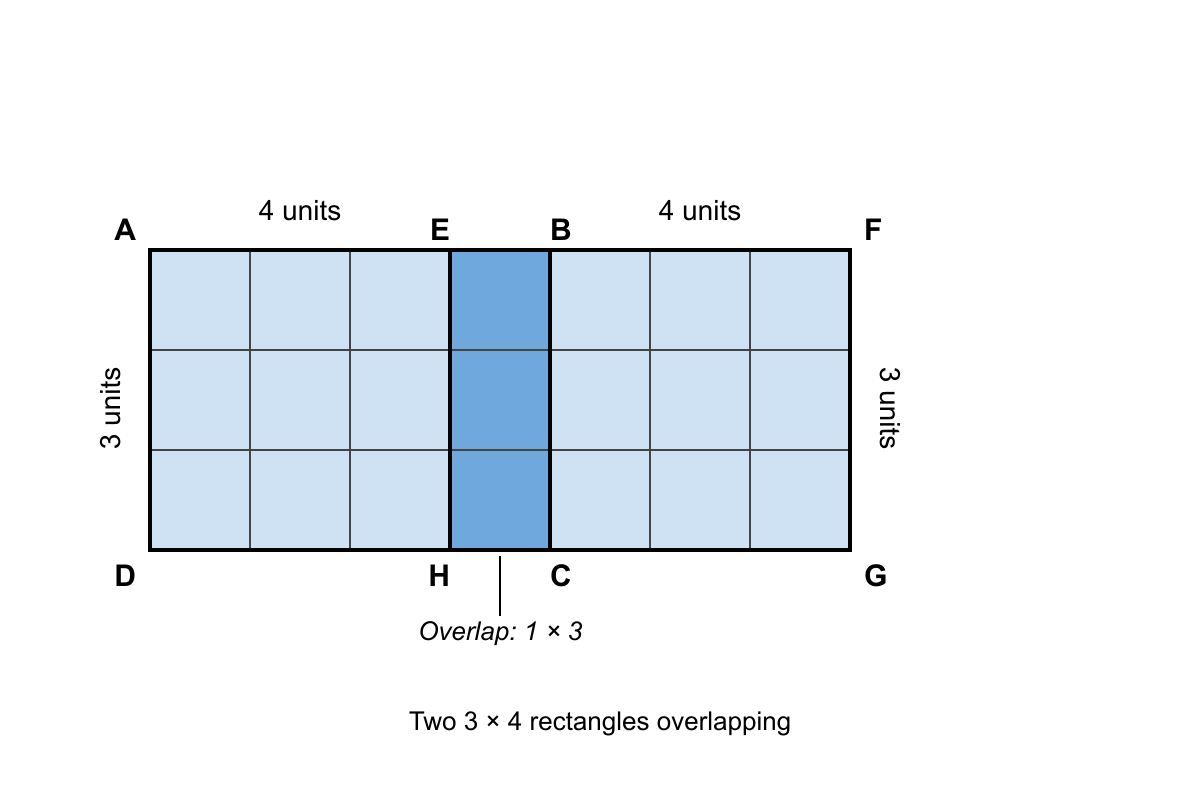
$$15$$ square units total coverage
$$21$$ square units total coverage
$$9$$ square units total coverage
$$24$$ square units total coverage
Explanation
When shapes overlap, we cannot simply add their areas. Total coverage = Area of Rectangle 1 + Area of Rectangle 2 - Overlapping area = 12 + 12 - 3 = 21 square units.
The rectangle in the figure below is divided into unit squares. Some unit squares are marked with dots. If the total area of the rectangle is $$20$$ square units, how many unit squares do NOT have dots?
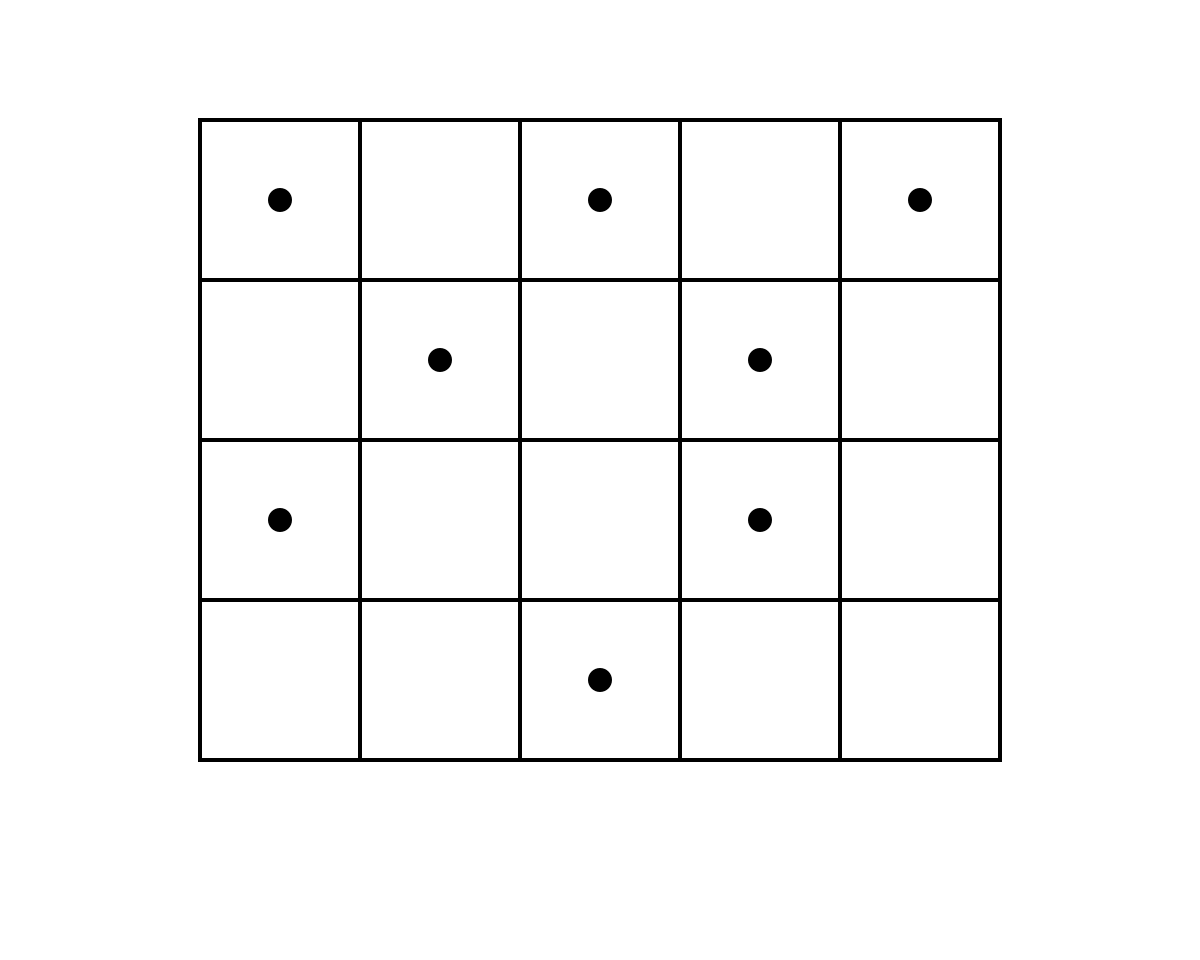
$$8$$ unit squares without dots
$$15$$ unit squares without dots
$$7$$ unit squares without dots
$$12$$ unit squares without dots
Explanation
The rectangle has area 20 square units, meaning 20 unit squares total. The figure shows 8 unit squares with dots, so 20 - 8 = 12 unit squares do not have dots. Choice B gives the number with dots instead.
The grid below shows a pattern where every third unit square is shaded. If this pattern continues for $$4$$ complete rows, each containing $$6$$ unit squares, what is the area of all the shaded unit squares?
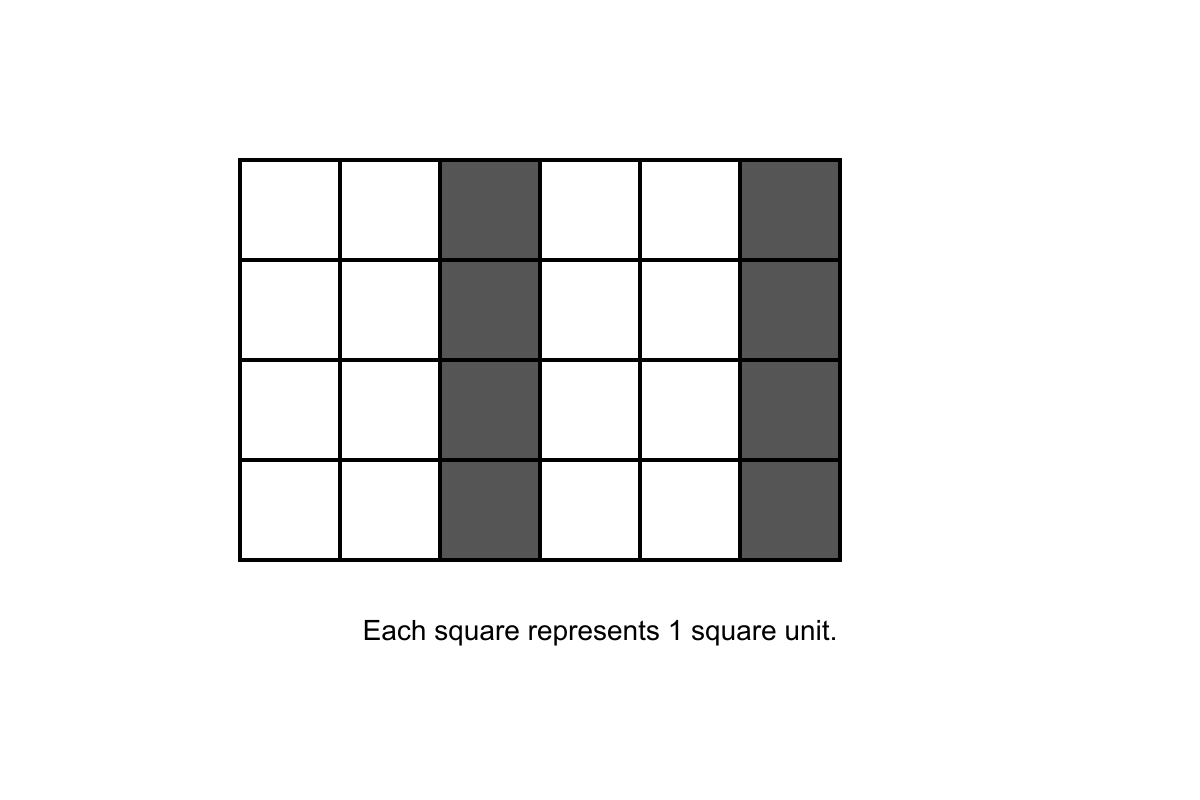
$$6$$ square units of shaded area
$$12$$ square units of shaded area
$$24$$ square units of shaded area
$$8$$ square units of shaded area
Explanation
Each row has 6 unit squares, with every third one shaded, giving 2 shaded squares per row. With 4 rows: 4 × 2 = 8 square units total.
The figure below shows a shape made of unit squares arranged in rows. Row 1 has $$2$$ unit squares, Row 2 has $$4$$ unit squares, and Row 3 has $$3$$ unit squares. What is the area of the entire shape?
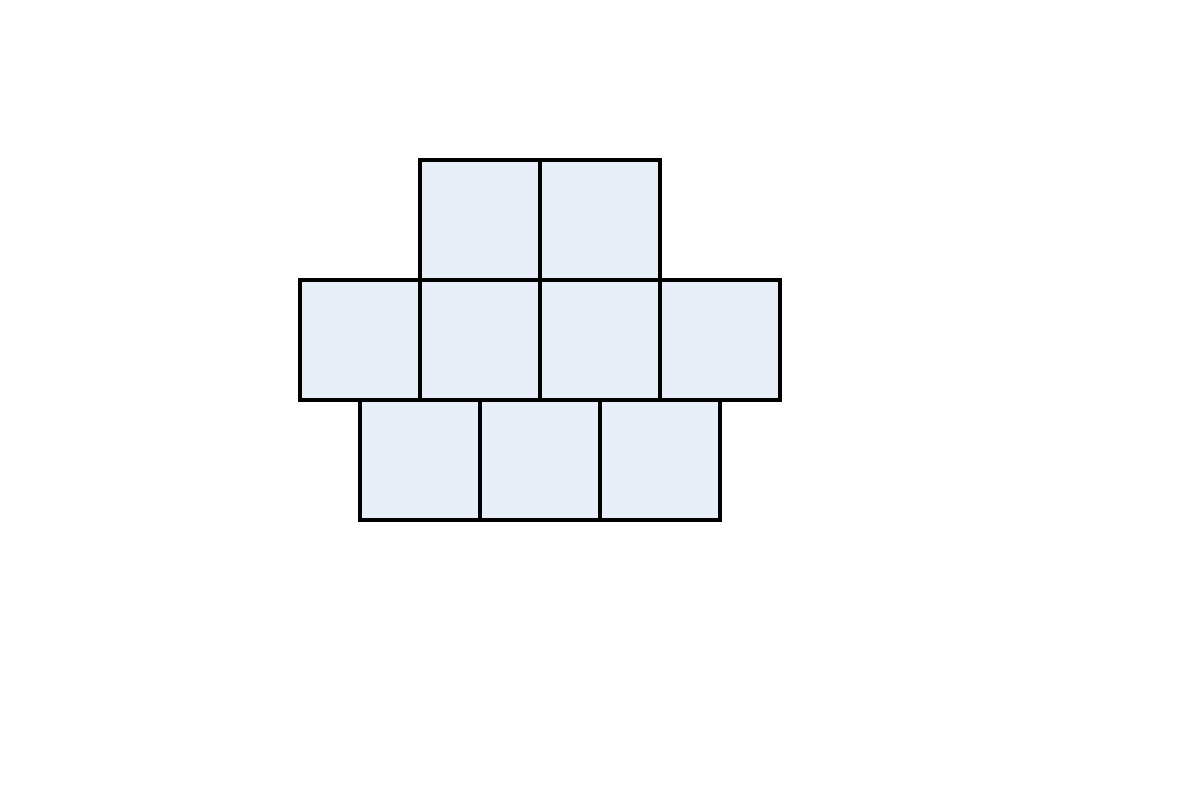
$$9$$ square units total area
$$6$$ square units total area
$$12$$ square units total area
$$24$$ square units total area
Explanation
Add the unit squares in each row: Row 1 + Row 2 + Row 3 = 2 + 4 + 3 = 9 square units total.