Rectangular Solids & Cylinders
Help Questions
GMAT Quantitative › Rectangular Solids & Cylinders



Explanation
To find the diagonal of a cube we can apply the formula 


Since we are given an area of a face of the cube, we can find the length of an edge simply by taking its square root.

Here the length of an edge is 3.
Thefore the final andwer is 
Find the volume of a cylinder whose height is 


Explanation
To find the volume of a cylinder, you must use the following equation:

Thus,

Find the volume of a cylinder whose height is
Explanation
To find the volume of a cylinder, you must use the following equation:
Thus,
Explanation
To find the diagonal of a cube we can apply the formula
Since we are given an area of a face of the cube, we can find the length of an edge simply by taking its square root.
Here the length of an edge is 3.
Thefore the final andwer is
Find the surface area of a cylinder whose height is 


Explanation
To find the surface area of a cylinder, you must use the following equation.

Thus,

Jenny wants to make a cube out of sheet metal. What is the length of one side of the cube?
I) The cube will require 
II) The cube will hold 
Either statement is sufficient to answer the question.
Both statements are needed to answer the question.
Neither statement is sufficient to answer the question. More information is needed.
Statement I is sufficient to answer the question, but statement II is not sufficient to answer the question.
Statement II is sufficient to answer the question, but statement I is not sufficient to answer the question.
Explanation
The length of an edge of a cube can be used to find either volume or surface area, and vice versa.
I) Gives us the surface area thus, we are able to calculate the length of an edge using the formula,


II) Gives us the volume thus, we are able to calculate the length of an edge using the formula,


Either can be used to find the side length.
An aquarium is shaped like a perfect cube; the area of each glass face is 

Note: 


The correct answer is not given among the other choices.
Explanation
A perfect cube has square faces; if a face has area 6.25 square meters, then each side of each face measures the square root of this, or 2.5 meters. The volume of the tank is the cube of this, or

Its capacity in liters is 
80% of this is

Which choice comes closest to the volume of a cube with surface area 


Explanation
The suface area of a cube is six times the square of the length of one side, so solve for 


This is the sidelength in centimeters; since we are looking at meters, divide this by 100 to convert to 
Cube this to get volume

Of the given choices, 3.5 cubic meters comes closest.
The length of a diagonal of a cube is 


Explanation
Let 


Cube the sidelength to get the volume:





Explanation
We are given the length of the diagonal of the cube.
Therefore we can find the length of an edge by using the formula


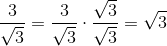
Therefore, the final answer is 