Techniques of antidifferentiation
Help Questions
AP Calculus AB › Techniques of antidifferentiation
Integrate:


Explanation
To integrate, the following substitution was made:

Now, we rewrite the integral in terms of u and integrate:

The following rule was used for integration:

Finally, rewrite the final answer in terms of our original x term:

Determine the value of 


Explanation
We can factor the equation inside the square root:

From here, increase each term's exponent by one and divide the term by the new exponent.

Now, substitute in the upper bound into the function and subtract the lower bound function value from it.

Therefore,

Integrate,
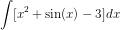
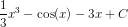
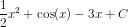

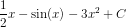

Explanation
Integrate
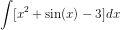
1) Apply the sum rule for integration,

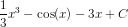
2) Integrate each individual term and include a constant of integration,
Further Discussion
Since indefinite integration is essentially a reverse process of differentiation, check your result by computing its' derivative.

This is the same function we integrated, which confirms our result. Also, because the derivative of a constant is always zero, we must include "C" in our result since any constant added to any function will produce the same derivative.
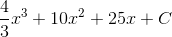
Given 



None of the other answers

Explanation
To answer this, we will need to FOIL our function first.

Now can find the antiderivatives of each of these three summands using the power rule.


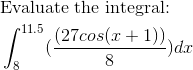
Find the antiderivative of the following.


Explanation




Explanation
Integrate:


Explanation
To integrate, the following substitution must be made:

Now, we rewrite the integral in terms of u and integrate:

The following integration rule was used:

To finish, we replace u with our original x term:

Evaluate the integral


Explanation
Evaluating integrals requires knowledge of the basic integral forms. In this problem, there is a group raised to an exponent, which is the 
This arrangement typically follows the basic integral form 


The exponent is 5, so the 
Since the inside of the exponent group is 

Now we differentiate 


Notice that the parts of our 


This is exactly what we are asked to integrate.
This means we can evaluate the integral by using basic integral form directly. Plugging in our 


This is equivalent to the answer 
Evaluate the integral


Not integrable
Explanation
There are a lot of pieces inside this integral. There are trigonometry functions, exponential functions, and a rational arrangement. Lots of possibilities.
This is where u-substitution is best. Try making u represent various parts and see if du gets all the other parts. After doing this enough times, you will see that we should make u be the exponent of the e.

Let's write the inner fraction as an x with a negative exponent

Now we differentiate and see what we get for du. This will require the chain rule. The outer structure is the 
Recall these derivatives:


Applying these we get

Simplifying gives us

This perfectly matches all remaining parts of our integral. Lets rewrite everything using u and du

This matches the basic integral form,

Thus, when we integrate we get

Rewriting back in terms of x, we get

This is our answer.
Calculate the following integral:


Explanation

Re-write the integrand as follows:

Make the following substitution: 

Apply the substitution to the integrand:

Evaluate the integral:

Re-substitute the value of u:

Solution:
