Complex Numbers/Polar Form
Help Questions
Trigonometry › Complex Numbers/Polar Form
The polar coordinates 


Explanation
Given the polar coordinates 


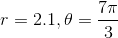

Likewise, given the polar coordinates 


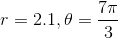

Therefore the rectangular coordinates of the point 
The polar coordinates
Explanation
Given the polar coordinates
Likewise, given the polar coordinates
Therefore the rectangular coordinates of the point
Find the following quotients, given that 

(a)

(b)

(a) 

(b) 

(a) 

(b) 

(a) 

(b) 

(a) 

(b) 

Explanation
The modulus of the quotient of two complex numbers is the modulus of the dividend divided by the modulus of the divisor. The amplitude of the quotient is the amplitude of the dividend minus the amplitude of hte divisor.
(a) The modulus for 


(b) The modulus for 


Multiply the following complex numbers (in polar form), giving the result in both polar and rectangular form.


Explanation
The modulus of the product of two complex numbers is the product of their moduli, and the amplitude of the product is the sum of their amplitudes.
Therefore, the new modulus will be 


We must also express this in rectangular form, which we can do by substituting 


Multiply the following complex numbers (in polar form), giving the result in both polar and rectangular form.
Explanation
The modulus of the product of two complex numbers is the product of their moduli, and the amplitude of the product is the sum of their amplitudes.
Therefore, the new modulus will be
We must also express this in rectangular form, which we can do by substituting
Express the complex number 


Explanation
To convert this number to rectangular form, first think about what 


Now plug these in and continue solving:


Find the following quotients, given that
(a)
(b)
(a)
(b)
(a)
(b)
(a)
(b)
(a)
(b)
Explanation
The modulus of the quotient of two complex numbers is the modulus of the dividend divided by the modulus of the divisor. The amplitude of the quotient is the amplitude of the dividend minus the amplitude of hte divisor.
(a) The modulus for
(b) The modulus for
Express the complex number
Explanation
To convert this number to rectangular form, first think about what
Now plug these in and continue solving:
Simplify 


Explanation
In order to solve this problem, we must combine real numbers with real numbers and imaginary numbers with imaginary numbers. Be careful to distribute the subtraction sign to all terms in the second set of parentheses.


Simplify
Explanation
In order to solve this problem, we must combine real numbers with real numbers and imaginary numbers with imaginary numbers. Be careful to distribute the subtraction sign to all terms in the second set of parentheses.