Plane Geometry
Help Questions
SSAT Middle Level Quantitative › Plane Geometry
What is the area of the triangle?
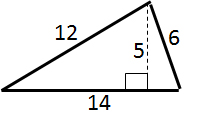


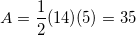
Explanation
Area of a triangle can be determined using the equation:

The ratio of the perimeter of one square to that of another square is 


Explanation
For the sake of simplicity, we will assume that the second square has sidelength 1; Then its perimeter is 

The perimeter of the first square is 


The ratio of the areas is therefore 
A square is 9 feet long on each side. How many smaller squares, each 3 feet on a side can be cut out of the larger square?


Explanation
Each side can be divided into three 3-foot sections. This gives a total of 
The area of the square is 81. What is the sum of the lengths of three sides of the square?


Explanation
A square that has an area of 81 has sides that are the square root of 81 (side2 = area for a square). Thus each of the four sides is 9. The sum of three of these sides is 

Find the perimeter of the triangle above.
Note: Figure not drawn to scale.


None of these answers are correct.

Explanation
The perimeter of a shape is the length around the shape. In order to find the perimeter of a triangle, add the lengths of the sides: 
Because the lengths are in inches, the answer must be in inches as well.
What is the area of the triangle?
Explanation
Area of a triangle can be determined using the equation:
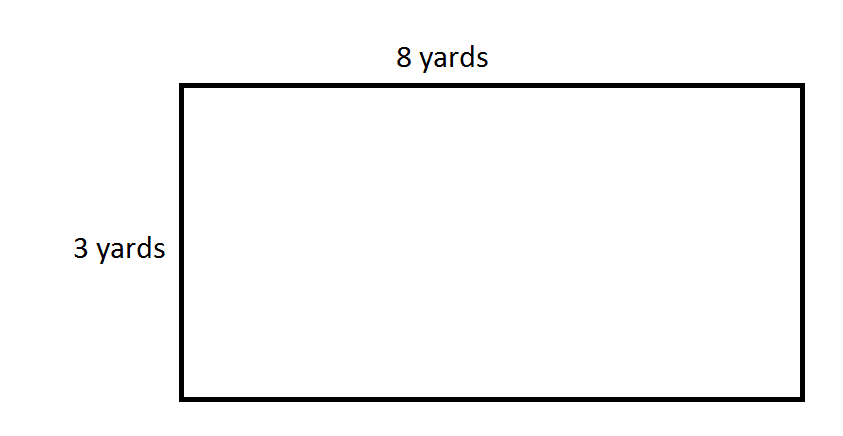
Give the area of the above rectangle in square feet.


Explanation
Since 1 yard = 3 feet, multiply each dimension by 3 to convert from yards to feet:


Use the area formula, substituting 


A square is 9 feet long on each side. How many smaller squares, each 3 feet on a side can be cut out of the larger square?
Explanation
Each side can be divided into three 3-foot sections. This gives a total of
A right triangle has one leg with a length of 6 feet and a hypotenuse of 10 feet. What is the length of the other leg?


Explanation
In geometry, a right angle triangle can occur with the ratio of 
When you know the length of two sides of a right angle triangle like this, you can calculate the third side using this ratio.
Here, the ratio is:

This is double the 
Another way to solve is to use the Pythagorean Theorem: 
We know that one leg is 6 feet and the hypotenuse is 10 feet.


What is the length of a line segment with end points 


Explanation
The length of a line segment can be determined using the distance formula:



