Coordinate Geometry
Help Questions
SAT Math › Coordinate Geometry
We have a square with length 2 sitting in the first quadrant with one corner touching the origin. If the square is inscribed inside a circle, find the equation of the circle.





Explanation
If the square is inscribed inside the circle, in means the center of the circle is at (1,1). We need to also find the radius of the circle, which happens to be the length from the corner of the square to it's center.

Now use the equation of the circle with the center and 
We get

A circle exists entirely in the first quadrant such that it intersects the 



Explanation
We are given two very important pieces of information. The first is that the circle exists entirely in the first quadrant, the second is that it intersects both the 

The fact that it is entirely in the first quadrant means that it cannot go past the two axes. For a circle to intersect the 
The intersection of the circle with 


This leaves us with a radius of 6 and an area of:

A circle has its origin at 


There is not enough information to answer this question.
Explanation
The radius of the circle is equal to the hypotenuse of a right triangle with sides of lengths 5 and 7.



This radical cannot be reduced further.
Whast line goes through the points 


Explanation
Let 

The slope is geven by: 

Then we use the slope-intercept form of an equation; 

And we convert

to standard form.
What is the slope of a line which passes through coordinates 


Explanation
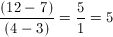
Slope is found by dividing the difference in the 

A line segment has endpoints (0,4) and (5,6). What are the coordinates of the midpoint?
(0,4)
(0,6)
(2.5,-5)
(2.5,5)
(3,9)
Explanation
A line segment has endpoints (0,4) and (5,6). To find the midpoint, use the midpoint formula:
X: (x1+x2)/2 = (0+5)/2 = 2.5
Y: (y1+y2)/2 = (4+6)/2 = 5
The coordinates of the midpoint are (2.5,5).
There is a line defined by the equation below:

There is a second line that passes through the point 


Explanation
Parallel lines have the same slope. Solve for the slope in the first line by converting the equation to slope-intercept form.
3x + 4y = 12
4y = _–_3x + 12
y = –(3/4)x + 3
slope = _–_3/4
We know that the second line will also have a slope of _–_3/4, and we are given the point (1,2). We can set up an equation in slope-intercept form and use these values to solve for the y-intercept.
y = mx + b
2 = _–_3/4(1) + b
2 = _–_3/4 + b
b = 2 + 3/4 = 2.75
Plug the y-intercept back into the equation to get our final answer.
y = –(3/4)x + 2.75
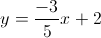
What line is perpendicular to 




Explanation
Convert the given equation to slope-intercept form.



The slope of this line is 
The perpendicular slope is 
Plug the new slope and the given point into the slope-intercept form to find the y-intercept.


So the equation of the perpendicular line is 
Consider the lines described by the following two equations:
4y = 3x2
3y = 4x2
Find the vertical distance between the two lines at the points where x = 6.
36
21
12
44
48
Explanation
Since the vertical coordinates of each point are given by y, solve each equation for y and plug in 6 for x, as follows:

Taking the difference of the resulting y -values give the vertical distance between the points (6,27) and (6,48), which is 21.
There is a line defined by the equation below:
There is a second line that passes through the point
Explanation
Parallel lines have the same slope. Solve for the slope in the first line by converting the equation to slope-intercept form.
3x + 4y = 12
4y = _–_3x + 12
y = –(3/4)x + 3
slope = _–_3/4
We know that the second line will also have a slope of _–_3/4, and we are given the point (1,2). We can set up an equation in slope-intercept form and use these values to solve for the y-intercept.
y = mx + b
2 = _–_3/4(1) + b
2 = _–_3/4 + b
b = 2 + 3/4 = 2.75
Plug the y-intercept back into the equation to get our final answer.
y = –(3/4)x + 2.75