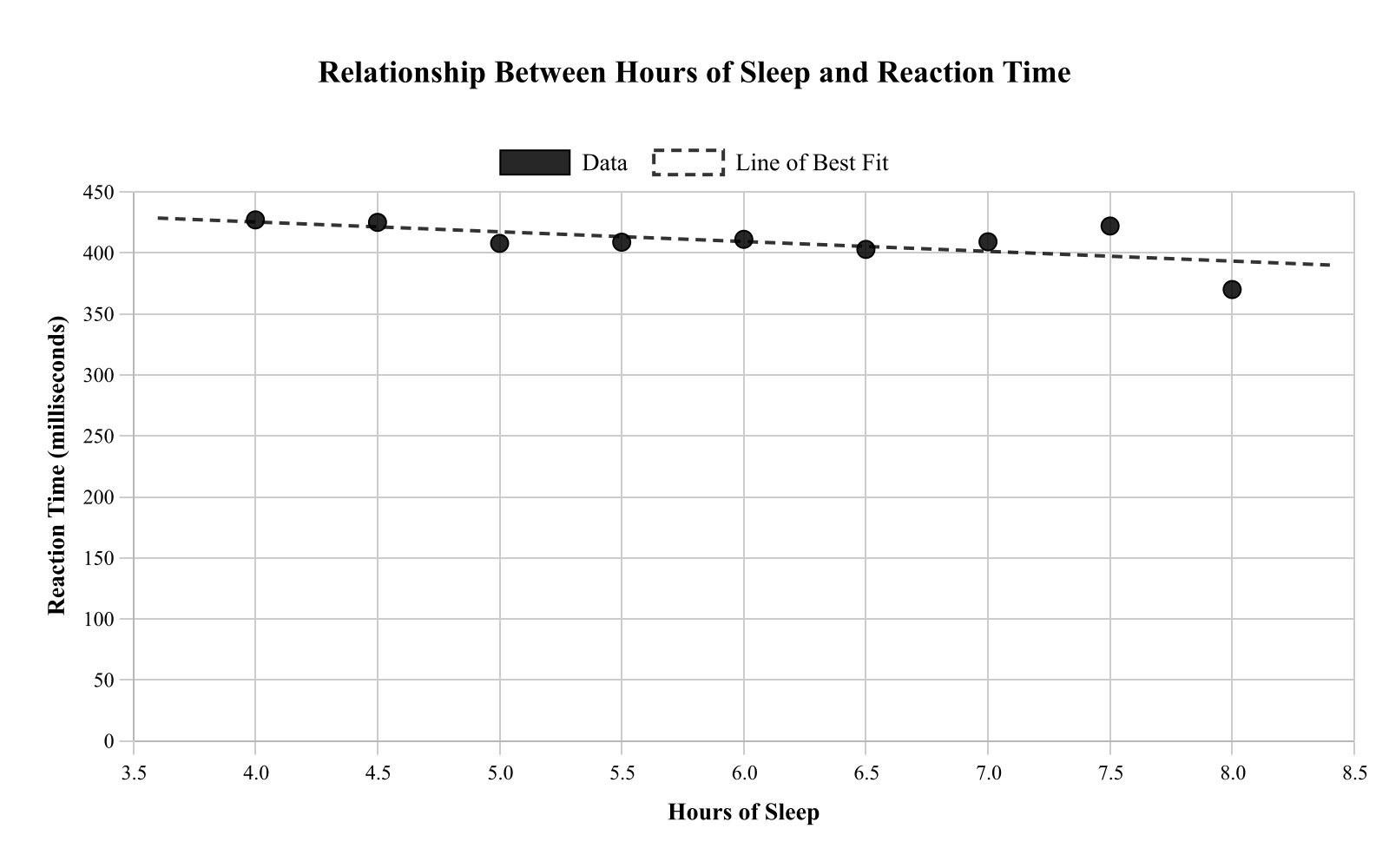
What this deck covers
This deck focuses on Scatter Plots, giving you a quick way to review the definitions, rules, and examples that matter most for SAT Math.
Study Scatter Plots in SAT Math with focused flashcards that help you recognize the idea, recall the key rule, and apply it in practice-style prompts.
0% Complete
What does a positive correlation look like on a scatter plot?
Tap card or press Space to flip
Points trend upwards from left to right. As x increases, y also increases, showing a positive relationship.
How well did you know it?
Card 1 / 79
Space to flip · ← / → to move · once flipped, → Got it · ← Still learning
This deck focuses on Scatter Plots, giving you a quick way to review the definitions, rules, and examples that matter most for SAT Math.
Work through these flashcards in short sessions. Try to answer each prompt before flipping the card, then revisit any cards you miss until the explanation feels automatic.
Answer: Points trend upwards from left to right. As x increases, y also increases, showing a positive relationship.
Answer: The residuals on the y-axis versus the independent variable. Helps assess whether the linear model fits the data well.
Answer: Negative correlation. Negative slope means variables move in opposite directions.
Answer: Negative correlation. Downward slope indicates variables move in opposite directions.
Answer: To quantify the strength and direction of a relationship. Measures how closely the data follows a linear pattern.
Answer: To display the relationship between two quantitative variables. Shows how two numerical variables relate or change together.
Answer: A pair of values for the two variables being compared. One coordinate from each variable creates a single data point.
Answer: The model is appropriate for the data. Random residuals suggest the linear model is valid.
Answer: No correlation. The variables are not related in a predictable way.
Answer: Groups of data points clustered together. Shows distinct groups or categories within the data set.
Answer: Weak negative correlation. −0.2 is close to 0, indicating a weak relationship.
Answer: A straight line that best represents the data on a scatter plot. Also called a trend line, it summarizes the data's relationship.
Answer: To visualize the relationship between two quantitative variables. Shows how one variable changes as another changes.
Answer: A strong relationship between the variables. Large changes in y correspond to small changes in x.
Answer: To quantify the strength and direction of a relationship. Measures how closely the data follows a linear pattern.
Answer: Perfect positive linear relationship. All points lie exactly on an upward-sloping line.
Answer: Extrapolation. Predicting outside the data range carries more uncertainty.
Answer: Points are scattered randomly with no clear trend. No predictable pattern exists between the two variables.
Answer: No correlation. Random scatter with no clear pattern means variables are unrelated.
Answer: To visualize the relationship between two quantitative variables. Shows how one variable changes as another changes.
Answer: Independent variable. The x-axis variable is controlled or chosen first.
Answer: Strong positive correlation. 0.85 is close to 1, indicating a strong positive relationship.
Answer: The rate of change between the variables. Slope shows how much y changes per unit increase in x.
Answer: Data points that deviate significantly from the pattern. These unusual points don't follow the overall trend.
Answer: A pair of values for the two variables being compared. One coordinate from each variable creates a single data point.
Answer: Predicting values within the range of the data. Uses the trend line between existing data points.
Answer: Interpolation. Predicting between existing points is generally more reliable.
Answer: The horizontal axis representing the independent variable. Also called the independent variable because it's controlled or measured first.
Answer: Dependent variable. The y-axis variable responds to changes in the x-variable.
Answer: Correct: indicate strong correlation. Tightly clustered points show strong, not weak correlation.
Answer: Linear relationship. Points can be approximated by a straight line.
Answer: Negative correlation. Downward slope indicates variables move in opposite directions.
Answer: A graph that shows the relationship between two variables using points. Each point plots one x-value against one y-value to visualize patterns.
Answer: Negative correlation. As one variable increases, the other decreases.
Answer: Positive correlation. Positive slope means both variables increase together.
Answer: No correlation. Zero means no linear relationship exists between the variables.
Answer: Positive correlation. Upward trend indicates both variables increase together.
Answer: Perfect positive linear relationship. All points lie exactly on an upward-sloping line.
Answer: Predicting values outside the range of the data. Extends the trend line beyond the given data points.
Answer: A relationship involving two variables. Scatter plots specifically examine two-variable relationships.
Answer: As one variable increases, the other variable also increases. Both variables move in the same direction together.
Answer: A weak relationship between the variables. Small changes in y correspond to changes in x.
Answer: To display the relationship between two quantitative variables. Shows how two numerical variables relate or change together.
Answer: Perfect negative linear relationship. All points lie exactly on a downward-sloping line.
Answer: By minimizing the distances from all points to the line. Uses least squares method to minimize total squared distances.
Answer: To show the general direction or pattern of the data. Helps visualize the overall relationship and make predictions.
Answer: Correlation coefficient. The r value measures strength and direction of correlation.
Answer: No correlation. Zero slope means y doesn't change as x changes.
Answer: Positive correlation. Upward trend indicates both variables increase together.
Answer: Correct: indicate strong correlation. Tightly clustered points show strong, not weak correlation.
Answer: The difference between observed and predicted values. Measures how far each point deviates from the trend line.
Answer: Linear regression. Method that creates the best-fitting line through data points.
Answer: No correlation. Random scatter indicates no predictable relationship between variables.
Answer: No linear relationship. Variables are not linearly related to each other.
Answer: As one variable increases, the other variable also increases. Both variables move in the same direction together.
Answer: A strong relationship between the variables. Large changes in y correspond to small changes in x.
Answer: The vertical axis representing the dependent variable. Also called the dependent variable because it responds to changes in x.
Answer: Non-linear relationship. The relationship follows a curved pattern, not a line.
Answer: Positive correlation. Positive slope means both variables increase together.
Answer: Linear regression. Method that creates the best-fitting line through data points.
Answer: Correlation coefficient. The r value measures strength and direction of correlation.
Answer: No correlation. Random scatter with no clear pattern means variables are unrelated.
Answer: A weak relationship between the variables. Small changes in y correspond to changes in x.
Answer: By minimizing the distances from all points to the line. Uses least squares method to minimize total squared distances.
Answer: Points trend downwards from left to right. As x increases, y decreases, showing an inverse relationship.
Answer: Outliers are data points that deviate significantly from the trend. They can affect trend lines and correlation strength significantly.
Answer: A point that lies far from the general pattern of the data. Look for points that don't follow the main cluster or trend.
Answer: Extrapolation. Predicting outside the data range carries more uncertainty.
Answer: Predicting values within the range of the data. Uses the trend line between existing data points.
Answer: Negative correlation. Downward trend indicates one variable decreases as the other increases.
Answer: From -1 to 1. Values closer to ±1 indicate stronger linear relationships.
Answer: No correlation. The variables are not related in a predictable way.
Answer: Points trend upwards from left to right. As x increases, y also increases, showing a positive relationship.
Answer: Line of best fit (or trend line). Drawn through data points to show the overall pattern or trend.
Answer: Positive correlation. As one variable increases, the other also increases.
Answer: Line of best fit (or trend line). Drawn through data points to show the overall pattern or trend.
Answer: A straight line that best represents the data on a scatter plot. Also called a trend line, it summarizes the data's relationship.