All questions
Question 1
What is the area of a trapezoid with a height of 7, a base of 5, and another base of 13?
 (correct answer)


Explanation: 
Question 2
Data Sufficiency Question
Solve for  ,
,  , and
, and  :
:

1. 
2. 
- Both statements taken together are sufficient to answer the question, but neither statement alone is sufficient (correct answer)
- Statement 1 alone is sufficient, but statement 2 alone is not sufficient to answer the question
- Statement 2 alone is sufficient, but statement 1 alone is not sufficient to answer the question
- Each statement alone is sufficient
- Statements 1 and 2 together are not sufficient, and additional data is needed to answer the question
Explanation: In order to solve an equation set, one requires a number of equations equal to the number of variables. Therefore, three equations are needed and both statements are required to solve the problem.
Question 3
Consider this system of equations:
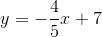

Does this system has exactly one solution?
Statement 1: The lines representing the equations are parallel.
Statement 2: 
- EITHER statement ALONE is sufficient to answer the question. (correct answer)
- Statement 1 ALONE is sufficient to answer the question, but Statement 2 ALONE is NOT sufficient to answer the question.
- Statement 2 ALONE is sufficient to answer the question, but Statement 1 ALONE is NOT sufficient to answer the question.
- BOTH statements TOGETHER are sufficient to answer the question, but NEITHER statement ALONE is sufficient to answer the question.
- BOTH statements TOGETHER are insufficient to answer the question.
Explanation: The solution of a system of linear equations is the point at which their lines intersect; if they are parallel, then by definition, there is no such point, and the system has no solution.
If  , then we can rewrite the second equation as
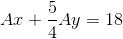 In slope-intercept form:
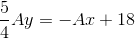

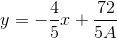 This line has a slope of
  . The other equation has a line with slope of
  also, as can be easily seen since it is already in slope-intercept form. Since both equations have lines with the same slope, they are either the same line or parallel lines; either way, the system does not have exactly one solution.
Question 4
A line segement on the coordinate plane has endpoints  and
and  . Which of the following expressions is equal to the length of the segment?
 (correct answer)



Explanation: Apply the distance formula, setting
 :
:



Question 5
Consider the function  .
.
State whether this function is even, odd, or neither, and give the reason for your answer.
 is not odd, because there exists at least one value of
  for which
  ;
;  is not even, because there exists at least one value of
  for which
  . (correct answer)
 is odd because
  for each value of
  in the domain.
 is even because
  for each value of
  in the domain.
 is odd because it is a polynomial of degree 3.
 is even because it is a polynomial of degree 3.
Explanation: A function is odd if and only if  for each value of
  in the domain; it is even if and only if
  for each value of
  in the domain. To disprove a function is odd or even, we need only find one value of
  for which the appropriate statement fails to hold.
Consider
for which the appropriate statement fails to hold.
Consider  :
:


 , so
, so  is not an odd function;
  , so
, so  is not an even function.
Question 6
Data Sufficiency Question- do not actually solve the problem
Solve for  .
.

1. 
2. 
- Statements 1 and 2 together are not sufficient, and additional data is needed to answer the question (correct answer)
- Statement 1 alone is sufficient, but statement 2 alone is not sufficient to answer the question
- Statement 2 alone is sufficient, but statement 1 alone is not sufficient to answer the question
- Both statements taken together are suffienct to answer the question, but neither statement alone is sufficient
- Each statement alone is sufficient
Explanation: In order to solve an equation with 4 variables, you need to know either 3 of the variables or have a system of 4 equations to solve.
Question 7
A monster is holding a brown paper bag filled with cookies. Inside the bag there are two types of cookies, chocolate chip and oatmeal raisin. If the monster pulls one cookie out at random, what is the probability that he pulls out a chocolate chip cookie.
1. There are a total of 24 cookies in the bag.
2. There are 8 more chocolate chip cookies in the bag than oatmeal raisin cookies.
- BOTH statements TOGETHER are sufficient, but NEITHER statement ALONE is sufficient. (correct answer)
- Statement (2) ALONE is sufficient, but statement (1) alone is not sufficient.
- Statement (1) ALONE is sufficient, but statement (2) alone is not sufficient.
- EACH statement ALONE is sufficient.
- Statements (1) and (2) TOGETHER are NOT sufficient.
Explanation: We need both statements to get the answer.
Statement 1 alone is not enough. Having 24 total cookies does not tell us the proportions of each type of cookie. We could have 1 chocolate chip cookie and 23 oatmeal raisin, or vice versa.
Statement 2 alone is not sufficient either. Knowing that there are 8 more chocolate chip cookies than oatmeal raisin without knowing the total amount in the bag does not help. It could be 1 oatmeal raisin cookie and 9 chocolate chip, or it could be 100 oatmeal raisin cookies and 108 chocolate chip cookies (although that is a pretty big bag!)
Only by having both statements together can we find the right proportion. If we let  be the number of chocolate chip cookies, and
  be the number of oatmeal raisin, we can set two equations and find the right ratio. We know that
 from statement 1, and
 from statement 2.
Substituting
from statement 2.
Substituting  into the first equation we get


 Therefore, we get 8 oatmeal raisin cookies, and 16 chocolate chip cookies. The answer is
 or 66.67% chance that the monster pulls out a chocolate chip cookie.
Question 8
For which of the following values of  would the median and the mode of the data set be equal?

 (correct answer)


- None of the other answers are correct.
Explanation: If the known values are ordered from least to greatest, the set looks like this:
 Below are each of the choices, followed by the set that results if it is added to the above set, followed by the median - the middle element - and the mode - the most frequently occurring element.



 Only the addition of 11 yields a set with median and mode equal to each other.
Question 9
A baseball travels at a rate of  . How long does it take to reach a fence that is
  away?
away?
 (correct answer)


Explanation: The first step is to convert the distance into feet:
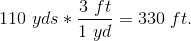 Then, divide the distance by the baseball's rate of travel:
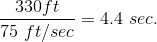
Question 10
If  , what does
  equal?
 (correct answer)


Explanation: We can use the fact that  to see that
  Since
Since  , we have
 .
.
Question 11
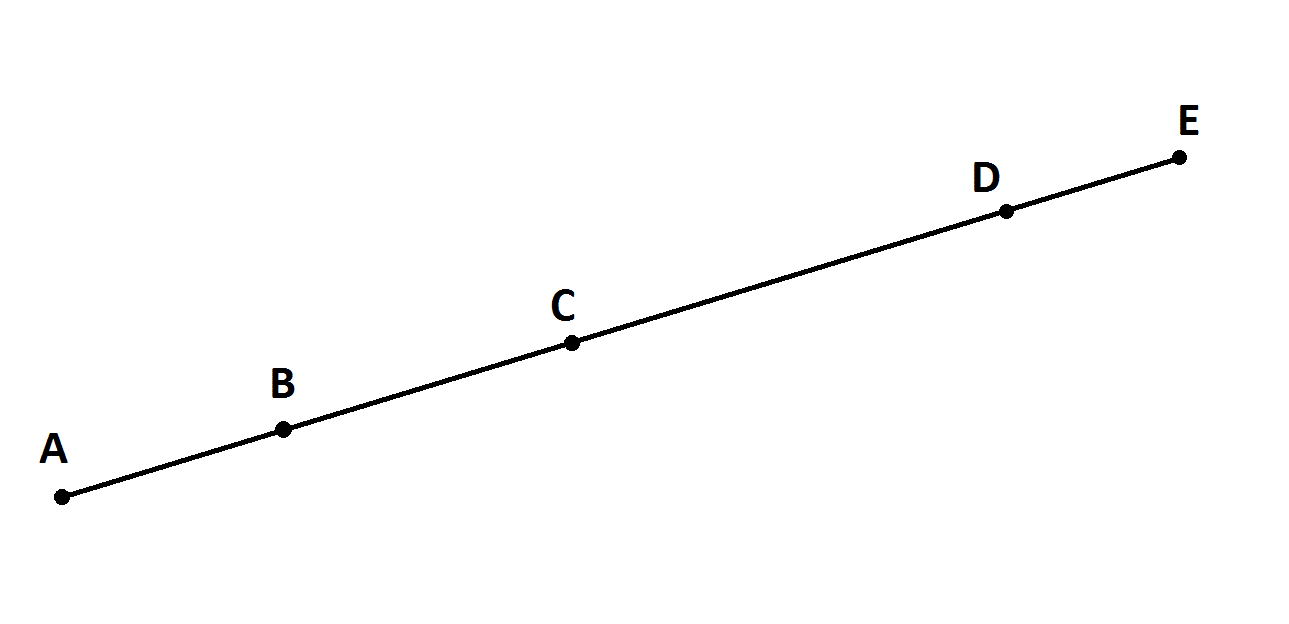
Note: Figure NOT drawn to scale.
Evaluate  .
.
Statement 1: 
Statement 2: 
- BOTH statements TOGETHER are insufficient to answer the question. (correct answer)
- Statement 1 ALONE is sufficient to answer the question, but Statement 2 ALONE is NOT sufficient to answer the question.
- Statement 2 ALONE is sufficient to answer the question, but Statement 1 ALONE is NOT sufficient to answer the question.
- EITHER statement ALONE is sufficient to answer the question.
- BOTH statements TOGETHER are sufficient to answer the question, but NEITHER statement ALONE is sufficient to answer the question.
Explanation: Even with both statements,  cannot be determined because the length of
  is missing.
For example, we can have
is missing.
For example, we can have  and
and  , making
  ; or, we can have
  and
and  , making
  . Neither scenario violates the conditions given.
Question 12
If an equilateral triangle has a perimeter of  , what is the length of each side?
 (correct answer)

- Cannot be determined
Explanation: An equilateral triangle has three equal sides; therefore, to find the length of each side, divide the perimeter by  :
:

Question 13
Simplify this expression as much as possible:

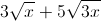 (correct answer)
- The expression cannot be simplified further



Explanation: 




Question 14
If an equilateral triangle has a perimeter of , what is the length of each side?
- (correct answer)
- Cannot be determined
Explanation: An equilateral triangle has three equal sides; therefore, to find the length of each side, divide the perimeter by :
Question 15
- BOTH statements TOGETHER are sufficient to answer the question, but NEITHER statement ALONE is sufficient to answer the question. (correct answer)
- EITHER statement ALONE is sufficient to answer the question.
- BOTH statements TOGETHER are insufficient to answer the question.
- Statement 1 ALONE is sufficient to answer the question, but Statement 2 ALONE is NOT sufficient to answer the question.
- Statement 2 ALONE is sufficient to answer the question, but Statement 1 ALONE is NOT sufficient to answer the question.
Explanation: The mean of a data set requires you to know the sum of the elements and the number of elements; you know the latter, but neither statement alone provides any clues to the former.
However, if you know both, you can add both sides of the equations as follows:


 Rewrite as:
 and divide by 9:
 Now you know the sum, so divide it by 6 to get the mean:
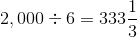 .
.
Question 16
Find the solution set of the inequality

 (correct answer)


Explanation: To solve a quadratic inequality, move all expressions to the left first:


 The square of a real number cannot be less than 0, so


 , the only solution.
Question 17
What is 15 percent of 80?
 (correct answer)


Explanation: This word problem can be written as
 Simplifying this, we get

Question 18
A vertical parabola has two  -intercepts, one at
  and one at
  .
.
Which of the following must be true about this parabola?
- The parabola must have the line of the equation
 as its line of symmetry. (correct answer)
 - The parabola must have
 as its vertex.
 - The parabola must have its
 -intercept at
  .
. - The parabola must be concave downward.
- None of the statements in the other choices must be true.
Explanation: A parabola with its -intercepts at and at has as its equation
 for some nonzero
  . If this is multiplied out, the equation can be rewritten as
 or, simplified,
 The sign of quadratic coefficient
  determines whether it is concave upward or concave downward. We do not have the sign or any way of determining it.
The
determines whether it is concave upward or concave downward. We do not have the sign or any way of determining it.
The  -coordinate of the
  -intercept is the contant,
  , but without knowing
  , we have no way of knowing
  .
The
.
The  -coordinate of the vertex of
  is the value
  . since
  , this expression becomes
 The
The  -coordinate is
 ,
but without knowing
,
but without knowing  , this coordinate, and the vertex itself, cannot be determined.
The line of symmetry is the line
, this coordinate, and the vertex itself, cannot be determined.
The line of symmetry is the line  ; this value was computed to be equal to 6, so the line can be determined to be
  .
.
Question 19
Determine the equation of the tangent line to the following curve at the point  :
:

 (correct answer)


Explanation: First find the slope of the tangent line by taking the derivative of the function and plugging in the x value of the given point to find the slope of the curve at that location:


 So the slope of the tangent line to the curve at the given point is
  . The next step is to plug this slope into the formula for a line, along with the coordinates of the given point, to solve for the value of the y intercept of the tangent line:

 We now know the slope and y intercept of the tangent line, so we can write its equation as follows:

Question 20
Some balls are placed in a large box; the balls include one ball marked "10", two balls marked "9", and so forth up to ten balls marked "1". A ball is drawn at random.
 is an integer between 1 and 10 inclusive. True or false: the probability that the ball will have the number
  marked on it is greater than
  .
.
Statement 1:  is a prime integer.
Statement 2: 
- STATEMENT 2 ALONE provides sufficient information to answer the question, but STATEMENT 1 ALONE does NOT provide sufficient information to answer the question. (correct answer)
- STATEMENT 1 ALONE provides sufficient information to answer the question, but STATEMENT 2 ALONE does NOT provide sufficient information to answer the question.
- EITHER STATEMENT ALONE provides sufficient information to answer the question.
- BOTH STATEMENTS TOGETHER provide sufficient information to answer the question, but NEITHER STATEMENT ALONE provides sufficient information to answer the question.
- BOTH STATEMENTS TOGETHER do NOT provide sufficient information to answer the question.
Explanation: The total number of balls in the box will be
 .
Since
.
Since
 ,
it follows that the number of balls is
,
it follows that the number of balls is
 .
The frequencies out of 55 of each outcome from 1 to 10, in order, are as follows:
.
The frequencies out of 55 of each outcome from 1 to 10, in order, are as follows:
 Their respective probabilities are their frequencies divided by 55:
 .
The probability that the ball will be marked "5" is
.
The probability that the ball will be marked "5" is
 ;
therefore, the probability that the ball will be marked with any given integer less than or equal to 5 will be greater than
;
therefore, the probability that the ball will be marked with any given integer less than or equal to 5 will be greater than  .
The probability that the ball will be marked "6" is
.
The probability that the ball will be marked "6" is
 ;
therefore, the probability that the ball will be marked with any given integer greater than or equal to 6 will be less than
;
therefore, the probability that the ball will be marked with any given integer greater than or equal to 6 will be less than  .
Therefore, it suffices to know whether the number on the ball is less than or equal to 5. Statement 2 states that the number on the ball is less than or equal to 5, so it is sufficient to answer the question in the affirmative. Statement 1 is insufficient, since there are primes less than or equal to 5 - 2, 3, and 5 - and one prime greater than 5, which is 7.
.
Therefore, it suffices to know whether the number on the ball is less than or equal to 5. Statement 2 states that the number on the ball is less than or equal to 5, so it is sufficient to answer the question in the affirmative. Statement 1 is insufficient, since there are primes less than or equal to 5 - 2, 3, and 5 - and one prime greater than 5, which is 7.
Question 21
What is the vertical asymptote of the graph of  ?
?
 (correct answer)


- The graph has no vertical asymptote.
Explanation: The graph of a logarithmic function has a vertical asymptote which can be found by finding the value at which the power is equal to 0:
 If
If  , then
  is an undefined expression, so the vertical asymptote is
  .
.
Question 22
Define a function  as follows:

Give the vertical aysmptote of the graph of  .
.
- The graph of
 does not have a vertical asymptote. (correct answer)


Explanation: Since any number, positive or negative, can appear as an exponent, the domain of the function  is the set of all real numbers; in other words,
  is defined for all real values of
  . It is therefore impossible for the graph to have a vertical asymptote.
Question 23
Define two sets as follows:


where  and
and  are distinct positive odd integers and
  and
and  are distinct positive even integers.
How many elements are contained in the set  ?
?
-

-

- BOTH statements TOGETHER are sufficient to answer the question, but NEITHER statement ALONE is sufficient to answer the question. (correct answer)
- Statement 1 ALONE is sufficient to answer the question, but Statement 2 ALONE is not sufficient.
- Statement 2 ALONE is sufficient to answer the question, but Statement 1 ALONE is not sufficient.
- EITHER statement ALONE is sufficient to answer the question.
- BOTH statements TOGETHER are insufficient to answer the question.
Explanation: Suppose we know  , but we do not assume the second statement.
If
, but we do not assume the second statement.
If  and
and  , then
  , a four-element set. If If
  and
and  , then
  , a three-element set. Therefore, we cannot make a conclusion about the size of
  . A similar argument can be used to show that assuming only the second statement also does not allow a conclusion.
If we know both statements, however,
. A similar argument can be used to show that assuming only the second statement also does not allow a conclusion.
If we know both statements, however,  , and we can prove that
  has four elements.
The answer is that both statements together are sufficient to answer this question, but neither statement alone is sufficient.
has four elements.
The answer is that both statements together are sufficient to answer this question, but neither statement alone is sufficient.
Question 24
What is the volume of a cylinder that is 12 inches high and has a radius of 6 inches?
 (correct answer)


Explanation: 
Question 25
The perimeter of a regular octagon is two kilometers. Give its sidelength in meters.
 (correct answer)


Explanation: One kilometer is equal to 1,000 meters, so two kilometers comprise 2,000 meters. A regular octagon has eight sides of equal length, so divide by 8 to get the sidelength:  meters.



