Question 1 of 25
Convert 
Basic Math
Practice Test 3 for Basic Math: real questions and explanations from the Varsity Tutors practice-test pool.
0%
0 / 25 answered
Question 1 of 25
Convert
Question Navigator
Convert
 (correct answer)


Explanation: To convert a decimal into percent, multiply the decimal by 100 and then add a "%" sign.

Paul had 


 (correct answer)


Explanation: This is a simple subtraction problem.
First, subtract the number of video games Paul gave to Chris on Monday.


What is the result of the above equation?
 (correct answer)


Explanation: We first multiply the numerators:


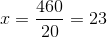
In 2012, a university received 150,249 applicants. In 2013, the same university received 190,201 applicants. By what percent did the total number of applicants increase from 2012 to 2013?
 (correct answer)


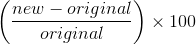
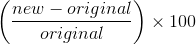
Explanation: To find the percent change, use the following formula:
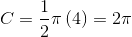
What is the perimeter of a semicircle with an area of 
 (correct answer)


Explanation: This is a multi-step problem. The perimeter of a semicircle is the sum of the circumference and diameter. First, since we are given the area, we will need to find the radius.
For the area of a semicircle:


Subtract.
 (correct answer)


Explanation: To subtract two fractions, they need to both share the same denominator. Since 81 is a multiple of 9, we only need to change the 1st fraction.

Determine the answer as a mixed number:
 (correct answer)


Explanation: 1. Find the least common denominator:
The lowest number that both 4 and 6 can go into is 12 meaning that it is the least common denominator.
2. Use the new least common denominator to create two equivalent fractions with a denominator of 12.


Billy earned 


 (correct answer)


Explanation: Billy had 


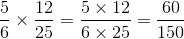
Multiply these fractions:
 (correct answer)


Explanation: When multiplying fractions, all we have to do is multiply the numerators together and multiply the denominators together:

Multiply:
 (correct answer)


Explanation: Multiply the numerators together, then multiply the denominators together.

Find the sum.
 (correct answer)


Explanation: First add the digits in the ones colume, this would be 


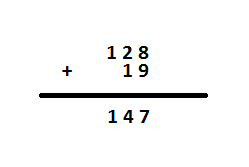
Factor the following expression completely
 (correct answer)


Explanation: First, we need to factor the numerator and the denominator separately.
To factor an expression with the form 


Kevin has won 

If each of Kevin's friends receive the same number of toys from Kevin, how many will be remaining?
 (correct answer)


Explanation: The correct answer is 2 remaining toys. Kevin has 34 toys to start and he keeps 4 for himself. This means that he has 30 toys to give to four friends.
When we divide 30 by 4, we get 7.5. Since each friend cannot get half a toy, each friend can receive 7 toys.


What is the least common denominator of the following fractions: 
 (correct answer)


Explanation: The correct answer is 36. The best way to approach this problem is to take each denominator and list out its multiples. You can then find the common multiple between each denominator. Multiples of 6: 6, 12, 18, 24, 30, 36, 42, 48 Multiples of 3: 3, 6, 9, 12, 15, 18, 21, 24, 27, 30, 33, 36, 39, 42 Multiples of 12: 12, 24, 36, 48, 60 Multiples of 36: 36, 72, 108 Multiples of 18: 18, 36, 54, 72 From the above multiples, we can see that the least common denominator is 36.
How many minutes are in a 
 minutes (correct answer)
 minutes
 minutes
 minutes
Explanation: Knowing that there are 60 minutes in an hour, multiply that amount by the total number of hours (3.5):

Solve:
 (correct answer)


Explanation: The answer is 


What is the reciprocal of 
 (correct answer)


Explanation: To get the reciprocal of a fraction, you simply switch the numerator and the denominator.
In our case our numerator is 


Convert
(correct answer)Explanation: To convert a decimal into percent, multiply the decimal by 100 and then add a "%" sign.
Round to the nearest hundredth:
 (correct answer)
 (correct answer)


Explanation: The hundredth place is the 2nd number after the decimal. Because the thousandth place is great than 5, we will need to round up to
What is 
 (correct answer)


Explanation: When terms with the same base are multiplied, multiply the coefficients together then add up all the exponents.
For the coefficients: 

Jane bought a pencil for 


 (correct answer)


Explanation: Add up all the individual items.

In March, an athlete weighed 

 (correct answer)


Explanation: The formula to find percentage change is

What is 
 (correct answer)


Explanation: Percents are numbers expressing parts of 


Lucy is a real estate agent who is paid a 


 (correct answer)


Explanation: To start, we need to convert the percent into a decimal.


Henry has taken a lot of tests this semester in his biology class. In total, he has taken 


 (correct answer)


Explanation: The mode is the number that appears most often in a set of numbers.