HSPT Mathematics
Help Questions
HSPT Math › HSPT Mathematics
What is the area of the figure below?


Explanation
To find the area of the figure above, we need to slip the figure into two rectangles.

Using our area formula, 


To find our final answer, we need to add the areas together.


Above is a target. The radius of the smaller quarter-circles is half that of the larger quarter-circles.
A blindfolded man throws a dart at the above target. Assuming the dart hits the target, and that no skill is involved, give the odds against the dart landing in the yellow region.
39 to 1
13 to 1
14 to 1
40 to 1
Explanation
Call the radius of one of the smaller quarter-circles 1 (the reasoning is independent of the actual radius). Then the area of each quarter-circle is

Each of the four wedges of one such quarter-circle has area

The yellow region is one such wedge.
The radius of each of the larger quarter-circles is 2, so the area of each is

The total area of the target is

Therefore, the yellow wedge is

of the target, and the odds against the dart landing in that region are 39 to 1.
Find the area of a square if the length is 


Explanation
The area of a square is:

Substitute the length and simplify.


What is the area of the figure below?


Explanation
To find the area of the figure above, we need to slip the figure into two rectangles.

Using our area formula, 


To find our final answer, we need to add the areas together.

A square is 9 feet long on each side. How many smaller squares, each 3 feet on a side can be cut out of the larger square?


Explanation
Each side can be divided into three 3-foot sections. This gives a total of 
Solve:


Explanation
The lowest common denominator of 2 and 7 is 14.


Find the sum of the following:


Explanation
To get the decimal from a fraction, divide the numerator by the denominator


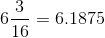

Which of the following statements demonstrates the associative property of addition?




None of the examples in the other responses demonstrates the associative property of addition.
Explanation
The associative property of addition states that to add three numbers, any two can be added first, followed by adding the sum to the third. Of the statements given, only

demonstrates this property, so it is the correct choice.
Which of the following operations is equivalent to taking of a number?
Dividing the number by

Dividing the number by

Dividing the number by

Moving the decimal point one place to the left, then doubling the result
Moving the decimal point one place to the left, then tripling the result
Explanation
Let's just pick a number at random, for example 
of this number is 


We can also work by simplifying the fractional form of . A percent can be written as the number divided by 

We can simplify this fraction: 
Either way, we get the same answer.
What is the slope of the line that passes through 


Explanation
We can use the slope formula:
