Graphing
Help Questions
Math › Graphing
True or false: The graph of 

False
True
Explanation
The vertical asymptote(s) of the graph of a rational function such as 
First, factor the numerator. It is a quadratic trinomial with lead term 

by using the grouping technique. We try finding two integers whose sum is 


Break the linear term:

Regroup:

Factor the GCF twice:


Therefore, 

Cancel the common factor 

Set the denominator equal to 0 and solve for 


The graph of 


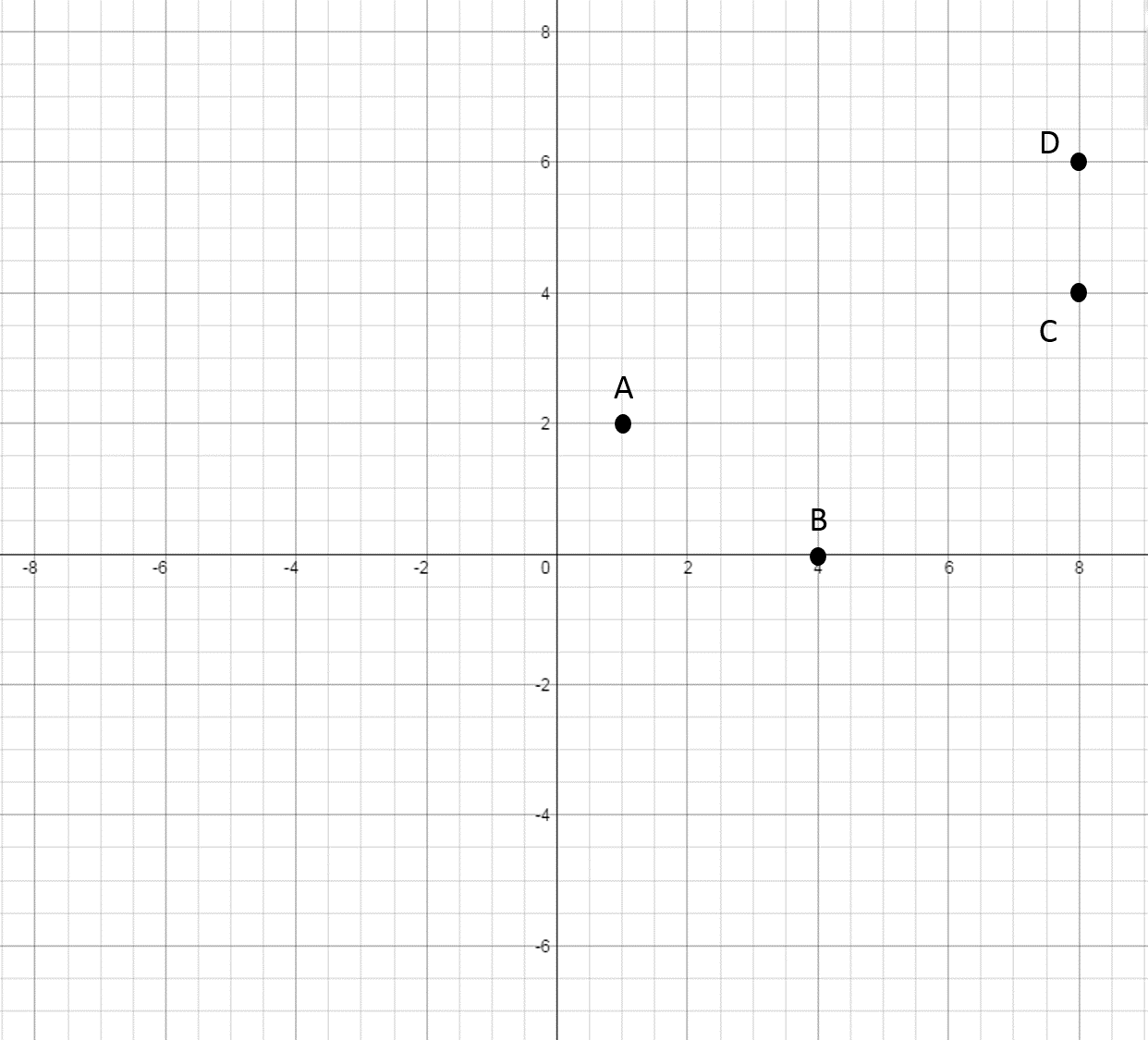
Find the point that corresponds to the following ordered pair:


Explanation
In order to get to the point 


This is point 
The points 


Explanation
A quadrant is set up in such a way that the positive numbers are to the right and top, while the negative numbers are to the left and bottom. The x-value (the first number in the ordered pair) is the distance left or right from the center. The y-value (the second number in the ordered pair) is the distance above or below the axis.


Define a function 

Give the vertical aysmptote of the graph of 
The graph of 


Explanation
Since any number, positive or negative, can appear as an exponent, the domain of the function 


Define a function 

Give the horizontal aysmptote of the graph of 


Explanation
The horizontal asymptote of an exponential function can be found by noting that a positive number raised to any power must be positive. Therefore, 


The length of line segment 



Explanation
To answer this question, we will have to manipulate the distance formula:

To get rid of the square root, we can square both sides:

and plug in the information given in the question.


At this point we can simply plug in the possible values to determine which combination of coordinates will make the equation above true.


Thus the correct coordinate is,

Give the domain of the function


The set of all real numbers


Explanation
The square root of a real number is defined only for nonnegative radicands; therefore, the domain of 


The domain of 

What is the domain of 
all real numbers


Explanation
The domain of the function specifies the values that 


Define

What is the natural domain of 


Explanation
The radical in and of itself does not restrict the domain, since every real number has a real cube root. However, since the expression 


27 is the only number excluded from the domain.
Give the domain of the function

The set of all real numbers


Explanation
The domain of any polynomial function, such as 
