Electromagnetics, Waves, and Optics
Help Questions
GRE Subject Test: Physics › Electromagnetics, Waves, and Optics
What is the total resistance of a circuit containing four resistors (


Explanation
For a circuit in series, the total resistance is simply given by the sum of each individual resistor:


A beam of light travels through a medium with index of refraction 


This situation is impossible.
Explanation
Total internal reflection occurs at the angle:

However, this angle is measured from a line normal to the plane of the interface; the angle we want, therefore, is 

A beam of light, with wavelength 

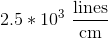
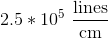


Explanation
The equation describing maxima of a diffraction grating is:

Where d is the separation of slits, which can also be expressed as:

Substituting d into the first equation and making the small angle approximation, one can solve for 

Note that the angle had to be converted from degrees to radians. Finally, the question asks for lines per centimeter, not meter, so the answer becomes 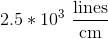
A car's horn has a frequency of 

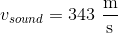


Explanation
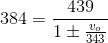
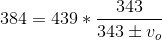
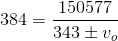
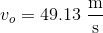
The equation for the Doppler effect with frequency for a moving source is given by:

Where 



A candle 


No image is created.
Explanation
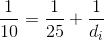
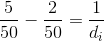
First, find the image distance 


Magnification of a lens is given by:
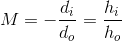
Where 


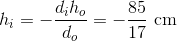
Because the sign is negative, the image is inverted.
What is the total resistance of a circuit containing four resistors (
Explanation
For a circuit in series, the total resistance is simply given by the sum of each individual resistor:
A reflective sphere has a diameter of 


Explanation
The focal length of a spherical mirror is one half of the radius, which is one quarter of the diameter. In the case of convex mirrors, the focal point is considered behind the surface, which gives the answer its negative sign.
A double slit experiment is set up with the following parameters: two slits are a separated by a distance 


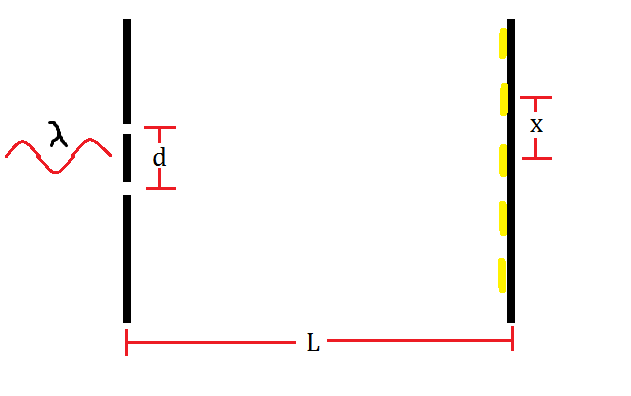


Explanation
The condition for constructive interference with double slit diffraction is given by:

Where 
Solving for the angle and using the small angle approximation, we get;
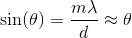
The distance 
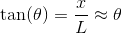
Again, with the help of the small angle approximation. Setting the two thetas equal to each other and solving for 

For the central band, 


A candle
No image is created.
Explanation
First, find the image distance
Magnification of a lens is given by:
Where
Because the sign is negative, the image is inverted.
A reflective sphere has a diameter of
Explanation
The focal length of a spherical mirror is one half of the radius, which is one quarter of the diameter. In the case of convex mirrors, the focal point is considered behind the surface, which gives the answer its negative sign.