Solutions
Help Questions
AP Chemistry › Solutions
Which of the following would most likely form a homogeneous solution?
Water and benzene (C6H6)
NaNO3 and octanol (C8H18O)
NH4Cl and water
A and B
All would form homogeneous solutions
Explanation
Like dissolves like. The NH4Cl and water mixture involves an ionic solid and a polar solvent. Examples a and b involve mixing polar/non-polar solvents and ionic and non-polar solvents.
What photon wavelength can promote a transition from the n = 1 (ground state) to the n = 3 (excited state)?
204 nm
306 nm
102 nm
408 nm
1 m
Explanation



Calculate the molar solubility of AgBr in 0.050 M AgNO3 at room temperature. The Ksp of AgBr is 5.4 x 10⁻¹³.
1.08 x 10⁻¹¹ M
2.16 x 10⁻¹¹ M
1.08 M
2.16 M
1.57 x 10⁻¹² M
Explanation


What photon wavelength can promote a transition from the n = 1 (ground state) to the n = 3 (excited state)?
204 nm
306 nm
102 nm
408 nm
1 m
Explanation
Which of the following will be the precipitate in the following reaction?
2KCl + Ca(OH)2 → 2KOH + CaCl2
Ca
Ca(OH)2
KOH
CaCl2
No precipitate forms
Explanation
Though the solubility of calcium hydroxide, Ca(OH)2, is fairly low, it is a reactant and will not form a precipitate. The solid calcium hydroxide will be added to an aqueous solution of potassium chloride, KCl. During the reaction, the calcium hydroxide will transition to potassium hydroxide (KOH) and calcium chloride (CaCl2), both of which are completely soluble. At the end of the reaction, no precipitate will be observed.
Which of the following would most likely form a homogeneous solution?
Water and benzene (C6H6)
NaNO3 and octanol (C8H18O)
NH4Cl and water
A and B
All would form homogeneous solutions
Explanation
Like dissolves like. The NH4Cl and water mixture involves an ionic solid and a polar solvent. Examples a and b involve mixing polar/non-polar solvents and ionic and non-polar solvents.
Consider the following balanced equation for the solubility of barium hydroxide in an aqueous solution.


What is the equilibrium expression for the balanced reaction?



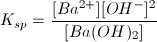
Explanation
When writing the equilibrium expression for an insoluble salt, remember that pure solids and liquids are not included in the expression. Also, the coefficients for the compounds in the balanced reaction become the exponents for the compounds in the equilibrium expression.
Given a generalized chemical reaction, we can determine the equilibrium constant expression.

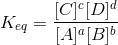
In our reaction, the reactant is a pure solid and is not included in the equilibrium calculation.


Which of the following compounds is insoluble in water?


Explanation
Unless paired with an alkali metal, carbonate compounds are generally insoluble. Compounds that contain nitrate or an alkali metal will generally be soluble in water, and hydroxides are soluble when paired with heavier alkaline earth metals (such as calcium).
Calculate the molar solubility of AgBr in 0.050 M AgNO3 at room temperature. The Ksp of AgBr is 5.4 x 10⁻¹³.
1.08 x 10⁻¹¹ M
2.16 x 10⁻¹¹ M
1.08 M
2.16 M
1.57 x 10⁻¹² M
Explanation
Which of the following compounds is insoluble in water?
Explanation
Unless paired with an alkali metal, carbonate compounds are generally insoluble. Compounds that contain nitrate or an alkali metal will generally be soluble in water, and hydroxides are soluble when paired with heavier alkaline earth metals (such as calcium).