Kites
Help Questions
Geometry › Kites
A kite has an area of 


Explanation
Let 

Recall how to find the area of a kite:

Plug in the given area and solve for 


Since we are dealing with geometric shapes, the answer must be a positive value. Thus, 
The length of the shorter diagonal is 
Find the area of a kite with diagonal lengths of 


Explanation
Write the formula for the area of a kite.

Plug in the given diagonals.
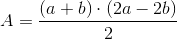
Pull out a common factor of two in 
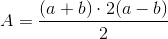

Use the FOIL method to simplify.


A kite has an area of
Explanation
Let
Recall how to find the area of a kite:
Plug in the given area and solve for
Since we are dealing with geometric shapes, the answer must be a positive value. Thus,
The length of the shorter diagonal is
Find the area of a kite with diagonal lengths of
Explanation
Write the formula for the area of a kite.
Plug in the given diagonals.
Pull out a common factor of two in
Use the FOIL method to simplify.
Two congruent equilateral triangles with sides of length 


Explanation
The shape being described is a rhombus with side lengths 1. Since they are equilateral triangles connected by one side, that side becomes the lesser diagonal, so 
The greater diagonal is twice the height of the equaliteral triangles, 
The area of a rhombus is half the product of the diagonals, so:

Two congruent equilateral triangles with sides of length
Explanation
The shape being described is a rhombus with side lengths 1. Since they are equilateral triangles connected by one side, that side becomes the lesser diagonal, so
The greater diagonal is twice the height of the equaliteral triangles,
The area of a rhombus is half the product of the diagonals, so:
If the length of the shorter diagonal is four, what is the length of the longer diagonal of this kite?


Explanation
We can find the longer diagonal by adding together the altitude of the top triangle and the altitude of the bottom triangle. To find these, use Pythagorean Theorem. We can use Pythagorean Theorem because one of the properties of a kite is that the two diagonals are perpendicular.
The top triangle has two sides of length 3 \[labeled in the picture\], and a base of 4 \[provided in the written directions\]. To figure out the altitude, split this triangle into 2 right triangles. The two legs are x \[the altitude\] and 2 \[half of the base 4\], and the hypotenuse is 3:


We will do something similar for the bottom triangle. Consider one of the right triangles. It will have a hypotenuse of 7, one leg that we don't know, x \[the altitude\], and one leg 2 \[half the shorter diagonal\]. Set up the equation using the Pythagorean Theorem:


That can be simplified by considering 45 as the product of 


Adding together the first answer of 


If the length of the shorter diagonal is four, what is the length of the longer diagonal of this kite?
Explanation
We can find the longer diagonal by adding together the altitude of the top triangle and the altitude of the bottom triangle. To find these, use Pythagorean Theorem. We can use Pythagorean Theorem because one of the properties of a kite is that the two diagonals are perpendicular.
The top triangle has two sides of length 3 \[labeled in the picture\], and a base of 4 \[provided in the written directions\]. To figure out the altitude, split this triangle into 2 right triangles. The two legs are x \[the altitude\] and 2 \[half of the base 4\], and the hypotenuse is 3:
We will do something similar for the bottom triangle. Consider one of the right triangles. It will have a hypotenuse of 7, one leg that we don't know, x \[the altitude\], and one leg 2 \[half the shorter diagonal\]. Set up the equation using the Pythagorean Theorem:
That can be simplified by considering 45 as the product of
Adding together the first answer of
If the area of a kite is 


Explanation
Let 

Recall how to find the area of a kite:

Plug in the given area and solve for 


Since we are dealing with geometric shapes, the answer must be a positive value. Thus, 
The length of the shorter diagonal is 
If the area of a kite is
Explanation
Let
Recall how to find the area of a kite:
Plug in the given area and solve for
Since we are dealing with geometric shapes, the answer must be a positive value. Thus,
The length of the shorter diagonal is