ACT Science
Help Questions
ACT Science › ACT Science
Sleep plays a vital role in defining the daily activities of virtually all animals. During periods of sleep, the parasympathetic nervous system becomes active and induces a relaxed state in response to increased levels of the hormone melatonin. Despite its ubiquity in the animal kingdom, the purpose of sleep and its role in our daily lives has been disputed by scientists. Two scientists discuss their theories about the purpose of sleep.
Scientist 1
During periods of sleep, animals are able to conserve energy that they would otherwise be spending on unnecessary activity. If an animal’s primary food source is most abundant during daylight, it is a waste of precious energy to be moving about at night. For example, many herbivores, such as squirrels, are diurnal (asleep during the night) because their food source is available during the day, while many insectivores, such as bats, are nocturnal (asleep during the day) because their food source is available during the night. Food sources, as an animal’s most valuable resource, dictate their sleep cycles. Many animal traits observable today evolved as a result of the supply and demand of food in their natural habitat.
Scientist 2
During waking hours, it is true that the body utilizes large amounts of energy; however, the role of sleep is to restore biological products that were utilized during periods of wakefulness, rather than simply to avoid utilizing energy in the first place. Many types of biological molecules, such as hormones, are released throughout the body while an animal is active. Sleep serves as a period of inactivity during which the body can manufacture and store a supply of these molecules, for future use during the next period of activity; furthermore, sleep allows the body to repair cellular damage that has accumulated during waking hours. Experimental evidence shows that when animals are deprived of sleep, their immune system quickly weakens and death rates increase. Sleep is necessary for animals to prevent accumulation of damage and to regenerate crucial biomolecules for daily life.
Studies have shown that students who sleep well the night before an exam receive better marks. Why might this be, according to the hypotheses of both scientists?
Students who sleep more have more energy and restored molecular balance.
Students who sleep less are less alert.
Students who sleep more have a better diet.
Students who sleep less start to become nocturnal.
Students who sleep more have better study habits.
Explanation
This question combines the two passage theories. "Students who sleep more have more energy and restored molecular balance" is the best answer because it reflects the viewpoints of both scientists.
A student was interested in determining the relationship between the current, voltage, and resistance in a direct circuit, such as those exemplified by batteries connected to light bulbs. The student built the circuit presented in Figure 1 using a 2 ohm resistor.
Figure 1:
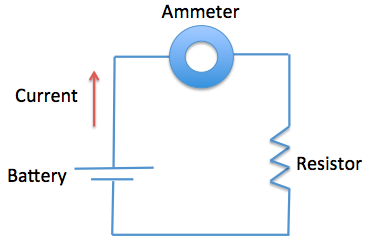
The current that flows through the circuit can be calculated using the equation 


The student used a 2 ohm resistor and batteries of various voltages to obtain the results in Table 1. The currents shown in the table are NOT calculated using the formula 

The passage and Table 1 present results with ideal batteries that do not have any internal resistance. If the batteries used were a real batteries that had internal resistance, how would the measured currents of the system change?
It would decrease.
It would increase.
It would remain the same.
It cannot be determined how current would change.
Explanation
If the batteries used in the circuit were to have additional resistance, then the overall resistance of the circuit would increase. Because we know that current and resistance are inversely related by 

A company developed new prototype car and wanted to test the new car. The car's acceleration time from 0mph to 60mph and stopping time from 60mph to 0mph were measured. An obstacle course involving a lot of turns was also constructed to determine how well the car can handle turning. The main concern of the company is the safety of the car and therefore all of the tests were performed on dry concrete, concrete after simulated rain, concrete that was covered with snow and in sand.
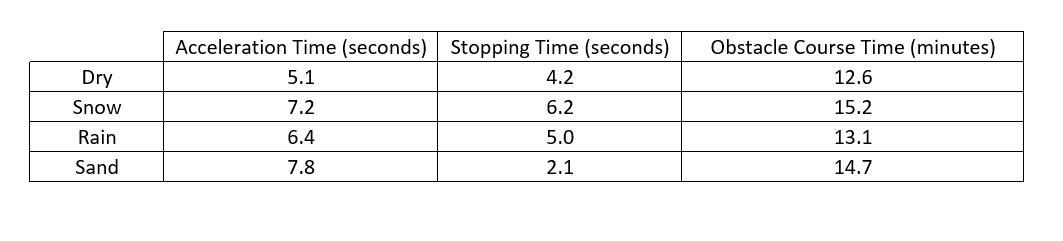
In order for the car to be safe on the roads, it is necessary for the car to have a stopping time of 4.5 seconds. What surfaces would the car not be safe on?
Rain and snow
All surfaces
Sand, snow and rain
Sand and rain
Explanation
The necessary stopping time is 4.5 seconds. When it comes to stopping time, the shorter the time the better for avoiding any hazards. Therefore the stopping times that are longer than 4.5 seconds are not safe. The rainy condition has a stopping time of 5.0 seconds and the snowy condition has a stopping time of 6.2 seconds. These two conditions are not safe when using this car.
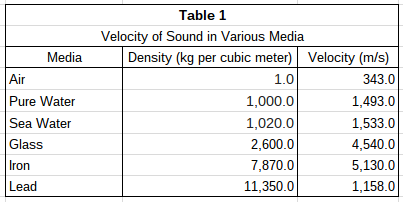
Sound waves travel through a medium by mechanically disturbing the particles of that medium. As particles in the medium are displaced by the sound wave, they in turn act upon neighboring particles. In this fashion, the wave travels through the medium through a parallel series of disturbed particles. Like in other forms of motion, the rate at which the sound wave travels can be measured by dividing the distance over which the wave travels by the time required for it to do so.
Study 1
A group of students hypothesizes that the velocity of sound is dependent upon the density of the medium through which it passes. They propose that with more matter in a given space, each particle needs to travel a shorter distance to disturb the adjacent particles. Using two microphones and a high speed recording device, the students measured the delay from the first microphone to the second. They chose a variety of media, shown in Table 1, and measured the velocity of sound through each using their two-microphone setup. The results are found in Table 1.
Study 2
The students wanted to test their hypothesis by using the same medium at different densities. To do this, they heated pure water to various temperatures and repeated the procedure described in Study 1. Their results can be found in Table 2.
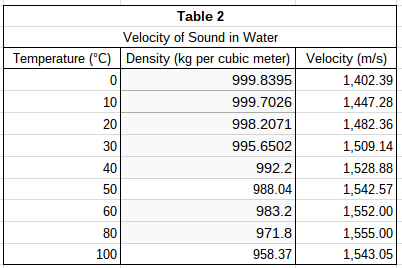
According to Study 2, water at which of the following temperatures yields the greatest velocity of sound?


Explanation
Velocities of sound in water can be found in the third column of Table 2. The highest velocity listed in the table is 1,555 m/s. Temperatures are listed in the first column; this sound velocity occurs in water that is 80°C.
Earth’s moon rotates like a satellite around Earth. It is the fifth largest moon in the Solar System and is best seen at night. The Earth’s moon is about 384,400 km from Earth and has an orbital period of twenty-seven days. Most scientists agree that the Moon formed about 4.5 billion years ago; however, there are several conflicting theories on the moon’s origin. Below two scientists discuss what they believe to be true.
Scientist 1
The Fission Theory states that the Moon and Earth were once the same formation. A part of the formation separated from Earth and became the moon. The formation that broke off to form the moon most likely came from the Pacific Ocean Basin. The rock densities of the moon are similar to the rock densities of the Earth’s mantle. This is because the part that broke off from the Earth to form the moon broke off from the outer part of the Earth’s mantle. The theory that the Moon and Earth formed separately is highly unlikely. For this theory to be true, Earth’s gravitational field would have had to pull the moon into orbit. This is unlikely because it would have required a very particular set up. Most objects that come into the Earth’s gravitational field have elliptical orbits. If the Moon was pulled into orbit with the Earth, it would have a comet-like elliptical orbit—which it does not.
Scientist 2
The Impactor Theory states that a small planet collided with the Earth just after the solar system was formed. This caused large amounts of materials from the outer shell of both planets to break off. This debris started orbiting the Earth and forming one collective body of material. That collective piece is what we now call the moon. The lunar rocks studied are burnt, implying they were heated at one time. This would make sense because when the small planet and Earth collide, the material became heated due to impact. In addition, the Moon does not have a magnetic field like Earth, but some of the rocks on the surface of the Moon hint the Moon could have had some sort of magnetic qualities at one time. This is because the Moon was partially made up of Earth’s outer rocks.
Which of the following best states the basis for the belief of Scientist 1?
The Moon was formed from a broken off piece of the Earth's mantle.
The Moon chipped off from the Earth, and was then pulled into Earth's orbit.
The Moon was formed from the fission of another planet.
The Moon was pulled into orbit with the Earth
The Moon has the exact same rock composition as the Earth.
Explanation
Scientist 1 believes that "a part of the formation separated from Earth and became the moon." Further, this piece was taken from the Earth's mantle as discussed in the sentence "the rock densities of the moon are similar to the rock densities of the Earth’s mantle."
Sleep plays a vital role in defining the daily activities of virtually all animals. During periods of sleep, the parasympathetic nervous system becomes active and induces a relaxed state in response to increased levels of the hormone melatonin. Yet, despite its ubiquity in the animal kingdom, the purpose of sleep and its role in our daily lives has been disputed by scientists. Two scientists discuss their theories about the purpose of sleep.
Scientist 1
During periods of sleep, animals are able to conserve energy that they would otherwise be spending on unnecessary activity. If an animal’s primary food source is most abundant during daylight, it is a waste of precious energy to be moving about at night. For example, many herbivores, such as squirrels, are diurnal (sleep during the night) because their food source is available during the day, while many insectivores, such as bats, are nocturnal (sleep during the day) because their food source is available during the night. Food sources, as an animal’s most valuable resource, dictate their sleep cycles. Many animal traits observable today evolved as a result of the supply and demand of food in their natural habitat.
Scientist 2
During waking hours, it is true that the body utilizes large amounts of energy. However, the role of sleep is to restore biological products that were utilized during periods of wakefulness, rather than simply avoid utilizing energy in the first place. Many types of biological molecules, such as hormones, are released throughout the body while an animal is active. Sleep serves as a period of inactivity during which the body can manufacture and store a supply of these molecules for future use during the next period of activity. Furthermore, sleep allows the body to repair cellular damages that has accumulated during waking hours. Experimental evidence shows that when animals are deprived of sleep, their immune system quickly weakens and death rates increase. Sleep is necessary for animals to prevent accumulation of damage and to regenerate crucial biomolecules for daily life.
Both scientists give evidence to support their theories. The evidence given by Scientist 1 can best be described as .
observational
quantitative
empirical
experimental
natural
Explanation
Scientist 1 gives two examples of animals that appear to follow the trends of his theory. "For example, many herbivores, such as squirrels, are diurnal . . . while many insectivores, such as bats, are nocturnal"
This evidence is strictly observational. There is no experimental set-up, quantitative or empirical data. Though the evidence is observation of animals in their natural state, observational is a commonly used classification of evidence, while natural is not, making observational the best answer choice.
In a physics class, students conducted a series of experiments by placing different objects into a beaker of water. They conducted twenty trials for each object. For each trial, they recorded whether or not the object floated.
First, they placed a steel paper clip into the water. They observed that the paper clip usually sank; however, they also saw that occasionally, the paper clip stayed afloat if it was placed very gently on top of the water. Next, they repeated the the same procedure using a cork, a toy boat made of aluminum, and a glass marble. They observed that both the cork and the toy boat always stayed afloat in the water, but that the glass marble always sank.
Below, three students give their explanations for these observations.
Student 1:
Objects float when they are less dense than the liquid in which they are immersed. For example, when immiscible liquids of varying densities are mixed together in a container, the most dense liquid will sink to the bottom of the container, while the least dense liquid will rise to the top. This same principle applies to solid objects. Because the cork and the aluminum toy boat always float, cork and the aluminum of the boat must be less dense than water. Because the glass marble always sinks, the glass of the marble must be more dense than water.
Objects that are more dense than water can also float due to surface tension. Surface tension occurs because molecules of a liquid are more attracted to each other more than they are to other objects. Molecules on the surface of water are attracted to the molecules around them and below them. This attraction causes a liquid's surface to behave if it were covered by a thin film, which resists penetration by other objects. Therefore, small objects such as paper clips can sometimes float on water when the upward force of water's surface tension exceeds the force of gravity pulling such objects down. Because the paper clips often sink and only float sometimes, we can conclude that they are indeed more dense than water, and that their floating is due to surface tension.
Student 2:
Objects float in two different cases: when they are buoyed by a liquid's surface tension or when their average density is less than that of the liquid in which they are immersed. The average density of cork is less than that of water. This is why the cork floats. In contrast, the density of glass is more than that of water. This is why the glass marble sinks.
However, the densities of aluminum and of steel are greater than that of water. Thus, density cannot be used to explain why the aluminum toy boat and the paper clip float. Both of these objects float because of surface tension. Because the paper clip does not have much mass, the normal upward force created by water's surface tension can be enough to allow it to float. Other objects with greater mass, like the toy boat, employ a particular shape to magnify the force of surface tension. The curved shape of the boat's bottom both stabilizes the boat and increases the amount of the boat's surface area that touches the water, maximizing the force due to surface tension that the boat receives.
Student 3:
In this experiment, the paper clip floats because of surface tension; however, the cork, toy boat, and marble float or sink because of their relationship to a buoyant force. All objects immersed in a liquid experience a buoyant force, which pushes them upward. The strength of this force is equal to the weight of the liquid displaced, or pushed aside, by an object. Every object also experiences a downward force due to gravity, which is measured as the object's weight, and which is directly proportional to the object's mass. When the buoyant force acting on an object is greater than the downward force due to gravity, the object floats. However, when the buoyant force is less than the force due to gravity, the object sinks. Both the cork and the aluminum toy boat are able to displace enough water to create a buoyant force that exceeds the force due to gravity, so they float. However, the glass marble does not displace enough water to create a sufficient buoyant force, so it sinks.
Paint is more dense than cooking oil; however, when a drop of paint is dripped into a container of cooking oil, it floats on top of the oil. If Student 1's explanation is correct, which of the following is most likely the reason for this observation?
The force on the drop of paint due to surface tension is greater than the force due to gravity.
The force on the drop of paint due to surface tension is less than the force due to gravity.
The buoyant force on the drop of paint is greater than the force due to gravity.
The buoyant force on the drop of paint is less than the force due to gravity.
The force on the drop of paint due to surface tension is less than the buoyant force.
Explanation
Student 1 says that objects may either float because they are less dense than water or because they rest on top of water due to the water's surface tension. Since we know that the drop of paint is more dense than water, it must float because of surface tension. According to Student 1, when something floats due to surface tension, the upward force from surface tension exceeds the downward force that gravity exerts on the drop of paint.
Laura is performing an experiment with a 5kg weight tied to a 3m rope tied to the ceiling as shown:
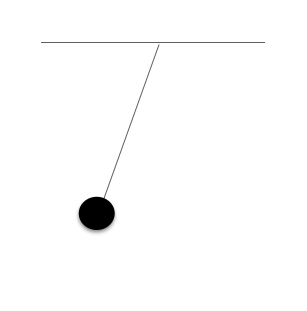
Laura drops the weight and allows it to swing freely. She measures how long it takes for the weight to return to it's original position (assume no forces outside of gravity are acting upon the pendulum). This is also called one oscillation.
Experiment 1:
Laura created the following table for her first measurement of the pendulum's oscillations.

Experiment 2:
Laura performed the experiment again, this time using a 6kg weight.
Experiment 3:
Laura performed the experiment again, this time using a 3kg weight and a 5m rope.
If Laura recreated experiment 1 using a 10kg weight, how long would 2 oscillations last?
6.949
8.972
13.898
10.212
31.416
Explanation
As shown by comparing experiment 1 and 2, the actual mass of the weight has no effect upon how long each oscillation is.
During digestion, the energy in food is converted to energy the body can use. Scientists use calorimetry experiments to measure the calories, or energy, provided by food when it is digested or burned.
The relationship used to find the heat transferred energy 



In this experiment, food was burned over a Bunsen burner under a can of 200 ml of water. The temperature change of the water and mass change of the food can be used to determine the calories in four different food items.
Table 1 shows the values of the change of mass of the food items, the change in temperature of the water and the energy. Table 2 shows the energy to mass ratio of three of those food items.
Table 1
Roasted Peanut Peanut Cracker Cheese Puff
Water Temp. Initial 23.9 °C 33.2 °C 40.3 °C 53.9 °C
Water Temp. Final 30.0 °C 40.9 °C 55.9 °C 62.8 °C
Food Mass Initial 0.69 g 0.61 g 3.21 g 1.22 g
Food Mass Final 0.38 g 0.21 g 0.91 g 0.48 g
Energy 1.22 Cal 1.54 Cal 3.12 Cal 1.78 Cal
Table 2
Sample Energy to Mass Ratio (Cal/g)
1 1.36
2 3.93
3 2.40
According to information from Tables 1 and 2, order the samples' energy to mass ratios from least to greatest.
Roasted Peanut, Cracker, Cheese Puff, Peanut
Roasted Peanut, Peanut, Cracker, Cheese Puff
Cracker, Roasted Peanut, Cheese Puff, Peanut
Peanut, Roasted Peanut, Cheese Puff, Cracker
Explanation
The order of "Roasted Peanut, Cracker, Cheese Puff, Peanut" is correct and can be found after estimating the energy of the food sample divided by the difference between the initial and final masses of the samples.
In a physics class, students conducted a series of experiments by placing different objects into a beaker of water. They conducted twenty trials for each object. For each trial, they recorded whether or not the object floated.
First, they placed a steel paper clip into the water. They observed that the paper clip usually sank; however, they also saw that occasionally, the paper clip stayed afloat if it was placed very gently on top of the water. Next, they repeated the the same procedure using a cork, a toy boat made of aluminum, and a glass marble. They observed that both the cork and the toy boat always stayed afloat in the water, but that the glass marble always sank.
Below, three students give their explanations for these observations.
Student 1:
Objects float when they are less dense than the liquid in which they are immersed. For example, when immiscible liquids of varying densities are mixed together in a container, the most dense liquid will sink to the bottom of the container, while the least dense liquid will rise to the top. This same principle applies to solid objects. Because the cork and the aluminum toy boat always float, cork and the aluminum of the boat must be less dense than water. Because the glass marble always sinks, the glass of the marble must be more dense than water.
Objects that are more dense than water can also float due to surface tension. Surface tension occurs because molecules of a liquid are more attracted to each other more than they are to other objects. Molecules on the surface of water are attracted to the molecules around them and below them. This attraction causes a liquid's surface to behave if it were covered by a thin film, which resists penetration by other objects. Therefore, small objects such as paper clips can sometimes float on water when the upward force of water's surface tension exceeds the force of gravity pulling such objects down. Because the paper clips often sink and only float sometimes, we can conclude that they are indeed more dense than water, and that their floating is due to surface tension.
Student 2:
Objects float in two different cases: when they are buoyed by a liquid's surface tension or when their average density is less than that of the liquid in which they are immersed. The average density of cork is less than that of water. This is why the cork floats. In contrast, the density of glass is more than that of water. This is why the glass marble sinks.
However, the densities of aluminum and of steel are greater than that of water. Thus, density cannot be used to explain why the aluminum toy boat and the paper clip float. Both of these objects float because of surface tension. Because the paper clip does not have much mass, the normal upward force created by water's surface tension can be enough to allow it to float. Other objects with greater mass, like the toy boat, employ a particular shape to magnify the force of surface tension. The curved shape of the boat's bottom both stabilizes the boat and increases the amount of the boat's surface area that touches the water, maximizing the force due to surface tension that the boat receives.
Student 3:
In this experiment, the paper clip floats because of surface tension; however, the cork, toy boat, and marble float or sink because of their relationship to a buoyant force. All objects immersed in a liquid experience a buoyant force, which pushes them upward. The strength of this force is equal to the weight of the liquid displaced, or pushed aside, by an object. Every object also experiences a downward force due to gravity, which is measured as the object's weight, and which is directly proportional to the object's mass. When the buoyant force acting on an object is greater than the downward force due to gravity, the object floats. However, when the buoyant force is less than the force due to gravity, the object sinks. Both the cork and the aluminum toy boat are able to displace enough water to create a buoyant force that exceeds the force due to gravity, so they float. However, the glass marble does not displace enough water to create a sufficient buoyant force, so it sinks.
Which of the following is mentioned by Student 2, but not by Students 1 or 3, as a factor that determines whether or not objects float?
the shape of the object
the size of the object
the density of water
the density of the object
Explanation
In his explanation, Student 2 says that the aluminum toy boat floats because of its shape. According to Student 2, the shape of the toy boat allows it to maximize the upward forces it experiences due to water's surface tension. Student 1 and Student 2 also mention surface tension, but neither of them mention the particular shape of an object as a factor that affects whether or not the object floats.