All questions
Question 1
You need to build a diagonal support for the bleachers at the local sportsfield. The support needs to reach from the ground to the top of the bleacher. How the support should look is highlighted in blue below. The bleacher wall is 10 feet high and perpendicular to the ground. The owner would like the support to only stick out 3 feet from the bleacher at the bottom. What is the length of the support you need to build?

- 20 ft
- 10.44 ft (correct answer)
- 109 ft
- 11.32 ft
Explanation: It is important to recognize that the bleacher, the ground, and the support form a right triangle with the right angle formed by the intersection of the bleacher wall and the ground. We know the bottom of the support should only be 3ft from the bleacher wall on the ground and the bleacher wall is 10ft high. We will use the Pythagorean Theorem to solve for the length of the support, which is the hypotenuse of this right triangle. Our base of the triangle is 3 feet and the leg is 10 feet.


 And so we need a support of 10.44 feet long.
Question 2
Change  angle to degrees.
 (correct answer)


Explanation: In order to change an angle into degrees, you must multiply the radian by  .
Therefore, to solve:
.
Therefore, to solve:

Question 3
 (correct answer)
- Undefined


Explanation: The Law of Sines is used here since we have Side - Angle - Side. We setup our equation as follows:
 Next, we substitute the known values:
 Now we cross multiply:
 Divide by 10 on both sides:
 Finally taking the inverse sine to obtain the desired angle:

Question 4
Which of the following trigonometric identities is INCORRECT?
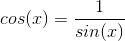 (correct answer)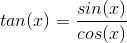
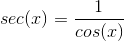
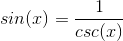
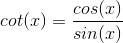
Explanation: Cosine and sine are not reciprocal functions.
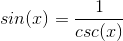 and
and 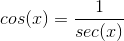
Question 5
If the cosine of an angle is negative, but the tangent is positive, what quadrant(s) does the angle lie in?
- Quadrant 3 (correct answer)
- Quadrants 3 and 4
- Quadrants 2 and 3
- Quadrant 2
- Quadrant 4
Explanation: Tangent is positive in two quadrants: quadrants 1 and 3 (where sine and cosine have the same sign as each other)
Cosine is negative in two quadrants: quadrants 2 and 3 (the left quadrants, where x is negative).
The only quadrant that shares both qualities is quadrant 3.
Question 6
 (correct answer)


Explanation: The problem gives the lengths of three sides and asks to find an angle. We can use the Law of Cosines to solve for the angle. Because we are solving for  , we use the equation:
 Substituting the values from the problem gives
 Isolating
  by itself gives

Question 7
Which of the following is true about the right triangle below?


 (correct answer)
Explanation: Since the pictured triangle is a right triangle, the unlabeled angle at the lower left is a right angle measuring 90 degrees. Since interior angles in a triangle sum to 180 degrees, the unlabeled angle at the upper left can be calculated by 180 - 60 - 90 = 30. The pictured triangle is therefore a 30-60-90 triangle. In a 30-60-90 triangle, the ratio between the hypotenuse and the shortest side length is 2:1. Therefore, C = 2A.
Question 8
Determine the quadrant that contains the terminal side of an angle  .
.
 (correct answer)


Explanation: Each quadrant represents a  change in degrees. Therefore, an angle of
  radians would pass through quadrants
  ,
,  ,
,  ,
,  and end in quadrant
  . The movement of the angle is in the clockwise direction because it is negative.
Question 9
Determine the magnitude of vector A.
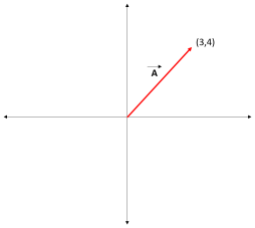

 (correct answer)

Explanation: We can use the pythagorean theorem to solve this problem. Using  as our hypotenuse, we can drop a vertical vector perpendicular to the x-axis. We will call this
  and it is 4 units in length. We can also extend a vector from the origin that connects to
  . We will call this
  and it is 3 units in length.
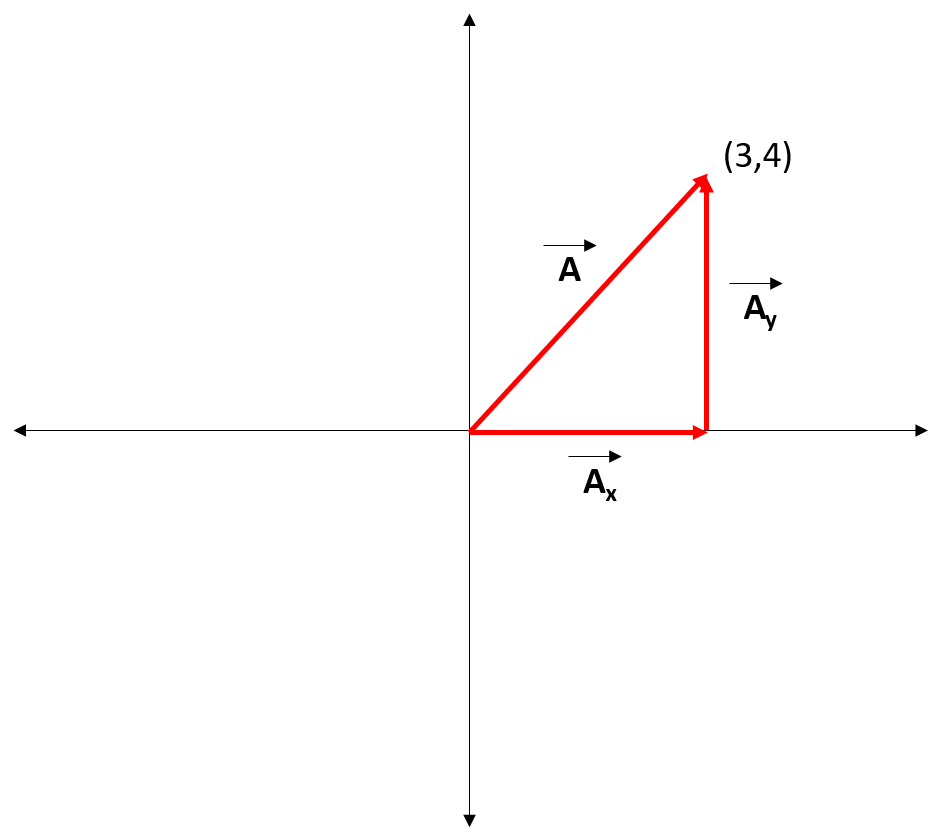 Using the pythagorean theorem:


Question 10
 (correct answer)


Explanation: By the Law of Cosines,
 or, equivalently,
 Substitute:


Question 11
Which of the following is the graph of  ?
?


 (correct answer)
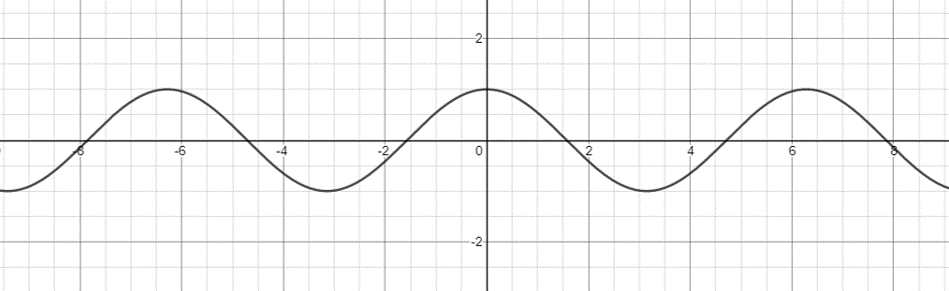
Explanation: To derive the graph of  , recall that
  . The graph of
  is
and the graph of
is
and the graph of  is
is
 Vertical asymptotes will occur in the graph of
  whenever
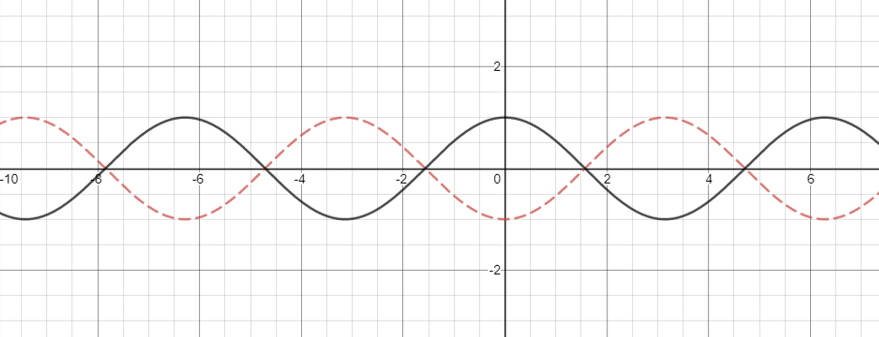
  . This is because the denominator of the tangent function will be equal to zero whenever the cosine function is equal to zero and then the entire function will be undefined at those points. Wherever cosine crosses the x-axis a vertical asymptote will occur. If we overlay the sine and cosine graphs we see the following:
 So our tangent graph will follow the same form as the sine and cosine graphs when they are increasing, but will have vertical asymptotes wherever cosine crosses the x-axis.
 And we are left with our graph of
Question 12
 (correct answer)


Explanation: Using the formula for area of a triangle equal to  , drawing
  and labelling its sides, angles, and height h, then using triangle trigonometry and substitution, we can derive the formulae
  , where R is equal to area. This can be used to find the area of a triangle when we know two of its sides and the included angle. Plugging in, we get:
 Therefore the area of this triangle is 129.2 square inches.
Question 13
Simplify the equation using identities:

 (correct answer)
- 1


Explanation: There are a couple valid strategies for solving this problem. The simplest is to first factor out  from both sides. This leaves us with:
 Next, substitute with the known identity
  to get:
 From here, we can eliminate the quadratic by converting:
 giving us
 Thus,
Thus,

Question 14
Which of the following is the correct definition of a phase shift?
- A measure of the length of a function between vertical asymptotes
- The distance a function is shifted diagonally from the general position
- The distance a function is shifted horizontally from the general position (correct answer)
- The distance a function is shifted vertically from the general position
Explanation: Take the function  for example. The graph for
  is
is
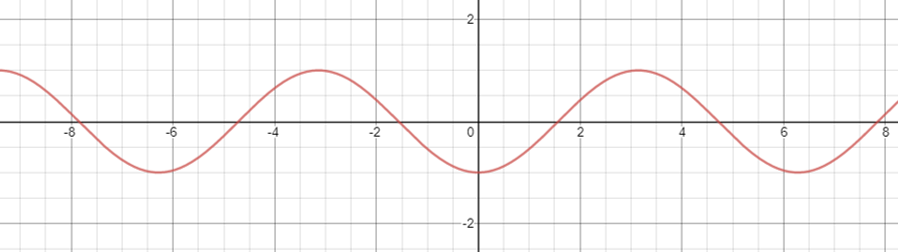
 If we were to change the function to
  , our phase shift is
  . This means we need to shift our entire graph
  units to the left.
 Our new graph
  is the following
Question 15

Find the zeros of the above equation in the interval
 .
.
 (correct answer)


Explanation: 
 Therefore,

 and that only happens once in the given interval, at
  , or 45 degrees.

Question 16
 (correct answer)


Explanation: We are given two sides of the right triangle, namely the hypotenuse and the opposite side of the angle. Therefore, we simply use the sine function to determine the angle:
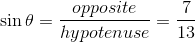 In order to isolate the angle we must apply the inverse sine function to both sides:

Question 17
What are the ways to write 360o and 720o in radians?
 (correct answer)


Explanation:  on the unit circle.
 on the unit circle.
Question 18
Convert  radians into degrees.
 (correct answer)


Explanation: Recall the definition of "radians" derived from the unit circle:
 The quantity of radians given in the problem is
  . All that is required to convert this measure into degrees is to denote the unknown angle measure in degrees by
  and set up a proportion equation using the aforementioned definition relating radians to degrees:
 Cross-multiply the denominators in these fractions to obtain:
 or
or
 .
Canceling like terms in these equations yields
.
Canceling like terms in these equations yields
 Hence, the correct angle measure of
  in degrees is
  .
.
Question 19
Use De Moivre's Theorem to evaluate  .
.


 (correct answer)
Explanation: First convert this point to polar form:


 Since this number has a negative imaginary part and a positive real part, it is in quadrant IV, so the angle is
  We are evaluating
  Using DeMoivre's Theorem:
DeMoivre's Theorem is
Using DeMoivre's Theorem:
DeMoivre's Theorem is
 We apply it to our situation to get:

 which is coterminal with
  since it is an odd multiplie

Question 20
- The area of quadrilateral
 is
is  . (correct answer)
 - The area of quadrilateral
 is
is  .
. - The perimeter of quadrilateral
 is
is  .
. - The perimeter of quadrilateral
 is
is  .
.
Explanation: Since  and
and  are perpendicular,
  is a right angle. Since no triangle can have more than one right angle, and
  is isosceles,
  must be congruent to
  . Since angle CBD is congruent to
  and
and  measures 90 degrees,
  and
and  can be calculated as follows:


 Therefore,
  and
and  are both equal to 45 degrees.
  is a 45-45-90 triangle. Therefore, the ratio between side lengths and hypotenuse
  is
is  . Anyone of the four side lengths of quadrilateral
  must, therefore, be equal to
  . To find the area of
  , multiply two side lengths:
  .
.
Question 21
Which of the following shifts are incorrect?
 (correct answer)



Explanation: The actual shift for  is
is  .
.
Question 22
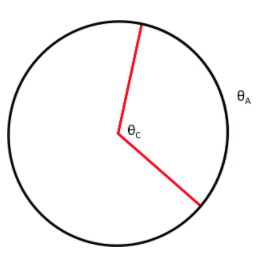
Which is true of the relationship between the arc measure and the central angle as shown below?
- They are equal (correct answer)
- The central angle is half of the arc length
- The central angle will always be a right angle
- The arc length is half of the central angle
Explanation: Every arc has a measure that is equal to the measure of the central angle that creates the arc. This is because the measure of the angle determines the distance around the circumference that the arc makes.
Question 23
Simplify the following expression using trigonometric identities:

 (correct answer)


- Can not be further reduced
Explanation: In order to simplify the given equation we should first try to determine if the Pythagorean Theorem as applicable to trigonomety can be utilized. We do this first due to the higher degree of the functions involved. We can notice that if we group the higher order sine and the higher order cosine, that we can in fact pull out some common terms:
 Now we notice that we can further group the terms:
 The first term in the previous equation is in fact the Pythagorean Theorem as applied to trigonometry and the second term is the sum of two angles with respect to the sine function:
 This reduced simply to the sum function for sine:

Question 24
Given a right triangle where  , find the missing side.
 (correct answer)


Explanation: Since the triangle in question is a right triangle we can use the Pythagorean Theorem. First, we must determine which sides we are given. Since the function we are given is cosine, we know that we are given the adjacent side and hypotenuse. Therefore, setting up the equation:
 Where,
  and
and  are given.
 Solving the above equation:
 We toss out the negative solution since the length of a side must be positive.
Question 25
Find the least positive coterminal angle to 
 (correct answer)


Explanation: To determine a coterminal angle we must add  to the original angle. In order to find the smallest positive coterminal angle, we add until we obtain the first positive angle. We first need to find the least common denominator as follows:


 ,
,  and angle
  determine the corresponding value for
 ,
,  , and
, and  find
find  to the nearest degree.


 as our hypotenuse, we can drop a vertical vector perpendicular to the x-axis. We will call this
  and it is 4 units in length. We can also extend a vector from the origin that connects to
  . We will call this
  and it is 3 units in length.


 ,
,  ,
,  and
and  . To the nearest tenth, what is
  ?
? ?
? , recall that
  . The graph of
  is
is is
is whenever
  . This is because the denominator of the tangent function will be equal to zero whenever the cosine function is equal to zero and then the entire function will be undefined at those points. Wherever cosine crosses the x-axis a vertical asymptote will occur. If we overlay the sine and cosine graphs we see the following:
 inches,
  inches, and
  .
.


 , drawing
  , where R is equal to area. This can be used to find the area of a triangle when we know two of its sides and the included angle. Plugging in, we get:
 for example. The graph for
  is
is , our phase shift is
  . This means we need to shift our entire graph
  units to the left.
 is the following
 and
and  , determine the measure of
  to the nearest degree.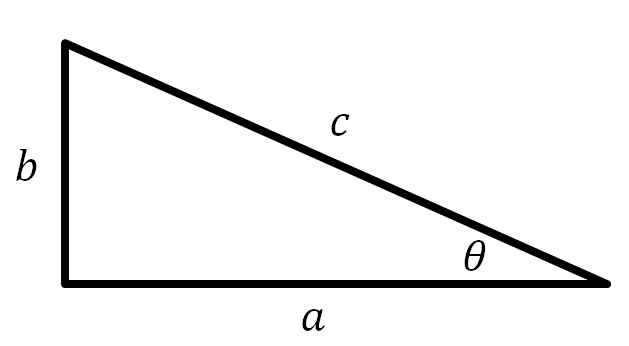


 is a diagonal of quadrilateral
  .
.  has a length of
  .
.  is congruent to
  .
.
 is
is  .
. is
is  .
. is
is  .
. is
is  .
. and
and  are perpendicular,
  is a right angle. Since no triangle can have more than one right angle, and
  is isosceles,
  must be congruent to
  . Since angle CBD is congruent to
  and
and  measures 90 degrees,
  and
and  can be calculated as follows:


 and
and  are both equal to 45 degrees.
  is a 45-45-90 triangle. Therefore, the ratio between side lengths and hypotenuse
  is
is  . Anyone of the four side lengths of quadrilateral
  must, therefore, be equal to
  . To find the area of
  , multiply two side lengths:
  .
.