Question 1 of 25
A right triangle has side lengths of 


Trigonometry
Practice Test 3 for Trigonometry: real questions and explanations from the Varsity Tutors practice-test pool.
0%
0 / 25 answered
Question 1 of 25
A right triangle has side lengths of
Question Navigator
A right triangle has side lengths of
 (correct answer)


Explanation: Similar triangles by defnition have proportional sides. We can divide corresponding parts in this case to find the scale factor.
Corresponding parts are the two smallest sides, the medium sides, and the largest sides.
Thus:


Which of the given functions has the greatest amplitude?
 (correct answer)


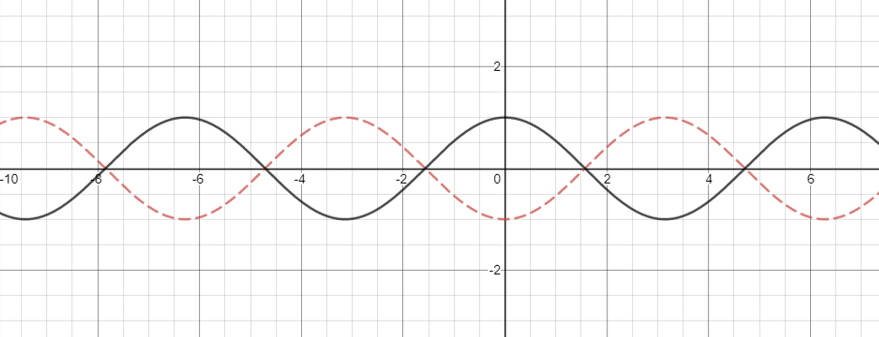
Explanation: The amplitude of a function is the amount by which the graph of the function travels above and below its midline. When graphing a sine function, the value of the amplitude is equivalent to the value of the coefficient of the sine. Similarly, the coefficient associated with the x-value is related to the function's period. The largest coefficient associated with the sine in the provided functions is 2; therefore the correct answer is 
Triangle 

What is the height of the triangle?
 (correct answer)


Explanation: An equilateral triangle has internal angles of 60°, so the sin of one of those angles is equivalent to the height of the triangle divided by the side length,

Solve for 
 (correct answer)


Explanation: First solve using the quadratic formula:


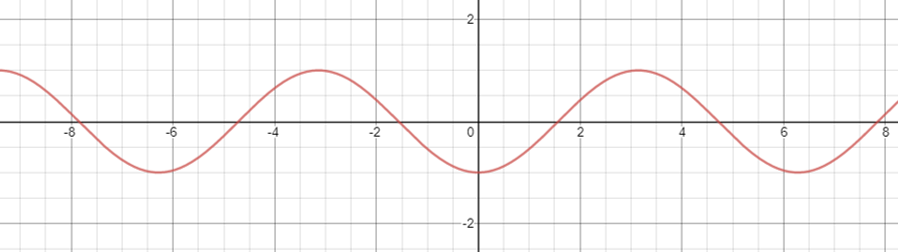
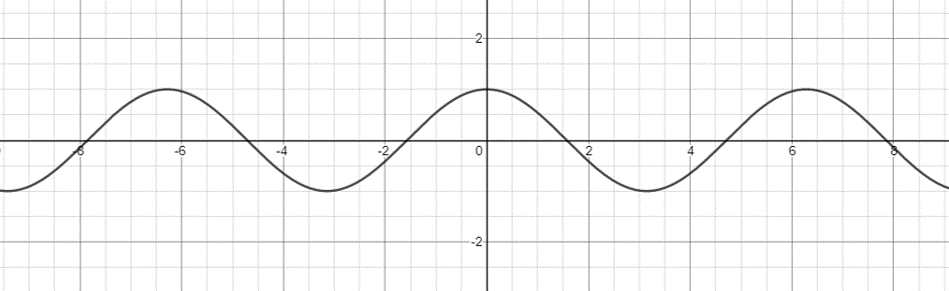
Which of the following is the graph of the inverse of 


 (correct answer)

Explanation: Note that the inverse of 


 And so the inverse of this graph must be the following with

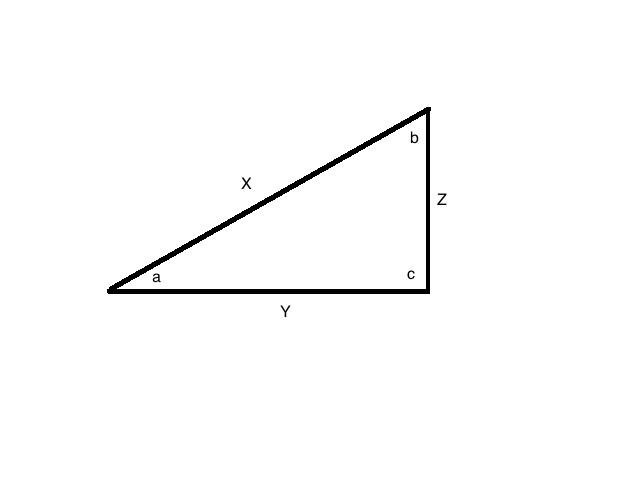
In this figure, if angle 


 (correct answer)


Explanation: Since 
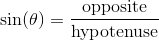


A 

 (correct answer)


Explanation: The length of the plank becomes the hypotenuse of the triangle, while the distance between the plank and the ground becomes the length of one side. To solve for the angle between the plank and the ground, you must find the value of 

Identify the phase shift of the following equation.
 (correct answer)


Explanation: If we use the standard form of a sine function


Simplify each expression below. Your answer should have (at most) one trigonometric function and no fractions.
1.
 (correct answer)


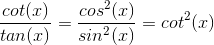
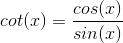
Explanation: Using the quotient identities for trig functions, you can rewrite,
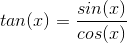
Find the exact value of the expression:
 (correct answer)


Explanation: There are two ways to solve this problem. If one recognizes the identity


If c=70, a=50, and 


 and
and 
 and
and 
Explanation: Notice that the given information is Angle-Side-Side, which is the ambiguous case. Therefore, we should test to see if there are no triangles that satisfy, one triangle that satisfies, or two triangles that satisfy this. From 


Solve the following trigonometric equation:
for
 (correct answer)


Explanation: Since 


Change 
 (correct answer)


Explanation: In order to change an angle into degrees, you must multiply the radian by 
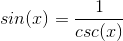
Which of the following trigonometric identities is INCORRECT?
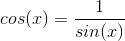 (correct answer)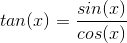
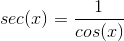
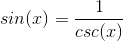
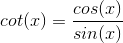
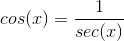
Explanation: Cosine and sine are not reciprocal functions.
If 


 (correct answer)


Explanation: The problem gives the lengths of three sides and asks to find an angle. We can use the Law of Cosines to solve for the angle. Because we are solving for 


Determine the quadrant that contains the terminal side of an angle 
 (correct answer)


Explanation: Each quadrant represents a 


In triangle 


 (correct answer)


Explanation: By the Law of Cosines,


Find the area of 


 (correct answer)


Explanation: Using the formula for area of a triangle equal to 


Which of the following is the correct definition of a phase shift?
Explanation: Take the function 




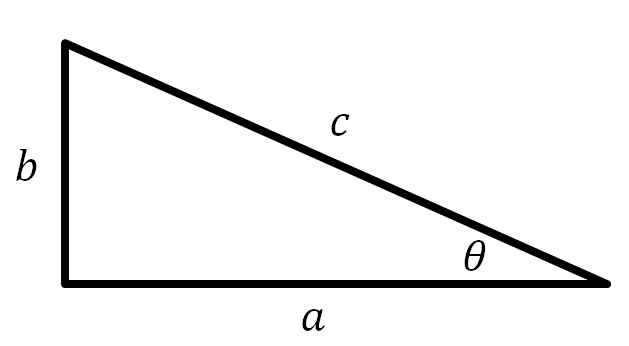
Given the accompanying right triangle where 


 (correct answer)


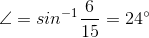
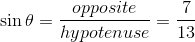
Explanation: We are given two sides of the right triangle, namely the hypotenuse and the opposite side of the angle. Therefore, we simply use the sine function to determine the angle:
Convert 
 (correct answer)


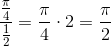
Explanation: Recall the definition of "radians" derived from the unit circle:


In the figure below, 


Which of the following is a true statement?
 is
is  . (correct answer)
 is
is  .
. is
is  .
. is
is  .
.Explanation: Since 


Which is true of the relationship between the arc measure and the central angle as shown below?
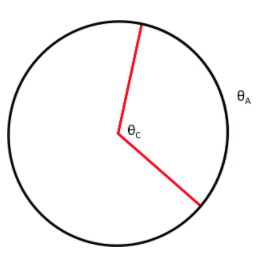
Explanation: Every arc has a measure that is equal to the measure of the central angle that creates the arc. This is because the measure of the angle determines the distance around the circumference that the arc makes.
Given a right triangle where 
 (correct answer)


Explanation: Since the triangle in question is a right triangle we can use the Pythagorean Theorem. First, we must determine which sides we are given. Since the function we are given is cosine, we know that we are given the adjacent side and hypotenuse. Therefore, setting up the equation:




Given sides 


 (correct answer)


Explanation: The Law of Sines is used here since we have Side - Angle - Side. We setup our equation as follows: