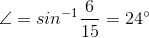
Question 1 of 25
If 


Trigonometry
Practice Test 2 for Trigonometry: real questions and explanations from the Varsity Tutors practice-test pool.
0%
0 / 25 answered
Question 1 of 25
If
Question Navigator
If
 (correct answer)


Explanation: The problem gives the lengths of three sides and asks to find an angle. We can use the Law of Cosines to solve for the angle. Because we are solving for 


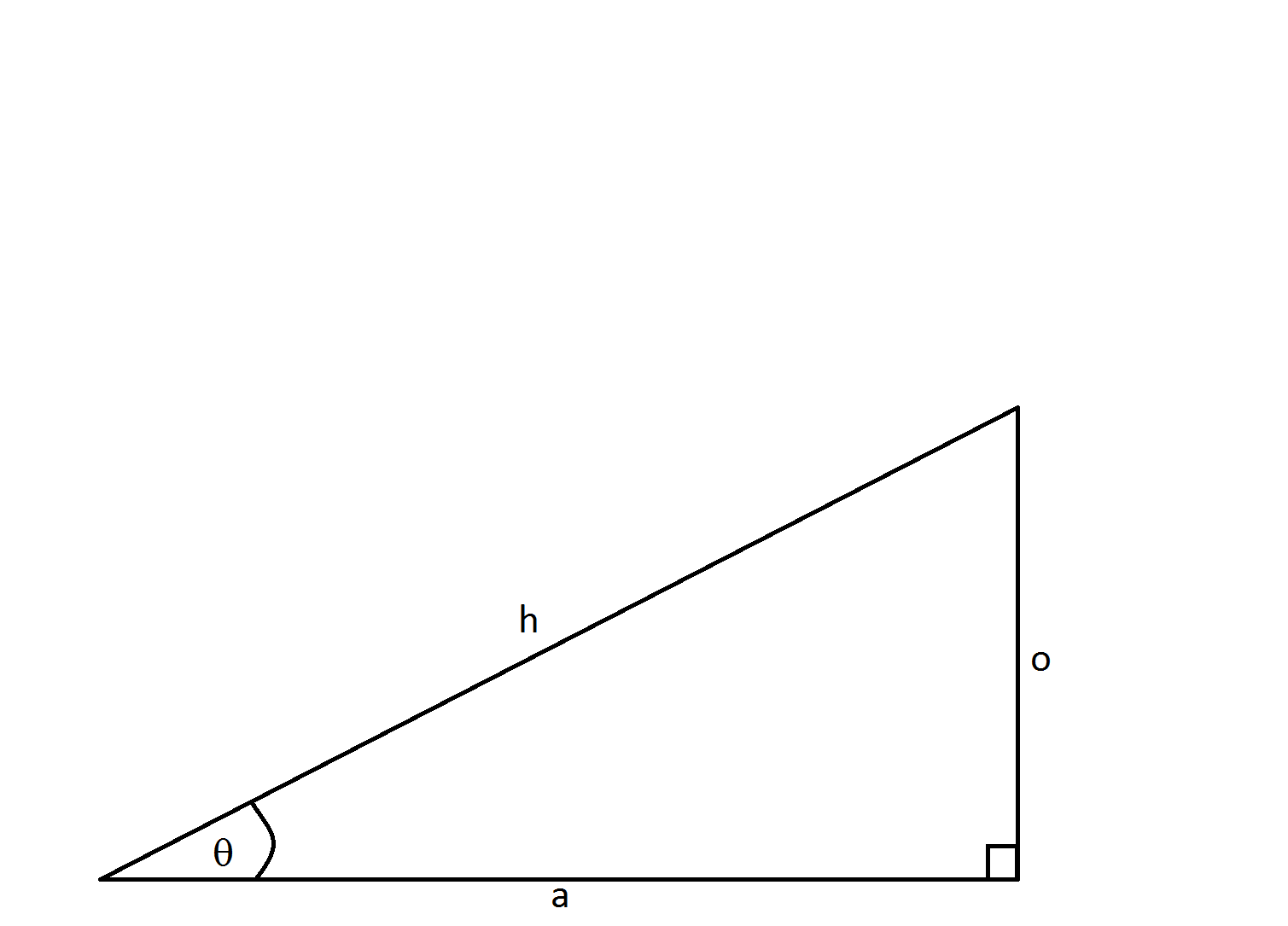
What is 


 (correct answer)


Explanation: In order to find 


Find the area of 


 (correct answer)


Explanation: Using the formula for area of a triangle equal to 


Find the value of 

 (correct answer)


Explanation: The first two things to recognize regarding our tirangle are 1) it is a right triangle and 2) it is an isosceles triangle. The two congruent sides tell us that the two non-right angles are also congruent, and a little quick math tells us that they each equal 45 degrees. This means our right triangle is not just any right triangle but a 45-45-90 triangle.
This is important because the sides of every 45-45-90 triangle follow the same ratio. The two legs are obviously always congruent to each other (being isosceles), but to find the hypotenuse, we simply have to multiply the length of a leg by 


Given the accompanying right triangle where 


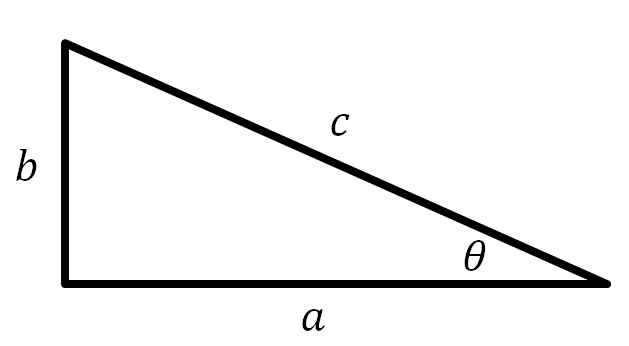
 (correct answer)


Explanation: We are given two sides of the right triangle, namely the hypotenuse and the opposite side of the angle. Therefore, we simply use the sine function to determine the angle:
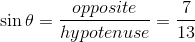
Simplify the following trigonometric function in fraction form:
 (correct answer)


Explanation: To determine the value of the expression, you must know the following trigonometric values:


A right triangle has side lengths of 


 (correct answer)


Explanation: Similar triangles by defnition have proportional sides. We can divide corresponding parts in this case to find the scale factor.
Corresponding parts are the two smallest sides, the medium sides, and the largest sides.
Thus:


Which of the following is the graph of 


 (correct answer)
Explanation: To derive the graph of 

 and the graph of
 Vertical asymptotes will occur in the graph of

 So our tangent graph will follow the same form as the sine and cosine graphs when they are increasing, but will have vertical asymptotes wherever cosine crosses the x-axis.
 And we are left with our graph of
Triangle 

What is the height of the triangle?
 (correct answer)


Explanation: An equilateral triangle has internal angles of 60°, so the sin of one of those angles is equivalent to the height of the triangle divided by the side length,

Use De Moivre's Theorem to evaluate 


 (correct answer)
Explanation: First convert this point to polar form:


Simplify the following expression using trigonometric identities:
 (correct answer)


Explanation: In order to simplify the given equation we should first try to determine if the Pythagorean Theorem as applicable to trigonomety can be utilized. We do this first due to the higher degree of the functions involved. We can notice that if we group the higher order sine and the higher order cosine, that we can in fact pull out some common terms:


A triangle has three angles 


 (correct answer)


Explanation: A triangle with a 


Which of the following completes the identity

 (correct answer)

Explanation: This formula is able to be derived directly from the identities for the sum and difference of cosines, 


Solve the following equation by squaring both sides:


 (correct answer)
Explanation: We begin with our original equation:


For which values of 


 (correct answer)


Explanation: Recall that 


Change 
 (correct answer)


Explanation: In order to change radians to degrees, we need to multiply the radian agle measure by 
Solve the following system:


Explanation: A number x is a solution if it satisfies both equations.
We note first we can write the first equation in the form :


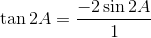
Using trigonometric identities determine whether the following is valid:


Explanation: We can choose either side to work with to attempt to obtain the equivalency. Here we will work with the right side as it is the more complex. First, we want to eliminate the negative angles using the appropriate relations. Sine is odd and therefore, the negative sign comes out front. Cosine is even which is interpreted by dropping the negative out of the equation:




Find the difference of the two vectors, 


 (correct answer)
Explanation: When finding the difference of two vectors, you must subtract the x and y components separately.


True or False: The inverse of the function 
Explanation: Consider the graph of the function 

 Now, for its inverse to also be a function it must pass the horizontal line test. This means that if a horizontal line is drawn anywhere on the graph it will only pass through one point.
 This is not true, and we can also see that if we graph the inverse of


Simplify 
 (correct answer)


Explanation: To solve this problem, make sure you set it up to multiply the entire parentheses by itself (a common mistake it to try to simply distribute the exponent 2 to each of the terms in the parentheses.)


A 

 (correct answer)


Explanation: The length of the plank becomes the hypotenuse of the triangle, while the distance between the plank and the ground becomes the length of one side. To solve for the angle between the plank and the ground, you must find the value of 

Find the zeros of the above equation in the interval

 (correct answer)


Explanation: 


The function shown below has an amplitude of and a period of .
 (correct answer)


Explanation: The amplitude is always a positive number and is given by the number in front of the trigonometric function. In this case, the amplitude is 4. The period is given by 

Given a right triangle where 
 (correct answer)


Explanation: Since the triangle in question is a right triangle we can use the Pythagorean Theorem. First, we must determine which sides we are given. Since the function we are given is cosine, we know that we are given the adjacent side and hypotenuse. Therefore, setting up the equation: