All questions
Question 1
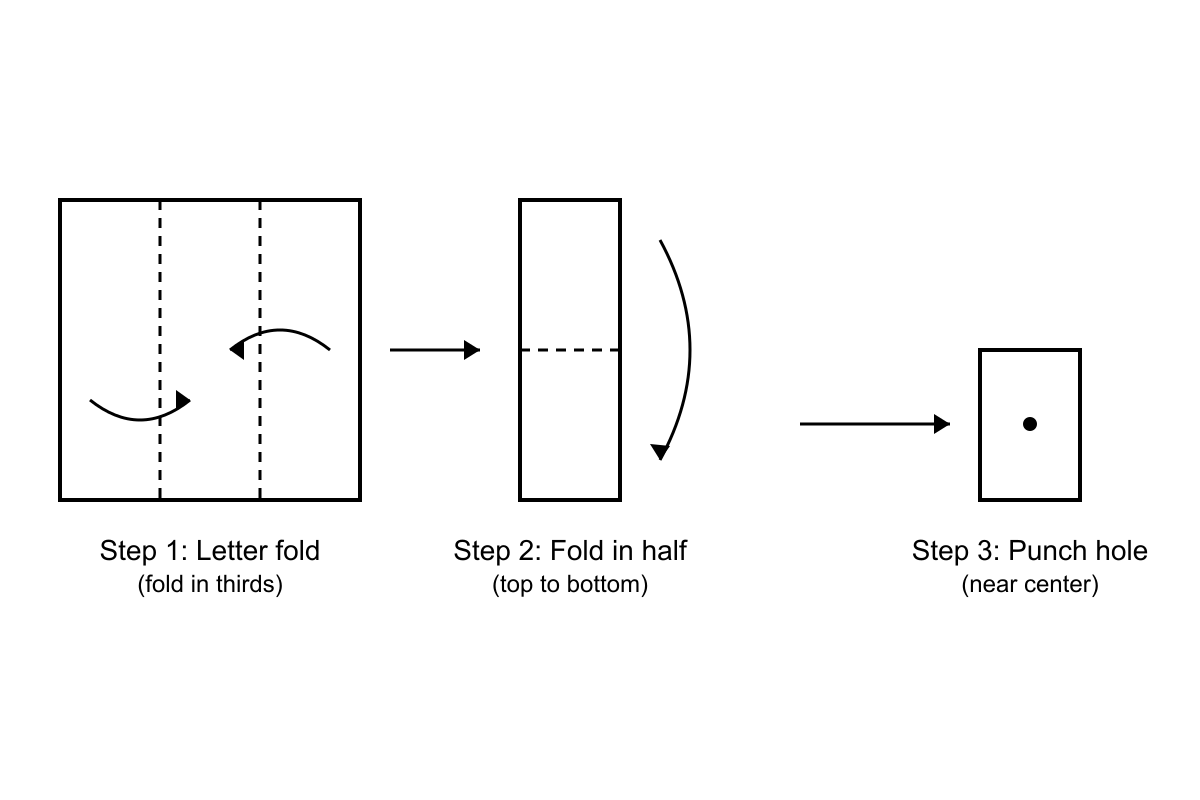
A square paper is folded in thirds (like a letter) from left to right, then folded in half from top to bottom. A hole is punched near the center of the final folded shape, as shown in the figure above. How many holes appear when unfolded?
- 4 holes
- 5 holes
- 6 holes (correct answer)
- 9 holes
Explanation: Folding in thirds creates 3 layers. Folding in half doubles that to 6 layers. A single punch through 6 layers produces 6 holes. (A) would require only halving folds (4 = 2×2). (B) cannot arise from these folds. (D) would be 3×3 — folding in thirds twice.
Question 2
Refer to the diagram above. A square paper is folded in half from top to bottom, then in half from left to right, then in half diagonally (bringing the folded corner to the opposite open corner). One hole is punched near the center of the final triangular shape. How many holes appear when unfolded?
- 4 holes
- 6 holes
- 8 holes (correct answer)
- 16 holes
Explanation: Each fold doubles the number of layers: 1 → 2 → 4 → 8 layers. One punch through 8 layers produces 8 holes. (A) counts only two folds. (B) is not a power of 2 (folding always doubles). (D) would require 4 folds.
Question 3
Refer to the figure above. A square paper is folded in half from left to right. Then the right edge of the resulting rectangle is folded back to meet the folded (left) edge, creating an accordion-style fold. A hole is punched through all layers near the top center. When unfolded, how many holes appear?
- 2 holes
- 3 holes
- 4 holes (correct answer)
- 5 holes
Explanation: The first fold creates 2 layers. The second accordion fold (folding the free edge back to meet the first fold) divides the rectangle in half again, creating 4 layers total (an accordion with 4 panels when unfolded). A single punch creates 4 holes across the paper. (A) counts only the first fold. (B) confuses accordion-fold panels. (D) overestimates.
Question 4
Refer to the figure above. A square paper is folded in half diagonally (upper-right to lower-left). A single hole is punched through both layers at the position shown. When unfolded, the two holes are located:
- On the same horizontal line, equidistant from the diagonal
- Symmetric across the diagonal fold line (mirror images across the diagonal) (correct answer)
- On the same vertical line, one above the other
- At the two ends of the diagonal fold
Explanation: A fold creates mirror symmetry across the fold line. A diagonal fold makes the two holes mirror images across the diagonal. (A) would be true only for a vertical fold. (C) would be true only for a horizontal fold. (D) is nonsensical — the holes are not at the corners.
Question 5
A square is folded in half from bottom to top, creating a rectangle. Then the top-right corner of the rectangle is folded down to touch the bottom-left corner of the rectangle (a diagonal fold). A hole is punched through all layers as shown above. When completely unfolded, how many holes appear on the paper?
- 2 holes
- 3 holes
- 4 holes (correct answer)
- It depends on whether the hole is on the folded diagonal
Explanation: The first fold creates 2 layers. The diagonal fold on the rectangle further doubles the layers to 4 (assuming the hole lies in the doubly-folded region). A punch through 4 layers gives 4 holes. (A) ignores the second fold. (B) is impossible for successive halving folds. (D) is a trap — the problem specifies the punch goes through all layers, so the count is determined.
Question 6
Refer to the figure above. A square piece of paper is folded along the diagonal from the upper-left corner to the lower-right corner, then a triangular notch is cut from the middle of the folded (diagonal) edge. When unfolded, what shape appears on the paper?
- A triangular notch on the diagonal edge only
- A diamond-shaped (rhombus) hole in the center of the paper (correct answer)
- Two separate triangular holes along the diagonal
- A square hole in the center of the paper
Explanation: When folded along the diagonal, a cut on the folded edge becomes symmetric about that diagonal when unfolded. A triangular notch cut from the folded edge mirrors across the diagonal to form a rhombus (diamond) shape in the center. (A) ignores that cuts on a fold unfold symmetrically. (C) would result if the cut were not on the fold. (D) would require a specific right-angle cut, not a generic triangular notch.
Question 7
Refer to the diagram above. A square piece of paper is folded in half from left to right, then in half from top to bottom. Two holes are punched: one in the upper-left region and one in the lower-right region of the folded square. When completely unfolded, the holes:
- Form a pattern of 4 holes that are collinear on one line
- Form a pattern of 8 holes symmetric about both center lines (correct answer)
- Form a pattern of 4 holes located near the paper's edges
- Form a pattern of 2 holes — one for each punch made
Explanation: Each punch through 4 layers produces 4 holes symmetric about both fold axes. Two punches therefore produce 2×4=8 holes, each set symmetric about the center. (A) cannot hold for 8 holes in general positions. (C) assumes incorrect hole locations. (D) ignores layer multiplication from folding. Question 8
Refer to the diagram above. A square paper is folded in half diagonally (lower-left to upper-right), then folded in half again by bringing the top corner down to the bottom corner. A hole is punched through all layers near the center of the final folded shape. How many holes appear when unfolded, and how are they arranged?
- 2 holes, symmetric across one diagonal only
- 4 holes forming a rectangle
- 4 holes, one on each of the two diagonals of the square (correct answer)
- 8 holes arranged in a circle around the center
Explanation: The first fold is along the diagonal from lower-left to upper-right. The second fold brings the top corner to the bottom corner — this fold runs along the other diagonal (upper-left to lower-right). So both diagonals are fold lines, creating 4 layers. A hole near the center produces 4 holes, symmetric about both diagonals — one along each diagonal near the center. (A) accounts for only one fold. (B) gives wrong symmetry (rectangle instead of diagonal-based). (D) overestimates the layers.
Question 9
A square piece of paper is folded in half from top to bottom. Then the resulting rectangle is folded in half from left to right. Then it is folded in half from top to bottom AGAIN. A hole is punched near the upper-right corner of the final folded shape (the all-open corner), as shown above. How many holes appear when unfolded, and where are they located?
- 8 holes arranged in a single row across the paper's top
- 8 holes forming two rows of 4, symmetric about horizontal center (correct answer)
- 4 holes positioned near each corner of the original paper
- 6 holes distributed evenly across the paper in two rows
Explanation: Three folds create 23=8 layers, so a punch gives 8 holes. The fold sequence creates symmetry about both horizontal and vertical center lines. Since the last fold was horizontal (top to bottom), and the punch was at the all-open corner, the 8 holes will form two rows of 4 holes each, symmetric about the horizontal center line. Question 10
A square piece of paper is folded in half from top to bottom, then folded in half again from left to right. Two holes are then punched through all layers: one near the folded corner and one near the opposite (all-open) corner. Refer to the diagram above showing the folds and hole positions. When the paper is completely unfolded, how will the holes appear?
- 4 holes arranged in a single row across the middle of the paper
- 4 holes forming a small square near the center of the paper
- 8 holes, with 4 near the center and 4 near the corners of the paper (correct answer)
- 4 holes, one in each corner of the paper
Explanation: Each hole is punched through 4 layers, producing 4 holes when unfolded. The hole near the folded (center) corner unfolds to 4 holes clustered around the center. The hole near the all-open corner unfolds to 4 holes, one near each corner of the paper. Total: 8 holes. (A) ignores that each punch creates 4 holes. (B) only accounts for the center-corner punch. (D) only accounts for the open-corner punch.
Question 11
Refer to the figure above. A square piece of paper is folded in half diagonally (lower-left to upper-right). A semicircular notch is cut from the middle of the hypotenuse (the fold line). When unfolded, what appears on the paper?
- A semicircular notch along the diagonal
- A complete circular hole on the diagonal (correct answer)
- Two semicircular notches on opposite edges
- A diamond-shaped hole at the center
Explanation: A semicircular cut made on a fold line (with the flat side on the fold) opens up to form a complete circle when unfolded, because the fold line becomes a line of symmetry through the middle of the circle. (A) would be the case only if the cut were on a free edge. (C) would require cuts on non-fold edges. (D) would result from a triangular cut on the fold.
Question 12
A square piece of paper is folded in half from left to right. Without unfolding, it is then folded in half from top to bottom. A small square is cut from the corner where ALL folded edges meet (the fully-folded corner), as shown above. When unfolded, what shape appears?
- A small square hole at one corner of the paper
- A small square hole at the exact center of the paper (correct answer)
- Four small square holes, one at each corner
- Two small square holes on the horizontal midline
Explanation: The corner where all folded edges meet corresponds to the center of the original square (the intersection of both fold lines). When a small square is cut from this fully-folded corner, it removes material from the center point. When unfolded, this creates one complete square hole at the exact center of the paper. (A) would result from cutting the all-open corner. (C) would result from a different fold pattern. (D) represents incorrect geometry for this fold sequence.