All questions
Question 1
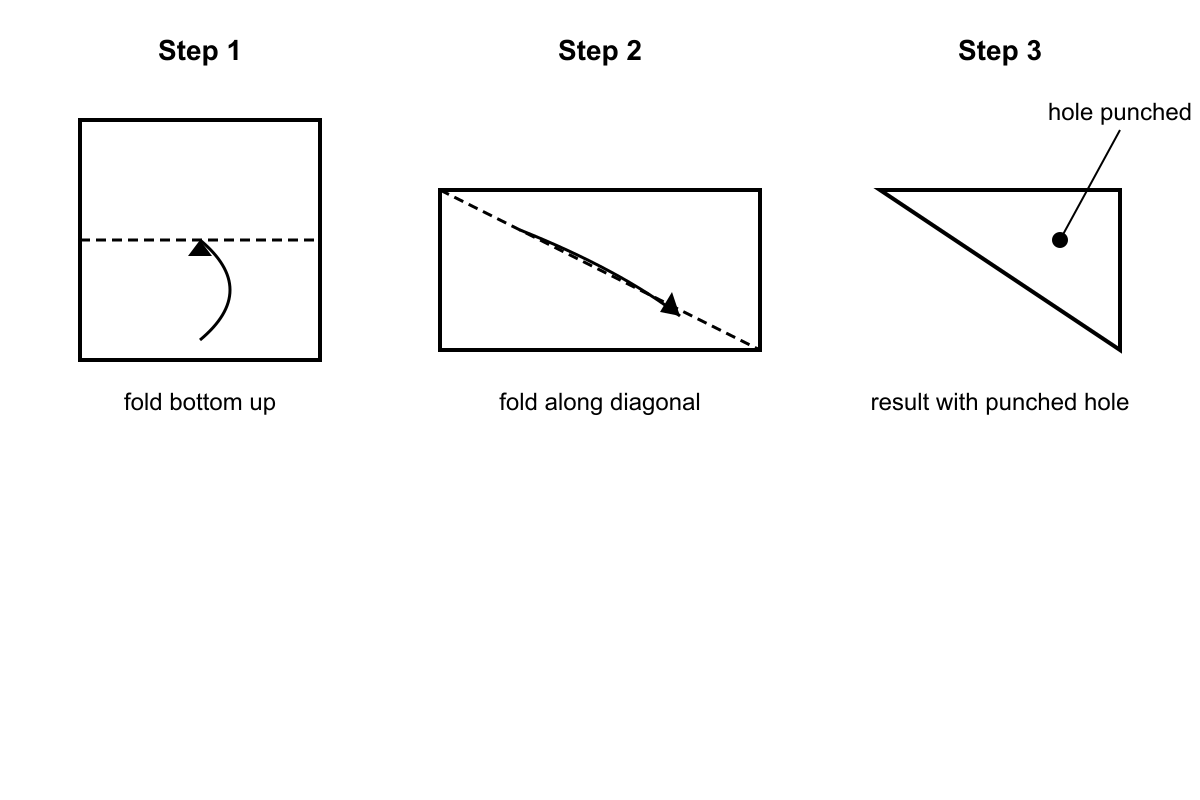
A square paper is folded in half from bottom to top. Then, the top-left corner of the resulting rectangle is folded diagonally down to meet the bottom-right corner of that rectangle. A single hole is punched near the middle of the now-overlapping region. Refer to the diagram. What pattern appears when the paper is fully unfolded?
- Two holes symmetric about the horizontal midline only
- Four holes forming a parallelogram, symmetric about the horizontal midline (correct answer)
- Three holes: two in the top half, one in the bottom half
- Four holes forming a rectangle aligned with the paper's edges
Explanation: The first fold creates 2 layers; the diagonal fold within the rectangle adds another reflection where the triangular flap overlies part of the rectangle. In the overlapped region, all 4 layers are punched. Unfolding the diagonal fold reflects the hole across that diagonal (producing an off-axis image), and unfolding the horizontal fold reflects both of those holes across the horizontal midline — producing 4 holes arranged as a parallelogram (not a rectangle, because the diagonal reflection axis is not parallel to the paper's edges). Choice A ignores the diagonal fold. Choice C miscounts layers. Choice D wrongly assumes the reflections produce an edge-aligned rectangle.
Question 2
A square piece of paper is folded in half from top to bottom, then folded in half again from left to right. A single hole is then punched through all layers near the top-right corner of the folded square. Refer to the diagram showing the folding sequence and hole position. When the paper is completely unfolded, how will the holes appear?
- Four holes, one near each corner of the original square (correct answer)
- Four holes, arranged in a small square near the center of the paper
- Two holes, both along the top edge of the paper
- Two holes, both along the right edge of the paper
Explanation: Each fold doubles the hole count. The first fold (top to bottom) places the top-right corner of the folded paper at what was the horizontal center-right of the original. The second fold (left to right) brings the corner point to a position that, when unfolded, reflects across both the horizontal and vertical midlines — producing holes in all four corners. Choice B results from mistakenly thinking the punch is near the center fold intersection. Choices C and D result from only accounting for one reflection instead of two.
Question 3
A square paper is folded in half from top to bottom. A single hole is punched through both layers, and the punch is placed EXACTLY on the bottom (folded) edge — so the hole is half above the fold line and half below it within the folded shape. Refer to the diagram. When unfolded, how does the hole appear?
- Two separate circular holes, one just above and one just below the horizontal midline
- A single circular hole centered on the horizontal midline (correct answer)
- Two circular holes far apart, one at the top edge and one at the bottom edge
- A single oval hole twice as tall as a normal punch
Explanation: When a hole is punched exactly on a fold, the two layers are punched through the SAME point on the crease. When unfolded, the two semicircular cutouts on either side of the fold align to form one complete circular hole centered on the fold (midline). Choice A is the classic error of treating each layer separately without realizing they share the fold point. Choice C confuses 'on the fold' with 'near an outer edge.' Choice D incorrectly imagines the hole stretches when unfolded.
Question 4
A rectangular piece of paper is folded once along its diagonal from the bottom-left to the top-right corner, forming a triangle. A single hole is punched near the midpoint of the hypotenuse (the folded edge). Based on the figure shown, how will the unfolded paper appear?
- Two holes, symmetric about the diagonal fold line
- One hole in the exact center of the rectangle
- Two holes, one near the bottom-left corner and one near the top-right corner
- One hole on the diagonal fold line itself (correct answer)
Explanation: The hole is punched on the folded edge itself. A hole punched exactly on a fold line produces only a single hole when unfolded, since both layers are punched at the same point on the crease. Choice A assumes the hole is off the fold line. Choice B incorrectly assumes the hole is at the paper's geometric center rather than the midpoint of the diagonal. Choice C confuses the midpoint of the hypotenuse with the endpoints.
Question 5
A square paper is folded in half from top to bottom. A hole is punched near the top edge (the OPEN edge, not the folded edge) of the folded rectangle. Refer to the diagram. Which statement correctly describes the unfolded pattern?
- Two holes near the top edge of the original square, close to each other
- Two holes near the top edge and bottom edge respectively, symmetric about the horizontal midline (correct answer)
- One hole at the top edge only
- Two holes near the horizontal midline, close to each other
Explanation: A single fold from top-to-bottom places the original top edge on top of the original bottom edge. A punch near the TOP (open) edge of the folded shape therefore goes through the original top edge AND the original bottom edge at mirror-image positions. When unfolded, one hole appears near the top edge and one near the bottom edge, symmetric about the horizontal midline. Choice A confuses the two layers with being on the same side. Choice C forgets that both layers are punched. Choice D incorrectly places the holes near the fold.
Question 6
A square paper is folded in half from right to left. Then, the resulting rectangle is folded in half from top to bottom. Finally, the upper-left corner of the small square is folded diagonally down to the opposite (lower-right) corner. A hole is punched through the center of the triangular folded result. Based on the figure, how many holes will appear in the unfolded square?
- 4
- 8 (correct answer)
- 6
- 5
Explanation: Two orthogonal half-folds create 2×2=4 layers. The diagonal fold of the resulting small square doubles this to 8 layers. A punch at the center of the triangle passes through all 8 layers (and is NOT on any fold line, since the center of the triangle is off each of the three fold creases). Therefore 8 distinct holes appear when unfolded. Choice A ignores the diagonal fold. Choice C assumes one fold intersection reduces count by 2. Choice D is an arbitrary value. Question 7
A square paper is folded in thirds accordion-style (fan fold): the left third folds forward onto the middle, then the right third folds BACKWARD behind the middle, creating a Z-shape seen from the side. A hole is punched through all three layers slightly above center. Based on the figure, when unfolded, the holes form:
- Three holes evenly spaced horizontally, all at the same vertical height (correct answer)
- Three holes in a diagonal line
- Two holes only, because one fold cancels
- Three holes, but the middle hole is vertically offset from the other two
Explanation: In a true accordion/Z-fold, each fold is a reflection, but when two folds of opposite direction are applied, every layer ends up the same height from the original bottom edge because reflection composed with reflection (at the same vertical level) preserves vertical position. The horizontal positions, however, are each in a different third. The result is three holes at the same height, one in each third, evenly spaced. Choice B incorrectly imagines a sloped pattern. Choice C misunderstands fold cancellation (folds don't cancel in position; they create multiple layers). Choice D is a plausible trap for students who forget that accordion folds preserve vertical alignment.
Question 8
A square paper is folded in thirds (left third folded over the middle, then right third folded over that, like a letter), producing a tall rectangle three layers thick. A single hole is punched through all three layers near the top of this rectangle, slightly left of center. Refer to the diagram. How do the holes appear when the paper is unfolded?
- Three holes in a horizontal row, evenly spaced across the top
- Three holes across the top; the middle and right holes equidistant from the left hole, but the right hole shifted further right
- Three holes across the top, but they are NOT evenly spaced — the right two are closer together than the left two (correct answer)
- Two holes across the top, with the middle third blank
Explanation: With a letter fold, the left third folds over first (one reflection), then the right third folds over that stack (a second reflection). The punch is 'slightly left of center' of the final rectangle. Unfolding the right flap reflects the punch about the right-third fold line; unfolding the left flap reflects the punch about the left-third fold line. Because the punch is off-center within the folded rectangle, the three resulting holes are NOT evenly spaced — the spacing on one side is larger than the other. Choice A incorrectly assumes the punch was centered. Choice B describes an impossible asymmetry. Choice D forgets that all three layers are punched.
Question 9
A square paper is folded in half from bottom to top, producing a rectangle. Then the LEFT half of that rectangle is folded forward over the right half. A single hole is punched through all layers at a position in the upper-right area of the final small square — specifically, slightly right of center and slightly above center within that small square. Refer to the diagram. Which of the following best describes the pattern of holes in the unfolded square?
- 4 holes forming a rectangle, with the rectangle's center coinciding with the center of the paper (correct answer)
- 4 holes forming a rectangle, but the rectangle is shifted to the upper-right of the paper's center
- 4 holes in an irregular quadrilateral shape
- 2 holes only, in the upper-right quadrant of the paper
Explanation: With two perpendicular half-folds (one horizontal, one vertical), there are 4 layers. Any single punch, regardless of its position within the final square, produces 4 holes arranged with point-symmetry about the CENTER of the original square — because the two folds' reflection axes are the vertical and horizontal midlines of the paper, which intersect at the paper's center. Reflecting a point across both midlines always produces a rectangle whose center is the paper's center, regardless of how off-center the original punch was within the folded shape. Choice B is the classic error: students think an off-center punch produces an off-center pattern. Choice C confuses this with non-orthogonal folds. Choice D undercounts layers.
Question 10
A square paper is folded in half diagonally (corner to opposite corner), and then folded in half again along the perpendicular bisector of the hypotenuse of the resulting triangle. A hole is punched through all layers near the right-angle vertex of the final shape. Based on the figure shown, how many holes appear when fully unfolded, and where?
- Two holes, on opposite corners of the original square
- Four holes, one near each corner of the original square (correct answer)
- Four holes, all clustered near the center of the paper
- Two holes, both on the same edge of the original square
Explanation: The first diagonal fold creates 2 layers; the second perpendicular fold creates 4 layers. The right-angle vertex of the final folded shape corresponds to a corner of the original square in one layer. Each reflection (first across the perpendicular bisector, then across the diagonal) maps that corner to a different corner of the square. The four reflections together produce one hole at each of the four corners. Choice A only accounts for the diagonal reflection. Choice C confuses corner with center. Choice D ignores that the diagonal fold sends the punch across the square.
Question 11
A square is folded in half from bottom to top, then in half again from bottom to top (an accordion-style first would differ, but here both folds are the same direction: bottom up). A hole is punched near the top-right corner of the final folded strip. Refer to the diagram. When unfolded, the holes form what pattern?
- 4 holes evenly spaced in a vertical line along the right edge
- 4 holes in a vertical line along the right edge, but NOT evenly spaced
- 2 holes on the right edge, near the top and bottom of the square
- 4 holes along the right edge, each centered within one quarter-height strip (correct answer)
Explanation: After two identical bottom-up folds, the paper is divided into 4 equal horizontal strips, all 4 layers stacked. A punch near the 'top' of the folded strip corresponds to a position that, when all fold reflections are resolved, appears at the vertical center of each of the 4 horizontal strips. This creates 4 evenly spaced holes along the right edge, each centered within its quarter-strip. Choice A incorrectly places holes at strip boundaries. Choice B introduces spacing variation that doesn't occur with uniform folds. Choice C undercounts the layers.
Question 12
A square paper is folded in half from left to right. A hole is punched so that its center is EXACTLY on the RIGHT edge of the folded rectangle (the open/free edge, not the fold). Refer to the diagram. What does the unfolded paper show?
- One hole on the left edge and one hole on the right edge of the original square
- A single hole centered on the vertical midline
- Two half-circle cutouts on the left and right outer edges of the original square (correct answer)
- One hole with an oval shape across the midline
Explanation: When the fold is on the LEFT and the punch is on the RIGHT (open) edge, the punch center is on the outer edges of both layers (which, when unfolded, correspond to the left and right outer edges of the original square). A hole punched with its center on an outer edge produces a semicircular cutout on that edge. Since both layers are punched on their respective outer edges, the unfolded paper shows a half-circle notch on the LEFT outer edge and another on the RIGHT outer edge. Choice A describes full circles, but half the circle is outside the paper. Choice B confuses 'right edge of folded' with 'the fold itself'. Choice D incorrectly merges the two cutouts.