TACHS Quiz: Perimeter And Area
12 questions · exam conditions
0:00
Perimeter And AreaQuestion 1 of 12

Use the diagram. A regular hexagon is inscribed in a circle of radius 66 cm. What is the perimeter of the hexagon?
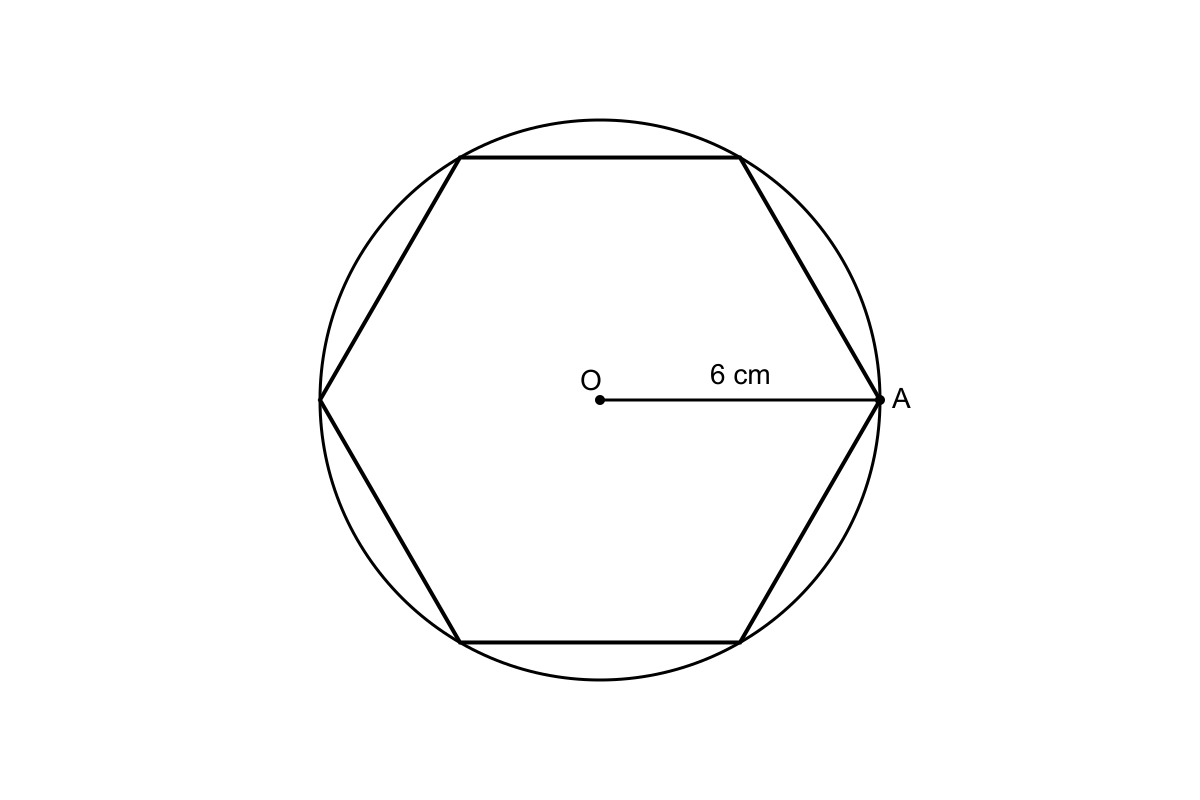
Question graphic
1818 cm
2424 cm
3636 cm
7272 cm
← Back to quizzes

TACHS Quiz

TACHS Quiz: Perimeter And Area

Practice Perimeter And Area in TACHS with focused quiz questions that help you check what you know, review explanations, and build confidence with test-style prompts.

What this quiz covers

This quiz focuses on Perimeter And Area, giving you a quick way to practice the rules, question types, and explanations that matter most for TACHS.

How to use this quiz

Try each quiz question before looking at the correct answer. Use the explanations to review missed ideas, then come back to similar questions until the pattern feels familiar.

All questions

Question 1

Use the diagram. A regular hexagon is inscribed in a circle of radius 66 cm. What is the perimeter of the hexagon?

  1. 1818 cm
  2. 2424 cm
  3. 3636 cm (correct answer)
  4. 7272 cm
Explanation: In a regular hexagon inscribed in a circle, each side equals the radius: side =6= 6 cm. Perimeter =6×6=36= 6 \times 6 = 36 cm. (A) uses 3 sides. (B) uses side 4. (D) uses side 12 (diameter).

Question 2

Refer to the diagram. A square has side length 1010 cm. Inside the square, four identical quarter-circles are drawn, each centered at a corner of the square with radius 55 cm. What is the area of the region INSIDE the square but OUTSIDE all four quarter-circles?

  1. 21.521.5 sq cm (correct answer)
  2. 5050 sq cm
  3. 78.578.5 sq cm
  4. 100100 sq cm
Explanation: Four quarter-circles of radius 55 combine to one full circle: area =π(52)=78.5= \pi(5^2) = 78.5 sq cm. Square area =100= 100. Remaining area =10078.5=21.5= 100 - 78.5 = 21.5 sq cm. (B) is 100/2100/2. (C) is the circle area alone. (D) is the square's full area.

Question 3

Refer to the figure. A rectangle measuring 1212 cm by 88 cm has a semicircle removed from one of its longer sides (the semicircle's diameter lies along the 1212-cm side and equals 88 cm). What is the area of the remaining shaded region?

  1. 70.8870.88 sq cm (correct answer)
  2. 45.7645.76 sq cm
  3. 20.8820.88 sq cm
  4. 75.4475.44 sq cm
Explanation: Rectangle area: 12×8=9612 \times 8 = 96. Semicircle radius: 8/2=48/2 = 4, area: 12πr2=12(3.14)(16)=25.12\tfrac{1}{2}\pi r^2 = \tfrac{1}{2}(3.14)(16) = 25.12. Shaded area: 9625.12=70.8896 - 25.12 = 70.88 sq cm. (B) subtracts a full circle instead of a semicircle. (C) uses radius 88 incorrectly. (D) adds instead of subtracts a quarter circle.

Question 4

Refer to the diagram. An equilateral triangle has a perimeter of 3030 cm. What is its area, to the nearest tenth? (Use 31.732\sqrt{3} \approx 1.732)

  1. 25.025.0 sq cm
  2. 43.343.3 sq cm (correct answer)
  3. 50.050.0 sq cm
  4. 86.686.6 sq cm
Explanation: Side =30/3=10= 30/3 = 10. Height =(103)/2=538.66= (10\sqrt{3})/2 = 5\sqrt{3} \approx 8.66. Area =12(10)(8.66)=43.3= \tfrac{1}{2}(10)(8.66) = 43.3 sq cm. Or use A=34s2=1.7324(100)=43.3A=\tfrac{\sqrt{3}}{4}s^2 = \tfrac{1.732}{4}(100)=43.3. (A) uses base × height/4. (C) uses half side squared. (D) omits the 12\tfrac{1}{2}.

Question 5

Use the figure. Two circles share the same center. The outer circle has radius 1010 cm and the inner circle has radius 66 cm. What is the area of the ring (annulus) between them?

  1. 12.5612.56 sq cm
  2. 25.1225.12 sq cm
  3. 50.2450.24 sq cm
  4. 200.96200.96 sq cm (correct answer)
Explanation: Area =π(R2r2)=3.14(10036)=3.14(64)=200.96= \pi(R^2-r^2)=3.14(100-36)=3.14(64)=200.96 sq cm. (A) uses (Rr)2=16(R-r)^2=16 with wrong factor. (B) uses 2π(Rr)2\pi(R-r). (C) uses (Rr)2π(R-r)^2 \pi.

Question 6

Refer to the circle shown. A circle has a circumference of 31.431.4 cm. What is its area?

  1. 15.715.7 sq cm
  2. 31.431.4 sq cm
  3. 78.578.5 sq cm (correct answer)
  4. 314314 sq cm
Explanation: Circumference =2πr= 2\pi r, so r=31.4/(23.14)=5r = 31.4/(2 \cdot 3.14) = 5 cm. Area =πr2=3.14(25)=78.5= \pi r^2 = 3.14(25) = 78.5 sq cm. (A) uses r=5r=5 but multiplies by π/2\pi/2. (B) confuses circumference with area. (D) uses r=10r=10 (diameter).

Question 7

Refer to the figure. What is the area of the rectangle?

  1. 40 cm240\text{ cm}^2 (correct answer)
  2. 26 cm226\text{ cm}^2
  3. 16 cm216\text{ cm}^2
  4. 13 cm213\text{ cm}^2
Explanation: Area of a rectangle is found with A=length×width=8 cm×5 cm=40 cm2A = \text{length}\times\text{width} = 8\text{ cm}\times5\text{ cm}=40\text{ cm}^2. B: 26 is the sum of the two sides, not the product. C: 16 comes from subtracting, not multiplying, the sides. D: 13 is half of the perimeter of the shorter sides, not the area.

Question 8

Refer to the figure. A parallelogram has a base of 1414 in and one slanted side of 1010 in that makes the slant so the height (perpendicular distance between bases) is 66 in. What is the perimeter and area of the parallelogram?

  1. Perimeter 4848 in; Area 8484 sq in (correct answer)
  2. Perimeter 4848 in; Area 140140 sq in
  3. Perimeter 4040 in; Area 8484 sq in
  4. Perimeter 6060 in; Area 140140 sq in
Explanation: Perimeter =2(14+10)=48= 2(14+10)=48 in. Area == base ×\times height =14×6=84= 14 \times 6 = 84 sq in. (B) uses slant as height. (C) miscomputes perimeter. (D) uses both wrong.

Question 9

Based on the figure shown, a right triangle has legs of length 66 and 88. A semicircle is drawn using the hypotenuse as its diameter, on the outside of the triangle. What is the total area enclosed by the triangle and semicircle combined?

  1. 39.2539.25 sq units
  2. 63.2563.25 sq units (correct answer)
  3. 73.2573.25 sq units
  4. 102.5102.5 sq units
Explanation: Hypotenuse =36+64=10= \sqrt{36+64}=10, so radius =5= 5. Triangle area =12(6)(8)=24= \tfrac{1}{2}(6)(8)=24. Semicircle area =12π(52)=12(3.14)(25)=39.25= \tfrac{1}{2}\pi(5^2) = \tfrac{1}{2}(3.14)(25)=39.25. Total: 24+39.25=63.2524+39.25=63.25. (A) is just the semicircle. (C) uses radius 1010 incorrectly. (D) uses full circle.

Question 10

Use the figure. An L-shaped figure is formed by removing a 33 ft by 44 ft rectangle from the corner of a 99 ft by 77 ft rectangle. What is the perimeter of the L-shape?

  1. 2525 ft
  2. 3232 ft (correct answer)
  3. 3939 ft
  4. 4646 ft
Explanation: The perimeter of an L-shape formed by removing a corner rectangle equals the perimeter of the original rectangle: 2(9+7)=322(9+7)=32 ft. The two cut edges replace equal-length portions of the original sides. (A) subtracts the cut. (C) adds cut lengths. (D) adds perimeter of both rectangles.

Question 11

Based on the figure, a kite has diagonals that meet at right angles. One diagonal is divided into segments of 33 cm and 99 cm, and the other diagonal has total length 88 cm. What is the area of the kite?

  1. 2424 sq cm
  2. 3636 sq cm
  3. 4848 sq cm (correct answer)
  4. 9696 sq cm
Explanation: Total length of first diagonal =3+9=12= 3+9=12. Kite area =12d1d2=12(12)(8)=48= \tfrac{1}{2}d_1 d_2 = \tfrac{1}{2}(12)(8)=48 sq cm. (A) uses only the 33-cm segment. (B) uses the 99-cm segment. (D) omits the 12\tfrac{1}{2}.

Question 12

Use the figure. A running track consists of a rectangle with a semicircle on each short end. The rectangle is 100100 m long and 6060 m wide (the short ends, which are the diameters of the semicircles). What is the total distance around the track (perimeter)? (Use π3.14\pi \approx 3.14)

  1. 188.4188.4 m
  2. 288.4288.4 m
  3. 376.8376.8 m
  4. 388.4388.4 m (correct answer)
Explanation: Perimeter =2(length)+π(diameter)=2(100)+3.14(60)=200+188.4=388.4= 2(\text{length}) + \pi(\text{diameter}) = 2(100) + 3.14(60) = 200 + 188.4 = 388.4 m. (A) is only the circular part. (B) uses one length plus circle. (C) doubles everything wrongly.