All questions
Question 1
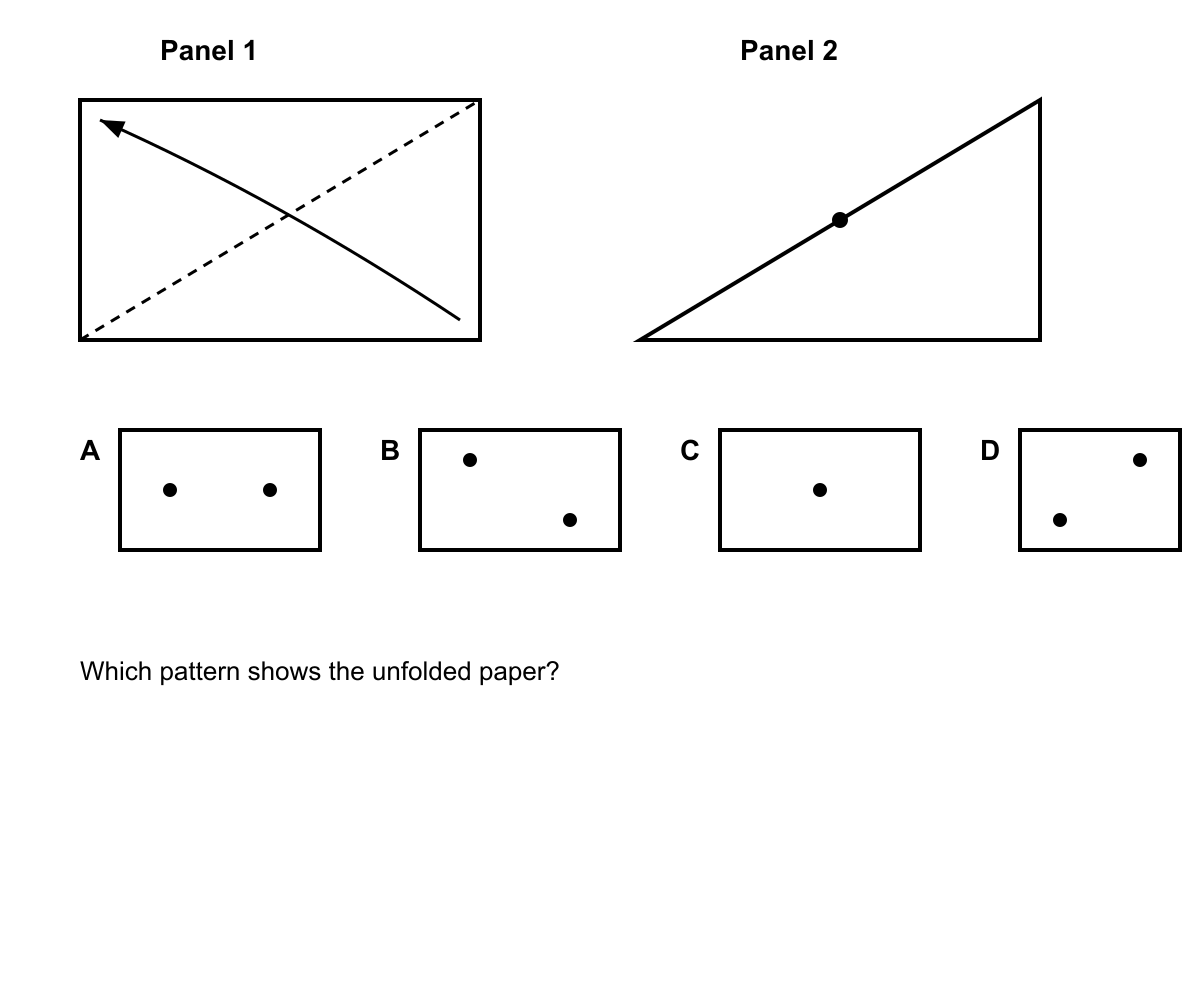
A rectangular piece of paper is folded diagonally from the bottom-left corner to the top-right corner, forming a triangle. Then a single hole is punched through both layers near the midpoint of the hypotenuse (the folded edge). Refer to the figure. Which choice shows the unfolded paper?
- A
- B
- C (correct answer)
- D
Explanation: When a hole is punched ON the fold line (the diagonal fold), the hole passes through the fold itself, producing only ONE hole when unfolded, located at the same spot. The midpoint of the hypotenuse corresponds to the center of the rectangle.
Question 2
A square piece of paper is folded in half horizontally, then folded in half vertically. A circular hole is punched through all layers near the center of the folded paper. When the paper is completely unfolded, how many holes will appear?
- Two holes arranged horizontally across the center
- Three holes forming a triangular pattern in the center
- Four holes arranged in a square pattern around the center (correct answer)
- One hole located exactly in the center of the paper
Explanation: When paper is folded in half horizontally and then vertically, it creates 4 layers. A single punch creates holes in all 4 layers. When unfolded, these appear as 4 holes arranged in a square pattern around the center. Choice A ignores the vertical fold, Choice B suggests an impossible triangular arrangement, and Choice D incorrectly assumes the holes would overlap perfectly.
Question 3
A piece of paper is folded in half twice in the same direction, creating four layers. A star-shaped hole is punched through all layers. How many star shapes appear when the paper is completely unfolded?
- Two star shapes positioned along the center line of the paper
- Three star shapes arranged in a linear pattern across the paper
- One star shape located at the center point of the paper
- Four star shapes distributed evenly across the length of the paper (correct answer)
Explanation: Paper folding problems test your spatial reasoning by asking you to visualize how cuts or punches affect multiple layers simultaneously. When you encounter these questions, think step-by-step through the folding process and imagine how each fold multiplies the number of holes created.
Let's trace through this problem systematically. You start with one sheet of paper and fold it in half twice in the same direction. The first fold creates 2 layers, and the second fold creates 4 layers total. When you punch through all 4 layers with one star-shaped hole, you're actually creating 4 separate holes - one in each layer.
Here's the key insight: when you unfold the paper, each layer's hole appears in a different position. Since the folds were made in the same direction, the holes will be distributed evenly along the length of the paper in a straight line. This gives you 4 star shapes total.
Choice A is wrong because it assumes only 2 holes appear, which would be the result of just one fold, not two. Choice B incorrectly suggests 3 holes, which doesn't match any logical folding pattern. Choice C assumes the holes would overlap perfectly when unfolded, creating just one star at the center - this would only happen if you folded the paper in different directions (like folding in half, then folding perpendicular to the first fold).
For paper folding questions on the TACHS, remember this rule: each fold doubles the number of holes created by a single punch. Two folds = 4 holes arranged linearly when the folds are in the same direction.
Question 4
A square piece of paper is folded diagonally, then folded diagonally again in the opposite direction, creating a smaller triangle. A small hole is punched through all layers. When completely unfolded, how many holes appear?
- Two holes positioned symmetrically along one diagonal of the square
- Three holes arranged in a triangular pattern in the center
- Four holes positioned symmetrically around the center of the square (correct answer)
- Eight holes distributed evenly across the entire surface of the square
Explanation: Two diagonal folds create 4 layers of paper. One punch through all 4 layers creates 4 holes that appear symmetrically around the center point when unfolded, due to the double diagonal symmetry. Choice A accounts for only one fold, Choice B suggests an impossible triangular arrangement, and Choice D incorrectly doubles the number of holes.
Question 5
A circular piece of paper is folded in half. Two small rectangular cuts are made along the folded edge, spaced apart from each other. What appears when the paper is unfolded?
- Two rectangular holes positioned along the diameter of the circle
- Four rectangular holes arranged symmetrically around the center of the circle (correct answer)
- Two rectangular holes positioned at opposite edges of the circle
- Four rectangular holes positioned randomly across the surface of the circle
Explanation: When a circular paper is folded in half and two cuts are made along the folded edge, each cut goes through both layers. This creates four holes total - two pairs of holes that are symmetrically arranged around the center. Choice A accounts for only one layer per cut, Choice C incorrectly places holes at edges, and Choice D suggests random rather than symmetric placement.
Question 6
Square folded along a diagonal. Punch at folded triangle's right-angle corner. Resulting pattern?
- 2 holes at opposite corners (correct answer)
- 1 hole at one paper corner
- 4 holes, one at each corner
- 2 holes along the diagonal
Explanation: Folding the square along a diagonal stacks two layers, and the right-angle corner of the folded triangle lands on one original corner while the layer underneath lands on the opposite corner. Punching there pierces both layers, so unfolding leaves two holes at opposite corners. The tempting mistake is thinking one hole at one corner, but the punch goes through two stacked layers.
Question 7
Square folded twice through both midlines. Punch at midpoint of an original edge of folded square. Resulting pattern?
- 4 holes along one diagonal
- 2 holes at opposite edges
- 4 holes at the four corners
- 4 holes on opposite edges (correct answer)
Explanation: Folding through both midlines stacks four layers, so the punch makes four holes. The punch is at the midpoint of an edge of the folded quarter square; unfolding reflects that point across both midlines. This places two holes on each of two opposite original edges, not at the corners. The tempting corners answer confuses the folded edge midpoint with a corner, but the holes land at quarter points of the edges.
Question 8
Square folded along a diagonal; triangle folded in half again. Punch at center of final triangle. Resulting pattern?
- 4 holes on both diagonals
- 4 holes on two center lines (correct answer)
- 2 holes on one center line
- 1 hole at the paper center
Explanation: Two folds make four layers, so the punch goes through four spots that unfold into four holes. Reflecting the punch point back across the diagonal fold and the altitude fold puts two holes on the horizontal center line and two on the vertical center line. The tempting error is to think it is a single hole at the paper center; the folded layers do not coincide there.
Question 9
Square folded vertically, then horizontally. Punch at corner where all four original corners meet. Resulting pattern?
- 4 holes, one in each corner (correct answer)
- 4 holes, one in each quadrant
- 2 holes on opposite edges
- 1 hole at the paper's center
Explanation: After the vertical fold, the two right corners lie on the left corners; after the horizontal fold, the bottom corners come up to the same spot. Punching this folded corner goes through all four layers, so when you unfold the paper, each original corner has a hole. The trap is thinking the folded corner becomes the center - but it stays at a corner, so you don't get one central hole.
Question 10
Square folded along a diagonal. Punch through center of the folded triangle. Resulting pattern?
- 1 hole at the square's center
- 2 holes along the fold line
- 2 holes on the other diagonal (correct answer)
- 4 holes forming a diamond
Explanation: Folding along a diagonal makes two layers. The point you punch is the centroid of the folded triangle, which lies on one half of the square, not at the square's center. Unfolding reflects that point across the fold line, so it appears again on the opposite half. The two points lie on the other diagonal, giving 2 holes there. The tempting wrong answer, 1 hole at the square's center, confuses the folded triangle's center with the square's center.
Question 11
A square paper is folded in thirds (left third folded to the right, then the right third folded over on top), creating three stacked layers. A single hole is punched through all three layers near the top of the folded strip. Refer to the figure. What does the unfolded paper look like?
- A (correct answer)
- B
- C
- D
Explanation: Folding in thirds creates three equal vertical panels stacked. A single punch through all three layers produces three holes when unfolded, one in each third, all at the same height (the top). Choice B ignores the middle layer. Choice C wrongly assumes misalignment. Choice D confuses the geometry entirely.
Question 12
A square paper is folded in half from left to right. Then a hole is punched near the top of the folded edge (the left edge of the resulting rectangle, which is the fold). Refer to the figure. Which answer shows the unfolded paper?
- A (correct answer)
- B
- C
- D
Explanation: When a punch is on the fold line itself, it creates a single hole (the two layers share the same point on the fold). The punch was near the top of the fold, so the unfolded hole appears at the top-center. Choice B would be correct if the hole were NEAR but not ON the fold. Choice C assumes the hole was at the open edge. Choice D misplaces the vertical position.
Question 13
A rectangular paper (taller than wide) is folded in half from bottom to top, then folded in half from bottom to top again. One hole is punched on the left edge of the folded shape, halfway up. Refer to the figure below. Which unfolded pattern is correct?
- 4 holes on the left edge of the rectangle, evenly spaced vertically. (correct answer)
- 2 holes on the left edge, top half and bottom half.
- 4 holes, 2 on the left edge and 2 on the right edge.
- 8 holes on the left edge.
Explanation: Two same-direction horizontal folds create 4 stacked layers. The left edge of the folded shape corresponds to the left edge of the original rectangle (it's never on a fold since all folds are horizontal). A single punch through 4 layers produces 4 holes, all on the left edge, evenly spaced at each quarter-height. Choice B undercounts layers. Choice C wrongly assumes a vertical fold. Choice D overcounts — there are only 4 layers, not 8.
Question 14
A square paper is folded in half from top to bottom, then in half from left to right, then in half diagonally (lower-left to upper-right of the small square). Three punches are made: one at the outermost corner (not on any fold), one on the diagonal fold near its midpoint, and one at the point where all three folds meet. Refer to the figure below. How many total holes appear on the unfolded paper?
- 8 + 4 + 1 = 13 holes. (correct answer)
- 8 + 8 + 8 = 24 holes.
- 8 + 2 + 1 = 11 holes.
- 4 + 2 + 1 = 7 holes.
Explanation: Three folds produce 8 layers. A punch OFF all folds: 8 holes. A punch ON exactly one fold (the diagonal): halves the count to 4 holes. A punch ON all three folds (their common point, which is the center): only 1 hole. Total = 8 + 4 + 1 = 13. Choice B forgets that on-fold punches don't duplicate across that fold. Choice C over-reduces the diagonal punch (the other two folds still reflect it, giving 4 not 2). Choice D undercounts layers throughout.
Question 15
A rectangular paper is folded in half vertically, then a semicircular cut is made starting from the folded edge and ending at the folded edge. What shape appears when the paper is unfolded?
- A complete circular hole positioned in the center of the rectangle (correct answer)
- Two semicircular holes positioned side by side in the rectangle
- An oval-shaped hole stretching across the width of the rectangle
- A semicircular hole located along one edge of the rectangle
Explanation: When paper is folded vertically and a semicircular cut is made from the folded edge back to the folded edge, the cut creates a semicircle through both layers along what becomes the center line when unfolded. The two semicircular cuts align to form one complete circular hole in the center. Choices B and D don't account for proper alignment, while Choice C suggests an incorrect oval shape.
Question 16
A square paper is folded diagonally in half, creating a triangle. A circular hole is punched near one corner of the triangle. When unfolded, what is the resulting pattern?
- Two circular holes positioned symmetrically across the diagonal fold line (correct answer)
- One circular hole located at the corner of the original square
- Four circular holes arranged in a diamond pattern around the center
- Two circular holes positioned adjacent to each other near one corner
Explanation: A diagonal fold creates symmetry across the diagonal line. When a hole is punched through both layers of the folded triangle, unfolding reveals two holes that mirror each other across the diagonal fold line. Choice B suggests no duplication occurred, Choice C implies multiple folds that didn't happen, and Choice D incorrectly positions the holes.
Question 17
A piece of paper is folded in half horizontally. A heart-shaped cut is made that touches both the folded edge and the open edge. What appears when the paper is unfolded?
- Two heart shapes positioned symmetrically across the horizontal center line
- One heart shape located in the center of the paper
- Two heart shapes positioned vertically along one side of the paper
- A symmetrical pattern resembling a double heart or butterfly shape (correct answer)
Explanation: When you encounter paper folding problems, visualize the symmetry that results when cuts are made through folded paper. The key principle is that any cut made through folded paper will create a mirror image when unfolded.
In this problem, the paper is folded horizontally, creating a crease that acts as a line of symmetry. When you make a heart-shaped cut that touches both the folded edge (the crease) and the open edge, you're cutting through both layers of paper simultaneously. Upon unfolding, this single cut creates two connected pieces that mirror each other across the fold line.
Since the heart touches the folded edge, the two resulting shapes remain connected at that point, creating a symmetrical double heart or butterfly-like pattern. The original heart shape essentially reflects across the horizontal fold line, producing a design that's symmetrical both horizontally and vertically.
Answer choice A is incorrect because it suggests two separate heart shapes rather than one connected symmetrical pattern. Answer choice B is wrong because a single cut through folded paper cannot produce just one isolated shape—it must create symmetrical elements. Answer choice C is incorrect because the symmetry occurs across the horizontal fold line, not vertically along one side.
The correct answer is D because it accurately describes the connected, symmetrical pattern that results from this type of fold-and-cut operation.
Strategy tip: For paper folding questions, always consider the fold line as your axis of symmetry and remember that cuts create mirror images, not separate identical shapes.
Question 18
A rectangular piece of paper is folded in half along its length. A small triangular cut is made along the folded edge. What pattern appears when the paper is unfolded?
- A single triangular hole along one long edge of the rectangle
- A diamond-shaped hole located in the center of the rectangle (correct answer)
- Two triangular holes positioned symmetrically along opposite long edges
- Two triangular holes positioned adjacent to each other along one edge
Explanation: Paper folding questions test your spatial reasoning and ability to visualize symmetry. When you encounter these problems, think about how cuts made on folded paper create mirror images when unfolded.
Let's trace through this step-by-step. When you fold a rectangular paper in half along its length, you're bringing the two long edges together. The fold line runs parallel to the short edges, creating a crease down the middle of the rectangle. Now, when you make a triangular cut along this folded edge, you're actually cutting through both layers of paper simultaneously at the center line.
Here's the key insight: when you unfold the paper, that single triangular cut becomes two triangular cuts that mirror each other across the fold line. Since the fold was along the length and positioned at the center, these two triangular cuts will meet at their points, forming a diamond shape right in the middle of the rectangle.
Choice A is wrong because cutting along the folded edge (which is at the center) won't create a hole along the outer edge. Choice C incorrectly assumes the holes appear along the outer long edges, but remember — you cut along the folded edge, not the outer edges. Choice D suggests the holes are adjacent along one edge, but this ignores the symmetrical nature of paper folding entirely.
For spatial reasoning questions on the TACHS, always mentally "unfold" the paper step by step. Remember that any cut made through folded layers will create symmetrical patterns, and the position of cuts on the folded paper determines where they'll appear when unfolded.