All questions
Question 1
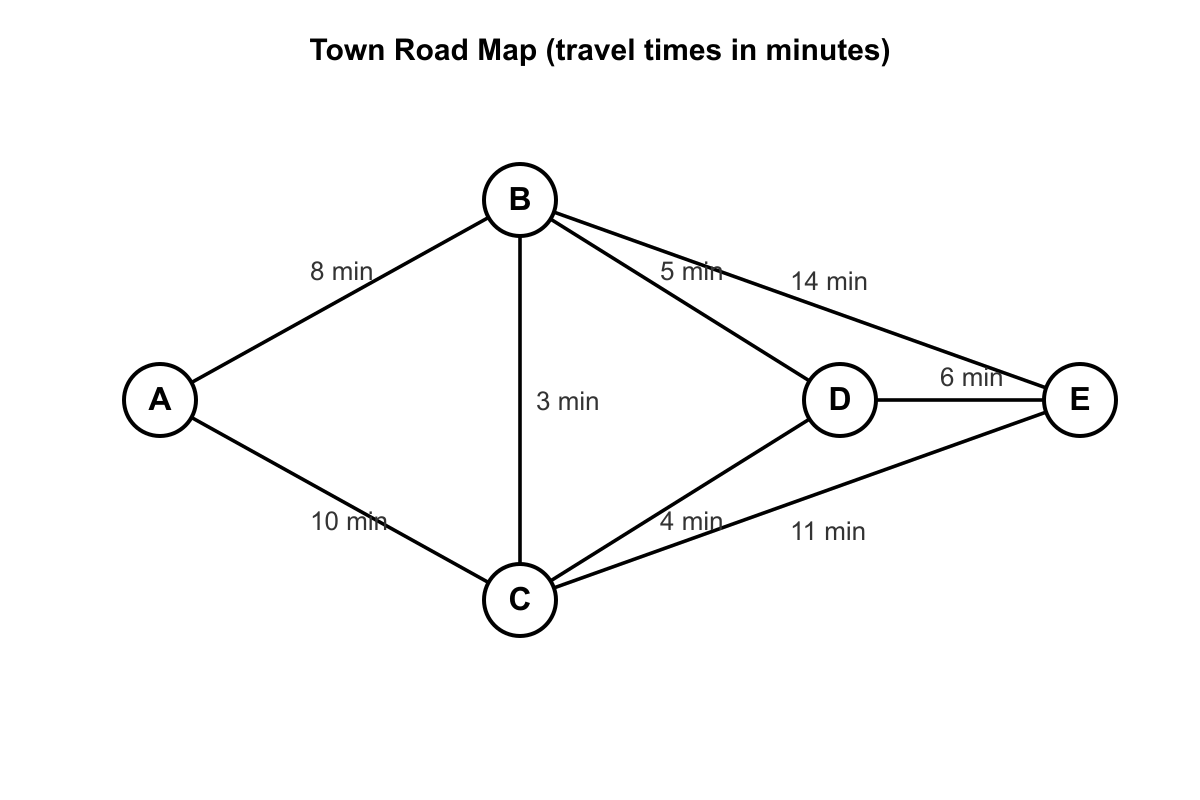
The map below shows the travel times in minutes between five towns along direct roads. Using the map, what is the shortest total travel time from Town A to Town E?
- 17 minutes
- 19 minutes (correct answer)
- 21 minutes
- 23 minutes
Explanation: Possible routes from A to E: A→B→E = 8+14 = 22; A→C→E = 10+11 = 21; A→B→D→E = 8+5+6 = 19; A→C→D→E = 10+4+6 = 20; A→B→C→D→E = 8+3+4+6 = 21. The shortest is A→B→D→E at 19 minutes. A=17 comes from missing the B→D segment. C=21 is A→C→E, a plausible near-optimal route. D=23 is A→B→C→E.
Question 2
Based on the pie charts below showing yearly spending, which sector is projected to shrink next year?
- Housing
- Food
- Transportation
- Entertainment (correct answer)
Explanation: Housing, food, and transportation all grew each of the last three years, while entertainment has decreased consistently. Therefore entertainment is the only sector projected to shrink if the trend holds. The other sectors trend upward.
Question 3
Based on the grid pattern shown, which of the cells labeled W, X, Y, Z contains the figure that breaks the established rule?
- W
- X
- Y (correct answer)
- Z
Explanation: The established rule from the example cells is: the number of dots inside each figure equals the number of sides of the outer shape minus 2. Cell W: pentagon (5 sides) with 3 dots (5-2=3) ✓. Cell X: hexagon (6 sides) with 4 dots (6-2=4) ✓. Cell Y: square (4 sides) with 3 dots, but should have 2 dots (4-2=2). This breaks the rule. Cell Z: triangle (3 sides) with 1 dot (3-2=1) ✓.
Question 4
Let a # b = a+b if a is even, else a-b. What is 8 # (9 # 3)?
- 12
- 20
- 2
- 14 (correct answer)
Explanation: Evaluate inside the parentheses first: 9 is odd, so 9 # 3 = 9 - 3 = 6. Then 8 is even, so 8 # 6 = 8 + 6 = 14. The trap is treating 9 # 3 as 9 + 3 = 12; that would give 20, but odd a means subtraction.
Question 5
Next term: 3, 4, 10, 33, 136, ?
- 685 (correct answer)
- 680
- 684
- 544
Explanation: Multiply each term by 1, 2, 3, 4, 5 and add 1, 2, 3, 4, 5: 3 x 1 + 1 = 4, 4 x 2 + 2 = 10, 10 x 3 + 3 = 33, 33 x 4 + 4 = 136, so 136 x 5 + 5 = 685. The tempting wrong answer is 680 because it multiplies by 5 but forgets to add the 5.
Question 6
Scrambled word code: '3 8 1'=fox chases hare; '8 5 2'=hare hides fast; '3 6 4'=fox runs near. Code for chases?
- 1 (correct answer)
- 3
- 8
- 4
Explanation: First and third statements both contain fox, and the only code they share is 3, so fox = 3. First and second both contain hare, and the only code they share is 8, so hare = 8. That leaves 1 in '3 8 1' for chases. Don't pick 3: it is fox, not chases.
Question 7
- G
- F (correct answer)
- E
- H
Explanation: The gaps shrink by one each time: Z to X is -2, X to U is -3, U to Q is -4, Q to L is -5, so next is L - 6 = F. The tempting mistake is to guess G by using a constant -5, but the step size grows each move.
Question 8
Maps: 2->5, 3->10, 4->17, 5->26. What is 6->?
- 35
- 36
- 37 (correct answer)
- 38
Explanation: Each pair is the input squared plus one: 2 squared + 1 = 5, 3 squared + 1 = 10, and so on, so 6 squared + 1 = 37. The trap is 36, which is just 6 squared, but every listed output includes the extra 1.
Question 9
Look at the geometric figures. Which letter must replace the question mark to continue the perimeter code?
- G
- H (correct answer)
- I
- J
Explanation: Each shape is coded by converting the number of sides to a letter using A=1, B=2, C=3, D=4, E=5, etc. Triangle (3 sides) = C+2 = E, square (4 sides) = D+2 = F, pentagon (5 sides) = E+2 = G, hexagon (6 sides) = F+2 = H. The pattern adds 2 to the alphabetical position of the number of sides.
Question 10
Based on the graph shown, what is the most reasonable prediction for the number of books that will be sold in May?
- 60
- 100
- 120
- 160 (correct answer)
Explanation: The bars double each month: Jan 10, Feb 20, Mar 40, Apr 80. Doubling 80 gives 160 for May. The other options either add a fixed amount or do not continue the doubling pattern.
Question 11
Look at the sequence of dot arrangements in the figure below. How many dots will be in the 8th arrangement?
- 64
- 72 (correct answer)
- 80
- 92
Explanation: Each arrangement follows the pattern where the nth figure has n rows and (n+1) columns of dots. Figure 1: 1×2 = 2 dots, Figure 2: 2×3 = 6 dots, Figure 3: 3×4 = 12 dots, Figure 4: 4×5 = 20 dots. The pattern is n(n+1) dots in the nth figure. Therefore, the 8th arrangement will have 8×9 = 72 dots.
Question 12
Look at the matrix of figures below. Which figure completes the 3×3 grid in the empty cell?
- A circle with 3 vertical stripes
- A triangle with 3 horizontal stripes
- A triangle with 3 vertical stripes (correct answer)
- A square with 3 vertical stripes
Explanation: Two independent rules operate: (1) In each row, the shape cycles circle→square→triangle. (2) In each column, the stripe orientation cycles horizontal→diagonal→vertical, and the stripe count increases 1→2→3. The missing cell is row 3, column 3: shape = triangle, stripe orientation = vertical, stripe count = 3. A keeps the wrong shape. B uses horizontal stripes (correct for row, wrong for column). D uses the wrong shape (square is for column 2).
Question 13
Study the analogy diagram. Which figure completes the analogy in the blank position?
- An upward-pointing arrow inside a pentagon
- A downward-pointing arrow inside a hexagon (correct answer)
- A rightward-pointing arrow inside a hexagon
- A leftward-pointing arrow inside a pentagon
Explanation: The first pair shows: left-arrow-in-square → right-arrow-in-pentagon (arrow reverses direction; outer shape gains one side). Applying the same rule to up-arrow-in-pentagon gives down-arrow-in-hexagon — choice B. A reverses neither. C changes shape correctly but only rotates 90° rather than 180°. D reverses direction but doesn't add a side.