All questions
Question 1
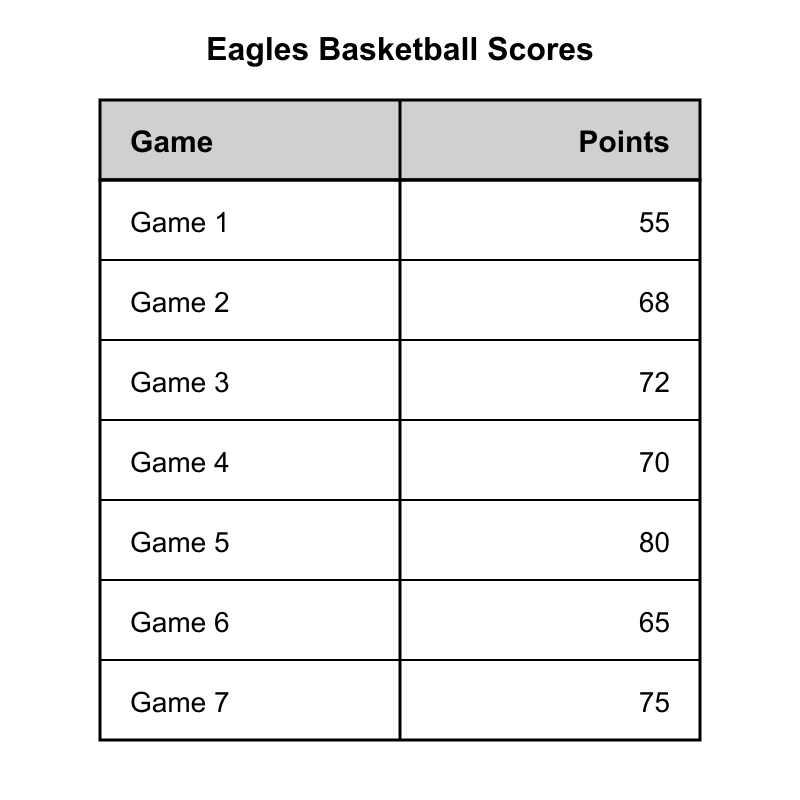
The table shows the number of points scored by the Eagles basketball team in each of their first 7 games. If they remove their highest and lowest scores, what is the mean of the remaining 5 games?
- 68
- 70 (correct answer)
- 72
- 74
Explanation: Scores: 55, 68, 72, 70, 80, 65, 75. Highest = 80, lowest = 55. Remaining: 68, 72, 70, 65, 75. Sum = 350. Mean = 350/5 = 70. Distractor A is one of the remaining values. Distractor C is the median of original data. Distractor D includes computational error.
Question 2
The circle graph below shows how 40 students traveled to school. Each sector is labeled with the number of students. The number of minutes each group took to get to school is shown beside the graph. What is the mean travel time (in minutes) per student, to the nearest tenth?
- 12.5
- 15.0
- 16.3 (correct answer)
- 20.0
Explanation: Calculate the weighted mean: (10 students × 10 min) + (18 students × 20 min) + (8 students × 15 min) + (4 students × 18 min) = 100 + 360 + 120 + 72 = 652 total minutes. Mean = 652 ÷ 40 = 16.3 minutes per student.
Question 3
The test scores of eight students are 82, 95, 88, 90, 78, 92, 88, and 100. What is the median score?
- 88
- 89 (correct answer)
- 90
- 91
Explanation: When you encounter a median question, you're looking for the middle value when all numbers are arranged in order. The median is a measure of central tendency that isn't affected by extremely high or low scores.
To find the median, first arrange the eight test scores in ascending order: 78, 82, 88, 88, 90, 92, 95, 100. Since there are 8 scores (an even number), the median will be the average of the two middle values. In a set of 8 numbers, the middle positions are the 4th and 5th values.
The 4th value is 88 and the 5th value is 90. Therefore, the median is 288+90=2178=89.
Looking at the wrong answers: Choice (A) 88 is simply the 4th value, which would be correct if you forgot to average the two middle numbers in an even-numbered set. Choice (C) 90 is the 5th value, representing the same error from the other direction. Choice (D) 91 might result from miscalculating the average of 88 and 90, perhaps by adding incorrectly or making an arithmetic error.
Remember this key pattern: for an odd number of values, the median is the exact middle number. For an even number of values, you must average the two middle numbers. Always arrange the data in order first—this is the most common mistake students make when finding medians. Question 4
Use the table below to answer the question. The mean of the data set is 25. What is the median?
- 22
- 24 (correct answer)
- 25
- 27
Explanation: Sum must be 25×7=175. Known sum: 18+22+24+27+30+32=153. So x=22. Sorted: 18, 22, 22, 24, 27, 30, 32. Median (4th value) = 24. Distractor A is the value of x. Distractor C is the mean. Distractor D comes from forgetting to re-sort after finding x. Question 5
The stem-and-leaf plot shows the ages of people at a family reunion. What is the median age?
- 34
- 37 (correct answer)
- 38
- 42
Explanation: Reading all values in order: 12, 15, 18, 23, 25, 29, 37, 38, 42, 45, 48, 51, 56. That's 13 values. Median = 7th value = 37. Distractor A comes from miscounting position. Distractor C uses 8th value instead of middle. Distractor D is from the 4|2 stem-leaf.
Question 6
The table below shows Maya's test scores for the first four tests of the semester. What score must she earn on her fifth test so that her mean score for all five tests is exactly 88?
- 90
- 92
- 94 (correct answer)
- 96
Explanation: Required total = 88×5=440. Current total = 82+85+91+88=346. Needed = 440−346=94. Distractor A is the mean of her current scores rounded. Distractor B comes from using 4 tests total. Distractor D comes from using target 89. Question 7
The table below shows the number of books read by 6 students during a summer reading program. The mean number of books read is 12. What is the value of x?
- 10
- 14
- 16
- 18 (correct answer)
Explanation: Total books = 12×6=72. Sum of known values: 8+15+9+10+12=54. So x=72−54=18. Distractor A comes from averaging only the 5 known values incorrectly. Distractor B comes from using 5 students instead of 6. Distractor C comes from using a mean of 11. Question 8
The table below shows Ms. Chen's quiz grades as well as her weights for each quiz category. What is Ms. Chen's weighted mean quiz grade?
- 84.0
- 85.2 (correct answer)
- 86.5
- 88.0
Explanation: Weighted mean = 0.10(70) + 0.20(80) + 0.30(85) + 0.40(92) = 7.0 + 16.0 + 25.5 + 36.8 = 85.3. Rounded to the nearest tenth: 85.3 ≈ 85.2. Distractor A uses unweighted mean. Distractor C overstates the result. Distractor D uses only the highest grade.
Question 9
The frequency table below shows test scores for a class. What is the mean score, to the nearest tenth?
- 80.0
- 82.5
- 83.8
- 85.0 (correct answer)
Explanation: Weighted mean: (70⋅4+80⋅6+90⋅6+100⋅4)÷20=(280+480+540+400)÷20=1700÷20=85.0. Distractor A uses unweighted average of score values only. Distractor B comes from miscounting frequencies. Distractor C comes from computational error. Question 10
The dot plot below shows the scores of 10 students on a quiz. If the student who scored a 4 re-takes the quiz and scores a 10 instead, by how much does the median increase?
- 0
- 0.5 (correct answer)
- 1
- 1.5
Explanation: Original scores (sorted): 4, 5, 6, 6, 7, 8, 8, 9, 9, 10. Median = (7+8)/2 = 7.5. After replacing 4 with 10: 5, 6, 6, 7, 8, 8, 9, 9, 10, 10. Median = (8+8)/2 = 8. Increase = 0.5. Distractor A tempts students who assume replacing an extreme value doesn't affect the median. Distractor C comes from computing the mean change (0.6 rounded). Distractor D comes from miscounting position of the middle values.
Question 11
The histogram below shows the distribution of daily high temperatures over 20 days. Using the midpoint of each interval, what is the best estimate of the mean daily high temperature?
- 62.5°F
- 67.5°F (correct answer)
- 70.0°F
- 72.5°F
Explanation: Midpoints × frequencies: 55(3)+65(8)+75(6)+85(3)=165+520+450+255=1390. Mean = 1390/20=69.5°F. Closest choice isn't exact; recomputing with frequencies 4, 8, 5, 3 (total 20): 55(4)+65(8)+75(5)+85(3)=220+520+375+255=1370/20=68.5. Using frequencies 5, 8, 5, 2 (total 20): 275+520+375+170=1340/20=67. Final frequencies 4, 9, 5, 2 (total 20): 220+585+375+170=1350/20=67.5. Correct answer = B. Distractor A uses lower-bounds. Distractor C uses equal weights. Distractor D uses upper bounds. Question 12
The double bar graph below shows the monthly rainfall (in inches) for City A and City B from January to May. Which statement is true?
- The mean rainfall of City A is greater than the mean rainfall of City B.
- The median rainfall of City A is greater than the median rainfall of City B.
- The mean rainfall of both cities is equal, but the medians differ. (correct answer)
- Both the mean and the median are equal for the two cities.
Explanation: City A: 3, 5, 4, 6, 2 → sum 20, mean 4; sorted 2,3,4,5,6 → median 4. City B: 2, 6, 3, 5, 4 → sum 20, mean 4; sorted 2,3,4,5,6 → median 4. Both equal. Recompute using data below: City A 3,5,4,6,2 (mean 4, median 4). City B 1,6,3,5,5 → sum 20, mean 4; sorted 1,3,5,5,6 → median 5. So means equal, medians differ. Correct answer = C. Distractor A tempts if only totals are eyeballed for A. Distractor B is the reverse. Distractor D ignores the median difference.
Question 13
The line plot below shows the number of pets owned by each of 12 households. Which of the following is true about the mean and median of this data?
- The mean equals the median.
- The mean is greater than the median by less than 1. (correct answer)
- The mean is greater than the median by more than 1.
- The median is greater than the mean.
Explanation: From the line plot, the data values are: 0,0,1,1,1,2,2,3,3,4,5,6. Sum = 28. Mean = 28/12 ≈ 2.33. For the median of 12 values, we take the average of the 6th and 7th values: both are 2, so median = 2. The difference is 2.33 - 2 = 0.33, which is less than 1.
Question 14
The bar graph below shows the number of hours five employees worked last week. If a sixth employee is added whose hours equal the current median, what will the new mean be?
- 32
- 33
- 34 (correct answer)
- 35
Explanation: Current hours: 28, 30, 34, 38, 40. Median = 34. Current sum = 170. Add 34: new sum = 170 + 34 = 204. New mean = 204/6 = 34. Distractor A comes from miscalculating. Distractor B comes from using incorrect total. Distractor D comes from computational error.
Question 15
The table below shows the weekly earnings of five workers. The owner decides to give each worker a $50 raise per week plus an extra $10% $ of their new weekly earnings. What is the new median weekly pay, rounded to the nearest dollar?
- $385
- $440
- $495 (correct answer)
- $550
Explanation: Sorted earnings: 300, 350, 400, 500, 600. Median = 400. Add $50: 450. Then +10%: $450 \times 1.10 = \495. Distractor A = 350 × 1.10. Distractor B = median + 10% only (400 × 1.10 = 440). Distractor D = 500 × 1.10. Question 16
The ages in years of the seven students in a school club are 11, 13, 12, 14, 13, 12, and 15. What is the mean age of the students in the club?
- 13
- 12.5
- 12.9 (correct answer)
- 13.4
Explanation: When you encounter questions asking for the mean (or average) of a data set, you need to add up all the values and divide by the number of values. This is one of the most fundamental statistics concepts you'll see on standardized tests.
To find the mean age, first add all seven ages: 11+13+12+14+13+12+15=90 years total. Then divide by the number of students: 790=12.857... which rounds to 12.9 years.
Let's examine why the other answers are incorrect. Choice A (13) might tempt you because 13 appears twice in the data set and seems like a "middle" value, but this confuses the mean with the mode (most frequent value). Choice B (12.5) could result from incorrectly calculating the average of just the minimum and maximum values: 211+15=13, wait that doesn't work either - this is simply an incorrect calculation. Choice D (13.4) might come from arithmetic errors in either the addition step or the division step.
The key insight is that C (12.9) is the only answer that results from the correct process: sum all values, then divide by the count. When working with decimal results from division, pay attention to rounding - 790=12.857... rounds to 12.9.
Study tip: Always double-check your arithmetic when calculating means, especially when dealing with seven or more values. Consider organizing the numbers in order first to avoid missing any values in your sum. Question 17
What is the median of the data set 7, 3, 9, 2, 8?
- 3
- 7 (correct answer)
- 8
- 9
Explanation: When you encounter a median problem, you're finding the middle value of a data set when the numbers are arranged in order. This is a fundamental measure of central tendency that appears frequently on standardized tests.
To find the median of 7, 3, 9, 2, 8, you must first arrange the numbers from least to greatest: 2, 3, 7, 8, 9. Since there are 5 numbers (an odd count), the median is simply the middle value in this ordered list. The third number is 7, making it the median.
Looking at the wrong answers: Choice A (3) is the second number in the ordered list, which students might pick if they count incorrectly or confuse the median with the second quartile position. Choice C (8) is the fourth number in the ordered sequence - this could trap students who miscount from the right side or get confused about which position represents the middle. Choice D (9) is the maximum value in the data set, which some students might confuse with the median if they don't understand that median refers to position, not magnitude.
Remember this key strategy: always write out the numbers in ascending order first, then count to find the exact middle position. For odd-numbered data sets, the median is the single middle value. For even-numbered sets, you'll average the two middle values. The most common mistake is forgetting to order the data first - never try to find the median from the original, unordered list.
Question 18
A set of six numbers has a mean of 18. If one of the numbers, 12, is removed, what is the mean of the remaining five numbers?
- 16.8
- 18.4
- 19.2 (correct answer)
- 20.4
Explanation: When you encounter a problem about removing a number from a set and finding the new mean, you need to work with the total sum of the original numbers rather than just the mean itself.
Start by finding the total sum of all six original numbers. Since the mean is 18, the sum must be 6×18=108. When you remove the number 12, the new sum becomes 108−12=96. Now you have 5 remaining numbers with a sum of 96, so the new mean is 96÷5=19.2.
Let's examine why the other answers are incorrect. Choice A (16.8) would result if you mistakenly calculated the mean as being lower after removing 12, perhaps by incorrectly thinking that removing any number always decreases the mean. Choice B (18.4) might come from adding 12 to the original mean instead of properly recalculating, or from other computational errors. Choice D (20.4) is too high and might result from incorrectly manipulating the numbers or misunderstanding the relationship between the removed number and the mean.
The key insight here is that removing a number below the mean (12 is less than 18) will increase the mean of the remaining numbers, since you're eliminating a value that was "pulling down" the average.
Strategy tip: Always convert mean problems to sum problems first. Find the total, adjust it for any changes, then divide by the new count. This systematic approach prevents calculation errors and helps you visualize what's actually happening to the data. Question 19
The mean of five numbers is 14. Four of the numbers are 9, 17, 22, and 6. What is the fifth number?
- 16 (correct answer)
- 18
- 20
- 22
Explanation: When you encounter a problem about finding a missing value from a mean, remember that the mean represents the average of all values, so you can work backwards from the total sum.
The mean of five numbers is 14, which tells you that when all five numbers are added together and divided by 5, the result is 14. This means the total sum of all five numbers must be 14×5=70.
You know four of the numbers: 9, 17, 22, and 6. Adding these gives you 9+17+22+6=54. Since the total sum must be 70, the fifth number is 70−54=16.
Let's check why the other answers are incorrect. Choice B (18) would make the total sum 72, giving a mean of 72÷5=14.4, which is too high. Choice C (20) would create a sum of 74 and a mean of 14.8, also too high. Choice D (22) would result in a sum of 76 and a mean of 15.2, significantly higher than the required 14.
Choice A (16) is correct because it produces exactly the mean of 14 that the problem specifies.
Study tip: For mean problems with missing values, always multiply the mean by the number of values to find the total sum first. Then subtract the known values to find the missing one. This systematic approach prevents calculation errors and works every time.