TACHS Quiz: Measurement Problem Solving
17 questions · exam conditions
0:00
Measurement Problem SolvingQuestion 1 of 17

Use the figure to answer the question. A parallelogram has a base of 1616 cm and a corresponding height of 77 cm. A triangle has the same area as this parallelogram and a base of 1414 cm. What is the height of the triangle?
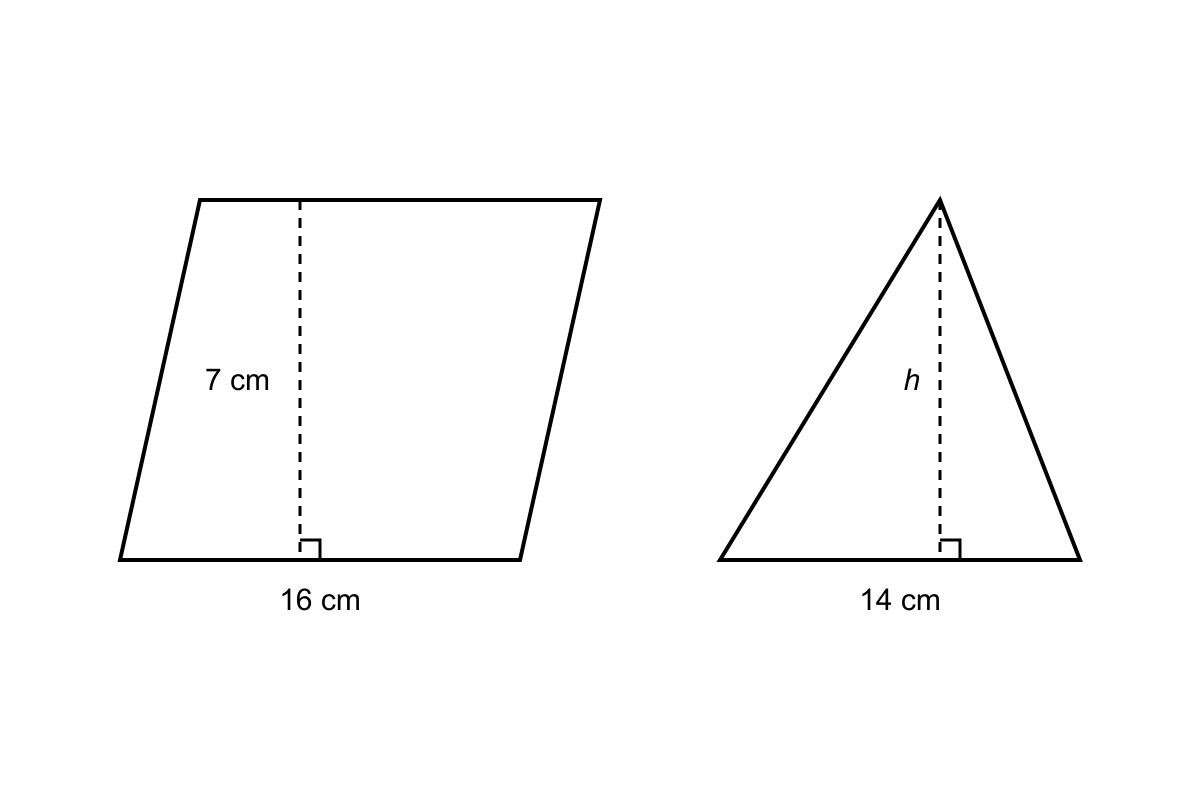
Question graphic
88 cm
1414 cm
1616 cm
2828 cm
← Back to quizzes

TACHS Quiz

TACHS Quiz: Measurement Problem Solving

Practice Measurement Problem Solving in TACHS with focused quiz questions that help you check what you know, review explanations, and build confidence with test-style prompts.

What this quiz covers

This quiz focuses on Measurement Problem Solving, giving you a quick way to practice the rules, question types, and explanations that matter most for TACHS.

How to use this quiz

Try each quiz question before looking at the correct answer. Use the explanations to review missed ideas, then come back to similar questions until the pattern feels familiar.

All questions

Question 1

Use the figure to answer the question. A parallelogram has a base of 1616 cm and a corresponding height of 77 cm. A triangle has the same area as this parallelogram and a base of 1414 cm. What is the height of the triangle?

  1. 88 cm
  2. 1414 cm
  3. 1616 cm (correct answer)
  4. 2828 cm
Explanation: Parallelogram area =16×7=112=16\times7=112. Triangle: 112=12(14)hh=16112=\tfrac12(14)h\Rightarrow h=16. (A) forgets factor of 22 in reverse. (B) equals the base. (D) doubles unnecessarily.

Question 2

Use the figure to solve. A rectangular swimming pool is 2525 meters long and 1010 meters wide. It is surrounded by a tiled deck of uniform width. The total area of the pool and deck together is 594594 square meters. What is the width of the deck?

  1. 22 meters
  2. 33 meters
  3. 44 meters (correct answer)
  4. 66 meters
Explanation: Let ww = deck width. (25+2w)(10+2w)=594(25+2w)(10+2w)=594. Expand: 250+70w+4w2=594250+70w+4w^2=594, so 4w2+70w344=04w^2+70w-344=0, 2w2+35w172=02w^2+35w-172=0. Using quadratic: w=35+1225+13764=35+26014=35+514=4w=\frac{-35+\sqrt{1225+1376}}{4}=\frac{-35+\sqrt{2601}}{4}=\frac{-35+51}{4}=4. (A), (B), (D) don't satisfy equation.

Question 3

Refer to the figure. A rectangular poster is 22 feet 66 inches wide and 33 feet 44 inches tall. A decorative ribbon will be placed along the entire border of the poster. How many inches of ribbon are needed?

  1. 7070 inches
  2. 120120 inches
  3. 140140 inches (correct answer)
  4. 160160 inches
Explanation: Width =30=30 in, height =40=40 in. Perimeter =2(30+40)=140=2(30+40)=140 in. (A) adds 30+4030+40 only. (B) mixes units wrong. (D) computes 2(30)+2(50)2(30)+2(50).

Question 4

Refer to the figure. The hexagonal figure is made by attaching a square to an equilateral triangle along one side. If each side of the square is 88 cm, what is the perimeter of the combined figure?

  1. 3232 cm
  2. 4040 cm (correct answer)
  3. 4848 cm
  4. 5656 cm
Explanation: The shared side is internal. Perimeter uses 3 sides of square ++ 2 sides of triangle =3(8)+2(8)=40=3(8)+2(8)=40 cm. (A) only the square. (C) doesn't remove the shared sides. (D) adds both shapes' full perimeters minus one side.

Question 5

Refer to the figure. A square and an equilateral triangle have the same perimeter. The side of the square is 99 inches. How long is each side of the triangle?

  1. 99 inches
  2. 1212 inches (correct answer)
  3. 13.513.5 inches
  4. 1818 inches
Explanation: Square perimeter =36=36 in. Triangle side =36/3=12=36/3=12 in. (A) equates sides not perimeters. (C) divides by 2.672.67 or confuses with half. (D) divides by 22.

Question 6

Refer to the figure. Each square in the grid has side length 1 m1\text{ m}. What is the area of the shaded garden?

  1. 20 m220\text{ m}^2
  2. 22 m222\text{ m}^2 (correct answer)
  3. 24 m224\text{ m}^2
  4. 26 m226\text{ m}^2
Explanation: Counting the shaded unit squares gives 22, so the area is 22 m222\text{ m}^2.
Distractors: A. Counts one fewer column (20 squares). C. Adds an extra 2 squares that are not shaded (24 squares). D. Miscounts by adding 4 nonexistent squares (26 squares).

Question 7

Refer to the figure. A rectangular living-room floor measures 1515 feet by 1212 feet. Carpet is sold in square yards. How many square yards of carpet are needed to exactly cover the floor?

  1. 99 square yards
  2. 2020 square yards (correct answer)
  3. 6060 square yards
  4. 180180 square yards
Explanation: Area =15×12=180=15\times12=180 sq ft. 11 sq yd =9=9 sq ft, so 180/9=20180/9=20 sq yd. (A) divides perimeter by something. (C) divides by 33 not 99. (D) leaves in square feet.

Question 8

The L-shaped figure shown is made up of two rectangles. Use the figure to find the perimeter of the entire L-shape.

  1. 4646 cm
  2. 5252 cm (correct answer)
  3. 5858 cm
  4. 6464 cm
Explanation: The L-shape has outer dimensions 16×1016\times10 with a 6×46\times4 rectangle removed from the top-right corner. Sides: 16+10+10+4+6+6=5216+10+10+4+6+6=52 cm. (A) forgets one segment. (C) adds the removed rectangle's perimeter twice. (D) uses 2(16+10)+2(6+...)2(16+10)+2(6+... ) over-counting.

Question 9

Refer to the figure. Parallelogram EFGHEFGH has base EH=12 cm\overline{EH}=12\text{ cm}, side FG=8 cm\overline{FG}=8\text{ cm}, and altitude h=6 cmh=6\text{ cm}. What is the area of EFGHEFGH?

  1. 72 cm272\text{ cm}^2 (correct answer)
  2. 96 cm296\text{ cm}^2
  3. 60 cm260\text{ cm}^2
  4. 48 cm248\text{ cm}^2
Explanation: Area of a parallelogram is base×height=12×6=72 cm2\text{base}\times\text{height}=12\times6=72\text{ cm}^2. Distractors: B. Multiplies base by the slanted side (12×8=96). C. Averages side and height before multiplying. D. Multiplies side (8) by height (6).

Question 10

Refer to the figure. Rhombus ABCDABCD has diagonals AC=12 cm\overline{AC}=12\text{ cm} and BD=10 cm\overline{BD}=10\text{ cm}. What is the area of the rhombus?

  1. 60 cm260\text{ cm}^2 (correct answer)
  2. 120 cm2120\text{ cm}^2
  3. 48 cm248\text{ cm}^2
  4. 24 cm224\text{ cm}^2
Explanation: Area of a rhombus =12(d1×d2)=12(12×10)=60 cm2=\tfrac12(d_1\times d_2)=\tfrac12(12\times10)=60\text{ cm}^2. Distractors: B. Multiplies the diagonals without halving. C. Halves only one diagonal before multiplying (\tfrac12×\times12×\times8). D. Halves both diagonals separately then multiplies.

Question 11

Refer to the figure. Rectangle ABCDABCD has a perimeter of 34 m34\text{ m}. Two opposite sides are each 11 m11\text{ m} long, and the other two opposite sides are each x mx\text{ m} long. What is the value of xx?

  1. 6 m6\text{ m} (correct answer)
  2. 5 m5\text{ m}
  3. 12 m12\text{ m}
  4. 13 m13\text{ m}
Explanation: The perimeter of a rectangle is 2(length+width)2(\text{length}+\text{width}). Here, 2(11+x)=342(11+x)=34, so 11+x=1711+x=17 and x=6 mx=6\text{ m}.
Distractors: B. 5 m5\text{ m} comes from subtracting incorrectly: 3411=23x=5 m34-11=23\rightarrow x=5\text{ m}. C. 12 m12\text{ m} mistakes perimeter for the missing side by doubling the given length. D. 13 m13\text{ m} results from dividing the perimeter by 2 and then adding the length instead of subtracting.

Question 12

Refer to the figure. Right triangle XYZXYZ has legs XY=9 cmXY=9\text{ cm} and YZ=12 cmYZ=12\text{ cm}. What is the perimeter of the triangle?

  1. 30 cm30\text{ cm}
  2. 34 cm34\text{ cm}
  3. 36 cm36\text{ cm} (correct answer)
  4. 38 cm38\text{ cm}
Explanation: Hypotenuse XZ=92+122=81+144=225=15 cmXZ=\sqrt{9^2+12^2}=\sqrt{81+144}=\sqrt{225}=15\text{ cm}. Perimeter =9+12+15=36 cm=9+12+15=36\text{ cm}. Distractors: A. Adds only the legs and one miscalculated hypotenuse (9+12+9=30). B. Uses 22515\sqrt{225}\approx15 correctly but then rounds down one leg. D. Adds an over-rounded hypotenuse of 17 cm.

Question 13

Refer to the figure. A flower bed is composed of a rectangle and a semicircle. The rectangle measures 12 m12\text{ m} by 8 m8\text{ m}, and the semicircle is attached along the 12 m12\text{ m} side, using it as the diameter. What is the total area of the flower bed to the nearest whole square meter?

  1. 140 m2140\text{ m}^2
  2. 147 m2147\text{ m}^2
  3. 150 m2150\text{ m}^2
  4. 153 m2153\text{ m}^2 (correct answer)
Explanation: Rectangle area =12×8=96 m2=12\times8=96\text{ m}^2. Semicircle radius r=6 mr=6\text{ m}, so area =12πr2=12π(36)=18π56.5 m2=\tfrac12\pi r^2=\tfrac12\pi(36)=18\pi\approx56.5\text{ m}^2. Total 96+56.5=152.5 m2153 m2\approx96+56.5=152.5\text{ m}^2\approx153\text{ m}^2.
Distractors: A. Rounds the semicircle area too low. B. Calculates using π3\pi\approx3 instead of 3.143.14. C. Uses π=3.14\pi=3.14 but mistakenly uses radius 5.

Question 14

Refer to the figure. A square lawn ABCDABCD has side length 18 m18\text{ m}. A uniform walkway surrounds the lawn on all four sides, forming a larger square EFGHEFGH whose side length is 22 m22\text{ m}. What is the area of just the walkway?

  1. 160 m2160\text{ m}^2 (correct answer)
  2. 176 m2176\text{ m}^2
  3. 200 m2200\text{ m}^2
  4. 196 m2196\text{ m}^2
Explanation: Area walkway =(22)2(18)2=484324=160 m2=(22)^2-(18)^2=484-324=160\text{ m}^2. Distractors: B. Uses outer area minus one incorrect inner dimension 17 m (484-289=195) then rounds. C. Adds the two areas instead of subtracting. D. Squares an average side length (20 m) then subtracts inner area incorrectly.

Question 15

Refer to the figure. A right triangle has legs of 99 cm and 1212 cm. A square is drawn with one side equal to the hypotenuse of this triangle. What is the perimeter of the square?

  1. 4242 cm
  2. 6060 cm (correct answer)
  3. 8484 cm
  4. 225225 cm
Explanation: Hypotenuse =81+144=225=15=\sqrt{81+144}=\sqrt{225}=15. Perimeter of square =4×15=60=4\times15=60. (A) uses 9+12+219+12+21. (C) uses 4×214\times21 (sum of legs). (D) is 15215^2, the area not perimeter.

Question 16

Use the figure shown. A trapezoid has parallel sides of 1414 inches and 2222 inches, and a height of 99 inches. A rectangle has the same area as this trapezoid and a width of 66 inches. What is the length of the rectangle?

  1. 2424 inches
  2. 2727 inches (correct answer)
  3. 3030 inches
  4. 3333 inches
Explanation: Trapezoid area =12(14+22)(9)=12(36)(9)=162=\tfrac12(14+22)(9)=\tfrac12(36)(9)=162. Rectangle length =162/6=27=162/6=27. (A) uses only 1414 as average. (C) uses the average 18×.../618\times... /6 incorrectly. (D) forgets the 12\tfrac12: 36×9/6...36\times9/6... .

Question 17

Refer to the figure. A rectangular garden measures 2424 feet by 1818 feet. A uniform path of width 33 feet is built around the outside of the garden. What is the area of the path alone, in square feet?

  1. 252252 square feet
  2. 288288 square feet (correct answer)
  3. 324324 square feet
  4. 180180 square feet
Explanation: Outer rectangle: (24+6)(18+6)=30×24=720(24+6)(18+6)=30\times24=720. Inner garden: 24×18=43224\times18=432. Path area =720432=288=720-432=288. (A) results from forgetting to double the width on each dimension (27×26432=27027\times26-432=270... close miscount). (C) comes from using width 33 only once on each side incorrectly. (D) is the perimeter times width (84×3/...84\times3/... ) style error without corners.