TACHS Quiz: Geometric Figures On Grids
9 questions · exam conditions
0:00
Geometric Figures On GridsQuestion 1 of 9

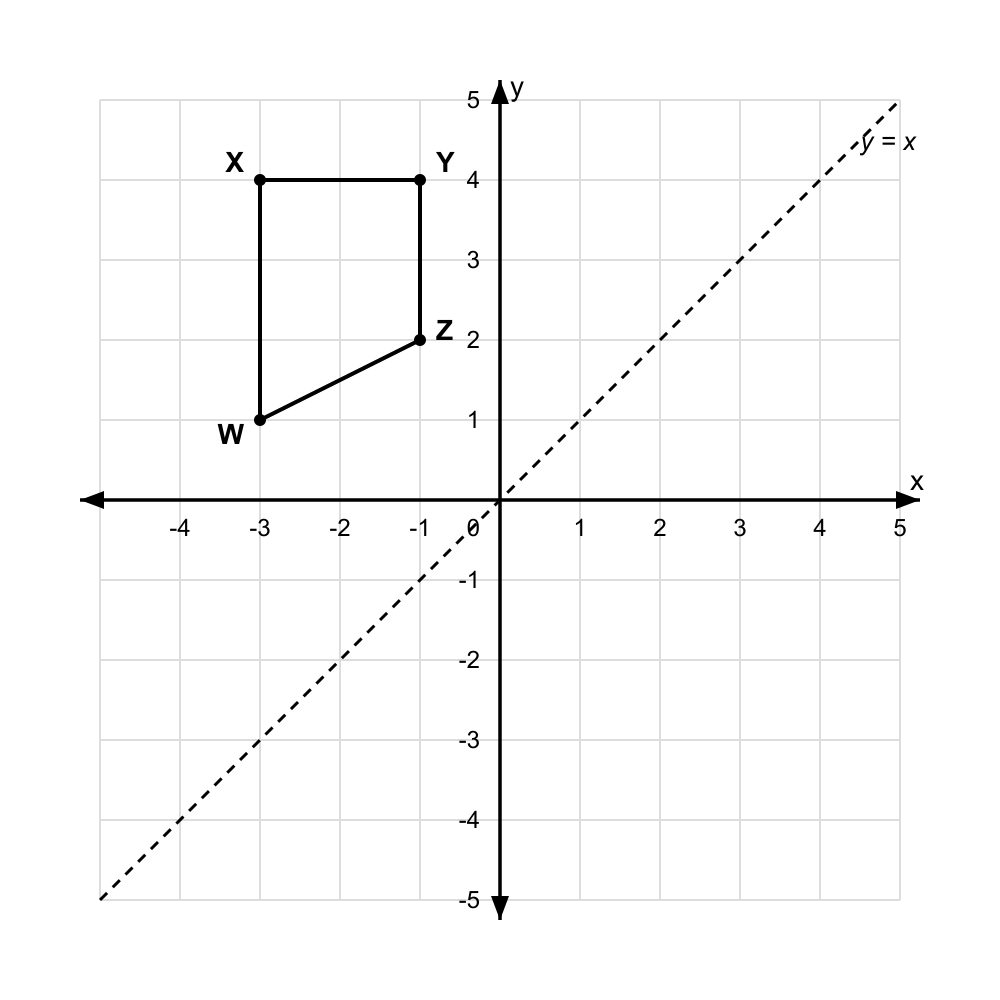
Look at the figure shown on the grid. Polygon WXYZWXYZ is reflected over the line y=xy=x to form polygon WXYZW'X'Y'Z'. What are the coordinates of YY'?

Question graphic
(4,1)(-4, 1)
(1,4)(1, -4)
(1,4)(-1, 4)
(4,1)(4, -1)
← Back to quizzes

TACHS Quiz

TACHS Quiz: Geometric Figures On Grids

Practice Geometric Figures On Grids in TACHS with focused quiz questions that help you check what you know, review explanations, and build confidence with test-style prompts.

What this quiz covers

This quiz focuses on Geometric Figures On Grids, giving you a quick way to practice the rules, question types, and explanations that matter most for TACHS.

How to use this quiz

Try each quiz question before looking at the correct answer. Use the explanations to review missed ideas, then come back to similar questions until the pattern feels familiar.

All questions

Question 1

Look at the figure shown on the grid. Polygon WXYZWXYZ is reflected over the line y=xy=x to form polygon WXYZW'X'Y'Z'. What are the coordinates of YY'?

  1. (4,1)(-4, 1)
  2. (1,4)(1, -4)
  3. (1,4)(-1, 4)
  4. (4,1)(4, -1) (correct answer)
Explanation: Reflection over y=xy=x swaps coordinates: (a,b)(b,a)(a,b) \to (b,a). Y(1,4)Y(4,1)Y(-1,4) \to Y'(4,-1). (A) is reflection over y-axis. (B) is reflection over y=xy=-x. (C) is the original point's negation only in x.

Question 2

Refer to the coordinate grid shown. Triangle ABCABC is translated by the rule (x,y)(x3,y+2)(x,y)\to(x-3,y+2), and then reflected over the x-axis. What are the coordinates of the final image of vertex CC?

  1. (0,5)(0, 5)
  2. (0,5)(0, -5) (correct answer)
  3. (6,5)(-6, -5)
  4. (6,5)(-6, 5)
Explanation: Start with C(3,3)C(3,3). Translation: (33,3+2)=(0,5)(3-3,3+2)=(0,5). Reflection over x-axis: (x,y)(x,y)(x,y)\to(x,-y) gives (0,5)(0,-5). (A) forgets the reflection. (C) reflects over y-axis instead. (D) reverses translation direction.

Question 3

Refer to the grid shown. Triangle ABCABC has vertices at A(3,4)A(-3, 4), B(5,4)B(5, 4), and C(2,2)C(2, -2). What is the area of triangle ABCABC in square units?

  1. 2424 (correct answer)
  2. 3030
  3. 4848
  4. 2020
Explanation: The base ABAB is horizontal from x=3x=-3 to x=5x=5, so its length is 88. The height is the perpendicular distance from C(2,2)C(2,-2) to the line y=4y=4, which is 4(2)=6|4-(-2)|=6. Area =12(8)(6)=24= \frac{1}{2}(8)(6) = 24. (B) incorrectly uses base 1010. (C) forgets to multiply by 12\frac{1}{2}. (D) uses height 55 from miscounting.

Question 4

Based on the figure, trapezoid ABCDABCD has ABCDAB \parallel CD. What is the area of trapezoid ABCDABCD?

  1. 1515 square units
  2. 1818 square units
  3. 2121 square units (correct answer)
  4. 2424 square units
Explanation: From the figure, the parallel bases are AB=3AB = 3 units and DC=4DC = 4 units. The height (perpendicular distance between the parallel bases) is 3(3)=63 - (-3) = 6 units. Using the trapezoid area formula: Area =12(b1+b2)×h=12(3+4)×6=12(7)(6)=21= \frac{1}{2}(b_1 + b_2) \times h = \frac{1}{2}(3 + 4) \times 6 = \frac{1}{2}(7)(6) = 21 square units.

Question 5

In the figure below, triangle RSTRST has been dilated from the origin by a scale factor of 32\frac{3}{2} to create triangle RSTR'S'T'. What are the coordinates of TT'?

  1. (3,6)(3, -6)
  2. (6,9)(6, -9) (correct answer)
  3. (9,6)(9, -6)
  4. (4.5,6)(4.5, -6)
Explanation: A dilation from the origin by factor kk maps (x,y)(kx,ky)(x,y)\to(kx,ky). T(4,6)(432,632)=(6,9)T(4,-6)\to(4\cdot\frac{3}{2},-6\cdot\frac{3}{2})=(6,-9). (A) only scaled x by 34\frac{3}{4}. (C) scaled incorrectly. (D) scaled only x-coordinate.

Question 6

Refer to the figure. What is the perimeter of the shaded L-shaped region?

  1. 12 units
  2. 13 units
  3. 14 units (correct answer)
  4. 16 units
Explanation: Tracing the outline from the lower-left corner: 4+1+2+2+2+3 = 14 units. Choices 12 and 13 miss one or two segments; 16 double-counts two edges.

Question 7

Refer to the figure on the grid. Point PP lies on segment ABAB such that AP:PB=3:1AP:PB = 3:1. What are the coordinates of point PP?

  1. (3,2)(3, 2)
  2. (5,4)(5, 4) (correct answer)
  3. (4,3)(4, 3)
  4. (6,5)(6, 5)
Explanation: With A(1,2)A(-1,-2) and B(7,6)B(7,6), PP divides ABAB in ratio 3:13:1 from AA. Using the section formula: P=(3(7)+1(1)4,3(6)+1(2)4)=(204,164)=(5,4)P=\left(\frac{3(7)+1(-1)}{4},\frac{3(6)+1(-2)}{4}\right)=\left(\frac{20}{4},\frac{16}{4}\right)=(5,4). (A) gives the midpoint. (C) uses ratio 1:11:1 wrongly. (D) uses ratio 1:31:3 from A.

Question 8

Use the coordinate grid shown. Which statement about quadrilateral ABCDABCD is true?

  1. ABCDABCD is a rhombus but not a square.
  2. ABCDABCD is a square. (correct answer)
  3. ABCDABCD is a rectangle but not a square.
  4. ABCDABCD is a parallelogram but not a rhombus or rectangle.
Explanation: Vertices A(0,0)A(0,0), B(3,2)B(3,2), C(1,5)C(1,5), D(2,3)D(-2,3). Side lengths: AB=13AB=\sqrt{13}, BC=4+9=13BC=\sqrt{4+9}=\sqrt{13}, CD=9+4=13CD=\sqrt{9+4}=\sqrt{13}, DA=4+9=13DA=\sqrt{4+9}=\sqrt{13}. All sides equal. Slopes: AB=23AB=\frac{2}{3}, BC=32=32BC=\frac{3}{-2}=-\frac{3}{2}; product =1=-1, so perpendicular. All sides equal and adjacent sides perpendicular: it's a square. (A) misses the right angles. (C) misses equal sides. (D) misses both.

Question 9

The figure below shows polygon ABCDEFABCDEF on a grid. What is the area of this polygon, in square units?

  1. 2020
  2. 2222 (correct answer)
  3. 2424
  4. 2626
Explanation: The L-shaped hexagon can be decomposed into two rectangles: a bottom rectangle with dimensions 6×3=186 \times 3 = 18 square units, and a top-left rectangle with dimensions 4×1=44 \times 1 = 4 square units. Total area =18+4=22= 18 + 4 = 22 square units.