All questions
Question 1
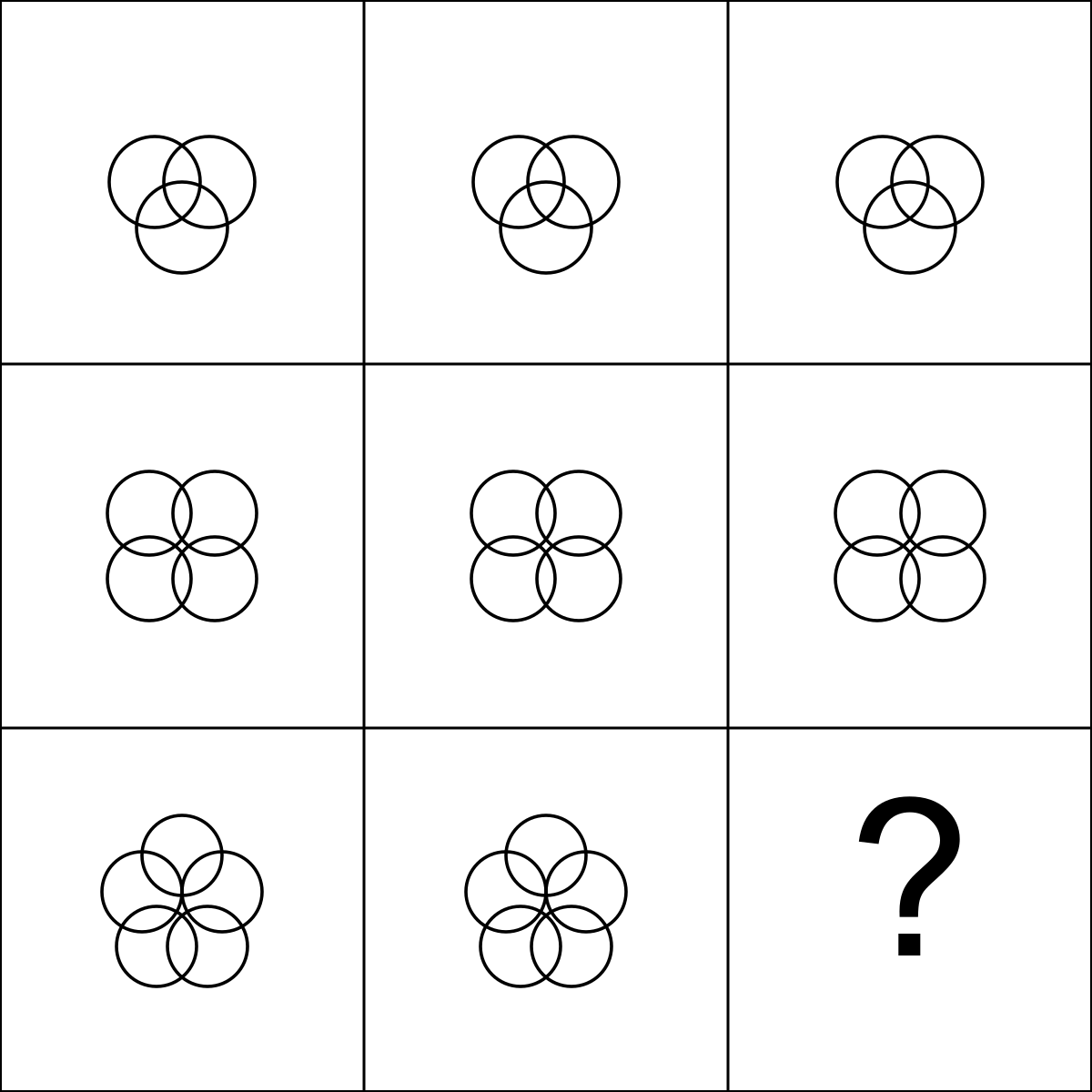
Examine the 3×3 figure matrix below. What figure completes the pattern according to the column rule?
- Five overlapping circles forming a ring (correct answer)
- Four overlapping circles forming a ring
- Three overlapping circles forming a triangle pattern
- Six overlapping circles forming a ring
Explanation: In each column, the number of overlapping circles increases by 1 per row (3, 4, 5). Column 3 row 1 has 3 circles, row 2 has 4 circles, so row 3 must have 5 circles. (B) repeats row 2. (C) repeats row 1. (D) increases by too much.
Question 2
Look at the figure matrix. Choose the figure that completes the empty cell based on how items in each column are related.
- A clock face showing 6:00
- A clock face showing 9:00 (correct answer)
- A clock face showing 3:00
- A clock face showing 12:00
Explanation: Down each column, the hour hand rotates 90° counterclockwise each step while the minute hand stays on 12. In column 3, row 1 shows 3:00, row 2 shows 12:00, so row 3 should show 9:00. (A) follows clockwise rotation instead. (C) repeats row 1. (D) repeats row 2.
Question 3
Refer to the figure matrix below. Which figure correctly completes the matrix according to the column rule?
- Four black dots arranged in a square
- Three black dots in a horizontal row
- Three black dots in a vertical column (correct answer)
- Four black dots arranged in a diamond
Explanation: Down each column, the number of dots stays constant but the arrangement rotates 90° clockwise. Column 3 shows 3 dots diagonally (row 1), 3 dots horizontally (row 2), so row 3 should be 3 dots vertically. (A) and (D) change the dot count. (B) repeats the row-2 arrangement.
Question 4
Col1: solid L, outline L-90, solid L-180; Col2: outline T, solid T-90, outline T-180; Col3: solid F, outline F-90, ?
- solid F-90
- solid F-180 (correct answer)
- outline F-180
- outline F-90
Explanation: Each column cycles rotations 0, 90, 180 degrees while the fill alternates. Column 3 starts solid, then outline, so the missing third must be solid; the rotation is 180, giving solid F-180. The tempting wrong choice is outline F-180: it gets the rotation right but ignores that the fill should return to solid.
Question 5
Col1: 3 sides, 4 sides, 7 sides; Col2: 4 sides, 5 sides, 9 sides; Col3: 5 sides, 6 sides, ?
- 10 sides
- 9 sides
- 11 sides (correct answer)
- 12 sides
Explanation: In each column, the first two numbers add to the third: 3 + 4 = 7, 4 + 5 = 9, so 5 + 6 = 11. The tempting wrong answer is 10 sides, which comes from guessing a pattern across rows instead of adding down each column. Count column by column and you'll land on 11 sides.
Question 6
Col1: solid ▲, outline ▷, solid ▼; Col2: outline ▷, solid ▼, outline ◁; Col3: solid ▼, outline ◁, ?
- solid ▲ (correct answer)
- outline △
- solid ◀
- outline ▽
Explanation: Read the grid in diagonal bands from upper left to lower right: one solid up-triangle, then two outline right-triangles, then three solid down-triangles, then two outline left-triangles. The missing lower-right cell begins the next band, so it must be solid, and the direction cycle up, right, down, left repeats to up. The tempting outline up-triangle gets the direction right but ignores the solid/outline alternation, which makes this cell solid.
Question 7
Col1: solid tri, outline sq, solid pent; Col2: outline sq, solid pent, outline hex; Col3: solid pent, outline hex, ?
- outline 7-sided
- solid 7-sided (correct answer)
- outline 8-sided
- solid 6-sided
Explanation: Follow the shapes diagonally: each step right or down adds one side, and the fill alternates solid and outline. The missing cell continues row 3 as solid pentagon - outline hexagon - solid 7-sided. The tempting wrong answer is outline 7-sided, but row 3 starts solid, so the missing shape must be solid, not outline.
Question 8
Col1: solid tri, outline sq, solid tri; Col2: solid sq, outline pent, solid sq; Col3: solid pent, outline hex, ?
- outline 5-sided
- outline 6-sided
- solid 6-sided
- solid 5-sided (correct answer)
Explanation: Each column repeats its starting solid shape after an outlined shape with one extra side: solid triangle, outline square, solid triangle; solid square, outline pentagon, solid square. So after solid pentagon and outline hexagon, the third must be another solid pentagon. The outline hexagon is a distractor because it completes only the middle pair, not the solid-outline-solid cycle.
Question 9
Based on the figure matrix shown, which figure fits the empty cell by following the column rule?
- A square grid with the bottom-right corner shaded (correct answer)
- A square grid with the top-left corner shaded
- A square grid with the center shaded
- A square grid with the top-right corner shaded
Explanation: Each column shows a 2×2 grid where the shaded cell moves one position clockwise each row. In column 3: row 1 has top-left shaded, row 2 has top-right shaded, so row 3 must have bottom-right shaded. (B) repeats row 1. (C) isn't a corner. (D) repeats row 2.
Question 10
Examine the figure matrix shown. Determine the column rule and choose the figure that completes the matrix.
- An arrow pointing right with two stripes
- An arrow pointing left with three stripes
- An arrow pointing down with three stripes (correct answer)
- An arrow pointing up with two stripes
Explanation: In each column, the arrow rotates 90° clockwise from row 1 to row 2 and another 90° clockwise from row 2 to row 3. The number of stripes in each column is constant. Column 3 shows: up-arrow with 3 stripes (row 1), right-arrow with 3 stripes (row 2), so row 3 must be down-arrow with 3 stripes. (A) has wrong direction and stripe count. (B) rotates counterclockwise. (D) doesn't rotate far enough and has wrong stripe count.
Question 11
Study the 3×3 matrix of figures below. Based on how the figures change going down each column, choose the correct figure for the missing cell.
- A hexagon with a small square inside (correct answer)
- A pentagon with a small square inside
- A hexagon with a small circle inside
- A pentagon with a small circle inside
Explanation: Each column's rule: the outer shape gains one side per row (square→pentagon→hexagon), and the inner shape repeats the outer shape of row 1 but shrunk. In column 3, row 1 is a small square, row 2 is a pentagon with a small square inside, so row 3 should be a hexagon with a small square inside. (B) ignores the side-increase rule. (C) confuses the inner shape with the row-1 shape of a different column. (D) mixes both errors.
Question 12
Look at the figure matrix. Identify the column relationship and select the figure that belongs in the empty box.
- A star with a black center and white points
- A star with a white center and black points (correct answer)
- A completely black star
- A completely white star
Explanation: Each column's rule: row 1 shows a fully white figure, row 2 shows the figure with ONLY the center shaded black, and row 3 shows the figure with ONLY the points/edges shaded black (inverse of row 2). In column 3, row 1 is a white star, row 2 is a star with a black center, so row 3 must be a star with black points and white center. (A) reverses the pattern. (C) and (D) ignore the partial-shading rule entirely.
Question 13
Look at the 3×3 figure matrix. Determine which figure belongs in the empty cell based on how figures change down each column.
- A large diamond containing a small black diamond and two small white diamonds
- A large diamond containing three small black diamonds
- A large diamond containing one small black diamond
- A large diamond containing two small black diamonds and one small white diamond (correct answer)
Explanation: Each column's rule: the outer shape stays the same; the total number of inner shapes increases by 1 per row (1, 2, 3); the number of BLACK inner shapes equals the row number minus 1, with remaining shapes white. Row 3 col 3: 3 total inner diamonds, 2 black, 1 white. (A) has only 1 black. (B) has all black. (C) has only 1 shape total.
Question 14
Based on the 3×3 figure matrix shown, which figure completes the pattern in the missing cell?
- A large circle containing two small triangles
- A large circle containing three small triangles (correct answer)
- A large triangle containing three small circles
- A large triangle containing two small circles
Explanation: In each column, the outer shape is constant, and the number of inner shapes increases by 1 each row. The inner shape in each column matches the outer shape of the NEXT column to the right (with column 3 wrapping to column 1). Column 3 outer shape is a circle; column 1's outer shape is a triangle, so inner shapes are triangles. Row 3 of column 3 needs 3 triangles inside a circle. (A) has wrong count. (C) and (D) swap inner and outer shapes.
Question 15
Refer to the 3×3 figure matrix. Based on the column relationship, what figure should appear in the empty cell?
- A circle inscribed in a square inscribed in a triangle
- A triangle inscribed in a square inscribed in a circle (correct answer)
- A square inscribed in a triangle inscribed in a circle
- A square inscribed in a circle inscribed in a triangle
Explanation: Each column nests shapes, with a new outer shape added each row. Row 1 of column 3 is a triangle; row 2 adds a square outside it (square containing triangle); row 3 adds a circle outside the square (circle containing square containing triangle). (A) reverses the nesting. (C) and (D) use incorrect combinations of shapes in the wrong order.
Question 16
Study the figure matrix below. Identify the column rule and choose the missing figure.
- A right-pointing arrow with a double line and a black tail (correct answer)
- A left-pointing arrow with a double line and a black tail
- A right-pointing arrow with a single line and a white tail
- A left-pointing arrow with a single line and a white tail
Explanation: Each column has three independent features that change down the rows: (1) line thickness goes single→double→double, (2) tail color goes white→white→black, and (3) direction stays constant within each column. Column 3's arrows all point right. Row 3 needs: double line (matches row 2 rule), black tail (new feature appearing at row 3), right-pointing. (B) flips direction. (C) and (D) fail to apply the cumulative feature rules.