TACHS Quiz: Basic Geometric Shape Properties
16 questions · exam conditions
0:00
Basic Geometric Shape PropertiesQuestion 1 of 16

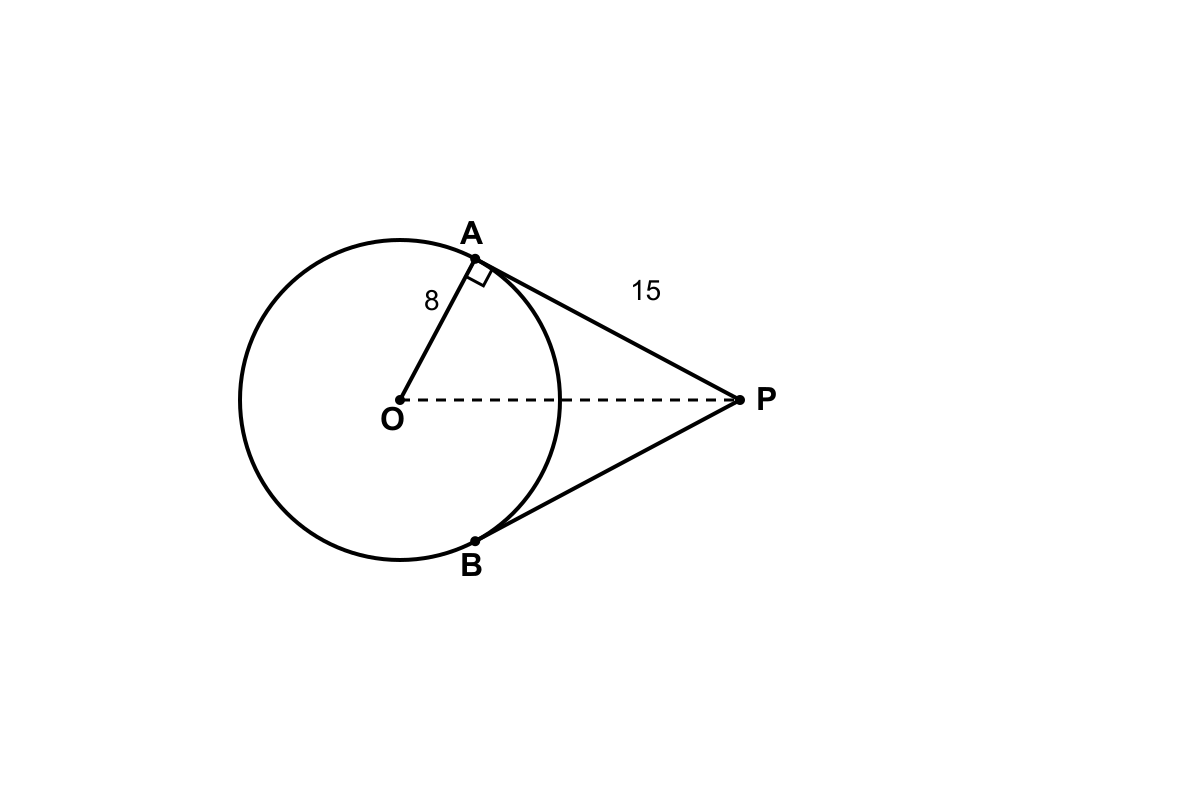
In the figure, PA\overline{PA} and PB\overline{PB} are tangent to the circle at points AA and BB, respectively. If PA=15PA = 15 and the radius of the circle is 8, what is the distance from PP to the center OO of the circle?

Question graphic
17
161\sqrt{161}
23
113\sqrt{113}
← Back to quizzes

TACHS Quiz

TACHS Quiz: Basic Geometric Shape Properties

Practice Basic Geometric Shape Properties in TACHS with focused quiz questions that help you check what you know, review explanations, and build confidence with test-style prompts.

What this quiz covers

This quiz focuses on Basic Geometric Shape Properties, giving you a quick way to practice the rules, question types, and explanations that matter most for TACHS.

How to use this quiz

Try each quiz question before looking at the correct answer. Use the explanations to review missed ideas, then come back to similar questions until the pattern feels familiar.

All questions

Question 1

In the figure, PA\overline{PA} and PB\overline{PB} are tangent to the circle at points AA and BB, respectively. If PA=15PA = 15 and the radius of the circle is 8, what is the distance from PP to the center OO of the circle?

  1. 17 (correct answer)
  2. 161\sqrt{161}
  3. 23
  4. 113\sqrt{113}
Explanation: The radius OA\overline{OA} is perpendicular to tangent PA\overline{PA} at AA. Triangle OAPOAP is right-angled at AA: OP=152+82=225+64=289=17OP = \sqrt{15^2 + 8^2} = \sqrt{225+64} = \sqrt{289} = 17. Distractor B uses 1528215^2-8^2 incorrectly. C uses the sum 15+815+8. D uses an incorrect combination of the given values.

Question 2

In the figure, rectangle PQRSPQRS has dimensions PQ=20PQ = 20 and QR=15QR = 15. Diagonals PR\overline{PR} and QS\overline{QS} intersect at point MM. What is the length of QM\overline{QM}?

  1. 10
  2. 12.5 (correct answer)
  3. 7.5
  4. 17.5
Explanation: Diagonal length = 202+152=625=25\sqrt{20^2+15^2}=\sqrt{625}=25. In a rectangle, diagonals bisect each other AND are equal, so QMQM = half of diagonal = 12.5. Distractor A is half of 20. C is half of 15. D is diagonal minus 7.5.

Question 3

In the figure, triangle ABCABC is equilateral with side length 12. Point DD lies on BC\overline{BC} such that BD=4BD = 4. What is the length of AD\overline{AD}?

  1. 474\sqrt{7} (correct answer)
  2. 4104\sqrt{10}
  3. 80\sqrt{80}
  4. 8
Explanation: Using the Law of Cosines in triangle ABDABD: AD2=AB2+BD22(AB)(BD)cos(60°)=144+162(12)(4)(0.5)=16048=112AD^2 = AB^2 + BD^2 - 2(AB)(BD)\cos(60°) = 144 + 16 - 2(12)(4)(0.5) = 160 - 48 = 112. So AD=112=47AD = \sqrt{112} = 4\sqrt{7}. Distractor B results from forgetting the subtraction: 160=410\sqrt{160} = 4\sqrt{10}. C is 80\sqrt{80} from using cos(60°)=0\cos(60°) = 0 incorrectly. D assumes the triangle splits into two right triangles incorrectly.

Question 4

Refer to the figure. A right triangle has legs of length 9 and 12. A circle is inscribed in the triangle (tangent to all three sides). What is the radius of the inscribed circle?

  1. 2
  2. 3 (correct answer)
  3. 4
  4. 4.5
Explanation: Hypotenuse = 81+144=15\sqrt{81+144}=15. For any triangle, r=Area/sr = \text{Area}/s where ss is semi-perimeter. Area = 12(9)(12)=54\frac{1}{2}(9)(12)=54. Semi-perimeter = (9+12+15)/2=18(9+12+15)/2 = 18. So r=54/18=3r = 54/18 = 3. (Alternatively, for right triangle: r=(a+bc)/2=(9+1215)/2=3r = (a+b-c)/2 = (9+12-15)/2 = 3.) Distractor A uses (a+bc)/3(a+b-c)/3. C uses a+bca+b-c divided wrongly. D is 9/29/2.

Question 5

Refer to the figure. A regular hexagon has a side length of 6. What is the area of the hexagon?

  1. 36336\sqrt{3}
  2. 54354\sqrt{3} (correct answer)
  3. 18318\sqrt{3}
  4. 72372\sqrt{3}
Explanation: A regular hexagon with side ss has area 332s2=332(36)=543\frac{3\sqrt{3}}{2}s^2 = \frac{3\sqrt{3}}{2}(36) = 54\sqrt{3}. Equivalently, 6 equilateral triangles with side 6: 634(36)=5436 \cdot \frac{\sqrt{3}}{4}(36) = 54\sqrt{3}. Distractor A uses 4 triangles. C uses 2 triangles. D uses 8 triangles.

Question 6

Refer to the figure. The shaded L-shaped patio is made by removing a 5 m by 4 m rectangle from the corner of an 11 m by 9 m rectangle. What is the area, in square meters, of the patio?

  1. 79 m² (correct answer)
  2. 60 m²
  3. 99 m²
  4. 20 m²
Explanation: Large rectangle area: 11×9=99 m2.11\times9=99\text{ m}^2. Removed rectangle area: 5×4=20 m2.5\times4=20\text{ m}^2. Patio area =9920=79 m2.=99-20=79\text{ m}^2.
B: 60 m² subtracts 39 instead of 20.
C: 99 m² is the full rectangle with nothing removed.
D: 20 m² is only the removed piece, not the patio.

Question 7

Refer to the figure. What is the length, in centimeters, of diagonal AC\overline{AC} of rectangle ABCDABCD?

  1. 10 cm (correct answer)
  2. 9 cm
  3. 11 cm
  4. 12 cm
Explanation: Rectangle sides are perpendicular, so ABC\triangle ABC is right with legs 8 cm and 6 cm. Using the Pythagorean Theorem: AC=82+62=64+36=100=10 cm.AC=\sqrt{8^{2}+6^{2}}=\sqrt{64+36}=\sqrt{100}=10\text{ cm}.
B: 9 cm comes from adding 3 to the shorter side, not using the theorem.
C: 11 cm results from adding 3 to the longer side, also incorrect.
D: 12 cm is the hypotenuse of a 5–12–13 triangle, but that does not match the given legs.

Question 8

Refer to the figure. Two concentric circles have radii 5 and 13. A chord of the larger circle is tangent to the smaller circle. What is the length of this chord?

  1. 12
  2. 18
  3. 24 (correct answer)
  4. 26
Explanation: The radius to the tangent point (length 5) is perpendicular to the chord and bisects it. Using Pythagorean theorem: half-chord = 13252=144=12\sqrt{13^2 - 5^2} = \sqrt{144} = 12. Full chord = 24. Distractor A is half the chord. B adds radii. D is the diameter of the large circle.

Question 9

Refer to the figure. A semicircle is attached to one of the 10-meter sides of a 10 m by 4 m rectangle to make a garden bed in the shape shown. Using π3.14,\pi \approx 3.14, what is the total area, in square meters, of the garden bed?

  1. 79.3 m² (correct answer)
  2. 65.0 m²
  3. 75.4 m²
  4. 90.0 m²
Explanation: Rectangle area =10×4=40 m2.=10\times4=40\text{ m}^2. The semicircle has radius 5 m, so area =12πr2=12(3.14)(25)=39.25 m2.=\tfrac12\pi r^{2}=\tfrac12(3.14)(25)=39.25\text{ m}^2. Total =40+39.2579.3 m2.=40+39.25\approx79.3\text{ m}^2.
B: 65.0 m² leaves out most of the semicircle's area.
C: 75.4 m² uses an incorrect radius of 4 m for the semicircle.
D: 90.0 m² overestimates by treating the added shape as a full circle instead of a half circle.

Question 10

Refer to the figure. Using π3.14,\pi \approx 3.14, what is the circumference, in meters, of the circle?

  1. 43.96 m (correct answer)
  2. 87.92 m
  3. 21.98 m
  4. 28.00 m
Explanation: The diameter is 14 m, so the radius is 7 m. Circumference C=2πr=2(3.14)(7)=43.96 m.C=2\pi r=2(3.14)(7)=43.96\text{ m}.
B: 87.92 m doubles the correct result, as though multiplying by 4π.
C: 21.98 m uses πr instead of 2πr.
D: 28.00 m uses 2r without π.

Question 11

Refer to the figure. The shaded region is an annulus (ring) formed by two concentric circles with radii 10 cm and 6 cm. Using π3.14,\pi \approx 3.14, what is the area, in square centimeters, of the shaded region?

  1. 201.0 cm² (correct answer)
  2. 314.0 cm²
  3. 157.0 cm²
  4. 113.0 cm²
Explanation: Outer area =π(102)=3.14(100)=314.=\pi(10^{2})=3.14(100)=314. Inner area =π(62)=3.14(36)=113.0.=\pi(6^{2})=3.14(36)=113.0. Shaded area =314113=201 cm2.=314-113=201\text{ cm}^2.
B: 314.0 cm² is the whole outer circle.
C: 157.0 cm² averages the two areas instead of subtracting.
D: 113.0 cm² is only the inner circle.

Question 12

Refer to the figure. A sector of a circle with radius 9 cm has a central angle of 120120^{\circ}. Using π3.14,\pi \approx 3.14, what is the area, in square centimeters, of the shaded sector?

  1. 56.5 cm²
  2. 84.8 cm² (correct answer)
  3. 188.5 cm²
  4. 254.3 cm²
Explanation: Sector area =120360×πr2=13(3.14)(92)=13(3.14)(81)=13(254.34)84.8 cm2.=\dfrac{120^{\circ}}{360^{\circ}}\times\pi r^{2}=\dfrac13(3.14)(9^{2})=\dfrac13(3.14)(81)=\dfrac13(254.34)\approx84.8\text{ cm}^2.
A: 56.5 cm² uses a 90° sector.
C: 188.5 cm² uses 240° instead of 120°.
D: 254.3 cm² is the full-circle area, not a sector.

Question 13

Refer to the figure. GHI\triangle GHI has two angles labeled 3535^{\circ} and 6565^{\circ} as shown. What is the measure of the unlabeled angle at vertex HH?

  1. 45°
  2. 60°
  3. 80° (correct answer)
  4. 90°
Explanation: Sum of angles in a triangle is 180180^{\circ}. 35+65+x=180x=80.35^{\circ}+65^{\circ}+x=180^{\circ}\Rightarrow x=80^{\circ}.
A: 45° assumes a right triangle incorrectly.
B: 60° results from subtracting from 125° instead of 180°.
D: 90° misinterprets the drawing as right-angled.

Question 14

Refer to the figure. In circle O,O, AB\overline{AB} is a diameter and point CC lies on the circle. What is the measure of ACB\angle ACB?

  1. 60°
  2. 90° (correct answer)
  3. 120°
  4. 180°
Explanation: An angle inscribed in a semicircle is a right angle, so mACB=90.m\angle ACB=90^{\circ}.
A: 60° might be chosen thinking the triangle is equilateral, but no equal sides are shown.
C: 120° misapplies the theorem to give an obtuse angle.
D: 180° is the measure of the diameter, not the inscribed angle.

Question 15

In the figure, AB\overline{AB} is a diameter of the circle with center OO, and CC is a point on the circle. If the measure of arc BCBC is 70°70°, what is the measure of angle OCAOCA?

  1. 35°35° (correct answer)
  2. 55°55°
  3. 70°70°
  4. 110°110°
Explanation: Arc BC=70°BC = 70° means central angle BOC=70°BOC = 70°. Since ABAB is a diameter, angle AOC=180°70°=110°AOC = 180° - 70° = 110°. Triangle AOCAOC is isosceles (OA=OCOA = OC = radius), so the base angles OACOAC and OCAOCA are equal: each is (180°110°)/2=35°(180° - 110°)/2 = 35°. Distractor B is 90°35°90° - 35°. C is the arc measure. D is the central angle AOCAOC.

Question 16

In the figure, a circle with radius 10 has a chord AB\overline{AB} of length 16. What is the distance from the center of the circle to the chord?

  1. 5
  2. 6 (correct answer)
  3. 8
  4. 84\sqrt{84}
Explanation: The perpendicular from the center bisects the chord, creating a right triangle with hypotenuse 10 (radius) and one leg 8 (half of chord). Other leg = 10064=6\sqrt{100-64}=6. Distractor A halves the radius. C is half the chord. D uses 10016\sqrt{100-16} (forgetting to halve the chord).