All questions
Question 1
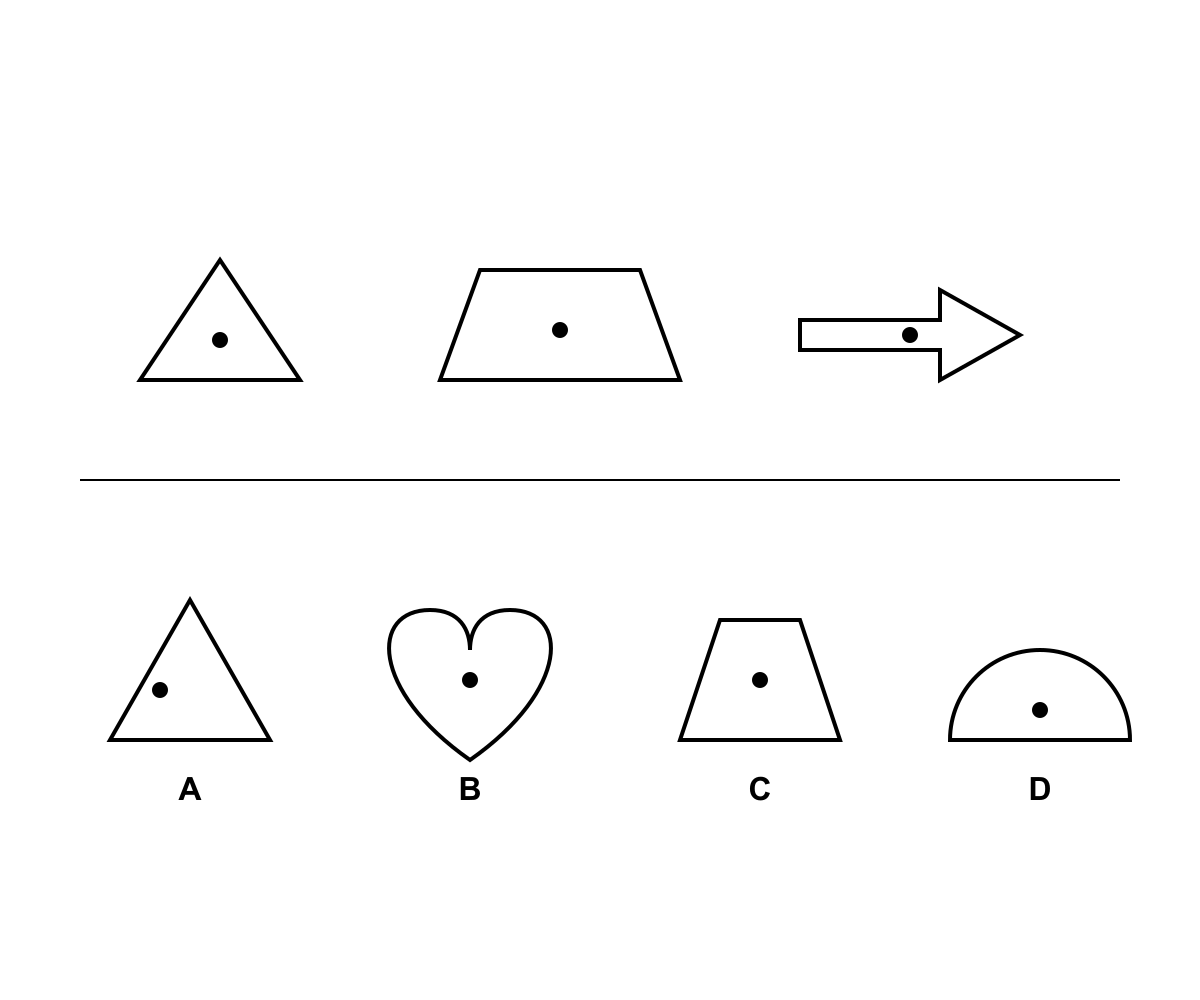
The figures on top share a common rule. Which of the answer choices does NOT belong with them?
- Figure A (correct answer)
- Figure B
- Figure C
- Figure D
Explanation: Each top figure is a shape that has exactly one line of symmetry AND contains exactly one small black circle placed ON that line of symmetry. In Figure A, the shape has one line of symmetry, but the black circle is placed OFF the axis of symmetry. B, C, and D all have the dot directly on the line of symmetry.
Question 2
Look carefully at the classification shown. Which figure completes the second group by the SAME rule that defines the first group?
- A black star with 5 points
- A white star with 6 points and a dot in the center
- A striped star with 5 points
- A white star with 5 points and a dot in the center (correct answer)
Explanation: The first group shows shapes that are all WHITE (unshaded), have an ODD number of points/sides, and contain a single dot at the center. The second group must follow the same three attributes. D is a white (unshaded) 5-pointed star (odd number of points) with a center dot — all three attributes match. A is black. B has an even number of points (6). C is striped, not white.
Question 3
Look at the figures in the box. Which answer choice does NOT belong with the others?
- Figure A
- Figure B (correct answer)
- Figure C
- Figure D
Explanation: Each figure consists of a polygon with a smaller identical polygon inside it, rotated 45° relative to the outer one, AND the inner shape is shaded. In Figure B, the inner shape is the same rotation as the outer (not rotated 45°), so it fails the orientation attribute. A, C, and D all show the inner polygon rotated 45° from the outer and shaded.
Question 4
Three figures on the left belong together. Based on the shared attributes, which of the figures on the right belongs with them?
- Figure A
- Figure B
- Figure C (correct answer)
- Figure D
Explanation: The three grouped figures each contain exactly one curved part and one straight part, and the curved part is always on the LEFT side of the figure. Figure C has a curve on the left and a straight segment on the right, matching both attributes. A has curve on the right (wrong orientation); B has two curves and no straight part; D has two straight parts and one curve, but the curve is on the bottom, not the left.
Question 5
Group: two-headed plain arrows, one left and one down. Which belongs?
- one-headed plain arrow up
- two-headed dotted arrow right
- two-headed plain arrow right (correct answer)
- two-headed split arrow right
Explanation: The group is defined by two-headed arrows with plain, solid shafts. Left and down set the direction, but direction isn't fixed, so a two-headed plain arrow right fits. The two-headed dotted arrow right is tempting because it also points right, but its dotted shaft breaks the plain-shaft rule.
Question 6
Set: figures with vertical divider, right half shaded. Which belongs?
- horizontal divider, right dark
- vertical divider, left dark
- vertical divider, no shading
- vertical divider, right dark (correct answer)
Explanation: The set requires a vertical divider with the right half shaded, so the matching figure is a vertical divider with the right side dark. A vertical divider with the left half shaded has the right divider but puts the shading on the wrong side, so it does not belong.
Question 7
Group: tall unshaded rectangles and tall unshaded ovals. Which belongs?
- tall unshaded triangle (correct answer)
- short unshaded rectangle
- tall shaded rectangle
- short shaded triangle
Explanation: The group varies only in shape (rectangle or oval), so shape is not the rule. The rule is tall and unshaded. A tall unshaded triangle fits. The short unshaded rectangle is tempting because it is unshaded and a rectangle, but it fails the tall condition.
Question 8
Set: outlined figures with one centered dot. Which belongs?
- outlined figure, corner dot
- filled figure, center dot
- outlined figure, center dot (correct answer)
- outlined figure, two dots
Explanation: The set requires two features: the figure must be outlined, not filled, and it must have exactly one dot in its center. An outlined figure with a centered dot matches both. The outlined figure with a corner dot is the tempting miss: it has the outline and a dot, but the dot isn't centered, so it fails the set.
Question 9
Which figure does NOT belong with the others in the row shown?
- Figure 1
- Figure 2 (correct answer)
- Figure 3
- Figure 4
Explanation: In Figures 1, 3, and 4, each is composed of exactly THREE parts: one large shape, one medium shape, and one small shape, stacked from largest (bottom) to smallest (top). Figure 2 has three parts but the medium shape is on top rather than in the middle, violating the size-ordering rule.
Question 10
The three figures on the left are alike in TWO ways. Which figure on the right shares BOTH of those attributes?
- Figure A
- Figure B
- Figure C
- Figure D (correct answer)
Explanation: The three reference figures share: (1) they are each made of exactly TWO overlapping shapes, and (2) the overlap region is SHADED while the non-overlapping parts are unshaded. Figure A has two shapes but the non-overlap regions are shaded (reversed). Figure B has three overlapping shapes, not two. Figure C has two shapes but no overlap (they merely touch). Figure D shows two overlapping shapes with only the intersection shaded, matching both attributes.
Question 11
Look at the four figures in the top row. Three of them are alike in a certain way. Which figure in the answer choices belongs with those three?
- A black triangle pointing right with two dots inside
- A white pentagon pointing up with three dots inside (correct answer)
- A black square with four dots inside
- A white hexagon with five dots inside
Explanation: In the top row, each figure is white, has a number of internal dots equal to (number of sides − 2), and has at least one vertex pointing up. Choice B (pentagon, 5 sides, 3 dots, point up) matches all three attributes. A fails because the figure is black and does not point up; C fails because it is black and has 4 dots (would need 2); D fails because it has 5 dots (would need 4) and no vertex pointing up.
Question 12
Study the four figures labeled 1 through 4. Three share a rule about parts. Which answer choice identifies the figure that does NOT follow the rule?
- Figure 1
- Figure 2
- Figure 3 (correct answer)
- Figure 4
Explanation: In Figures 1, 2, and 4, the number of small shapes inside equals the number of sides of the outer shape minus 1. Figure 1: triangle (3 sides) with 2 dots. Figure 2: square (4 sides) with 3 dots. Figure 4: hexagon (6 sides) with 5 dots. Figure 3 is a pentagon (5 sides) with only 3 dots (should be 4), so it breaks the pattern.
Question 13
Study the figures in the top group. Which of the choices below belongs with the group?
- A 3×3 grid with the four corners shaded
- A 3×3 grid with center and four edge-middles shaded (correct answer)
- A 3×3 grid with three squares shaded in an L-shape
- A 3×3 grid with one diagonal completely shaded
Explanation: Each reference figure is a 3×3 grid with exactly 5 shaded squares arranged in a pattern with both horizontal and vertical symmetry. Choice B (center plus 4 edge-middles forming a plus sign) has 5 shaded squares and both symmetries. A has only 4 shaded squares. C has 3 shaded squares and no symmetry. D has 3 squares shaded with only diagonal symmetry.
Question 14
Look at the group of figures above. Which figure in the answer choices belongs to the same group?
- A right-pointing arrow with a striped tail
- An up-pointing arrow with a solid black tail
- A left-pointing arrow with a white tail and a dotted head
- A down-pointing arrow with a striped head and white tail (correct answer)
Explanation: Every figure in the group is an arrow in which the HEAD is striped and the TAIL is white (unshaded). Choice D matches this pattern: striped head and white tail. A has the striping in the wrong part (tail instead of head). B has solid coloring, not striped. C has a dotted head, not striped.
Question 15
Based on the figure classification shown, which choice belongs with the three figures on the left?
- A circle divided into 4 equal parts with 2 opposite parts shaded
- A circle divided into 6 equal parts with 3 alternating parts shaded (correct answer)
- A circle divided into 8 equal parts with 4 consecutive parts shaded
- A circle divided into 5 equal parts with 2 adjacent parts shaded
Explanation: Each reference circle is divided into an even number of equal parts (6, 8, 10), with exactly half the parts shaded in an alternating pattern. Choice B follows this rule: 6 parts (even), 3 shaded alternately (half). A has only 4 parts, breaking the pattern of 6 or more. C has consecutive shading, not alternating. D has an odd number of parts (5) and adjacent shading.