Practice Identifying Truss Components in Statics with focused quiz questions that help you check what you know, review explanations, and build confidence with test-style prompts.
What this quiz covers
This quiz focuses on Identifying Truss Components, giving you a quick way to practice the rules, question types, and explanations that matter most for Statics.
How to use this quiz
Try each quiz question before looking at the correct answer. Use the explanations to review missed ideas, then come back to similar questions until the pattern feels familiar.
All questions
Question 1
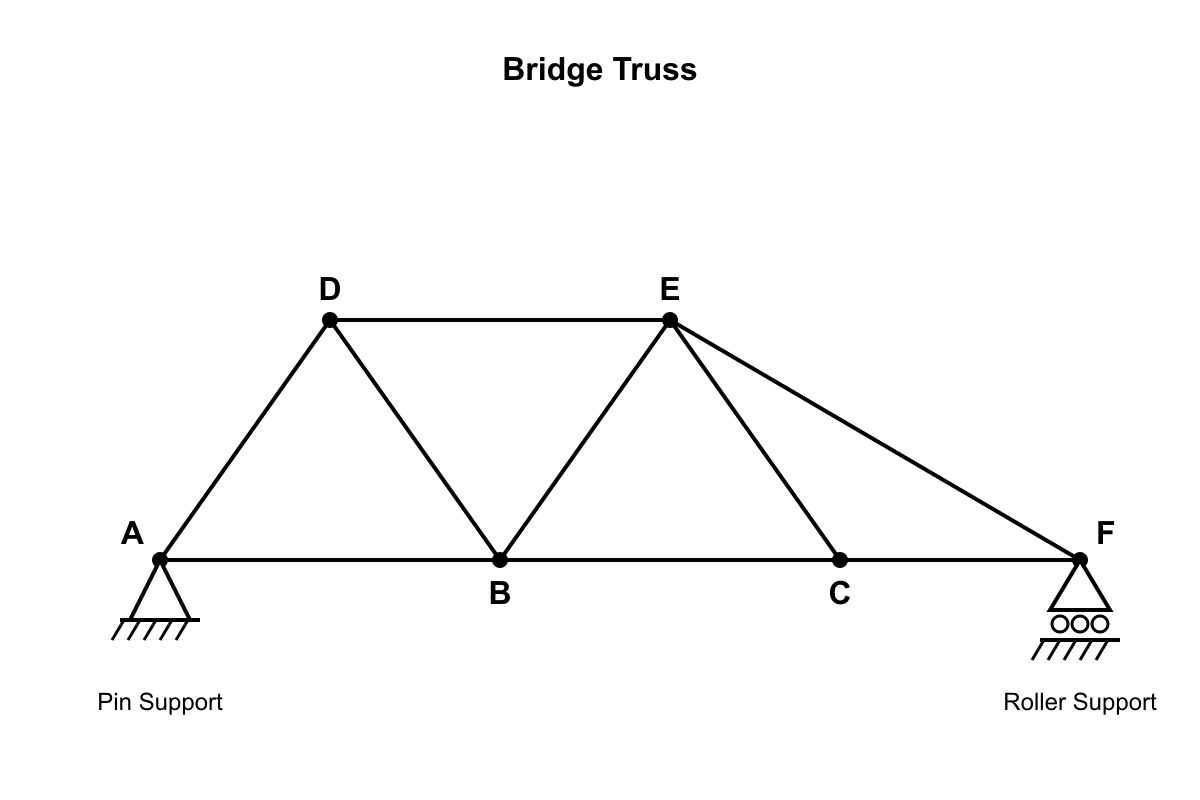
In the bridge truss shown, which joints are classified as support joints?
Only joint A since it has both horizontal and vertical reaction components
Only joint F since it allows horizontal movement while preventing vertical movement
Joints A and F since they both provide reaction forces to the foundation (correct answer)
Joints A, B, and F since they are all connected to the bottom chord
All joints that connect more than two members should be considered supports
Explanation: Support joints are those that connect the truss to its foundation or support structure and provide reaction forces. Both joint A (pin support) and joint F (roller support) are support joints since they transfer loads from the truss to the supports, regardless of how many reaction components each provides.
Question 2
A student identifies the following components in a roof truss: 12 joints, 21 members, and 3 reaction components. What can be concluded about this truss configuration?
The truss is statically determinate since 2j = m + r (24 = 21 + 3) (correct answer)
The truss is statically indeterminate with one degree of indeterminacy
The truss is unstable due to insufficient constraints for equilibrium
The truss has exactly the right number of members for stability
The truss configuration cannot exist due to contradictory joint count
Explanation: When analyzing truss configurations, you need to apply the fundamental relationship between joints (j), members (m), and reaction components (r) to determine static determinacy. The key equation is 2j=m+r, which represents the condition for static determinacy in a planar truss.With 12 joints, 21 members, and 3 reaction components, let's check this relationship: 2(12)=24 and 21+3=24. Since 2j=m+r (24 = 24), the equation is satisfied exactly, confirming that answer A is correct - the truss is statically determinate.Answer B is incorrect because static indeterminacy occurs when m+r>2j, meaning you have more unknowns than equilibrium equations available. Here, the numbers balance perfectly, so there's no indeterminacy.Answer C misinterprets the situation entirely. Instability occurs when m+r<2j, indicating insufficient constraints. Since our equation balances, the truss has adequate constraints for equilibrium.Answer D uses vague language about having the "right number of members for stability." While the truss does have the correct number of members relative to joints and reactions, this phrasing doesn't demonstrate understanding of the determinacy condition.Remember this pattern: when 2j=m+r, you have exactly enough equations to solve for all unknowns, making the structure statically determinate. This is the "sweet spot" for truss analysis - not too few constraints (unstable) and not too many (indeterminate).
Question 3
A truss analysis reveals that member BC carries 15 kN tension, member CD carries 10 kN compression, and member BD carries 8 kN tension. At joint D, if member DE is the only other connected member, what can be determined about member DE?
Member DE must carry 12 kN compression to maintain equilibrium at joint D
Member DE force magnitude depends on the angle between members CD and DE (correct answer)
Member DE must carry exactly 10 kN tension to balance member CD
Member DE force cannot be determined without knowing all applied loads
Member DE carries zero force since joint D has three members in equilibrium
Explanation: When analyzing forces at a truss joint, you must apply the principle of static equilibrium: the sum of forces in both x and y directions must equal zero. This requires knowing both the magnitude and direction of all forces acting at the joint.At joint D, you have three known forces: CD (10 kN compression), BD (8 kN tension), and DE (unknown). To find DE's force using equilibrium equations ∑Fx=0 and ∑Fy=0, you need to resolve each force into its x and y components. This requires knowing the angle that each member makes with the horizontal (or with each other).The correct answer is B because the force in DE depends entirely on the geometric arrangement of the members. The same magnitude forces from CD and BD will require different equilibrating forces in DE depending on whether the members meet at 30°, 60°, 90°, or any other angle.Answer A incorrectly assumes you can determine a specific force value without knowing member orientations. Answer C makes the oversimplified assumption that DE simply "balances" CD with equal and opposite force, ignoring the contribution from member BD and the vector nature of forces. Answer D is wrong because you actually can determine DE's force once you know the geometry - you don't need information about external loads since those are already reflected in the given member forces.Remember: joint equilibrium problems always require both force magnitudes and directions. When geometry is missing, the problem becomes indeterminate regardless of how many force values you're given.
Question 4
A structural engineer counts 8 joints and 11 members in a proposed truss design with standard pin and roller supports. What is the most likely issue with this design?
The truss has insufficient members and will be unstable under load (correct answer)
The truss has too many members and will be statically indeterminate
The truss is properly designed since it satisfies 2j > m + r
The member count is correct but the joint count should be increased
The design is acceptable if proper support reactions are provided
Explanation: When analyzing truss stability, you need to apply the fundamental relationship between joints (j), members (m), and reactions (r). For a statically determinate and stable truss, the equation m+r=2j must be satisfied, where the factor of 2 accounts for the two equilibrium equations (ΣFx = 0 and ΣFy = 0) available at each joint.With 8 joints and 11 members, plus 3 reactions from standard pin and roller supports, you have: 11+3=14 total constraints, but 2(8)=16 equilibrium equations. Since 14 < 16, the structure lacks sufficient constraints to maintain stability under load.Choice A correctly identifies that insufficient members create instability. The truss needs at least 13 members (plus 3 reactions) to equal the 16 equilibrium equations required.Choice B is wrong because having too many members would make m+r>2j, leading to static indeterminacy. Here, we have the opposite problem with m+r<2j.Choice C incorrectly states the stability criterion. The condition 2j>m+r actually indicates instability, not proper design. This truss satisfies this inequality (16 > 14), confirming the problem rather than proper design.Choice D misses the core issue entirely. Adding more joints without proportionally increasing members would only worsen the stability problem by creating even more equilibrium equations to satisfy.Remember: Always check m+r=2j for truss analysis. If the left side is smaller, you have instability; if larger, you have indeterminacy.
Question 5
When identifying zero-force members in a truss, which joint configuration typically indicates a zero-force member?
Any joint where exactly three members meet and no external load is applied
A joint where two non-collinear members meet and no external load is applied
A joint where four or more members meet regardless of loading conditions
A joint where two collinear members meet with one additional member and no external load (correct answer)
Any joint that connects to both tension and compression members simultaneously
Explanation: When analyzing trusses, identifying zero-force members is crucial for simplifying your calculations. Zero-force members carry no internal force and can be temporarily removed from your analysis without affecting the structure's equilibrium.The key principle is applying equilibrium equations (∑Fx=0 and ∑Fy=0) at joints. When two collinear members meet with one additional member and no external load is applied, the additional member must be a zero-force member. Here's why: the two collinear members can only exert forces along their common line of action. For the joint to be in equilibrium, the third member would need to provide a force component perpendicular to this line. Since there's no external load to balance, this perpendicular component must be zero, meaning the third member carries no force.Option A is incorrect because three non-collinear members at an unloaded joint can all carry force while maintaining equilibrium. Option B describes a stable joint configuration where both members typically carry force to maintain equilibrium - this doesn't create a zero-force condition. Option C is wrong because joints with four or more members don't automatically contain zero-force members, regardless of loading; you'd need to analyze the specific geometry and loading.Remember this pattern: look for the "odd member out" - when two members are collinear and a third member branches off at an unloaded joint, that branching member is your zero-force member. This is one of the most reliable zero-force identification rules in truss analysis.
Question 6
When analyzing the joint at the intersection of the top chord and a vertical web member in a truss, which statement about member identification is most accurate?
The vertical member always carries compression while chord members carry tension
Member forces depend on loading, but member types are defined by geometric position (correct answer)
Chord members are always longer than web members in any truss configuration
Web members can be removed without affecting the primary load-carrying capacity
Member identification changes based on the direction of applied loads
Explanation: When analyzing truss members, you need to distinguish between structural classification and force analysis. Truss members are categorized by their geometric position and structural role, not by the forces they carry under specific loading conditions.Option B correctly identifies this fundamental principle. Members are classified as chord members (top and bottom horizontal elements that form the main structural outline) or web members (internal diagonal and vertical elements) based on their geometric position in the truss configuration. However, the actual forces—whether tension or compression—depend entirely on the applied loads, load magnitude, and load location. The same member can experience tension under one loading scenario and compression under different loading conditions.Option A incorrectly assumes that member forces are predetermined by member type. Vertical web members can carry either tension or compression depending on loading patterns, and chord members similarly experience varying force types based on load distribution and truss geometry.Option C makes a false geometric generalization. While chord members are often longer in many common truss configurations, this isn't universally true. Some truss designs have web members that exceed chord member lengths, particularly in trusses with steep angles or unusual proportions.Option D dangerously misunderstands structural behavior. Web members are critical for maintaining truss stability and transferring loads between chord members. Removing web members would compromise the truss's ability to carry loads and could lead to structural failure.Remember: In truss analysis, always separate member classification (based on geometry) from force analysis (based on loading). This distinction is crucial for proper structural understanding.
Question 7
A truss joint connects five members with forces of 20 kN, 15 kN, 12 kN, and 8 kN in four of the members. If the joint is in equilibrium and no external loads are applied, what can be concluded about the fifth member?
The fifth member must carry 55 kN to balance the sum of other forces
The fifth member force depends on the angular orientations of all members (correct answer)
The fifth member must be a zero-force member since five members cannot equilibrate
The fifth member force equals the vector sum of the other four member forces
The problem cannot be solved without additional equilibrium equations from other joints
Explanation: When analyzing truss joints in equilibrium, you must consider that forces are vectors with both magnitude and direction. The key principle is that the vector sum of all forces at a joint must equal zero for equilibrium: ∑F=0.The correct answer is B because the fifth member's force absolutely depends on the angular orientations of all members. Even though you know the magnitudes of the four forces (20 kN, 15 kN, 12 kN, and 8 kN), you cannot determine the fifth force without knowing the direction each member points. For example, if all four known forces point in the same direction, the fifth member would need a large force to balance them. But if some forces oppose others, the required balancing force could be much smaller.Option A incorrectly assumes you simply add the force magnitudes (20+15+12+8 = 55 kN), ignoring that forces are vectors that must be added considering their directions. Option C contains a fundamental misconception - there's no limit on how many members can meet at a joint and still be in equilibrium, as long as their vector sum equals zero. Option D is closer but imprecise in its wording; the fifth member force equals the negative of the vector sum of the other four forces, not simply "the vector sum."Remember: whenever you see truss problems mentioning force magnitudes but not directions, immediately think about how the geometry affects the solution. Force magnitudes alone are never sufficient - you always need directional information to solve for unknown forces in trusses.
Question 8
When examining a truss joint that connects four members, what is the maximum number of unknown forces that can be solved using equilibrium equations at that joint alone?
Four unknown forces can be solved since there are four members present
Three unknown forces can be solved using two equilibrium equations plus geometry
Two unknown forces can be solved using the two available equilibrium equations (correct answer)
Only one unknown force can be solved due to the complexity of the joint
No unknown forces can be solved without additional information from other joints
Explanation: When analyzing truss joints, you're applying the fundamental principle that equilibrium equations are your primary tool for solving unknown forces. At any joint in a truss, you have exactly two equilibrium equations available: ∑Fx=0 and ∑Fy=0. This is true regardless of how many members connect at that joint.The correct answer is C because these two equilibrium equations can solve for a maximum of two unknown forces. This is a basic principle of algebra - you need at least as many independent equations as you have unknowns to solve a system.Option A incorrectly assumes that the number of solvable unknowns equals the number of members. Having four members at a joint doesn't give you four equations - you still only have two equilibrium conditions. Option B suggests that geometry provides an additional equation, but geometric relationships (like member angles) are constraints you use within your equilibrium equations, not separate solving equations. Option D underestimates the power of equilibrium analysis - joint complexity doesn't reduce the number of equations available.This limitation is why the method of joints for truss analysis requires strategic thinking. You typically start at joints where only two members have unknown forces, solve those, then move to adjacent joints where your previous solutions reduce the unknowns to two or fewer. Remember: two equilibrium equations maximum means two unknowns maximum at any single joint analysis.
Question 9
A truss designer proposes a structure with 6 joints, 9 members, and plans to use one pin support and one roller support. What modification is needed for structural adequacy?
Add 2 more members to satisfy the stability requirement of 2j = m + r
Remove 3 members to prevent static indeterminacy in the structure
Add 1 more joint to balance the member-to-joint ratio properly
Change one support to a fixed support to increase reaction components
The current design is adequate and requires no structural modifications (correct answer)
Explanation: When analyzing truss stability, you need to apply the fundamental relationship for statically determinate structures: 2j=m+r, where j = joints, m = members, and r = reaction components.Let's check the proposed structure: 6 joints, 9 members, one pin support (2 reactions), and one roller support (1 reaction) gives us r = 3 total reactions. Substituting into our equation: 2(6)=12, but m+r=9+3=12. The equation is satisfied, so the structure appears mathematically stable.However, there's a critical issue not addressed by the basic equation: geometric stability. A structure can satisfy 2j=m+r yet still be geometrically unstable if members are arranged improperly, creating mechanisms or causing instability due to concurrent reaction forces.Answer A incorrectly suggests adding 2 members, but this would create m+r=11+3=14>12, making the structure statically indeterminate, not more stable. Answer B wrongly claims removing 3 members would help, but this would create m+r=6+3=9<12, making the structure unstable and underconstrained. Answer C suggests adding a joint, but this would require 2(7)=14 while keeping m+r=12, creating instability. Answer D proposes changing to a fixed support, which would give r = 5, making m+r=14>12 and creating indeterminacy.The key insight: always check both mathematical determinacy using 2j=m+r AND geometric stability by examining member arrangements and support locations. Both conditions must be satisfied for a properly functioning truss.
Question 10
A student counts the structural components in a transmission tower truss and finds 15 joints, 25 members, and determines there are 6 support reaction components. What is the degree of static indeterminacy?
The structure is statically determinate with zero degree of indeterminacy
The structure has one degree of static indeterminacy requiring additional analysis (correct answer)
The structure has two degrees of static indeterminacy due to excess members
The structure is unstable and cannot be analyzed using statics alone
The degree of indeterminacy cannot be determined without member arrangement details
Explanation: When analyzing trusses, you need to determine if the structure can be solved using equilibrium equations alone or if it requires additional methods due to having more unknowns than available equations.To find the degree of static indeterminacy, use the formula: Degree=m+r−2j, where m is the number of members, r is the number of reaction components, and j is the number of joints.Substituting the given values: Degree=25+6−2(15)=25+6−30=1Since the result is positive (1), this structure has one degree of static indeterminacy, meaning it has one more constraint than necessary for stability and requires methods beyond simple equilibrium equations to solve.Answer A is incorrect because a statically determinate structure would yield a degree of zero, not one. Answer C is wrong because the calculation clearly shows one degree, not two degrees of indeterminacy. Answer D is incorrect because a negative degree would indicate instability—our positive result confirms the structure is stable but redundant.The key insight is that this transmission tower has one redundant member or support reaction. While this makes the structure more robust (failure of one member won't cause collapse), it also makes analysis more complex, requiring methods like the force method or displacement method.Remember: positive degree = statically indeterminate (over-constrained), zero degree = statically determinate (perfectly constrained), negative degree = unstable (under-constrained). Always check your arithmetic carefully when applying the indeterminacy formula.
Question 11
When examining a truss joint where a horizontal member, a vertical member, and a diagonal member meet, what information is needed to determine if any member carries zero force?
Only the angles between members since geometry determines zero-force conditions
Only the external loads applied at that specific joint location
Both the member orientations and any external loads applied at the joint (correct answer)
The material properties and cross-sectional areas of each member
The support conditions at the ends of the truss structure
Explanation: When analyzing truss joints for zero-force members, you're applying the method of joints, which requires considering both geometric constraints and loading conditions together.Zero-force members occur under specific circumstances at a joint. If only two non-collinear members meet at an unloaded joint, both must carry zero force to maintain equilibrium. If three members meet at an unloaded joint and two are collinear, the third member carries zero force. However, these geometric rules only apply when no external loads act at the joint.The correct answer is C because determining zero-force conditions requires both member orientations (geometry) and external loading information. You need the member angles to identify potential geometric configurations that could produce zero forces, but you also must know whether external loads are applied at the joint, since any external load can activate members that would otherwise carry zero force.Answer A is incomplete because geometry alone isn't sufficient—external loads can force all members to carry load regardless of their orientation. Answer B misses the geometric aspect entirely; even with loading information, you can't determine member forces without knowing how the members are oriented relative to each other. Answer D focuses on material properties and cross-sections, which affect member stresses and deflections but don't determine whether forces exist in the first place—that's purely a statics equilibrium question.Remember: Zero-force member identification always requires checking both the joint geometry AND the loading conditions. Geometry sets up the possibility, but loading determines whether that possibility becomes reality.
Question 12
In a space truss with tetrahedral elements, joint K connects to members KL, KM, KN, KP, KQ, and KR. If this joint is in equilibrium under applied loads, and members KL, KM, and KN are coplanar while KP, KQ, and KR are non-coplanar, what is the maximum number of unknown member forces that can be determined using equilibrium equations at joint K alone?
Three unknown forces can be determined using three equilibrium equations (correct answer)
Six unknown forces can be determined using three equilibrium equations
Four unknown forces can be determined using three equilibrium equations
Five unknown forces can be determined using three equilibrium equations
Explanation: At any joint in a space truss, there are three equilibrium equations available: ∑Fx=0, ∑Fy=0, and ∑Fz=0. Since we can only write three independent equilibrium equations at a joint, we can solve for at most three unknown forces, regardless of how many members connect to the joint. With six unknown member forces and only three equations, this joint alone cannot determine all member forces - additional information from other joints or methods of analysis would be required.
Question 13
A planar truss has pinned supports at joints A and C, with a roller support at joint B. Joint D is an internal joint connected to three members. If member CD fails and is removed from the structure, what type of structural element does the remaining connection at joint C become?
A fixed support capable of resisting moments and two force components
A pinned support resisting two perpendicular force components only (correct answer)
A roller support resisting one force component perpendicular to movement
An internal joint with zero force resistance in all directions
Explanation: When member CD is removed, joint C still has its original pinned support connection to the foundation, which provides reactions in two perpendicular directions (typically horizontal and vertical) but cannot resist moments. The removal of member CD doesn't change the fundamental nature of the support at C - it remains a pinned connection. A pinned support always resists forces in two directions regardless of how many truss members connect to it.
Question 14
A bridge truss has 15 joints and is supported by one pin support and one roller support. Using the method of joints for analysis, if 8 joints have already been analyzed and all forces determined, what is the total number of member forces that remain unknown?
Fourteen member forces remain unknown for the remaining joints
Ten member forces remain unknown for the remaining joints
Zero member forces remain unknown since analysis is complete (correct answer)
Six member forces remain unknown for the remaining joints
Explanation: In the method of joints, once you solve for member forces at a joint, those forces are known throughout the entire length of each member. When 8 joints have been completely analyzed in a statically determinate truss, and if the analysis was performed correctly, all member forces in the entire truss are determined. This is because truss members are two-force members with constant internal force along their length. The remaining 7 joints can be checked for equilibrium, but no new unknown forces remain to be determined.
Question 15
In the truss shown, which statement correctly identifies the structural components at joint C?
Joint C connects two compression members and has a pin support
Joint C connects two tension members and one compression member
Joint C connects three members and serves as a roller support
Joint C connects two members and serves as an internal hinge connection
Joint C connects three members with no external support reaction (correct answer)
Explanation: Joint C is an internal joint that connects three truss members (typically two diagonal members and one chord member) without any external support. It is neither a pin nor roller support, which only occur at the truss boundaries. The joint simply connects members and allows force transmission between them.
Question 16
In the truss configuration shown, which statement correctly describes the support conditions?
Joint A provides two reaction components while joint E provides one reaction component (correct answer)
Joint A provides vertical support only while joint E provides horizontal support only
Both joints A and E provide two reaction components each for stability
Joint A prevents all motion while joint E prevents only vertical motion
The support at joint A is redundant since joint E can carry all reactions
Explanation: Joint A has a pin support which provides two reaction components (horizontal and vertical). Joint E has a roller support which provides only one reaction component (vertical). This gives a total of 3 reaction components, which is appropriate for a statically determinate structure.
Question 17
In the parallel chord truss shown, what is the primary structural advantage of having parallel top and bottom chords?
Parallel chords ensure all web members have identical lengths for construction efficiency
Parallel chords create uniform depth providing consistent moment resistance along the span (correct answer)
Parallel chords allow web members to be oriented at optimal angles for force transfer
Parallel chords eliminate the need for diagonal web members in the truss design
Parallel chords reduce the total number of joints required for structural stability
Explanation: Parallel chords maintain constant truss depth along the span, providing uniform moment resistance. This is particularly advantageous for uniformly loaded spans where bending moment varies along the length but the structural depth remains constant, optimizing material use.
Question 18
In the space truss shown below, how many reaction components are typically provided by the support system?
Three reaction components since space structures require X, Y, and Z constraint
Six reaction components to prevent all possible rigid body motions in space
Four reaction components with one pin and one roller support arrangement
Nine reaction components due to the three-dimensional member configuration
Explanation: B
Question 19
A three-dimensional space frame has joint connections that must resist forces in multiple directions. If joint P connects to six members in space, and three of these members lie in the xy-plane while the other three have components in all three coordinate directions, which statement best describes the support requirements for the space frame?
Three reaction components are needed with one support preventing translation in each direction
Six reaction components are needed with two supports preventing all translations and rotations (correct answer)
Four reaction components are needed with supports preventing three translations and one rotation
Five reaction components are needed with supports preventing three translations and two rotations
Explanation: A three-dimensional space frame requires six reaction components to prevent rigid body motion: three to prevent translation in the x, y, and z directions, and three to prevent rotation about the x, y, and z axes. This typically requires two properly configured supports - for example, one fixed support providing three reaction components (preventing translation in three directions) and one support providing three additional reaction components (preventing the three rotational motions). The specific member configuration at joint P doesn't change the fundamental support requirements for the entire space frame structure.
Question 20
A roof truss has both top chord and bottom chord members, with web members connecting them. If the bottom chord member between joints 4 and 5 is removed for maintenance, and temporary cables are installed from joint 4 to joint 6 and from joint 5 to joint 3, what structural role do these temporary cables serve?
They function as permanent web members replacing the original diagonal configuration
They provide temporary stability connections but do not replace chord functions
They act as external supports providing additional reaction points to ground
They serve as temporary chord members maintaining the primary load path (correct answer)
Explanation: When analyzing truss modifications, you need to understand the distinction between chord members (primary load-carrying elements) and web members (connecting elements that provide stability and load distribution). The key is identifying what function the removed member served and how the temporary installation maintains structural integrity.The bottom chord member between joints 4 and 5 is a primary load-carrying element that helps form the main structural framework of the truss. When removed, this creates a gap in the continuous load path that must be maintained for the truss to function properly. The temporary cables from joint 4 to joint 6 and joint 5 to joint 3 create an alternative path that bypasses the removed section while preserving the chord's primary function of carrying loads around the truss perimeter.Option A is incorrect because these cables don't replace web members - they're specifically addressing the missing chord member, not diagonal bracing elements. Option B misses the critical point that these cables must replace the chord function, not just provide general stability. Option C is wrong because the cables connect existing joints within the truss structure rather than creating new ground support points or external reactions.Option D correctly identifies that the cables serve as temporary chord members. They maintain the essential load path that the removed bottom chord section normally provides, ensuring structural continuity during maintenance.Remember: when temporary structural modifications are made, the replacement elements must serve the same primary function as the removed components. In trusses, maintaining continuous chord paths is critical for load transfer.