Question 1 of 25
Fill in the blank.

SSAT Elementary Level Quantitative
Practice Test 3 for SSAT Elementary Level Quantitative: real questions and explanations from the Varsity Tutors practice-test pool.
0%
0 / 25 answered
Question 1 of 25
Fill in the blank.
Question Navigator
Fill in the blank.
 (correct answer)


Explanation: The opposite of multiplication is division. In order to find the missing piece of this multiplication problem we can divide.

What number is in the hundredths place of 
 (correct answer)


Explanation: Note the question asks for hundredTHS not hundreDS. The hundredths place of a number is two places to the right of the decimal. Thus the correct answer is 
Fill in the missing piece of the table.

 (correct answer)


Explanation: To solve this problem we can set up a proportion and cross multiply to solve for our unknown.


Fill in the missing piece of the table.

 (correct answer)


Explanation: To solve this problem we can set up a proportion and cross multiply to solve for our unknown.


 (correct answer)


Explanation: 


Kate's class is going to plant flowers outside of their class window. To help decide what flower to plant, her teacher took a class vote.
Use the graph below to help answer the question.
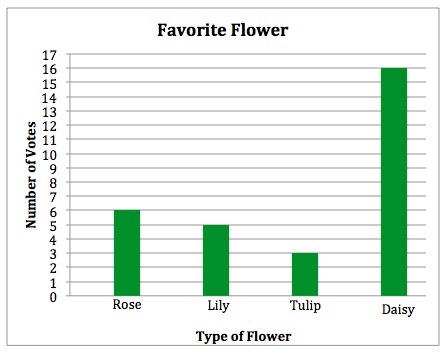
What is the title of the graph?
Explanation: The title of a bar graph can be found at the top of the graph, and it tells you what type of data the graph is displaying. In this case, our title is "Favorite Flower".
Fill in the blank.

 (correct answer)

Explanation: When we are counting, 

 (correct answer)


Explanation: To solve this problem, we multiply 


Use the chart below to answer the question.

How many students in first grade have a sibling?
 (correct answer)


Explanation: Each square represents 


If there are 2 blue marbles and 18 red marbles in a jar, what is the probability that Jeff will pick out a red marble?
 (correct answer)


Explanation: First, add the total number of marbles, which is 


 (correct answer)


Explanation: To add we count up. Start at 


What fraction of the number line is pink?

 (correct answer)


Explanation: The number line is split up into 


Use the computation shown to find the products:
 (correct answer)


Explanation: The computation shows that 


Find the sum.
 (correct answer)


Explanation: The correct answer is 841. We start in the ones column on the far right and add 6 and 5. This is 11 so we have to carry the tens digit (1) to the next column and being the ones digit (also a 1) down. Adding the tens column we get


 (correct answer)


Explanation: To add we count up. Start at 


Find the area of a triangle with a base of 6in and a height that is three times the base.
 (correct answer)


Explanation: To find the area of a triangle, we will use the following formula:


What two shapes can you find in this shape?

Explanation: 
Which of the choices below lists ONLY examples of triangles?
Explanation: isosceles: triangle with two equal sides and two equal angles scalene: triangle with no equal sides and no equal angles equilateral: triangle with three equal sides and three equal angles
 (correct answer)


Explanation: To subtract we can count backwards. Start at 


 (correct answer)


Explanation: When subtracting any number by 


 (correct answer)


Explanation: To subtract we can count backwards. Start at 


 (correct answer)


Explanation: To subtract we can count backwards. Start at 


Use the triangles  below to help you answer the subtraction problem.

 (correct answer)

Explanation: We have 


What is the area of the rectangle?

 (correct answer)


Explanation: We can find the area by counting the squares within the rectangle. There are 

 (correct answer)


Explanation: Add the "whole" parts of the numbers: 





