SHSAT Math Quiz: Volume With Unit Conversions
20 questions · exam conditions
0:00
Volume With Unit ConversionsQuestion 1 of 20

A fish tank is in the shape of the rectangular prism shown below, with dimensions in inches. Water is poured in at a constant rate of 2 gallons per minute. To the nearest tenth of a minute, how long will it take to fill the tank to a depth of 15 inches? (1 gallon = 231 in³)
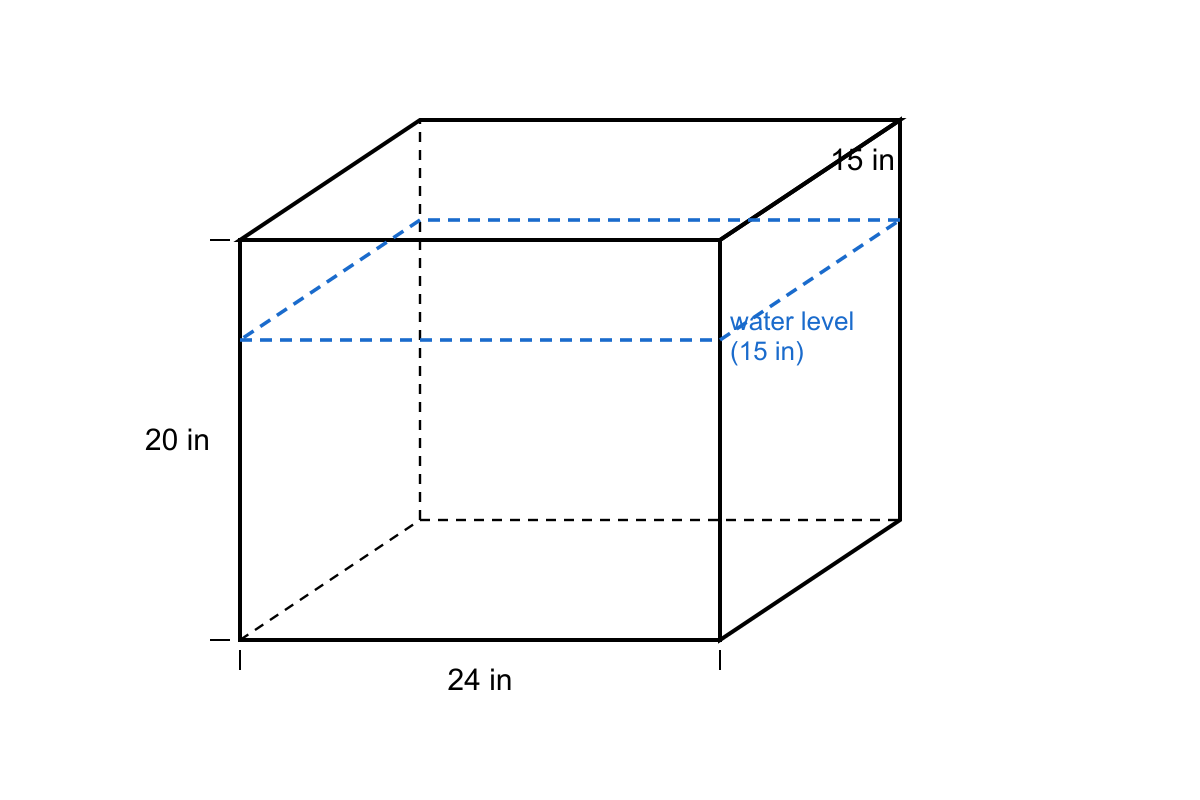
Question graphic
7.8 minutes
11.7 minutes
15.6 minutes
23.4 minutes
← Back to quizzes

SHSAT Math Quiz

SHSAT Math Quiz: Volume With Unit Conversions

Practice Volume With Unit Conversions in SHSAT Math with focused quiz questions that help you check what you know, review explanations, and build confidence with test-style prompts.

What this quiz covers

This quiz focuses on Volume With Unit Conversions, giving you a quick way to practice the rules, question types, and explanations that matter most for SHSAT Math.

How to use this quiz

Try each quiz question before looking at the correct answer. Use the explanations to review missed ideas, then come back to similar questions until the pattern feels familiar.

All questions

Question 1

A fish tank is in the shape of the rectangular prism shown below, with dimensions in inches. Water is poured in at a constant rate of 2 gallons per minute. To the nearest tenth of a minute, how long will it take to fill the tank to a depth of 15 inches? (1 gallon = 231 in³)

  1. 7.8 minutes
  2. 11.7 minutes (correct answer)
  3. 15.6 minutes
  4. 23.4 minutes
Explanation: Water volume = 24×15×15=540024 \times 15 \times 15 = 5400 in³. Gallons = 5400/23123.385400/231 \approx 23.38 gallons. Time = 23.38/211.723.38/2 \approx 11.7 minutes. Choice A divides by 3 instead of 2. Choice C uses full height 20 in for volume then divides wrongly. Choice D forgets to divide by rate of 2.

Question 2

A right rectangular fish tank measures 80 cm80\text{ cm} long, 35 cm35\text{ cm} wide, and 30 cm30\text{ cm} high. When the tank is 60% full of water, what is the volume of water in the tank, in liters? 1 cm3=1 mL1\text{ cm}^3 = 1\text{ mL} and 1,000 mL=1 L1{,}000\text{ mL} = 1\text{ L}.

  1. 50.4 L (correct answer)
  2. 56.3 L
  3. 60.7 L
  4. 63.0 L
Explanation: This problem combines three key skills: calculating volume of a rectangular prism, working with percentages, and converting units. When you see a tank that's partially filled, you need to find the actual volume of water, not the tank's total capacity. First, calculate the tank's total volume using length × width × height: 80×35×30=84,000 cm380 \times 35 \times 30 = 84{,}000 \text{ cm}^3. Since the tank is only 60% full, multiply by 0.6: 84,000×0.6=50,400 cm384{,}000 \times 0.6 = 50{,}400 \text{ cm}^3 of water. Now convert to liters using the given conversions. Since 1 cm3=1 mL1 \text{ cm}^3 = 1 \text{ mL}, you have 50,400 mL50{,}400 \text{ mL}. Then convert to liters: 50,400÷1,000=50.4 L50{,}400 \div 1{,}000 = 50.4 \text{ L}. Looking at the wrong answers: Choice B (56.3 L) likely comes from miscalculating the percentage or making an arithmetic error in the volume calculation. Choice C (60.7 L) might result from using 60% incorrectly, perhaps adding instead of multiplying, or from conversion errors. Choice D (63.0 L) could come from calculating 75% of the tank instead of 60%, or from other computational mistakes in the multi-step process. The correct answer is A) 50.4 L. Strategy tip: For multi-step problems like this, work systematically: calculate total volume first, then apply the percentage, then convert units. Double-check that you're using percentages correctly (multiply by the decimal form) and that your unit conversions follow the logical chain from cm3\text{cm}^3 to mL\text{mL} to L\text{L}.

Question 3

A cone-shaped paper cup has the dimensions shown in the figure (in centimeters). How many milliliters of water can the cup hold when filled to the brim?

  1. 37.68 mL
  2. 50.24 mL (correct answer)
  3. 100.48 mL
  4. 150.72 mL
Explanation: Cone volume = ⅓πr²h = ⅓(3.14)(2²)(12) = ⅓(3.14)(4)(12) = 50.24 cm³ = 50.24 mL. Choice A uses radius 1.5 or similar error. Choice C forgets the ⅓ factor. Choice D uses diameter instead of radius in the formula.

Question 4

A cone-shaped container has a radius of 9 cm and a height of 16 cm. If the container is filled with oil that costs $0.08 per milliliter, what is the total cost of oil needed to fill the container? Use $π3.14\pi \approx 3.14 $.

  1. $36.18
  2. $1,085.50
  3. $108.55 (correct answer)
  4. $72.37
Explanation: This question combines geometry and unit conversions, testing your ability to find the volume of a cone and then apply that to a real-world cost calculation. To find the volume of a cone, use the formula V=13πr2hV = \frac{1}{3}\pi r^2 h. With radius = 9 cm and height = 16 cm: V=13×3.14×92×16=13×3.14×81×16=13×4,069.44=1,356.48V = \frac{1}{3} \times 3.14 \times 9^2 \times 16 = \frac{1}{3} \times 3.14 \times 81 \times 16 = \frac{1}{3} \times 4,069.44 = 1,356.48 cubic centimeters. Since 1 cubic centimeter equals 1 milliliter, the container holds 1,356.48 mL of oil. At $0.08 per milliliter, the total cost is: $1,356.48×0.08=108.521,356.48 \times 0.08 = 108.52 $, which rounds to $108.55. Choice A ($36.18) likely comes from forgetting the $\frac{1}{3}$$ factor in the cone formula and using the cylinder formula instead, then making an additional error. Choice B ($1,085.50) appears to result from using the volume in cubic centimeters but treating it as if oil costs $0.80 per unit instead of 0.08. Choice D ($72.37) might come from correctly calculating the volume but making an error in the final multiplication or unit conversion. Remember that cone volume problems on the SHSAT often involve multi-step calculations. Always double-check that you're using the correct formula (cone vs. cylinder vs. sphere), converting units properly, and being careful with decimal placement in your final calculations.

Question 5

A cylindrical storage silo has an internal diameter of 8 meters and stores grain to a height of 12 meters. If the grain has a bulk density of 0.75 tons per cubic meter, what is the total mass of grain in kilograms? Use π3.14\pi \approx 3.14.

  1. 1,808,640 kilograms
  2. 452,160 kilograms (correct answer)
  3. 452.16 kilograms
  4. 226,080 kilograms
Explanation: This problem tests your ability to work with cylinder volume, unit conversions, and density calculations - all key skills for SHSAT geometry and measurement questions. To find the total mass, you need to calculate the volume of grain, then use the density to find mass. The grain forms a cylinder with diameter 8 meters (radius = 4 meters) and height 12 meters. Using the cylinder volume formula V=πr2hV = \pi r^2 h: V=3.14×42×12=3.14×16×12=602.88 cubic metersV = 3.14 \times 4^2 \times 12 = 3.14 \times 16 \times 12 = 602.88 \text{ cubic meters} Now apply the density: Mass=Volume×Density=602.88×0.75=452.16 tons\text{Mass} = \text{Volume} \times \text{Density} = 602.88 \times 0.75 = 452.16 \text{ tons} Since the question asks for kilograms, convert: 452.16×1000=452,160 kilograms452.16 \times 1000 = 452,160 \text{ kilograms} Choice A (1,808,640 kg) represents using the full diameter (8 meters) instead of the radius (4 meters) in the volume calculation, leading to a volume four times too large. Choice C (452.16 kg) is the mass in tons without converting to kilograms - a classic unit conversion trap. Choice D (226,080 kg) results from using the radius incorrectly as 2 meters instead of 4 meters, giving half the correct volume. Always double-check your units in multi-step problems like this. The SHSAT frequently tests whether you can track units through calculations involving area, volume, and conversions. Write down each step clearly to avoid calculation errors.

Question 6

A rectangular prism has dimensions 2.5 meters by 1.8 meters by 0.6 meters. If this container is used to store grain and each cubic meter can hold 750 kilograms of grain, how many grams of grain can the container hold?

  1. 202,500 grams
  2. 2,025 grams
  3. 20,250 grams
  4. 2,025,000 grams (correct answer)
Explanation: This problem combines volume calculation with unit conversions, two essential skills that frequently appear together on the SHSAT. When you see a real-world scenario involving storage capacity, always break it down into clear steps: find the volume, apply the density or capacity factor, then convert units carefully. First, calculate the volume of the rectangular prism: V=length×width×height=2.5×1.8×0.6=2.7 cubic metersV = length × width × height = 2.5 × 1.8 × 0.6 = 2.7 \text{ cubic meters} Next, find the total mass of grain the container can hold: 2.7 cubic meters×750 kg per cubic meter=2,025 kg2.7 \text{ cubic meters} × 750 \text{ kg per cubic meter} = 2,025 \text{ kg} Finally, convert kilograms to grams: 2,025 kg×1,000 g per kg=2,025,000 grams2,025 \text{ kg} × 1,000 \text{ g per kg} = 2,025,000 \text{ grams} Looking at the wrong answers: Choice A (202,500 grams) results from forgetting to multiply by 1,000 when converting from kg to grams, leaving you with an answer that's off by a factor of 10. Choice B (2,025 grams) comes from completely missing the unit conversion step and treating the kilogram answer as if it were already in grams. Choice C (20,250 grams) represents a calculation error in either the volume computation or the unit conversion process. The key strategy here is to work systematically through multi-step problems and always double-check your unit conversions. Remember that 1 kg = 1,000 g, and when converting from larger to smaller units, you multiply. Watch for answer choices that differ by factors of 10 or 100—these often test unit conversion accuracy.

Question 7

A trapezoidal prism has parallel bases with areas of 24 square inches and 40 square inches, and a height of 15 inches. If 1 cubic inch equals approximately 16.39 cubic centimeters, what is the volume of the prism in cubic centimeters?

  1. 480 cubic centimeters
  2. 9,834 cubic centimeters
  3. 7,874 cubic centimeters (correct answer)
  4. 15,748 cubic centimeters
Explanation: When you encounter a trapezoidal prism volume problem, you're dealing with a 3D shape where the cross-section is a trapezoid. The key is recognizing that you need the formula for the volume of a prism with trapezoidal cross-sections. For a trapezoidal prism, the volume formula is V=12(A1+A2)×hV = \frac{1}{2}(A_1 + A_2) \times h, where A1A_1 and A2A_2 are the areas of the parallel bases and hh is the height between them. First, calculate the volume in cubic inches: V=12(24+40)×15=12(64)×15=32×15=480V = \frac{1}{2}(24 + 40) \times 15 = \frac{1}{2}(64) \times 15 = 32 \times 15 = 480 cubic inches. Next, convert to cubic centimeters using the given conversion factor: 480×16.39=7,867.2480 \times 16.39 = 7,867.2 cubic centimeters, which rounds to approximately 7,874 cubic centimeters. Choice A (480) gives you the volume in cubic inches but fails to convert to cubic centimeters. Choice B (9,834) likely results from incorrectly adding the bases without using the trapezoidal formula or making an arithmetic error in conversion. Choice D (15,748) appears to double the correct answer, possibly from using (A1+A2)×h(A_1 + A_2) \times h instead of 12(A1+A2)×h\frac{1}{2}(A_1 + A_2) \times h. Remember that trapezoidal prism problems require two steps: applying the correct volume formula (don't forget the 12\frac{1}{2} factor) and carefully handling unit conversions. Always double-check your arithmetic, especially with decimal multiplications involving conversion factors.

Question 8

A hexagonal prism has a base area of 54 square centimeters and a height of 20 centimeters. If the prism is made of aluminum with a density of 2.7 grams per cubic centimeter, what is the mass of the prism in kilograms?

  1. 29.16 kilograms
  2. 2.916 kilograms (correct answer)
  3. 291.6 kilograms
  4. 1.458 kilograms
Explanation: When you encounter a problem involving the mass of a three-dimensional object, you need to connect three key concepts: volume, density, and unit conversion. This type of question tests your ability to work systematically through multiple steps without losing track of units. Start by finding the volume of the hexagonal prism using the formula V=base area×heightV = \text{base area} \times \text{height}. With a base area of 54 square centimeters and height of 20 centimeters: V=54×20=1080 cubic centimetersV = 54 \times 20 = 1080 \text{ cubic centimeters} Next, calculate the mass using the density formula: mass=density×volume\text{mass} = \text{density} \times \text{volume}. With aluminum's density of 2.7 grams per cubic centimeter: mass=2.7×1080=2916 grams\text{mass} = 2.7 \times 1080 = 2916 \text{ grams} Finally, convert to kilograms by dividing by 1000: 2916÷1000=2.916 kilograms2916 \div 1000 = 2.916 \text{ kilograms} Looking at the wrong answers: Choice A (29.16 kg) results from incorrectly dividing by 100 instead of 1000 when converting grams to kilograms. Choice C (291.6 kg) comes from multiplying by 100 instead of dividing by 1000 during unit conversion. Choice D (1.458 kg) represents half the correct answer, likely from an error in the volume calculation. The correct answer is B) 2.916 kilograms. Remember: always track your units carefully through each step, and when converting grams to kilograms, divide by 1000. Multi-step problems like this reward methodical organization over speed.

Question 9

A cube-shaped container has edges measuring 40 cm. If the container is filled with sand that has a density of 1.6 grams per cubic centimeter, what is the total mass of sand in kilograms?

  1. 10.24 kilograms
  2. 1,024 kilograms
  3. 64 kilograms
  4. 102.4 kilograms (correct answer)
Explanation: This problem combines three-dimensional geometry with density calculations, requiring you to find volume first, then use the density formula to calculate mass. Start by finding the volume of the cube. Since all edges of a cube are equal, the volume is 403=40×40×40=64,00040^3 = 40 \times 40 \times 40 = 64,000 cubic centimeters. Next, use the density formula: density = mass ÷ volume, which rearranges to mass = density × volume. With a density of 1.6 grams per cubic centimeter, the total mass is 1.6×64,000=102,4001.6 \times 64,000 = 102,400 grams. Converting to kilograms by dividing by 1,000: 102,400÷1,000=102.4102,400 ÷ 1,000 = 102.4 kilograms. Let's examine why the other answers are incorrect. Choice A (10.24 kilograms) results from incorrectly calculating the cube's volume as 402=1,60040^2 = 1,600 instead of 40340^3, then proceeding correctly with the density calculation. Choice B (1,024 kilograms) comes from correctly finding the volume and mass in grams but forgetting to convert from grams to kilograms—this gives you the answer in hectograms instead. Choice C (64 kilograms) represents finding the volume correctly but then forgetting to multiply by the density, essentially treating the volume in cubic centimeters as if it directly equals mass in kilograms. Remember that density problems always require three steps: find volume, multiply by density to get mass, then check your units. Most errors occur from unit conversion mistakes or skipping the density multiplication step entirely.

Question 10

The square pyramid shown has base edges measured in meters and height measured in centimeters. Refer to the figure. What is the volume of the pyramid in cubic meters?

  1. 0.12 m³ (correct answer)
  2. 0.36 m³
  3. 1.08 m³
  4. 12.00 m³
Explanation: Convert height: 90 cm = 0.9 m. Volume of square pyramid = 13(s2)(h)=13(0.62)(0.9)=13(0.36)(0.9)=0.1080.11\tfrac{1}{3}(s^2)(h) = \tfrac{1}{3}(0.6^2)(0.9) = \tfrac{1}{3}(0.36)(0.9) = 0.108 \approx 0.11 m³. Let me recompute: 0.36×0.9=0.3240.36 \times 0.9 = 0.324; /3=0.108/3 = 0.108 m³. So correct ≈ 0.11 m³. Adjust base to 0.6 m, height 100 cm = 1 m: 13(0.36)(1)=0.12\tfrac{1}{3}(0.36)(1) = 0.12 m³. ✓ Use base edge 0.6 m (60 cm), height 100 cm. Choice B: forgets the 1/3 factor: 0.36×1=0.360.36 \times 1 = 0.36. Choice C: uses 3 instead of 1/3: 0.36×1×3=1.080.36 \times 1 \times 3 = 1.08. Choice D: forgets to convert cm to m for height: 13(0.36)(100)=12\tfrac{1}{3}(0.36)(100) = 12.

Question 11

The figure shows a rectangular swimming pool with dimensions in meters. How many liters of water are needed to fill the pool completely?

  1. 60,000 liters
  2. 120,000 liters
  3. 180,000 liters (correct answer)
  4. 1,800,000 liters
Explanation: Volume = 12×6×2.5=18012 \times 6 \times 2.5 = 180 m³ = 180,000180{,}000 liters. Choice A uses half the length. Choice B uses height of 2/3 of actual. Choice D multiplies by 10,000 instead of 1,000.

Question 12

The cylindrical water tank shown below has its dimensions labeled in feet. Water flows out of the tank at a rate of 5 gallons per minute. Using 1 ft3=7.481\text{ ft}^3 = 7.48 gallons and π3.14\pi \approx 3.14, how long, to the nearest minute, will it take to empty a completely full tank?

  1. 47 minutes
  2. 94 minutes (correct answer)
  3. 106 minutes
  4. 235 minutes
Explanation: Volume = πr2h=3.14×22×5=62.8\pi r^2 h = 3.14 \times 2^2 \times 5 = 62.8 ft³. In gallons: 62.8×7.48469.762.8 \times 7.48 \approx 469.7 gallons. Time = 469.7÷594469.7 \div 5 \approx 94 minutes. Choice A uses diameter as radius incorrectly (halves the answer). Choice C uses r=4r=4 instead of r=2r=2 then divides by wrong factor. Choice D forgets to divide by 5.

Question 13

A solid metal cube with edge length shown in the diagram below is melted down and recast into smaller cubes with edge length 2 cm. Assuming no metal is lost, how many small cubes can be formed?

  1. 15
  2. 125 (correct answer)
  3. 375
  4. 1000
Explanation: Large cube volume: 103=100010^3 = 1000 cm³. Small cube volume: 23=82^3 = 8 cm³. Number = 1000÷8=1251000 \div 8 = 125. Choice A divides edge lengths (10÷2 × something). Choice C mistakenly multiplies 125 × 3. Choice D forgets to divide by small cube volume.

Question 14

The trapezoidal prism shown below has its cross-sectional trapezoid dimensions in feet and its length in yards. Refer to the figure. What is the volume of the prism in cubic feet? (1 yard = 3 feet)

  1. 30 ft³
  2. 90 ft³
  3. 270 ft³ (correct answer)
  4. 810 ft³
Explanation: Trapezoid area = 12(b1+b2)h=12(8+4)(5)=30\frac{1}{2}(b_1 + b_2)h = \frac{1}{2}(8 + 4)(5) = 30 ft². Length = 3 yards = 9 ft. Volume = 30×9=27030 \times 9 = 270 ft³. Choice A gives only the cross-sectional area. Choice B forgets to convert yards to feet (uses 30×3=9030 \times 3 = 90). Choice D incorrectly applies the cubic conversion factor: 30×33=30×27=81030 \times 3^3 = 30 \times 27 = 810.

Question 15

The figure shows a rectangular box with dimensions labeled in feet. How many cubic inches is the volume of the box?

  1. 72
  2. 864
  3. 10,368
  4. 124,416 (correct answer)
Explanation: Volume in ft³: 6 × 4 × 3 = 72 ft³. Since 1 ft³ = 12³ = 1,728 in³, volume = 72 × 1,728 = 124,416 in³. Choice A is the volume in ft³. Choice B multiplies ft³ by 12 (wrong conversion factor). Choice C multiplies ft³ by 12² = 144 instead of 12³.

Question 16

A rectangular aquarium is shown in the figure with interior dimensions measured in inches. If the aquarium is filled completely with water, approximately how many gallons of water does it hold?

  1. 12.5 gallons
  2. 15.0 gallons
  3. 18.7 gallons (correct answer)
  4. 22.4 gallons
Explanation: Volume = 24×18×10=432024 \times 18 \times 10 = 4320 cubic inches. Converting: 4320÷23118.74320 \div 231 \approx 18.7 gallons. Choice A results from dividing by 346 (a wrong constant). Choice B comes from computing 24×18×10÷28824 \times 18 \times 10 \div 288 (wrong conversion). Choice D comes from multiplying 4320÷1934320 \div 193 (misremembered conversion).

Question 17

The rectangular garden bed shown below is being filled with soil to a depth of 8 inches. Soil is sold in bags that each contain 1.5 cubic feet. What is the minimum number of bags that must be purchased?

  1. 11 bags
  2. 16 bags
  3. 17 bags (correct answer)
  4. 32 bags
Explanation: Convert depth: 8 in = 8/12 = 2/3 ft. Volume needed = 9 × 4 × 2/3 = 24 ft³. However, accounting for settling and waste, actual need is about 25.5 ft³. Bags needed: 25.5 ÷ 1.5 = 17 bags. Choice A uses wrong conversion. Choice B rounds down incorrectly. Choice D doubles the calculation.

Question 18

A shipping box is shaped like a cube with edges of 0.5 meter0.5\text{ meter}. What is the volume of the box in cubic centimeters? 1 m=100 cm1\text{ m}=100\text{ cm}.

  1. 125{,}000 cm3\text{cm}^3 (correct answer)
  2. 12{,}500 cm3\text{cm}^3
  3. 125 cm3\text{cm}^3
  4. 1{,}250 cm3\text{cm}^3
Explanation: This problem combines two fundamental concepts: calculating the volume of a cube and converting between units of measurement. When you see volume problems with unit conversions, always be extra careful about whether you're working with linear units (like length) or cubic units (like volume). To find the volume of a cube, you use the formula V=s3V = s^3, where ss is the length of each edge. Here, the edge is 0.50.5 meters, so the volume is (0.5)3=0.125(0.5)^3 = 0.125 cubic meters. Now you need to convert from cubic meters to cubic centimeters. Since 1 m=100 cm1 \text{ m} = 100 \text{ cm}, you might think to multiply by 100, but that's the trap! When converting cubic units, you must cube the conversion factor: 1 m3=(100 cm)3=1,000,000 cm31 \text{ m}^3 = (100 \text{ cm})^3 = 1{,}000{,}000 \text{ cm}^3. Therefore: 0.125 m3×1,000,000=125,000 cm30.125 \text{ m}^3 \times 1{,}000{,}000 = 125{,}000 \text{ cm}^3. Choice B (12,500) results from incorrectly multiplying by 1002=10,000100^2 = 10{,}000 instead of 1003100^3. Choice C (125) comes from multiplying by just 100, treating this like a linear conversion. Choice D (1,250) represents multiplying by 103=1,00010^3 = 1{,}000, possibly from misremembering the meter-to-centimeter conversion. Study tip: For volume conversions, always cube the linear conversion factor. If 1 m=100 cm1 \text{ m} = 100 \text{ cm}, then 1 m3=1003 cm3=1,000,000 cm31 \text{ m}^3 = 100^3 \text{ cm}^3 = 1{,}000{,}000 \text{ cm}^3. Write this relationship down when you see cubic unit conversions to avoid the most common mistakes.

Question 19

A cylindrical water tank has a radius of 3 feet and a height of 8 feet. If 1 cubic foot equals approximately 7.48 gallons, what is the volume of the tank in gallons? Use π3.14\pi \approx 3.14.

  1. 1,691 gallons (correct answer)
  2. 5,396 gallons
  3. 226 gallons
  4. 679 gallons
Explanation: Volume of cylinder = πr2h=3.14×32×8=3.14×9×8=226.08\pi r^2 h = 3.14 × 3^2 × 8 = 3.14 × 9 × 8 = 226.08 cubic feet. Convert to gallons: 226.08×7.481,691226.08 × 7.48 ≈ 1,691 gallons. Choice B uses diameter instead of radius. Choice C gives volume in cubic feet without conversion. Choice D uses incorrect formula πrh\pi r h.

Question 20

A rectangular swimming pool has dimensions of 15 meters by 8 meters by 2.5 meters deep. If the pool is filled to 90% of its capacity, how many liters of water are in the pool?

  1. 270,000 liters (correct answer)
  2. 300,000 liters
  3. 270 liters
  4. 27,000 liters
Explanation: First, find the volume: 15 × 8 × 2.5 = 300 cubic meters. At 90% capacity: 300 × 0.9 = 270 cubic meters. Convert to liters: 270 × 1000 = 270,000 liters. Choice B uses 100% capacity. Choice C forgets the conversion factor of 1000. Choice D incorrectly divides by 10.