SHSAT Math Quiz: Reading Coordinates
20 questions · exam conditions
0:00
Reading CoordinatesQuestion 1 of 20

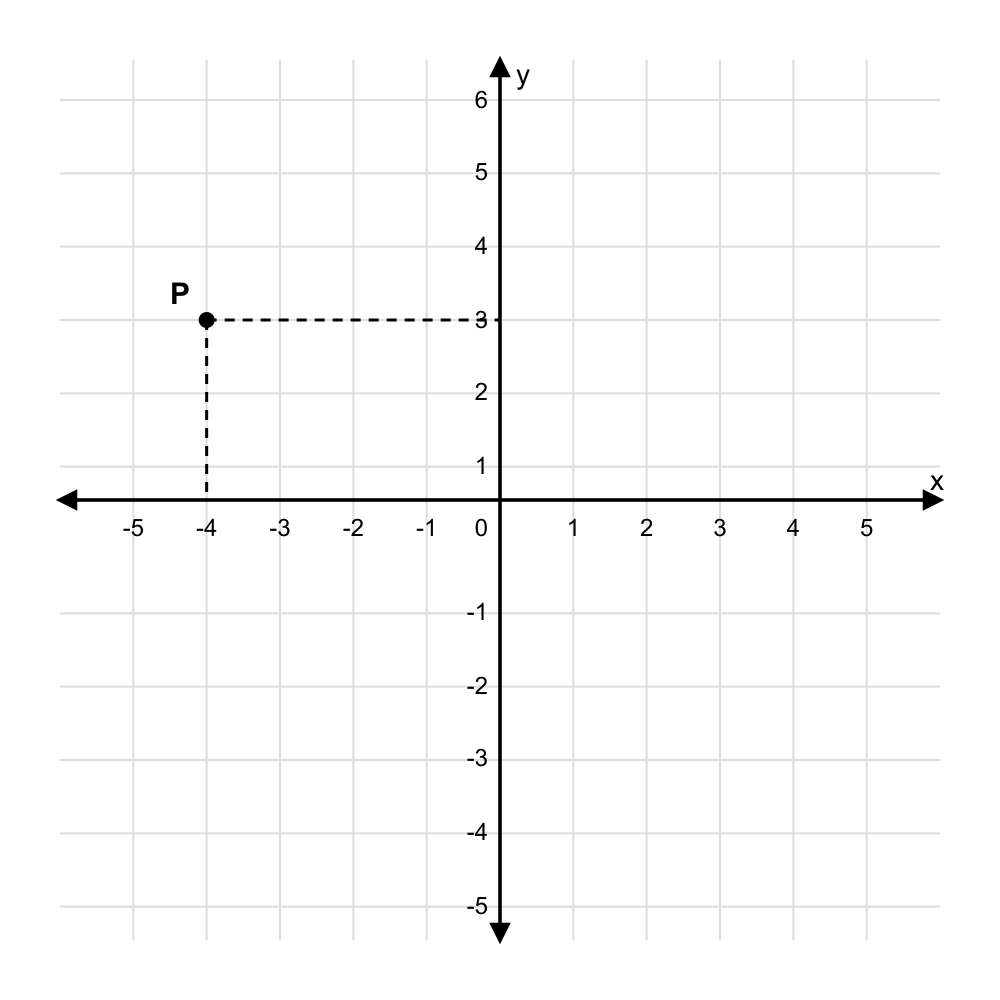
In the coordinate plane shown, point PP is located at the intersection of two dashed gridlines. Based on the coordinate plane shown, what are the coordinates of point PP?

Question graphic
(3,4)(-3, 4)
(4,3)(4, -3)
(4,3)(-4, 3)
(3,4)(3, -4)
← Back to quizzes

SHSAT Math Quiz

SHSAT Math Quiz: Reading Coordinates

Practice Reading Coordinates in SHSAT Math with focused quiz questions that help you check what you know, review explanations, and build confidence with test-style prompts.

What this quiz covers

This quiz focuses on Reading Coordinates, giving you a quick way to practice the rules, question types, and explanations that matter most for SHSAT Math.

How to use this quiz

Try each quiz question before looking at the correct answer. Use the explanations to review missed ideas, then come back to similar questions until the pattern feels familiar.

All questions

Question 1

In the coordinate plane shown, point PP is located at the intersection of two dashed gridlines. Based on the coordinate plane shown, what are the coordinates of point PP?

  1. (3,4)(-3, 4)
  2. (4,3)(4, -3)
  3. (4,3)(-4, 3) (correct answer)
  4. (3,4)(3, -4)
Explanation: Point PP is plotted 4 units to the left of the y-axis (x = -4) and 3 units above the x-axis (y = 3), giving (4,3)(-4, 3). Choice A reverses which coordinate has the negative sign. Choice B swaps x and y. Choice D both swaps and places the signs incorrectly.

Question 2

Refer to the coordinate plane shown. Point MM is the midpoint of segment PQ\overline{PQ}, where PP and QQ are plotted on the graph. What are the coordinates of point MM?

  1. (1,2)(1, 2) (correct answer)
  2. (2,1)(2, 1)
  3. (1,2)(-1, 2)
  4. (0,3)(0, 3)
Explanation: Reading P = (-3, -2) and Q = (5, 6) from the graph. The midpoint is M=(3+52,2+62)=(1,2)M = \left(\frac{-3+5}{2}, \frac{-2+6}{2}\right) = (1, 2). Choice B swaps x and y. Choice C uses subtraction instead of addition for x. Choice D averages x-values incorrectly or counts the origin.

Question 3

In the coordinate plane shown, four points are plotted. Using the coordinate plane shown, which point satisfies the equation 2xy=52x - y = 5?

  1. Point FF
  2. Point GG
  3. Point HH (correct answer)
  4. Point JJ
Explanation: Reading the coordinates from the graph: F = (1, 3), G = (3, 2), H = (4, 3), J = (-1, -3). Testing each point in the equation 2xy=52x - y = 5: Point F: 2(1)3=152(1) - 3 = -1 \neq 5. Point G: 2(3)2=452(3) - 2 = 4 \neq 5. Point H: 2(4)3=52(4) - 3 = 5 \checkmark. Point J: 2(1)(3)=152(-1) - (-3) = 1 \neq 5. Only point H satisfies the equation.

Question 4

The coordinate plane shown has a non-standard scale. Using the coordinate plane shown, what are the coordinates of point KK?

  1. (3,2)(3, 2)
  2. (6,10)(6, 10)
  3. (15,10)(15, 10) (correct answer)
  4. (10,15)(10, 15)
Explanation: Each gridline on the x-axis represents 5 units, and each gridline on the y-axis represents 2 units. Point KK is 3 gridlines right of the y-axis (3 × 5 = 15) and 5 gridlines above the x-axis (5 × 2 = 10), giving (15, 10). Choice A counts gridlines without applying the scale. Choice B swaps the scales of the two axes. Choice D reverses the coordinates.

Question 5

Using the coordinate plane shown, triangle PQRPQR has vertices plotted. What is the area of triangle PQRPQR?

  1. 1212 square units
  2. 1515 square units (correct answer)
  3. 1818 square units
  4. 2424 square units
Explanation: Reading the vertices: P = (-2, 1), Q = (4, 1), R = (1, 6). The base PQ is horizontal with length 4 - (-2) = 6. The height from R to line y = 1 is 6 - 1 = 5. Area = 12(6)(5)=15\frac{1}{2}(6)(5) = 15. Choice A uses base 6 and height 4 (misreads R's y-coordinate). Choice C uses base 6 and height 6 (counts including endpoints). Choice D forgets the 12\frac{1}{2} factor.

Question 6

The coordinate plane shown contains four points labeled AA, BB, CC, and DD. Using the coordinate plane shown, which point has coordinates whose sum x+yx + y is the greatest?

  1. Point AA
  2. Point BB (correct answer)
  3. Point CC
  4. Point DD
Explanation: Reading the coordinates: A = (-2, 6), B = (5, 3), C = (6, 1), D = (-3, 8). The sums are: A: 4, B: 8, C: 7, D: 5. Point B has the greatest sum (8). Students who pick D likely chose the point that appears highest on the graph (largest y alone). Students who pick C chose the rightmost point (largest x alone). Students who pick A confused the coordinates and read y before x.

Question 7

Refer to the coordinate plane shown. Point PP lies exactly halfway between two gridlines in both directions. What are the coordinates of point PP?

  1. (2,3)(2, 3)
  2. (2.5,3.5)(2.5, 3.5) (correct answer)
  3. (3,4)(3, 4)
  4. (3.5,2.5)(3.5, 2.5)
Explanation: Point P is between x = 2 and x = 3 (so x = 2.5) and between y = 3 and y = 4 (so y = 3.5), giving (2.5,3.5)(2.5, 3.5). Choice A rounds both coordinates down. Choice C rounds both up. Choice D has the coordinates swapped.

Question 8

Based on the coordinate plane shown, four points are labeled. Which of the labeled points lies on the graph of y=x23y = x^2 - 3?

  1. Point AA
  2. Point BB
  3. Point CC
  4. Point DD (correct answer)
Explanation: Reading the points: A = (1, 1), B = (-2, 4), C = (0, 3), D = (3, 6). Testing y=x23y = x^2 - 3: A: 1² - 3 = -2 ≠ 1 ✗; B: (-2)² - 3 = 4 - 3 = 1 ≠ 4 ✗; C: 0² - 3 = -3 ≠ 3 ✗; D: 3² - 3 = 9 - 3 = 6 ✓. Choice A confuses with y = x². Choice B confuses with y = x². Choice C misreads the sign on the constant.

Question 9

Based on the coordinate plane shown, point QQ lies on the segment connecting (4,2)(-4, -2) and (8,4)(8, 4) at the location indicated. What are the coordinates of point QQ?

  1. (0,0)(0, 0)
  2. (2,1)(2, 1)
  3. (4,2)(4, 2) (correct answer)
  4. (2,1)(-2, -1)
Explanation: Reading directly from the graph, point Q is plotted at (4,2)(4, 2). Students who assume Q is the midpoint of the segment's endpoints would wrongly compute (2,1)(2, 1) (choice B). Choice A is the origin, where the segment crosses the axes. Choice D is the reflection of the midpoint through the origin.

Question 10

A point G is at the same x-coordinate as H(5, -2) and the same y-coordinate as J(-3, 7). What are the coordinates of G?

  1. (5,7)(5,\,7) (correct answer)
  2. (3,2)( -3,\,-2)
  3. (7,5)(7,\,5)
  4. (2,5)( -2,\,5)
Explanation: When you encounter coordinate problems, remember that every point is written as (x,y)(x, y) where the first number is the x-coordinate (horizontal position) and the second is the y-coordinate (vertical position). To find point G, you need to identify which coordinate it shares with each given point. Since G has the same x-coordinate as H(5, -2), G's x-coordinate is 5. Since G has the same y-coordinate as J(-3, 7), G's y-coordinate is 7. Therefore, G is at (5,7)(5, 7). Looking at the answer choices: Choice A gives (5,7)(5, 7), which correctly takes the x-coordinate from H and the y-coordinate from J. This is our answer. Choice B gives (3,2)(-3, -2), which incorrectly takes the x-coordinate from J and the y-coordinate from H — the opposite of what the problem asks for. Choice C gives (7,5)(7, 5), which swaps the coordinates we found. This represents a common mistake where students mix up which number goes in which position. Choice D gives (2,5)(-2, 5), which takes the y-coordinate from H (instead of the x-coordinate) and places the correct x-coordinate in the y-position. Study tip: When working with coordinates, always double-check which point contributes which coordinate. Write out "x from  " and "y from  " to avoid mixing them up. Remember that coordinates are always written in alphabetical order: x comes before y, just like in the alphabet.

Question 11

In the coordinate plane, a point W is plotted at the intersection of x=2x=-2 and y=52.y=\tfrac{5}{2}. What ordered pair represents W?

  1. (2,2.5)(-2,\,2.5) (correct answer)
  2. (2.5,2)(2.5,\,-2)
  3. (2.5,2)( -2.5,\,2)
  4. (2,2.5)( -2,\,-2.5)
Explanation: When you encounter questions about plotting points from line intersections, you're working with the fundamental concept that every point in the coordinate plane has exactly one x-coordinate and one y-coordinate, written as an ordered pair (x,y)(x, y). The question tells you that point W is at the intersection of x=2x = -2 and y=52y = \frac{5}{2}. This means W has an x-coordinate of 2-2 and a y-coordinate of 52\frac{5}{2}. Since 52=2.5\frac{5}{2} = 2.5, the ordered pair is (2,2.5)(-2, 2.5). Looking at the wrong answers: Choice B gives (2.5,2)(2.5, -2), which reverses the coordinates—this puts the y-value in the x-position and makes the x-coordinate positive instead of negative. Choice C shows (2.5,2)(-2.5, 2), which incorrectly makes the x-coordinate 2.5-2.5 instead of 2-2 and converts 52\frac{5}{2} to 22 instead of 2.52.5. Choice D gives (2,2.5)(-2, -2.5), which has the correct x-coordinate but makes the y-coordinate negative when it should be positive. Remember that in ordered pairs, the first number is always the x-coordinate and the second is always the y-coordinate. When you see equations like x=2x = -2 or y=52y = \frac{5}{2}, these directly give you the coordinates. Also, be careful with fraction-to-decimal conversions: 52=2.5\frac{5}{2} = 2.5, not 22 or any other value.

Question 12

Point F lies exactly halfway between (0, 12) and (0, -4) on the y-axis. What are the coordinates of F?

  1. (0,4)(0,\,4) (correct answer)
  2. (0,8)(0,\,8)
  3. (0,8)(0,\, -8)
  4. (4,0)(4,\,0)
Explanation: When you see a problem asking for the midpoint between two points, you're looking for the point that sits exactly halfway between them. Since both given points (0,12)(0, 12) and (0,4)(0, -4) lie on the y-axis (they both have x-coordinates of 0), point F will also be on the y-axis with an x-coordinate of 0. To find the y-coordinate of the midpoint, you add the two y-coordinates and divide by 2: 12+(4)2=82=4\frac{12 + (-4)}{2} = \frac{8}{2} = 4. Therefore, point F is at (0,4)(0, 4). You can verify this makes sense: from (0,4)(0, -4) to (0,4)(0, 4) is a distance of 8 units, and from (0,4)(0, 4) to (0,12)(0, 12) is also 8 units, confirming F is exactly halfway between them. Looking at the wrong answers: Choice B gives (0,8)(0, 8), which would be the result if you mistakenly used only the positive y-values or made an arithmetic error. Choice C gives (0,8)(0, -8), which might occur if you subtracted instead of adding, or confused the direction. Choice D gives (4,0)(4, 0), which incorrectly places the point on the x-axis instead of the y-axis—this happens when students mix up coordinates or don't notice that both original points share the same x-coordinate. Remember the midpoint formula: for any two points, average their x-coordinates and average their y-coordinates separately. When points share the same x- or y-coordinate, the midpoint will too.

Question 13

On a coordinate grid, point S is 3 units to the left of the origin and 6 units above it. What are the coordinates of S?

  1. (3,6)(-3,\,6) (correct answer)
  2. (3,6)(3,\,6)
  3. (6,3)(-6,\,3)
  4. (3,6)(-3,\,-6)
Explanation: When working with coordinate grids, you need to understand how position relates to coordinates. The coordinate system uses an ordered pair (x,y)(x, y) where the first number represents horizontal position and the second represents vertical position. To find point S, let's translate the given information systematically. "3 units to the left of the origin" means you move 3 units in the negative x-direction from (0,0)(0, 0), giving you an x-coordinate of 3-3. "6 units above the origin" means you move 6 units in the positive y-direction, giving you a y-coordinate of +6+6. Therefore, point S is at (3,6)(-3, 6). Looking at the answer choices: Choice A gives (3,6)(-3, 6), which correctly represents 3 units left (negative x) and 6 units up (positive y). Choice B shows (3,6)(3, 6), which would place the point 3 units to the right of the origin instead of left. Choice C gives (6,3)(-6, 3), which switches the distances—this would be 6 units left and 3 units up. Choice D shows (3,6)(-3, -6), which has the correct x-coordinate but places the point 6 units below the origin instead of above it. Remember this key pattern: "left" and "below" correspond to negative coordinates, while "right" and "above" correspond to positive coordinates. Always check that your x-coordinate (first number) matches the horizontal direction and your y-coordinate (second number) matches the vertical direction described in the problem.

Question 14

On a map grid, one unit represents 1 mile. A campsite is located at (-2, 5). How far north of the x-axis is the campsite?

  1. 5 miles north (correct answer)
  2. 2 miles north
  3. 5 miles east
  4. 2 miles west
Explanation: When you see coordinate geometry questions, remember that the coordinate plane gives you precise location information. The x-coordinate tells you horizontal position (east-west), while the y-coordinate tells you vertical position (north-south). For the campsite at (-2, 5), you need to focus on what "north of the x-axis" means. The x-axis is the horizontal line where y=0y = 0. Any point north of this line has a positive y-coordinate, and the distance north equals the y-coordinate value. Since the campsite has coordinates (-2, 5), the y-coordinate is 5. This means the campsite is 5 units north of the x-axis. Given that each unit represents 1 mile, the campsite is 5 miles north of the x-axis, making choice A correct. Choice B (2 miles north) incorrectly uses the x-coordinate instead of the y-coordinate. The x-coordinate of -2 tells you about east-west position, not north-south distance. Choice C (5 miles east) uses the correct number but confuses direction—it mistakes the y-coordinate for eastward movement. Choice D (2 miles west) makes two errors: it uses the wrong coordinate and ignores that we're measuring distance north, not describing directional movement west. Remember this key pattern: distance north or south of the x-axis always depends on the y-coordinate, while distance east or west of the y-axis depends on the x-coordinate. When measuring distance from an axis, you're looking for how far away the point is, which means taking the absolute value if needed.

Question 15

A point P' is reflected across the y-axis from point P(-8, 3). What are the coordinates of P'?

  1. (8,3)(8,\,3) (correct answer)
  2. (8,3)( -8,\,-3)
  3. (3,8)(3,\,8)
  4. (3,8)( -3,\,8)
Explanation: When you encounter reflection problems, focus on understanding how each type of reflection transforms coordinates systematically. Reflecting a point across the y-axis follows a specific rule: the y-coordinate stays the same, while the x-coordinate changes to its opposite (negative becomes positive, positive becomes negative). Think of it as "flipping" the point horizontally across the vertical y-axis line. Starting with point P(-8, 3), when we reflect it across the y-axis:
  • The x-coordinate changes from -8 to +8
  • The y-coordinate remains 3
  • Therefore, P' = (8, 3)
Looking at the wrong answers: Choice B (-8, -3) represents reflection across the x-axis instead, where the x-coordinate stays the same and the y-coordinate changes sign. Choice C (3, 8) incorrectly swaps the x and y coordinates, which would happen in a reflection across the line y = x. Choice D (-3, 8) combines multiple errors—both swapping coordinates and changing the wrong sign. The key pattern to remember: reflection across the y-axis affects only the x-coordinate (it becomes its opposite), while reflection across the x-axis affects only the y-coordinate. On the SHSAT, coordinate geometry problems often test whether you can distinguish between different types of transformations, so practice identifying the axis of reflection and applying the correct rule to avoid mixing up these transformations.

Question 16

In the coordinate plane, point R' is obtained by translating point R(-2, -7) 5 units right and 3 units up. What are the coordinates of R'?

  1. (3,4)(3,\,-4) (correct answer)
  2. (7,10)( -7,\,-10)
  3. (3,10)(3,\,-10)
  4. (7,4)( -7,\,-4)
Explanation: When you encounter translation problems in coordinate geometry, remember that translations involve sliding a point to a new location by moving specific distances horizontally and vertically. To translate point R(-2, -7), you need to apply the given movements to each coordinate. Moving "5 units right" means adding 5 to the x-coordinate, and moving "3 units up" means adding 3 to the y-coordinate. Starting with R(-2, -7):
  • New x-coordinate: -2 + 5 = 3
  • New y-coordinate: -7 + 3 = -4
Therefore, R' = (3, -4). Let's examine why the other choices are incorrect. Choice B gives (-7, -10), which results from subtracting instead of adding—moving 5 units left and 3 units down rather than right and up. Choice C shows (3, -10), where the x-coordinate is correct but the y-coordinate comes from subtracting 3 instead of adding it (moving down instead of up). Choice D gives (-7, -4), where the y-coordinate is correct but the x-coordinate results from subtracting 5 instead of adding it (moving left instead of right). The answer is A. Study tip: For translations, create a simple rule: right/up means add, left/down means subtract. When you see "right" or "up," immediately think positive; when you see "left" or "down," think negative. Double-check by visualizing the movement on a coordinate plane—does your final point make sense given the direction of translation?

Question 17

Refer to the coordinate plane shown. A triangle has vertices at points RR, SS, and TT. What are the coordinates of the vertex that lies in Quadrant III?

  1. (5,2)(-5, 2)
  2. (3,4)(3, -4)
  3. (3,4)(-3, -4) (correct answer)
  4. (4,3)(-4, -3)
Explanation: Quadrant III contains points where both x and y are negative. Reading the graph, R = (-5, 2) is in Quadrant II, S = (3, -4) is in Quadrant IV, and T = (-3, -4) is in Quadrant III. Choice A is in Quadrant II. Choice B is in Quadrant IV. Choice D swaps the x- and y-coordinates of point T.

Question 18

Using the coordinate plane shown, a line passes through the two marked points. What is the slope of the line?

  1. 35-\dfrac{3}{5} (correct answer)
  2. 53-\dfrac{5}{3}
  3. 35\dfrac{3}{5}
  4. 53\dfrac{5}{3}
Explanation: Reading the two marked points: (-3, 4) and (2, 1). Slope = 142(3)=35\frac{1-4}{2-(-3)} = \frac{-3}{5}. Choice B inverts rise and run. Choice C drops the negative sign (line slants down left-to-right, so slope is negative). Choice D both inverts and drops the sign.

Question 19

Refer to the coordinate plane shown. Points AA, BB, CC, and DD are the four vertices of a rectangle, but only three are labeled. What are the coordinates of vertex DD?

  1. (2,3)(-2, -3) (correct answer)
  2. (4,3)(4, -3)
  3. (2,4)(-2, 4)
  4. (4,4)(4, 4)
Explanation: Reading the labeled vertices: A = (-2, 4), B = (4, 4), C = (4, -3). For a rectangle ABCD, vertex D must share A's x-coordinate and C's y-coordinate: D = (-2, -3). Choice B repeats C. Choice C repeats A. Choice D repeats B.

Question 20

In the coordinate plane shown, parallelogram ABCDABCD has three labeled vertices. Based on the coordinate plane shown, what are the coordinates of the unlabeled fourth vertex DD?

  1. (7,5)(7, 5) (correct answer)
  2. (5,7)(5, 7)
  3. (9,3)(9, 3)
  4. (3,5)(3, 5)
Explanation: Reading directly from the coordinate plane, the fourth vertex DD is plotted at (7,5)(7, 5). Choice B swaps the x- and y-coordinates. Choice C represents a miscounting of grid squares. Choice D would place the point at the wrong location on the graph.