SHSAT Math Quiz: Perimeter Of Polygons
11 questions · exam conditions
0:00
Perimeter Of PolygonsQuestion 1 of 11

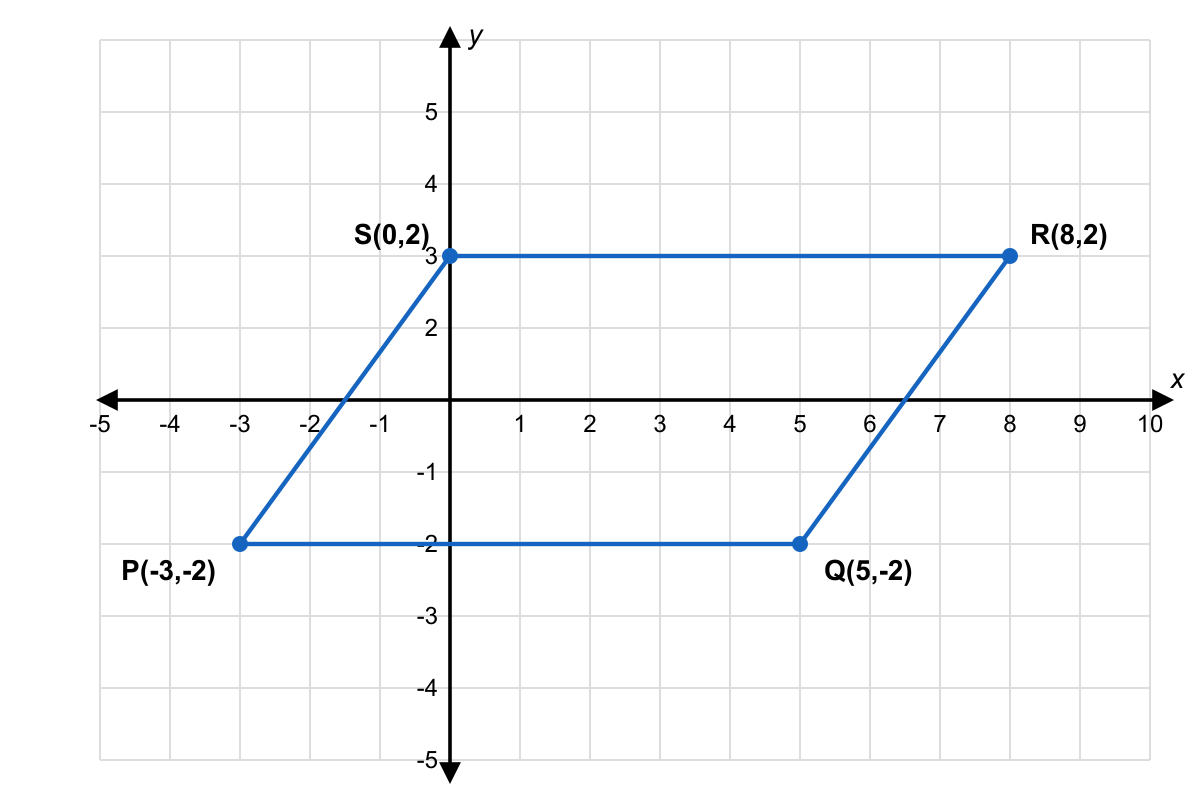
Refer to the coordinate plane shown. Quadrilateral PQRSPQRS has vertices P(3,2)P(-3,-2), Q(5,2)Q(5,-2), R(8,2)R(8,2), S(0,2)S(0,2). What is the perimeter of PQRSPQRS?

Question graphic
2121
2626
2828
3232
← Back to quizzes

SHSAT Math Quiz

SHSAT Math Quiz: Perimeter Of Polygons

Practice Perimeter Of Polygons in SHSAT Math with focused quiz questions that help you check what you know, review explanations, and build confidence with test-style prompts.

What this quiz covers

This quiz focuses on Perimeter Of Polygons, giving you a quick way to practice the rules, question types, and explanations that matter most for SHSAT Math.

How to use this quiz

Try each quiz question before looking at the correct answer. Use the explanations to review missed ideas, then come back to similar questions until the pattern feels familiar.

All questions

Question 1

Refer to the coordinate plane shown. Quadrilateral PQRSPQRS has vertices P(3,2)P(-3,-2), Q(5,2)Q(5,-2), R(8,2)R(8,2), S(0,2)S(0,2). What is the perimeter of PQRSPQRS?

  1. 2121
  2. 2626 (correct answer)
  3. 2828
  4. 3232
Explanation: PQ=5(3)=8PQ=|5-(-3)|=8; QR=(85)2+(2(2))2=9+16=5QR=\sqrt{(8-5)^2+(2-(-2))^2}=\sqrt{9+16}=5; RS=80=8RS=|8-0|=8; SP=(0(3))2+(2(2))2=9+16=5SP=\sqrt{(0-(-3))^2+(2-(-2))^2}=\sqrt{9+16}=5. Perimeter =8+5+8+5=26=8+5+8+5=26. Distractor A miscounts horizontal. C forgets Pythagoras (uses horizontal diff only). D doubles diagonals.

Question 2

In the figure shown, all angles that appear to be right angles are right angles. What is the perimeter, in inches, of the polygon?

  1. 5454
  2. 5858 (correct answer)
  3. 6262
  4. 6666
Explanation: For a rectilinear polygon, the sum of all horizontal segments on the top equals the sum on the bottom; similarly for vertical segments. The bounding box is 18 in wide and 11 in tall, so the perimeter equals 2(18+11)=582(18+11)=58 in. Distractor A forgets one jog. C adds an interior edge twice. D double-counts a segment.

Question 3

Refer to the figure. A rectangular garden measuring 24 ft by 16 ft is surrounded on all four sides by a uniform walkway 3 ft wide. What is the perimeter of the outer boundary of the walkway?

  1. 8080 ft
  2. 9292 ft
  3. 104104 ft (correct answer)
  4. 116116 ft
Explanation: The outer rectangle has dimensions (24+6)×(16+6)=30×22(24+6)\times(16+6)=30\times 22. Perimeter =2(30+22)=104=2(30+22)=104 ft. Distractor A is the garden's perimeter. B adds only 3 ft once per dimension. D adds 6 ft twice.

Question 4

A trapezoid has parallel sides of length 1414 cm and 2222 cm. The non-parallel sides each make a 60°60° angle with the longer base. If the height of the trapezoid is 434\sqrt{3} cm, what is the perimeter?

  1. 4444 cm
  2. 4848 cm
  3. 5252 cm (correct answer)
  4. 5656 cm
Explanation: The height is 434\sqrt{3} cm and each non-parallel side makes a 60°60° angle with the base. Using trigonometry: sin(60°)=heightside length=43side length\sin(60°) = \frac{\text{height}}{\text{side length}} = \frac{4\sqrt{3}}{\text{side length}}. Since sin(60°)=32\sin(60°) = \frac{\sqrt{3}}{2}, we have 32=43side length\frac{\sqrt{3}}{2} = \frac{4\sqrt{3}}{\text{side length}}, so side length = 43×23=8\frac{4\sqrt{3} \times 2}{\sqrt{3}} = 8 cm. Perimeter = 14+22+8+8=5214 + 22 + 8 + 8 = 52 cm. Choice A (44) omits one side. Choice B (48) uses incorrect side calculation. Choice D (56) adds an extra 4 cm error.

Question 5

A regular octagon is inscribed in a circle of radius 1010 cm. What is the perimeter of the octagon, rounded to the nearest whole number?

  1. 5959 cm
  2. 6161 cm (correct answer)
  3. 6363 cm
  4. 6565 cm
Explanation: For a regular octagon inscribed in a circle of radius rr, each side length equals 2rsin(π8)2r\sin(\frac{\pi}{8}). The central angle for each side is 360°8=45°\frac{360°}{8} = 45°, so each side subtends 22.5°22.5° at the center. Using sin(22.5°)=2220.3827\sin(22.5°) = \frac{\sqrt{2-\sqrt{2}}}{2} \approx 0.3827, each side length 2(10)(0.3827)=7.654\approx 2(10)(0.3827) = 7.654 cm. Perimeter =8×7.65461.2= 8 \times 7.654 \approx 61.2 cm, which rounds to 6161 cm.

Question 6

A regular hexagon is inscribed in a circle of radius 10 cm, and an equilateral triangle is inscribed in the same circle. Using the figure shown, what is the positive difference between the perimeter of the hexagon and the perimeter of the triangle?

  1. 6030360-30\sqrt{3} cm (correct answer)
  2. 3036030\sqrt{3}-60 cm
  3. 6036060\sqrt{3}-60 cm
  4. 3030 cm
Explanation: A regular hexagon inscribed in a circle of radius rr has side length rr, so perimeter =6(10)=60=6(10)=60 cm. An equilateral triangle inscribed in a circle of radius rr has side length r3r\sqrt{3}, so perimeter =3(103)=303=3(10\sqrt{3})=30\sqrt{3} cm. Since 30351.96<6030\sqrt{3}\approx 51.96 < 60, the hexagon has the larger perimeter. The positive difference is 6030360-30\sqrt{3} cm. Distractor B reverses the order. C uses incorrect side length formula. D uses diameter instead of proper calculation.

Question 7

Refer to the figure. Trapezoid ABCDABCD has ABCDAB\parallel CD, with AB=14AB=14, CD=30CD=30, and legs AD=BCAD=BC. The height of the trapezoid is 6. What is the perimeter of trapezoid ABCDABCD?

  1. 5454
  2. 6464 (correct answer)
  3. 6868
  4. 7474
Explanation: Since the trapezoid is isosceles, each leg's horizontal projection is (3014)/2=8(30-14)/2=8. Each leg =82+62=100=10=\sqrt{8^2+6^2}=\sqrt{100}=10. Perimeter =14+30+10+10=64=14+30+10+10=64. Distractor A uses leg 5; C uses leg 12; D uses leg 15.

Question 8

In the figure shown, a right triangle with legs 9 and 12 shares its hypotenuse with one side of a rectangle. The opposite side of the rectangle has length equal to the hypotenuse, and the rectangle's other two sides have length 8. What is the perimeter of the combined figure (triangle plus rectangle)?

  1. 4646 (correct answer)
  2. 5252
  3. 5656
  4. 6262
Explanation: Hypotenuse =92+122=15=\sqrt{9^2+12^2}=15. The shared edge (hypotenuse = 15) is interior and not counted. Perimeter = two legs (9 + 12) + three sides of rectangle excluding shared side (15 + 8 + 8) = 9+12+15+8+8=529+12+15+8+8=52. Wait recount: triangle contributes its two legs = 9+12=21 (hypotenuse shared). Rectangle contributes 3 sides: the far 15-side and two 8-sides = 15+8+8=31. Total = 21+31=52. Answer B. Distractor A forgets one short side; C adds hypotenuse; D adds hypotenuse twice.

Question 9

Refer to the figure. A track consists of a rectangle with two semicircular ends. The straight portions are each 80 m long, and the width of the rectangle (equal to the diameter of each semicircle) is 50 m. What is the perimeter (total length around) of the track, to the nearest meter? (Use π3.14159\pi\approx 3.14159.)

  1. 257257 m
  2. 307307 m
  3. 317317 m (correct answer)
  4. 417417 m
Explanation: The two semicircles combine to form a full circle of diameter 50, circumference 50π157.0850\pi\approx 157.08 m. Add the two straight sides: 2(80)=1602(80)=160. Total 157.08+160=317.08317\approx 157.08+160=317.08\approx 317 m. Distractor A forgets one straight; B uses radius 50 in circumference formula incorrectly; D includes the diameter segments (which aren't part of the track).

Question 10

A rhombus has diagonals of length 1616 cm and 1212 cm. What is the perimeter of the rhombus?

  1. 2828 cm
  2. 4040 cm (correct answer)
  3. 5656 cm
  4. 6464 cm
Explanation: In a rhombus, the diagonals bisect each other at right angles. Half-diagonals have lengths 8 cm and 6 cm. Using the Pythagorean theorem, each side length = 82+62=64+36=100=10\sqrt{8^2 + 6^2} = \sqrt{64 + 36} = \sqrt{100} = 10 cm. Perimeter = 4×10=404 \times 10 = 40 cm. Choice A (28) would result from adding the half-diagonals incorrectly. Choice C (56) might come from 2(16+12)2(16 + 12). Choice D (64) might come from 4×164 \times 16.

Question 11

A regular polygon has an exterior angle of 24°24°. If each side length is 66 cm, what is the perimeter of this polygon?

  1. 7272 cm
  2. 8484 cm
  3. 9090 cm (correct answer)
  4. 9696 cm
Explanation: The sum of exterior angles of any polygon is 360°360°. If each exterior angle is 24°24°, then the number of sides = 360°24°=15\frac{360°}{24°} = 15. With each side length = 6 cm, perimeter = 15×6=9015 \times 6 = 90 cm. Choice A (72) uses 12 sides instead of 15. Choice B (84) uses 14 sides. Choice D (96) uses 16 sides.