SHSAT Math Quiz: Input Output Rules
19 questions · exam conditions
0:00
Input Output RulesQuestion 1 of 19

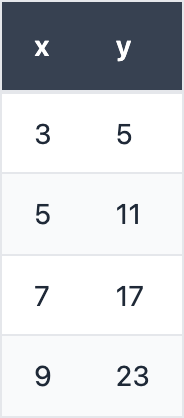
Refer to the table to answer the question. Which rule describes the relationship between xx and yy?

Question graphic
y=3x4y = 3x - 4
y=2x1y = 2x - 1
y=x24y = x^{2} - 4
y=x34y = \dfrac{x}{3} - 4
← Back to quizzes

SHSAT Math Quiz

SHSAT Math Quiz: Input Output Rules

Practice Input Output Rules in SHSAT Math with focused quiz questions that help you check what you know, review explanations, and build confidence with test-style prompts.

What this quiz covers

This quiz focuses on Input Output Rules, giving you a quick way to practice the rules, question types, and explanations that matter most for SHSAT Math.

How to use this quiz

Try each quiz question before looking at the correct answer. Use the explanations to review missed ideas, then come back to similar questions until the pattern feels familiar.

All questions

Question 1

Refer to the table to answer the question. Which rule describes the relationship between xx and yy?

  1. y=3x4y = 3x - 4 (correct answer)
  2. y=2x1y = 2x - 1
  3. y=x24y = x^{2} - 4
  4. y=x34y = \dfrac{x}{3} - 4
Explanation: For each input, multiply by 3 and subtract 4: 3(3)4=5,  3(5)4=11,  3(7)4=17,  3(9)4=233(3)-4=5,\;3(5)-4=11,\;3(7)-4=17,\;3(9)-4=23. Only choice A produces all listed outputs. B gives 3→5 but 5→9. C gives 3→5 but 5→21. D gives non-integer outputs for most inputs.

Question 2

The table shown below lists some values of a function rr. Which rule is consistent with all the values in the table shown?

  1. r(x)=x+12r(x) = \dfrac{x+1}{2}
  2. r(x)=x214r(x) = \dfrac{x^2 - 1}{4}
  3. r(x)=x12r(x) = \dfrac{x-1}{2}
  4. r(x)=(x1)24r(x) = \dfrac{(x-1)^2}{4} (correct answer)
Explanation: For r(x)=(x1)24r(x) = \frac{(x-1)^2}{4}: r(1)=0r(1) = 0 ✓, r(3)=4/4=1r(3) = 4/4 = 1 ✓, r(5)=16/4=4r(5) = 16/4 = 4 ✓, r(7)=36/4=9r(7) = 36/4 = 9 ✓, r(9)=64/4=16r(9) = 64/4 = 16 ✓. Choice A gives 1,2,3,4,51, 2, 3, 4, 5. Choice B gives 0,2,6,12,200, 2, 6, 12, 20 — matches x=1x=1 only. Choice C gives 0,1,2,3,40, 1, 2, 3, 4 — matches x=1,3x=1, 3 only.

Question 3

Refer to the table to determine the rule for yy.

  1. y=x3y=x^{3} (correct answer)
  2. y=2x+1y=2^{x}+1
  3. y=3x2y=3x-2
  4. y=x2+x+1y=x^{2}+x+1
Explanation: Cube each input: 13=1,  23=8,  33=27,  43=641^{3}=1,\;2^{3}=8,\;3^{3}=27,\;4^{3}=64. B gives 3→9. C gives 4→10. D gives 3→13.

Question 4

Using the table, select the rule that fits all data pairs.

  1. y=(x3)2y = (x - 3)^{2} (correct answer)
  2. y=x23y = x^{2} - 3
  3. y=x26x+9y = x^{2} - 6x + 9
  4. y=x26x+6y = x^{2} - 6x + 6
Explanation: The pattern shows (x3)2(x-3)^2: when x=3, y=0; when x=4, y=1; when x=5, y=4; when x=6, y=9. B gives 3→6 (incorrect). C is equivalent to A since (x3)2=x26x+9(x-3)^2 = x^2-6x+9. D gives 3→-3 (incorrect).

Question 5

Use the values in the table to answer the question. Which rule generates every output shown?

  1. y=x1y=x-1
  2. y=x1y=|x-1| (correct answer)
  3. y=x+1y=|x|+1
  4. y=x21y=x^{2}-1
Explanation: Taking the absolute value after subtracting 1 works: 01=1,  11=0,  21=1,  31=2|0-1|=1,\;|1-1|=0,\;|2-1|=1,\;|3-1|=2\,. A gives negative for 0. C gives 0→1 but 1→2. D gives 0→−1.

Question 6

Based on the table, which equation represents the relationship between xx and yy?

  1. y=x2xy = x^{2} - x (correct answer)
  2. y=2x+3y = 2x + 3
  3. y=x2+xy = x^{2} + x
  4. y=3x2y = 3x^{2}
Explanation: Compute x2xx^{2}-x: 222=2,  323=6,  424=12,  525=202^{2}-2=2,\;3^{2}-3=6,\;4^{2}-4=12,\;5^{2}-5=20, matching the table. B gives 2→7 not 2. C gives 2→6 not 2. D gives 2→12 not 2.

Question 7

Use the table to find the input–output rule.

  1. y=x21y = x^{2} - 1
  2. y=2x+1y = 2x + 1
  3. y=x2+1y = x^{2} + 1 (correct answer)
  4. y=3x2y = 3x - 2
Explanation: Square each input and add 1: 12+1=2,  22+1=5,  32+1=10,  42+1=171^{2}+1=2,\;2^{2}+1=5,\;3^{2}+1=10,\;4^{2}+1=17. Only y=x2+1y=x^{2}+1 matches. B produces 1→3. A gives 1→0. D gives 1→1.

Question 8

Using the table, choose the rule that matches the data.

  1. y=2x21y = 2x^{2} - 1
  2. y=x2+3y = x^{2} + 3
  3. y=3x22y = 3x^{2} - 2 (correct answer)
  4. y=4x1y = 4x - 1
Explanation: Compute 3x223x^{2}-2: 1→1, 2→10, 3→25, 4→46, matching. A gives 1→1 but 2→7. B gives 2→7. D is linear.

Question 9

Look at the table to answer the question. Which rule correctly produces the given outputs?

  1. y=1xy = \dfrac{1}{x}
  2. y=3xy = 3^{x}
  3. y=6xy = \dfrac{6}{x} (correct answer)
  4. y=2x3y = 2x - 3
Explanation: Dividing 6 by the input: 1→6, 2→3, 3→2, 6→1. A gives 1→1. B gives 2→9. D gives negative values.

Question 10

Based on the table, which rule best represents yy in terms of xx?

  1. y=2xy = 2^{x} (correct answer)
  2. y=x2y = x^{2}
  3. y=3x+1y = 3x + 1
  4. y=x2y = \dfrac{x}{2}
Explanation: Outputs double each time the input increases by 1: 21=2,  22=4,  23=8,  24=162^{1}=2,\;2^{2}=4,\;2^{3}=8,\;2^{4}=16. B gives 3→9 not 8. C produces 3→10. D gives fractions for small inputs.

Question 11

Refer to the table to answer the question. Identify the rule that produces the listed outputs.

  1. y=x21y = \dfrac{x}{2} - 1 (correct answer)
  2. y=2x1y = 2x - 1
  3. y=x12y = \dfrac{x-1}{2}
  4. y=x3y = x - 3
Explanation: Halve each input and subtract 1: 421=1,  821=3,  1221=5,  1621=7\tfrac{4}{2}-1=1,\;\tfrac{8}{2}-1=3,\;\tfrac{12}{2}-1=5,\;\tfrac{16}{2}-1=7. B gives 4→7 not 1. C gives 4→1.5 not 1. D gives 4→1 correctly but 8→5 not 3.

Question 12

Refer to the table to answer the question. What rule maps xx to yy?

  1. y=x+1y = \sqrt{x} + 1 (correct answer)
  2. y=x2+1y = x^{2} + 1
  3. y=x+1y = \sqrt{x + 1}
  4. y=2xy = 2\sqrt{x}
Explanation: Square roots: 0+1=1,  1+1=2,  4+1=3,  9+1=4\sqrt{0}+1=1,\;\sqrt{1}+1=2,\;\sqrt{4}+1=3,\;\sqrt{9}+1=4. B gives 1→2 but 4→17. C gives 0→1 but 1→√2. D gives 4→4 not 3.

Question 13

Use the table to answer the question. Which rule matches every pair in the table?

  1. y=(x+2)2y = (x+2)^{2}
  2. y=x2+4y = x^{2}+4
  3. y=x2+2xy = x^{2}+2x (correct answer)
  4. y=4x+4y = 4x+4
Explanation: Compute x2+2xx^{2}+2x: 12+2(1)=3,  22+2(2)=8,  32+2(3)=15,  42+2(4)=241^{2}+2(1)=3,\;2^{2}+2(2)=8,\;3^{2}+2(3)=15,\;4^{2}+2(4)=24, matching the table. A gives 1→9 not 3. B gives 1→5 not 3. D gives 1→8 not 3.

Question 14

Use the table to identify the rule that matches every input–output pair.

  1. y=2x+1y = 2x + 1 (correct answer)
  2. y=x+3y = x + 3
  3. y=3x1y = 3x - 1
  4. y=x2+1y = x^{2} + 1
Explanation: Each input is doubled and then 1 is added: 2(2)+1=5,  2(4)+1=9,  2(6)+1=13,  2(8)+1=172(2)+1=5,\;2(4)+1=9,\;2(6)+1=13,\;2(8)+1=17. Only y=2x+1y=2x+1 fits all four pairs. B gives 2→5 but fails for 4→9 (it gives 7). C gives 2→5 but 4→11. D gives 2→5 and 4→17, which is wrong for 4.

Question 15

Use the table to select the correct input–output rule.

  1. y=102xy = 10 - 2x
  2. y=x+5y = x + 5
  3. y=5xy = 5x
  4. y=5xy = 5 - x (correct answer)
Explanation: Subtract the input from 5: 5(1)=6,  50=5,  51=4,  52=35-(-1)=6,\;5-0=5,\;5-1=4,\;5-2=3. A gives -1→12. B gives -1→4. C gives outputs of ±5.

Question 16

Use the table to determine which rule generates the outputs.

  1. y=2x2+xy = 2x^{2} + x
  2. y=x3xy = x^{3} - x
  3. y=x(x2+1)y = x( x^{2} + 1 ) (correct answer)
  4. y=3x2xy = 3x^{2} - x
Explanation: Compute x(x2+1)=x3+xx(x^{2}+1)=x^{3}+x: 1→2, 2→10, 3→30, 4→68, matching. A gives 4→36. B gives 3→24. D gives 4→44.

Question 17

Use the table to identify the rule.

  1. y=(1)xy = (-1)^{x}
  2. y=x2(integer part of x2)y = x - 2(\text{integer part of }\frac{x}{2}) (correct answer)
  3. y=2xy = 2x
  4. y=x2y = x - 2
Explanation: The outputs alternate 1,0,1,0 showing the remainder when x is divided by 2. For odd x, remainder is 1; for even x, remainder is 0. A gives pattern 1,-1,1,-1 (negative values). C doubles inputs giving 2,4,6,8. D subtracts 2 yielding -1,0,1,2.

Question 18

Look at the table to answer the question. Which rule correctly links the inputs and outputs?

  1. y=x24y = \dfrac{x^{2}}{4}
  2. y=(x+2)24y = \dfrac{(x+2)^{2}}{4}
  3. y=x4+2y = \dfrac{x}{4} + 2
  4. y=x24+2y = \dfrac{x^{2}}{4} + 2 (correct answer)
Explanation: Compute x24+2\dfrac{x^{2}}{4}+2: for x=0, 4, 8, 12 gives 2,6,18,38. A yields 0,4,16,36. B yields bigger numbers. C is linear.

Question 19

Look at the table to answer the question. Which rule produces the outputs from the given inputs?

  1. y=(1)x+1y = (-1)^{x} + 1
  2. y=2x2y = 2x - 2
  3. y=(2)xy = ( -2)^{x} (correct answer)
  4. y=x22xy = x^{2} - 2x
Explanation: Powers of −2 alternate sign and double magnitude: (2)0=1,(2)1=2,(2)2=4,(2)3=8(-2)^{0}=1, (-2)^{1}=-2, (-2)^{2}=4, (-2)^{3}=-8 matching 1,−2,4,−8. A gives 0→2. B gives 0→−2. D gives 2→0.