What this quiz covers
This quiz focuses on Coordinate Point Patterns, giving you a quick way to practice the rules, question types, and explanations that matter most for SHSAT Math.
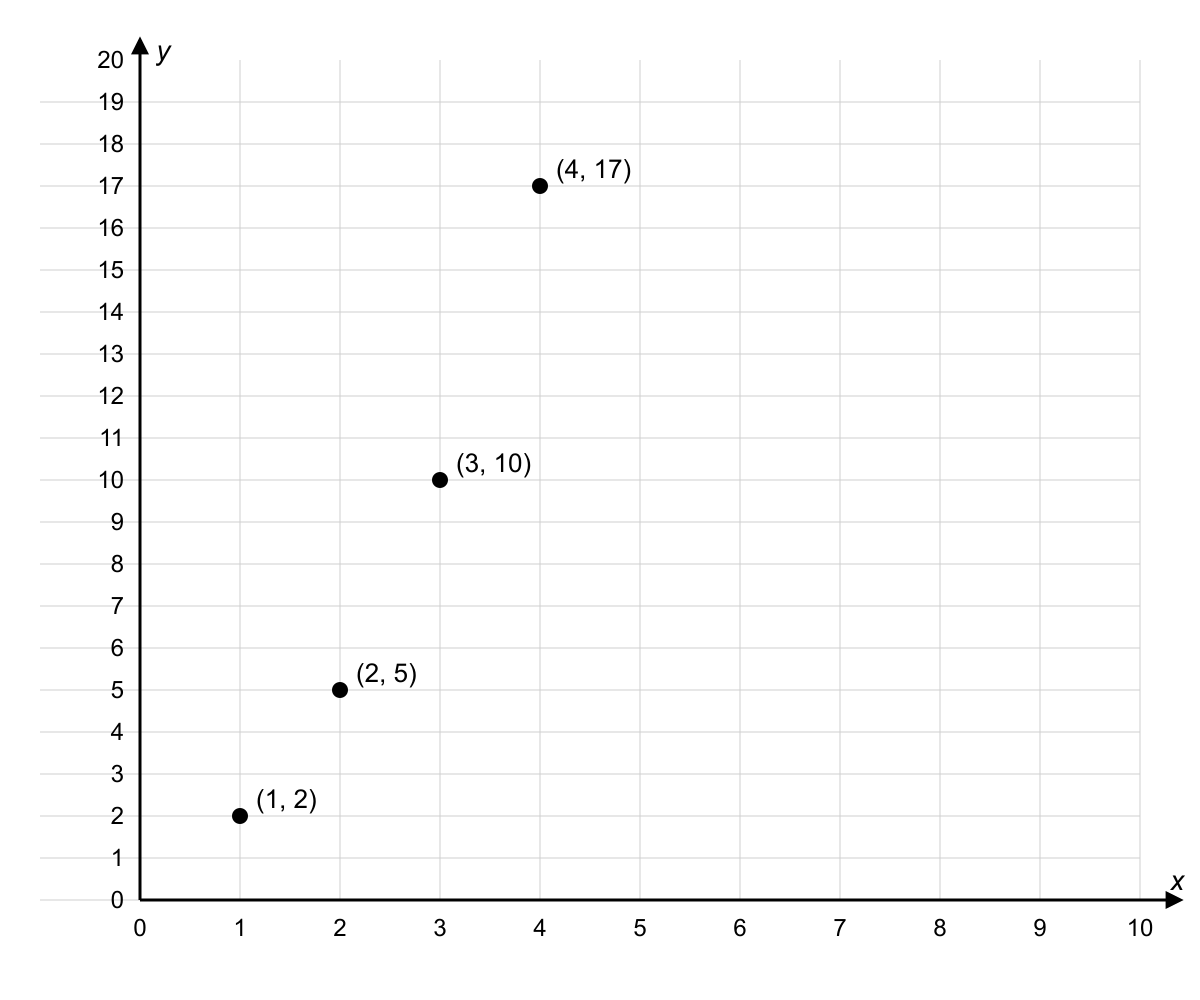
The coordinate plane shown displays the first four points of a pattern: (1,2), (2,5), (3,10), and (4,17). If the pattern continues, what will be the y-coordinate of the point whose x-coordinate is 9?
SHSAT Math Quiz
Practice Coordinate Point Patterns in SHSAT Math with focused quiz questions that help you check what you know, review explanations, and build confidence with test-style prompts.
This quiz focuses on Coordinate Point Patterns, giving you a quick way to practice the rules, question types, and explanations that matter most for SHSAT Math.
Try each quiz question before looking at the correct answer. Use the explanations to review missed ideas, then come back to similar questions until the pattern feels familiar.
The coordinate plane shown displays the first four points of a pattern: (1,2), (2,5), (3,10), and (4,17). If the pattern continues, what will be the y-coordinate of the point whose x-coordinate is 9?
The coordinate plane below shows a sequence of points: (0,1),(1,2),(2,4),(3,8),(4,16). If the pattern continues, which point lies on the x-axis line y=1024?
The coordinate plane shown displays a pattern where each point (xn,yn) satisfies xn+1=xn+2 and yn+1=yn+xn. If (x1,y1)=(1,0), what are the coordinates of the 6th point?
Refer to the coordinate plane. Five points form a pattern such that each successive point is obtained by moving +2 in x and doubling the previous y-value. If P1=(1,3), what is the sum of the coordinates of P5?
Consider the ordered triple of points (0,0),(2,1),(4,2). If the pattern continues in the same way, what will be the y-coordinate of the point whose x-coordinate is 10?
The table lists coordinate points generated by a rule. Use the table to answer the question. Which point also satisfies the same rule?
On the coordinate plane shown, points are plotted at (1,3), (2,6), (4,12), and (5,15), but the point for x=3 is missing. If the pattern continues linearly, and the sum of ALL six y-coordinates (including x=3 and x=6) equals what value?
Based on the pattern shown in the coordinate plane, point Pn has coordinates (n,f(n)). The first six points are (1,2),(2,5),(3,10),(4,17),(5,26),(6,37). What is the y-coordinate of P12 MINUS the y-coordinate of P7?
Refer to the coordinate plane shown. The points follow a pattern in the order labeled P1,P2,P3,P4,…. What are the coordinates of P20?
In the coordinate plane, point A is at (3,−2) and point B is at (7,6). Point C lies on the line segment AB such that AC:CB=1:3. What are the coordinates of point C?
A set of points follows the pattern: (1,1), (2,3), (3,6), (4,10), (5,15), … If point (n,y) belongs to this set, which equation best describes the relationship between n and y?
The coordinate plane shown displays points A1,A2,A3,… located at (1,1),(2,4),(3,9),(4,16),… Which of the following is NOT a point in this pattern?
In the coordinate plane shown, points Q1,Q2,Q3,… are plotted at (2,1),(4,4),(6,9),(8,16),… If this pattern continues, at what x-coordinate does the y-value first exceed 200?
Refer to the figure. The points plotted form a pattern on the coordinate plane: (1,1),(2,3),(4,9),(8,27),(16,81),… If the pattern continues, what is the y-coordinate of the point whose x-coordinate is 128?
The points (1,3),(3,5),(5,7),(7,9) follow a consistent pattern. Which point comes next in this pattern?