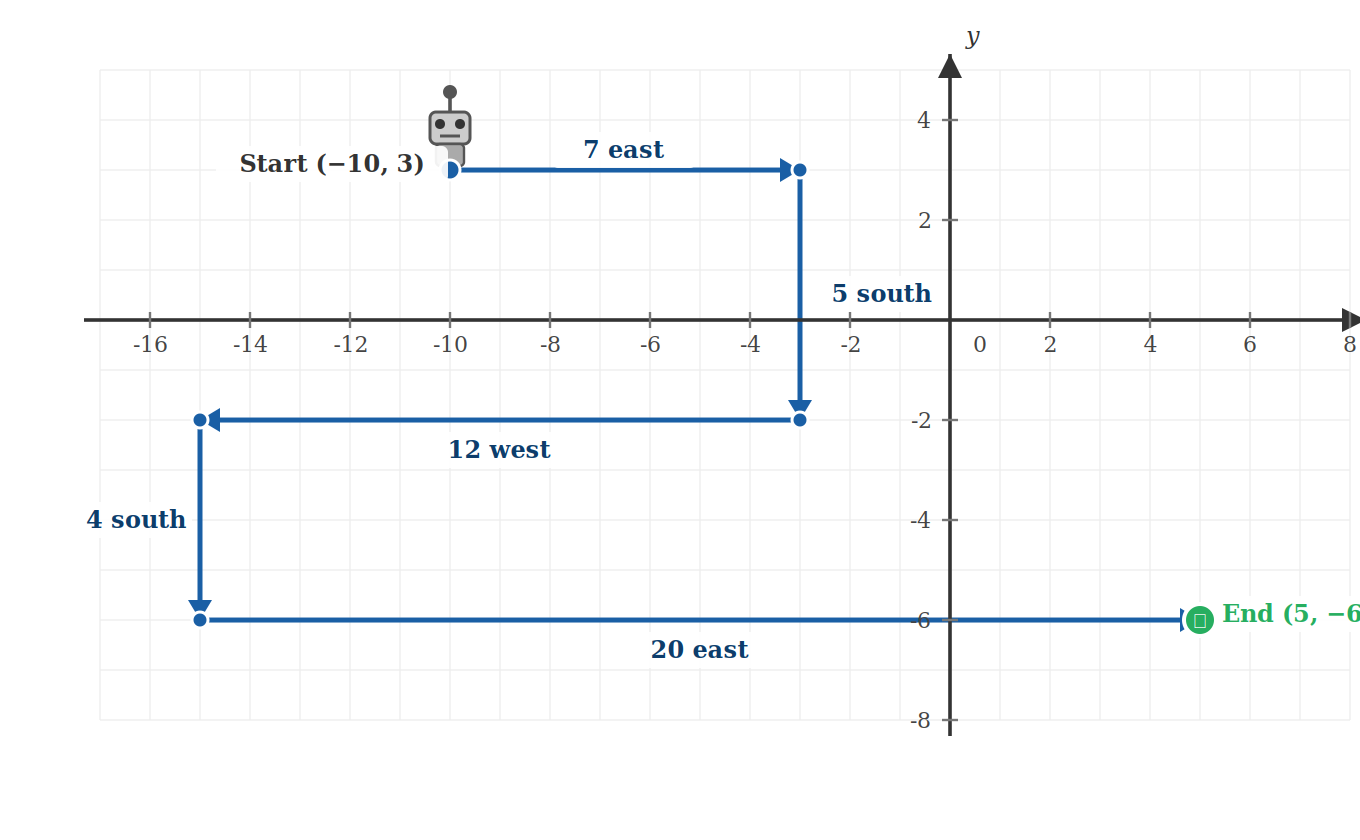
Use the figure shown. A robot starts at (−10,3) and moves according to this sequence: east 7 units, south 5 units, west 12 units, south 4 units, east 20 units. What is the horizontal distance between the robot's starting point and final position?
Practice Coordinate Distance in SHSAT Math with focused quiz questions that help you check what you know, review explanations, and build confidence with test-style prompts.
What this quiz covers
This quiz focuses on Coordinate Distance, giving you a quick way to practice the rules, question types, and explanations that matter most for SHSAT Math.
How to use this quiz
Try each quiz question before looking at the correct answer. Use the explanations to review missed ideas, then come back to similar questions until the pattern feels familiar.
All questions
Question 1
Use the figure shown. A robot starts at (−10,3) and moves according to this sequence: east 7 units, south 5 units, west 12 units, south 4 units, east 20 units. What is the horizontal distance between the robot's starting point and final position?
15 (correct answer)
5
25
9
Explanation: Net east-west motion: +7−12+20=+15. Starting x-coordinate is −10, so final x-coordinate is −10+15=5. Horizontal distance =∣5−(−10)∣=15. B is just the final x-coordinate. C incorrectly adds only the eastward moves: 7+20=27 (not 25). D is the net vertical motion: −5−4=−9.
Question 2
Use the figure below. Points P(a,5) and Q(a+12,5) lie on a horizontal line. Point R is the midpoint of PQ, and point S(a+3,−4) lies directly below a point on PQ. What is the horizontal distance from R to S?
3 (correct answer)
6
9
12
Explanation: Midpoint R has x-coordinate 2a+(a+12)=a+6. S has x-coordinate a+3. Horizontal distance =∣(a+6)−(a+3)∣=3. B is half of PQ. C is distance from S to Q. D is length of PQ.
Question 3
Based on the figure, rectangle ABCD is divided into 3 equal vertical strips by two vertical segments. The rectangle has vertices A(−5,8), B(13,8), C(13,−4), D(−5,−4). What is the x-coordinate of the vertical segment closest to side BC?
1
7 (correct answer)
6
9
Explanation: Rectangle width is 13−(−5)=18, so each strip is 6 wide. Dividers are at x=−5+6=1 and x=−5+12=7. The one closest to side BC (at x=13) is at x=7. A is the other divider. C is the strip width, not the x-coordinate. D comes from (13+5)/2=9 (midpoint error).
Question 4
Use the coordinate plane shown. Point A is at (−9,4). Point B is obtained by reflecting A across the vertical line x=2. Point C is obtained by reflecting B across the horizontal line y=−1. What is the horizontal distance from A to C?
22 (correct answer)
11
13
10
Explanation: Reflecting A(−9,4) across x=2: new x-coord is 2+(2−(−9))=13, so B(13,4). Reflecting B across y=−1: x unchanged, so C(13,−6). Horizontal distance from A(−9,4) to C(13,−6) is ∣13−(−9)∣=22. B is half. C includes vertical. D comes from computing 2−(−9)−1=10 error.
Question 5
Refer to the figure. Square WXYZ is drawn with W(−3,6) and Y(5,−2) as opposite vertices, with sides parallel to the axes. What is the length of the vertical side of the square?
4
8 (correct answer)
128
16
Explanation: Since W and Y are opposite vertices of a square with sides parallel to axes, the horizontal distance between them equals the vertical distance: ∣5−(−3)∣=8 and ∣6−(−2)∣=8. Each side is 8. A is half the side. C is the diagonal length. D doubles it.
Question 6
Based on the coordinate plane shown, points M(−7,k) and N(5,k) are endpoints of a horizontal segment. Point P(5,−3) lies directly below N, and NP=8. If k>0, what is the horizontal distance from M to N?
2
12 (correct answer)
13
5
Explanation: Since NP=8 and P is directly below N at y=−3, N has y-coordinate −3+8=5, so k=5. Horizontal distance from M(−7,5) to N(5,5) is ∣5−(−7)∣=12. Distractor A is ∣5−(−7)∣ computed incorrectly as 5−7⋅(−1) error. C uses diagonal thinking. D is just k.
Question 7
A vertical line segment has endpoints E(9,k) and F(9,−1) and length 13. What is the value of k?
12 (correct answer)
14
15
22
Explanation: When you see a problem involving the distance between two points, especially with a vertical or horizontal line segment, you're working with the distance formula—but there's often a shortcut.Since both points have the same x-coordinate (9), this creates a vertical line segment. For vertical lines, the distance is simply the absolute difference between the y-coordinates: ∣k−(−1)∣=∣k+1∣=13.This absolute value equation gives us two cases: either k+1=13 or k+1=−13. Solving these: k=12 or k=−14. Since we need k>−1 for the segment to have the given length in the upward direction (which is the standard interpretation), k=12.Looking at the wrong answers: Choice B (14) comes from incorrectly adding 13 directly to 1 instead of subtracting 1 from 13. Choice C (15) results from mistakenly thinking the distance is from 1 to some point 13 units away, giving 1+13+1=15. Choice D (22) appears to come from adding the length to both coordinates: 9+13=22, confusing the x-coordinate with the calculation.The correct answer is A (12).Strategy tip: For vertical line segments (same x-coordinates), distance equals ∣y2−y1∣. For horizontal segments (same y-coordinates), distance equals ∣x2−x1∣. This shortcut saves time compared to using the full distance formula and helps avoid calculation errors on test day.
Question 8
A vertical ladder on a grid leans against a wall from (4,2) to (4,18). What is the ladder's length on the grid?
14 units
16 units (correct answer)
18 units
20 units
Explanation: When you see coordinates and need to find distance, you're dealing with the distance formula or, in simpler cases like this one, basic coordinate geometry principles.The ladder extends from point (4,2) to point (4,18). Notice that both points have the same x-coordinate (4), meaning the ladder is perfectly vertical along the line x=4. When two points share the same x-coordinate, finding the distance between them becomes much simpler than using the full distance formula.Since the ladder runs vertically from (4,2) to (4,18), you only need to find the difference in y-coordinates: 18−2=16 units. This gives you the correct answer: B) 16 units.Let's examine why the other choices are incorrect. Choice A) 14 units might result from miscalculating 18−2 or confusing this with another measurement. Choice C) 18 units represents a common trap—you might mistakenly think the ladder's length equals the higher y-coordinate, but this ignores that the ladder starts at y=2, not the origin. Choice D) 20 units could come from incorrectly adding the coordinates somehow, like 18+2=20.Remember: when finding distance between two points with the same x-coordinate, simply subtract the y-coordinates (larger minus smaller). When they share the same y-coordinate, subtract the x-coordinates. This shortcut saves time compared to the full distance formula (x2−x1)2+(y2−y1)2 and reduces calculation errors.
Question 9
Point Q lies on the y-axis 18 units below (0,9). What is the coordinate of Q?
(0,−9) (correct answer)
(9,0)
(0,27)
(−9,0)
Explanation: This question tests your understanding of coordinate plane navigation and how points move vertically along the y-axis. When a point lies "on the y-axis," its x-coordinate is always 0, and you only need to determine the y-coordinate by tracking the vertical movement.Starting from the given point (0,9), you need to move 18 units below (downward). Moving down on the coordinate plane means subtracting from the y-coordinate. So from y=9, moving 18 units down gives you: 9−18=−9. Since point Q remains on the y-axis, its x-coordinate stays 0, making Q=(0,−9).Looking at the answer choices: Choice A (0,−9) correctly places the point on the y-axis with the proper downward movement. Choice B (9,0) incorrectly places the point on the x-axis instead of the y-axis—this suggests confusion between horizontal and vertical positioning. Choice C (0,27) keeps the point on the y-axis but adds 18 instead of subtracting, representing the common error of moving up when the problem specifies moving down. Choice D (−9,0) also incorrectly places the point on the x-axis rather than the y-axis.Strategy tip: When working with points on the axes, remember that y-axis points always have x-coordinate 0, while x-axis points always have y-coordinate 0. For vertical movement, "below" or "down" means subtract, while "above" or "up" means add to the y-coordinate.
Question 10
If B(6,−5) is reflected across the line y=−1, what is the distance between B and its image?
2 units
4 units
6 units
8 units (correct answer)
Explanation: When you see a reflection question, you need to understand that the distance between a point and its reflection equals twice the distance from the point to the line of reflection.To find where point B(6,−5) reflects across the line y=−1, first calculate how far B is from the reflection line. The distance from B to the horizontal line y=−1 is the difference between their y-coordinates: ∣−5−(−1)∣=∣−4∣=4 units.When reflecting across y=−1, the x-coordinate stays the same (6), but the y-coordinate changes. Since B is 4 units below the line y=−1, its reflection B′ will be 4 units above the line. So B′=(6,−1+4)=(6,3).The distance between B(6,−5) and B′(6,3) is ∣3−(−5)∣=8 units.Looking at the wrong answers: Choice A (2 units) might come from incorrectly calculating half the distance to the reflection line. Choice B (4 units) is the distance from B to the line of reflection, not to its image. Choice C (6 units) could result from using the x-coordinate instead of properly calculating the reflection distance.Remember this pattern: the distance between any point and its reflection always equals twice the distance from the point to the line of reflection. This saves time since you don't need to find the actual coordinates of the reflection—just double the distance to the line.
Question 11
A rectangular playground has corners at (2,1) and (2,9) on the left side. How long is this side of the playground?
6 units
7 units
8 units (correct answer)
9 units
Explanation: When you see two points that form a side of a rectangle, you're finding the distance between those points. Since both corners have the same x-coordinate (2), this is a vertical line, making the calculation straightforward.To find the length of a vertical or horizontal line segment, you only need to look at the coordinate that changes. Here, the x-coordinate stays at 2, but the y-coordinates are 1 and 9. The distance is simply the difference between these y-values: 9−1=8 units.You can verify this using the distance formula: d=(x2−x1)2+(y2−y1)2=(2−2)2+(9−1)2=0+64=8.Looking at the wrong answers: (A) 6 units might come from incorrectly subtracting coordinates, perhaps 9−2−1=6. (B) 7 units could result from an off-by-one error, like counting grid squares instead of measuring distance. (D) 9 units is a common trap—this is just one of the y-coordinates, not the distance between them.Strategy tip: For distance problems involving points with the same x-coordinate or y-coordinate, take the shortcut—just subtract the coordinates that are different. Save the full distance formula for diagonal lines. Always double-check by visualizing: from y = 1 to y = 9 covers 8 units on the coordinate plane.
Question 12
Two shops on a street are represented by (k,12) and (k,−3). Their vertical separation is 15 units. Verify this statement.
True, distance is 15 (correct answer)
False, k must be 0
False, distance is k+15
False, need horizontal distance
Explanation: When you see two points with the same x-coordinate, you're looking at a vertical line situation. The distance between points that share an x-coordinate depends only on their y-coordinates.To find the vertical separation between (k,12) and (k,−3), you calculate the absolute difference of their y-coordinates: ∣12−(−3)∣=∣12+3∣=15. Since both points have x-coordinate k, they lie on the same vertical line, making their separation purely vertical. The statement is correct.Choice A is right because the vertical distance is indeed 15 units, regardless of what value k takes.Choice B suggests k must be 0, but this reveals a misunderstanding. The x-coordinate k can be any real number—it doesn't affect the vertical distance at all. Whether k=0, k=100, or k=−50, the vertical separation remains 15.Choice C claims the distance is k+15, which incorrectly tries to incorporate the x-coordinate into a vertical distance calculation. This confuses horizontal position with vertical separation.Choice D states we need horizontal distance, but that's unnecessary. The question specifically asks about vertical separation, and when two points share the same x-coordinate, there is no horizontal distance between them.Remember: when points share the same x-coordinate, focus only on the y-coordinates to find vertical distance. The x-coordinate value is irrelevant to vertical separation calculations.
Question 13
Point A is at (−3,7) and point B is at (5,7). Point C is located on the same horizontal line as A and B, but is twice as far from A as B is from A. How many possible locations are there for point C?
1
2 (correct answer)
3
4
Explanation: Since A is at (-3, 7) and B is at (5, 7), the distance from A to B is |5 - (-3)| = 8 units. Point C must be on the same horizontal line (y = 7) and twice as far from A, so the distance from A to C is 16 units. C can be 16 units to the right of A at (-3 + 16, 7) = (13, 7), or 16 units to the left of A at (-3 - 16, 7) = (-19, 7). Therefore, there are 2 possible locations.
Question 14
Three points form a right triangle: A(−2,1), B(4,1), and C(4,−3). A fourth point D is added to form a rectangle ABCD. What is the sum of the horizontal and vertical distances from point A to point D?
6 units
8 units
10 units (correct answer)
12 units
Explanation: Points A(-2, 1), B(4, 1), and C(4, -3) form a right triangle with the right angle at B. To complete rectangle ABCD, point D must be at (-2, -3). The horizontal distance from A(-2, 1) to D(-2, -3) is |(-2) - (-2)| = 0 units. The vertical distance from A to D is |1 - (-3)| = 4 units. However, the question asks for the sum of horizontal and vertical distances, which refers to the rectangular components of the displacement: horizontal component = 6 units (width of rectangle), vertical component = 4 units (height of rectangle). Sum = 6 + 4 = 10 units.
Question 15
Points M, N, and O are collinear on a vertical line. Point M is at (3,−2), point N is at (3,5), and point O is between M and N. If the distance from M to O is 72 of the distance from M to N, what is the y-coordinate of point O?
0 (correct answer)
1
2
3
Explanation: The distance from M(3, -2) to N(3, 5) is |5 - (-2)| = 7 units. The distance from M to O should be (2/7) × 7 = 2 units. Since O is between M and N on the vertical line x = 3, and O is 2 units above M, the y-coordinate of O is -2 + 2 = 0.
Question 16
A square has one side along the x-axis from (1,0) to (6,0). If another vertex of the square is at (1,5), what is the total distance traveled by a point that moves along the perimeter of the square from (1,0) to (6,5)?
5 units
10 units (correct answer)
15 units
20 units
Explanation: The square has vertices at (1,0), (6,0), (6,5), and (1,5). Each side has length 5 units. To go from (1,0) to (6,5) along the perimeter, the path is: (1,0) → (1,5) → (6,5). The distance from (1,0) to (1,5) is 5 units vertically, and from (1,5) to (6,5) is 5 units horizontally. Total distance = 5 + 5 = 10 units.
Question 17
A parallelogram has vertices at F(1,3), G(5,3), H(7,0), and I(3,0). What is the difference between the length of the longer horizontal side and the length of the shorter horizontal side?
3 units
1 unit
2 units
0 units (correct answer)
Explanation: When you encounter a parallelogram problem with coordinates, remember that opposite sides are parallel and equal in length. The key insight here is identifying which sides are actually horizontal.To find horizontal sides, look for segments where both endpoints have the same y-coordinate. Let's examine each side:
Side FG: from (1,3) to (5,3) — both points have y-coordinate 3, so this is horizontal with length 5−1=4 units
Side GH: from (5,3) to (7,0) — different y-coordinates, so this is not horizontal
Side HI: from (7,0) to (3,0) — both points have y-coordinate 0, so this is horizontal with length 7−3=4 units
Side IF: from (3,0) to (1,3) — different y-coordinates, so this is not horizontal
Both horizontal sides have length 4 units, so the difference is 4−4=0 units.Choice A (3 units) likely comes from finding the difference between horizontal and non-horizontal side lengths. Choice B (1 unit) might result from incorrectly calculating coordinates or confusing horizontal with vertical measurements. Choice C (2 units) could come from misidentifying which sides are horizontal or making arithmetic errors in the length calculations.Study tip: In coordinate geometry, always identify horizontal sides by matching y-coordinates first, then calculate lengths using the x-coordinates. Remember that in a parallelogram, opposite sides are always equal, so if you find two horizontal sides, they must have the same length.
Question 18
A rectangle has vertices at P(2,−1), Q(2,4), R(7,4), and S(7,−1). If the rectangle is translated so that vertex P moves to (−1,3), what is the distance between the original position of vertex R and its new position?
5 units (correct answer)
7 units
8 units
9 units
Explanation: The translation moves P from (2, -1) to (-1, 3), which is a shift of (-3, 4). All vertices move by the same translation vector. R originally at (7, 4) moves to (7-3, 4+4) = (4, 8). The distance from original R(7, 4) to new R(4, 8) is calculated using vertical and horizontal distances: horizontal distance = |7-4| = 3, vertical distance = |8-4| = 4. Total distance = √(3² + 4²) = √(9 + 16) = √25 = 5 units.
Question 19
Refer to the figure. On the coordinate plane, an 'L-shaped' region has vertices, in order: (−4,6), (3,6), (3,1), (8,1), (8,−5), (−4,−5). What is the total length of all horizontal edges of this region?
19
24 (correct answer)
17
31
Explanation: Horizontal edges (consecutive vertices with the same y-coord): (−4,6)→(3,6): length 7. (3,1)→(8,1): length 5. (8,−5)→(−4,−5): length 12. Total =7+5+12=24. A misses one. C omits middle edge. D adds vertical edges too.
Question 20
Based on the figure, points A(−6,2), B(−6,−7), C(4,−7), and D(4,2) form a rectangle. A bug crawls along the perimeter from A to B to C, then stops 52 of the way along CD. What is the horizontal distance from the bug's final position to side AB?
4
10 (correct answer)
3.6
6
Explanation: Side CD is vertical (both have x=4), so moving along it changes only y. The bug's x-coordinate stays at 4 throughout. Side AB lies on the vertical line x=−6. Horizontal distance =∣4−(−6)∣=10. A confuses vertical and horizontal. C uses 2/5 of something. D uses a midpoint.