SHSAT Math Quiz: Composite Figure Area
9 questions · exam conditions
0:00
Composite Figure AreaQuestion 1 of 9

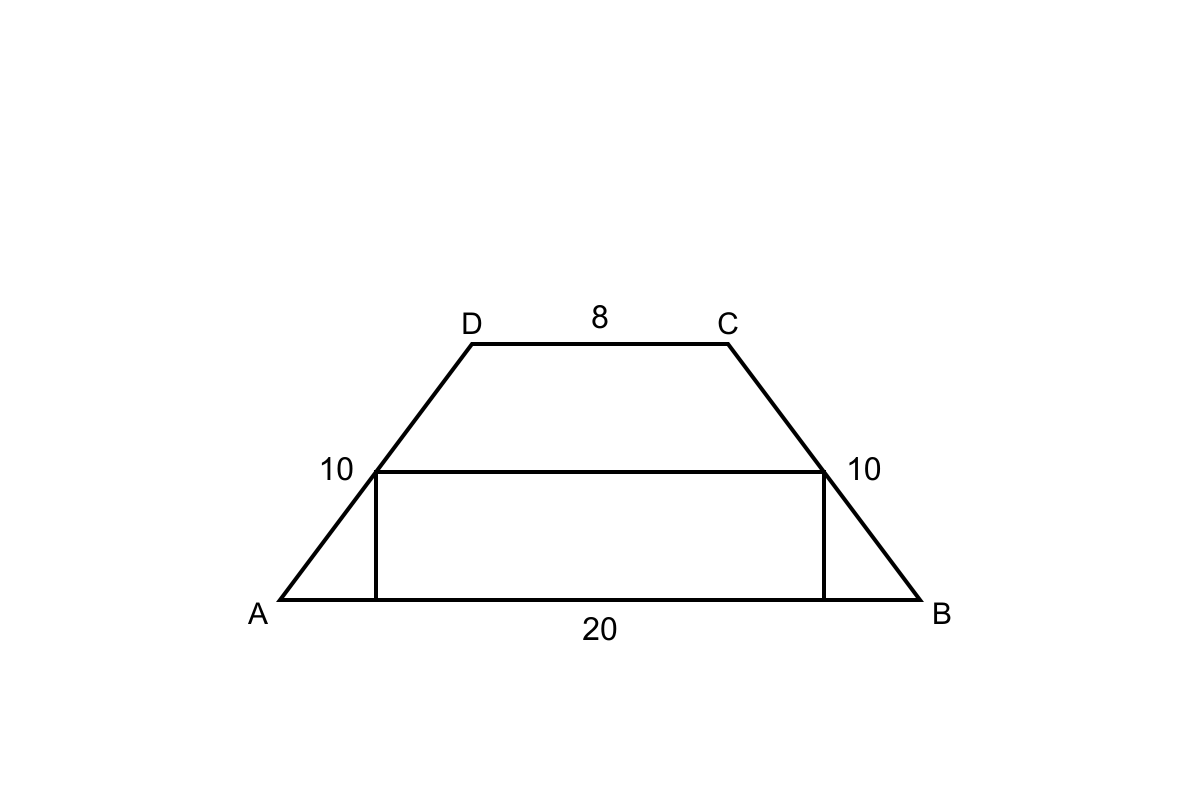
Refer to the figure. A trapezoid has parallel sides of lengths 20 and 8, and its non-parallel sides are both 10. A rectangle is inscribed in the trapezoid such that one of its sides lies on the longer parallel side, and the opposite side has its endpoints on the two non-parallel sides of the trapezoid. If the rectangle's height equals half the trapezoid's height, what is the area of the rectangle?
Question graphic
3232
5656
6464
4848
← Back to quizzes

SHSAT Math Quiz

SHSAT Math Quiz: Composite Figure Area

Practice Composite Figure Area in SHSAT Math with focused quiz questions that help you check what you know, review explanations, and build confidence with test-style prompts.

What this quiz covers

This quiz focuses on Composite Figure Area, giving you a quick way to practice the rules, question types, and explanations that matter most for SHSAT Math.

How to use this quiz

Try each quiz question before looking at the correct answer. Use the explanations to review missed ideas, then come back to similar questions until the pattern feels familiar.

All questions

Question 1

Refer to the figure. A trapezoid has parallel sides of lengths 20 and 8, and its non-parallel sides are both 10. A rectangle is inscribed in the trapezoid such that one of its sides lies on the longer parallel side, and the opposite side has its endpoints on the two non-parallel sides of the trapezoid. If the rectangle's height equals half the trapezoid's height, what is the area of the rectangle?

  1. 3232
  2. 5656 (correct answer)
  3. 6464
  4. 4848
Explanation: Trapezoid's height: the two legs hang over 2082=6\frac{20-8}{2}=6 horizontally. Leg = 10, so height =10036=8=\sqrt{100-36}=8. Rectangle height = 4. At height 4 (halfway up), the cross-sectional width of the trapezoid = average of 20 and 8 = 14. So rectangle is 14×4=5614 \times 4 = 56. Distractor (A) uses width 8. Distractor (C) uses full height 8 and width 8. Distractor (D) uses width 12.

Question 2

Use the figure shown. In the figure, a square of side 6 has four congruent isosceles right triangles attached to its sides (each hypotenuse coinciding with a side of the square, and each triangle pointing outward). The resulting 8-pointed figure's outer boundary is then enclosed by the smallest possible square. What is the area of the smallest enclosing square?

  1. 7272
  2. 108108
  3. 144144 (correct answer)
  4. 162162
Explanation: Each isosceles right triangle has hypotenuse 6, so legs 62=32\frac{6}{\sqrt{2}}=3\sqrt{2}, and height from hypotenuse to right-angle vertex = 33. The outer points of the triangles extend 3 units beyond each side of the inner square, so the enclosing square has side 6+3+3=126+3+3=12, area 144144. Distractor (A) adds only one triangle's height. Distractor (B) uses diagonal-based side. Distractor (D) uses height 323\sqrt{2} instead of 3.

Question 3

A regular hexagon is inscribed in a circle of radius 8 cm. Six identical isosceles triangles are then constructed on the exterior of the hexagon, with each triangle having its base as one side of the hexagon and its apex 4 cm from the base. What is the total area of the six external triangles?

  1. 48348\sqrt{3} square cm
  2. 96396\sqrt{3} square cm
  3. 9696 square cm (correct answer)
  4. 192192 square cm
Explanation: In a regular hexagon inscribed in a circle of radius 8 cm, each side length equals the radius = 8 cm. Each external triangle has base 8 cm and height 4 cm. Area of one triangle = (1/2)(8)(4) = 16 square cm. Total area of six triangles = 6 × 16 = 96 square cm. Choice A uses the area of the hexagon itself (6 × (√3/4) × 8²). Choice B doubles the correct answer. Choice D uses height = 8 instead of 4.

Question 4

A compound figure is formed by placing a square of side length 6 inches on top of an equilateral triangle with the same side length. The square and triangle share a common side. If a circle with radius 2 inches is then removed from the center of the square, what is the area of the remaining figure?

  1. 36+934π36 + 9\sqrt{3} - 4\pi square inches (correct answer)
  2. 36+1834π36 + 18\sqrt{3} - 4\pi square inches
  3. 42+934π42 + 9\sqrt{3} - 4\pi square inches
  4. 30+934π30 + 9\sqrt{3} - 4\pi square inches
Explanation: Square area = 6² = 36 square inches. Equilateral triangle area = (√3/4)(6²) = 9√3 square inches. Circle area = π(2²) = 4π square inches. Total remaining area = 36 + 9√3 - 4π. Choice B incorrectly calculates triangle area as (√3/2)(6²) = 18√3. Choice C adds an extra 6 to the square area. Choice D subtracts 6 from the square area.

Question 5

A sector of a circle with radius 12 inches and central angle 120° has a rectangular piece removed from it. The rectangle has one side along a radius of the sector, with dimensions 4 inches by 6 inches. What is the area of the remaining figure?

  1. 48π2448\pi - 24 square inches (correct answer)
  2. 24π2424\pi - 24 square inches
  3. 36π2436\pi - 24 square inches
  4. 144π24144\pi - 24 square inches
Explanation: Sector area = (θ/360°) × πr² = (120°/360°) × π(12)² = (1/3) × 144π = 48π square inches. Rectangle area = 4 × 6 = 24 square inches. Remaining area = 48π - 24 square inches. Choice B uses 60° instead of 120°. Choice C uses 90° central angle. Choice D uses full circle area instead of sector area.

Question 6

A circular pizza with radius 9 inches has two identical rectangular slices removed. Each rectangular slice has dimensions 3 inches by 6 inches and is positioned so that one of its 6-inch sides lies along a diameter of the pizza. What is the area of the remaining pizza?

  1. 81π3681\pi - 36 square inches (correct answer)
  2. 81π1881\pi - 18 square inches
  3. 18π3618\pi - 36 square inches
  4. 162π36162\pi - 36 square inches
Explanation: Original pizza area = π(9)² = 81π square inches. Each rectangular slice has area 3 × 6 = 18 square inches. Two slices remove 2 × 18 = 36 square inches total. Remaining area = 81π - 36. Choice B only removes one slice. Choice C uses wrong formula for circle area (uses diameter instead of radius). Choice D uses diameter in circle formula: π(18)² = 324π, then halved incorrectly.

Question 7

Use the figure. A circle of radius 10 is inscribed in a square. Inside the circle, a smaller square is inscribed (with vertices on the circle). What is the area of the region inside the larger square but outside the smaller square?

  1. 400200400 - 200
  2. 200200 (correct answer)
  3. 400100π400 - 100\pi
  4. 100π200100\pi - 200
Explanation: The large square has side 20 (equal to the circle's diameter), area 400. The smaller square inscribed in the circle has diagonal equal to the circle's diameter = 20, so its side is 202=102\frac{20}{\sqrt{2}}=10\sqrt{2} and area (102)2=200(10\sqrt{2})^2=200. Difference = 400200=200400-200=200. Distractor (A) is the unsimplified form but listed awkwardly. Distractor (C) subtracts the circle instead of the inner square. Distractor (D) is the area between circle and inner square.

Question 8

Refer to the figure. In the figure, ABCDABCD is a rectangle with AB=16AB=16 and BC=10BC=10. Point PP lies on side CDCD such that DP=6DP=6. Segments APAP and BPBP divide the rectangle into three triangles. What is the area of triangle ABPABP?

  1. 4848
  2. 8080 (correct answer)
  3. 6060
  4. 9696
Explanation: Triangle ABPABP has base AB=16AB=16 and height equal to the distance from PP to line ABAB, which is 10 (the width of the rectangle). Area = 12(16)(10)=80\frac{1}{2}(16)(10)=80. Distractor (A) uses base 16 and height 6: 12(16)(6)\frac{1}{2}(16)(6). Distractor (C) uses base 12 and height 10. Distractor (D) forgets the 12\frac{1}{2}.

Question 9

Refer to the figure. An L-shaped figure is formed by cutting a smaller rectangle from the corner of a larger rectangle. The outer rectangle measures 15 by 12, and the removed rectangular corner measures 6 by 4. A diagonal line is then drawn from one inner corner of the L-shape, dividing the L into two regions. If the diagonal connects the inner corner (where the cut meets) to the opposite outer corner, and one of the two resulting regions is a trapezoid with parallel sides 9 and 15, what is the area of the trapezoid?

  1. 7272
  2. 8484
  3. 9696 (correct answer)
  4. 108108
Explanation: The L-shape area = 15(12)6(4)=18024=15615(12) - 6(4) = 180 - 24 = 156. The trapezoid has parallel sides 9 and 15; its height equals 8 (since 12 − 4 = 8). Area = 12(9+15)(8)=96\frac{1}{2}(9+15)(8) = 96. Distractor (A) uses height 6: 12(24)(6)=72\frac{1}{2}(24)(6)=72. Distractor (B) = 156 − 72. Distractor (D) uses height 9.