SHSAT Math Quiz: Area Of Common Figures
20 questions · exam conditions
0:00
Area Of Common FiguresQuestion 1 of 20

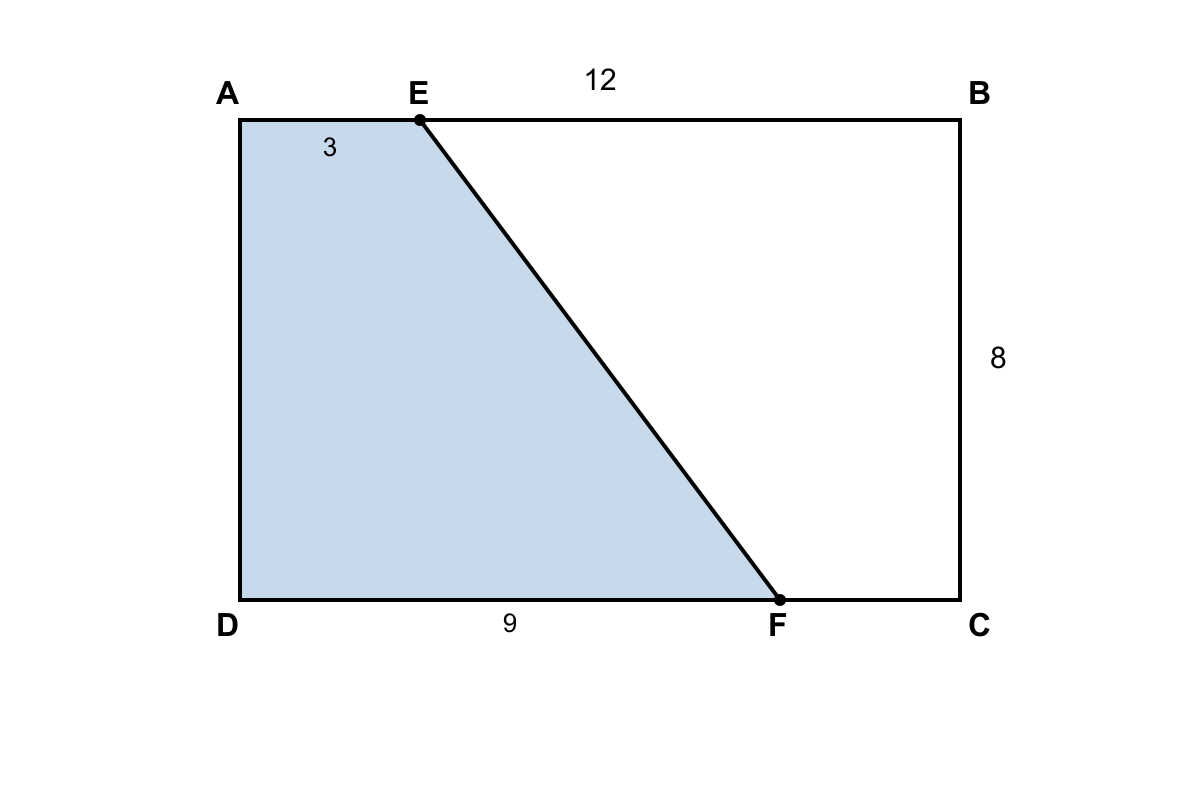
In the figure, rectangle ABCDABCD has AB=12AB = 12 and BC=8BC = 8. Point EE is on ABAB with AE=3AE = 3, and point FF is on CDCD with DF=9DF = 9. What is the area of quadrilateral AEFDAEFD?

Question graphic
3636
4242
4848
5454
← Back to quizzes

SHSAT Math Quiz

SHSAT Math Quiz: Area Of Common Figures

Practice Area Of Common Figures in SHSAT Math with focused quiz questions that help you check what you know, review explanations, and build confidence with test-style prompts.

What this quiz covers

This quiz focuses on Area Of Common Figures, giving you a quick way to practice the rules, question types, and explanations that matter most for SHSAT Math.

How to use this quiz

Try each quiz question before looking at the correct answer. Use the explanations to review missed ideas, then come back to similar questions until the pattern feels familiar.

All questions

Question 1

In the figure, rectangle ABCDABCD has AB=12AB = 12 and BC=8BC = 8. Point EE is on ABAB with AE=3AE = 3, and point FF is on CDCD with DF=9DF = 9. What is the area of quadrilateral AEFDAEFD?

  1. 3636
  2. 4242
  3. 4848 (correct answer)
  4. 5454
Explanation: AEFDAEFD is a trapezoid with parallel sides AE=3AE = 3 (on ABAB) and DF=9DF = 9 (on DCDC), with perpendicular distance AD=8AD = 8 between them. Area =12(3+9)(8)=12(12)(8)=48= \tfrac{1}{2}(3+9)(8) = \tfrac{1}{2}(12)(8) = 48. Distractor A uses 12(3)(8)+12(9)(8)=12+36=48\tfrac{1}{2}(3)(8)+\tfrac{1}{2}(9)(8) = 12+36=48... that's correct too. B: (3+9)(8)/26=42(3+9)(8)/2 - 6 = 42 (arithmetic error). D: uses (3+9)(9)/2=54(3+9)(9)/2 = 54.

Question 2

Parallelogram ABCDABCD has vertices A(0,0)A(0,0), B(5,0)B(5,0), C(7,4)C(7,4), and D(2,4)D(2,4). What is the area of ABCDABCD?

  1. 1616
  2. 1818
  3. 2020 (correct answer)
  4. 2424
Explanation: When you encounter a parallelogram with given coordinates, you have several methods to find its area. The most reliable approach is using the formula: Area = base × height. Let's identify the base and height of parallelogram ABCDABCD. Side ABAB lies along the x-axis from (0,0)(0,0) to (5,0)(5,0), giving us a horizontal base of length 55. To find the height, we need the perpendicular distance from this base to the opposite side DCDC. Since ABAB is horizontal along y=0y = 0, and the opposite vertices C(7,4)C(7,4) and D(2,4)D(2,4) both have yy-coordinate 44, the height is simply the vertical distance: 40=44 - 0 = 4. Therefore, Area = 5×4=205 \times 4 = 20. Let's examine why the other answers are incorrect. Choice (A) 1616 results from incorrectly using 4×44 \times 4, perhaps confusing the height with another measurement. Choice (B) 1818 might come from miscalculating the base length or attempting an incorrect formula application. Choice (D) 2424 could result from using 6×46 \times 4, where 66 might be mistakenly calculated as the base length. You can verify this is indeed a parallelogram by checking that opposite sides are parallel: AB=(5,0)\overrightarrow{AB} = (5,0) and DC=(5,0)\overrightarrow{DC} = (5,0), while AD=(2,4)\overrightarrow{AD} = (2,4) and BC=(2,4)\overrightarrow{BC} = (2,4). Strategy tip: For coordinate geometry problems involving parallelograms, always look for horizontal or vertical sides first—they make base and height calculations much simpler than using the cross-product formula.

Question 3

The area of a triangle is 60 ft260\text{ ft}^2 and its base is 12 ft12\text{ ft}. What is the height of the triangle?

  1. 5 ft5\text{ ft}
  2. 8 ft8\text{ ft}
  3. 10 ft10\text{ ft} (correct answer)
  4. 15 ft15\text{ ft}
Explanation: When you encounter a triangle area problem where you're given the area and one dimension, you need to work with the fundamental area formula: Area=12×base×height\text{Area} = \frac{1}{2} \times \text{base} \times \text{height}. Since you know the area is 60 ft260 \text{ ft}^2 and the base is 12 ft12 \text{ ft}, you can substitute these values and solve for the missing height. Setting up the equation: 60=12×12×h60 = \frac{1}{2} \times 12 \times h. Simplifying: 60=6h60 = 6h, so h=10 fth = 10 \text{ ft}. You can verify this: 12×12×10=60\frac{1}{2} \times 12 \times 10 = 60 Looking at the wrong answers reveals common calculation errors. Choice A (5 ft5 \text{ ft}) gives you 12×12×5=30 ft2\frac{1}{2} \times 12 \times 5 = 30 \text{ ft}^2, which is exactly half the required area—this suggests forgetting to account for the 12\frac{1}{2} factor properly. Choice B (8 ft8 \text{ ft}) yields 12×12×8=48 ft2\frac{1}{2} \times 12 \times 8 = 48 \text{ ft}^2, falling short of the target. Choice D (15 ft15 \text{ ft}) produces 12×12×15=90 ft2\frac{1}{2} \times 12 \times 15 = 90 \text{ ft}^2, which overshoots significantly and might result from incorrectly using Area=base×height\text{Area} = \text{base} \times \text{height} without the 12\frac{1}{2}. The answer is C. Study tip: Always double-check triangle area calculations by plugging your answer back into the original formula. The 12\frac{1}{2} factor is the most common source of errors in triangle problems, so make it a habit to explicitly write it in every step.

Question 4

A triangular garden covers 120 m2120\text{ m}^2. If the base is lengthened by 25%25\% while the height remains the same, what is the new area?

  1. 135 m2135\text{ m}^2
  2. 140 m2140\text{ m}^2
  3. 145 m2145\text{ m}^2
  4. 150 m2150\text{ m}^2 (correct answer)
Explanation: When you encounter area problems involving percentage changes, focus on how each dimension affects the total area. For triangular areas, remember that Area=12×base×height\text{Area} = \frac{1}{2} \times \text{base} \times \text{height}. Since the original triangular garden has an area of 120 m2120\text{ m}^2, we can write: 120=12×b×h120 = \frac{1}{2} \times b \times h, where bb is the base and hh is the height. When the base increases by 25%, the new base becomes b+0.25b=1.25bb + 0.25b = 1.25b. The height stays the same. So the new area is: New Area=12×(1.25b)×h=1.25×(12×b×h)=1.25×120=150 m2\text{New Area} = \frac{1}{2} \times (1.25b) \times h = 1.25 \times \left(\frac{1}{2} \times b \times h\right) = 1.25 \times 120 = 150\text{ m}^2 This confirms answer D is correct. Looking at the wrong answers: Choice A (135 m2135\text{ m}^2) represents adding 25% of something incorrectly—perhaps 25% of 60 instead of 120. Choice B (140 m2140\text{ m}^2) might come from mistakenly adding 120+20=140120 + 20 = 140, confusing the percentage calculation. Choice C (145 m2145\text{ m}^2) doesn't follow any clear mathematical relationship to the given information and likely results from computational errors. Strategy tip: When one dimension of a shape changes by a percentage while others remain constant, the area changes by that same percentage. A 25% increase in base (with height constant) means a 25% increase in area. Always multiply the original area by (1+percentage change)(1 + \text{percentage change}) rather than trying complex calculations.

Question 5

A triangular banner has a base of 12 cm12\text{ cm} and a height of 9 cm9\text{ cm}. What is the area of the banner?

  1. 42 cm242\text{ cm}^2
  2. 48 cm248\text{ cm}^2
  3. 54 cm254\text{ cm}^2 (correct answer)
  4. 108 cm2108\text{ cm}^2
Explanation: When you encounter area problems involving triangles, remember that the triangle area formula is one of the most fundamental geometric calculations: Area = 12×base×height\frac{1}{2} \times \text{base} \times \text{height}. For this triangular banner, you have a base of 12 cm and a height of 9 cm. Substituting these values into the formula: Area = 12×12×9=1082=54 cm2\frac{1}{2} \times 12 \times 9 = \frac{108}{2} = 54\text{ cm}^2. This confirms that choice C is correct. Let's examine why the other answers are wrong. Choice A (42 cm²) likely comes from incorrectly adding the base and height, then multiplying by some factor—this completely ignores the proper triangle formula. Choice B (48 cm²) might result from miscalculating 12×12×9\frac{1}{2} \times 12 \times 9 as 12×96\frac{1}{2} \times 96 due to arithmetic errors. Choice D (108 cm²) is the most common trap—this is what you get when you forget the 12\frac{1}{2} factor and simply multiply base times height (12×9=10812 \times 9 = 108). This mistake happens because students sometimes confuse the triangle area formula with the rectangle area formula. Remember this key distinction: rectangles use length × width, but triangles always require the 12\frac{1}{2} factor because a triangle is essentially half of a rectangle. When you see any triangle area problem on the SHSAT, write down the formula first to avoid forgetting that crucial 12\frac{1}{2}.

Question 6

The area of a triangle is expressed as 12(3x1)(x+2)\dfrac{1}{2}(3x-1)(x+2) square units. If the base is 3x13x-1 units and the height is x+2x+2 units, which of the following represents the area in simplest polynomial form?

  1. 3x2+5x22\dfrac{3x^2+5x-2}{2} (correct answer)
  2. 3x2+5x+22\dfrac{3x^2+5x+2}{2}
  3. 3x2+x22\dfrac{3x^2+x-2}{2}
  4. 3x25x22\dfrac{3x^2-5x-2}{2}
Explanation: This question tests your ability to multiply polynomials and express the result in simplest form. When you see an area formula given as a product of expressions, you need to expand and simplify to find the polynomial form. The area is given as 12(3x1)(x+2)\frac{1}{2}(3x-1)(x+2). To find the simplest polynomial form, you need to multiply the binomials (3x1)(3x-1) and (x+2)(x+2) using the distributive property (FOIL method). Multiply: (3x1)(x+2)=3xx+3x2+(1)x+(1)2(3x-1)(x+2) = 3x \cdot x + 3x \cdot 2 + (-1) \cdot x + (-1) \cdot 2 =3x2+6xx2=3x2+5x2= 3x^2 + 6x - x - 2 = 3x^2 + 5x - 2 Therefore, the area equals 3x2+5x22\frac{3x^2 + 5x - 2}{2}. Looking at the wrong answers: Choice B gives 3x2+5x+22\frac{3x^2 + 5x + 2}{2}, which results from incorrectly making the constant term positive instead of negative — this happens when you forget that (1)×2=2(-1) \times 2 = -2. Choice C gives 3x2+x22\frac{3x^2 + x - 2}{2}, which comes from incorrectly combining the middle terms as 6xx=x6x - x = x instead of 6xx=5x6x - x = 5x. Choice D gives 3x25x22\frac{3x^2 - 5x - 2}{2}, which results from making the middle term negative, likely from sign errors during the FOIL process. When multiplying binomials, always double-check your signs and carefully combine like terms. The FOIL method helps ensure you don't miss any terms in the expansion.

Question 7

In the figure, quadrilateral ABCDABCD has vertices A(0,0)A(0,0), B(8,0)B(8,0), C(10,5)C(10,5), and D(2,5)D(2,5). What is the area of ABCDABCD?

  1. 3030
  2. 4040 (correct answer)
  3. 4545
  4. 5050
Explanation: ABAB goes from (0,0)(0,0) to (8,0)(8,0), length 88. DCDC goes from (2,5)(2,5) to (10,5)(10,5), length 88. Both are horizontal, so ABCDABCD is a parallelogram with base 88 and height 55 (the vertical distance between y=0y=0 and y=5y=5). Area =85=40= 8 \cdot 5 = 40. Distractor A treats it as a triangle (halves). C uses 959 \cdot 5 (average of bases times height — trapezoid formula misapplied). D uses 10510\cdot 5.

Question 8

In the figure, triangle ABCABC is equilateral with side length 1212. Point MM is the midpoint of BCBC. What is the area of triangle ABMABM?

  1. 18318\sqrt{3} (correct answer)
  2. 3636
  3. 36336\sqrt{3}
  4. 7272
Explanation: Triangle ABMABM has base BM=6BM = 6 and height equal to the altitude of the equilateral triangle from AA: h=32(12)=63h = \tfrac{\sqrt{3}}{2}(12)=6\sqrt{3}. Area =12(6)(63)=183= \tfrac{1}{2}(6)(6\sqrt{3})=18\sqrt{3}. Distractor B uses 12(6)(12)=36\tfrac{1}{2}(6)(12)=36 (wrong height). C is the full equilateral triangle's area. D is (6)(12)(6)(12).

Question 9

A parallelogram has a base of 12 cm and a height of 8 cm. If this parallelogram is transformed into a triangle with the same base, what must be the height of the triangle to have an area that is 25% greater than the parallelogram's area?

  1. 10 cm
  2. 12 cm
  3. 15 cm
  4. 20 cm (correct answer)
Explanation: The parallelogram's area is 12 × 8 = 96 cm². An area 25% greater is 96 + 0.25(96) = 96 + 24 = 120 cm². For a triangle with base 12 cm to have area 120 cm², we need ½ × 12 × h = 120, so 6h = 120, giving h = 20 cm. Choice A (10 cm) gives the same area as the original parallelogram. Choice B (12 cm) gives area 72 cm². Choice C (15 cm) gives area 90 cm².

Question 10

A parallelogram and a trapezoid have the same area of 84 square inches. The parallelogram has a base of 12 inches and height of 7 inches. If the trapezoid has parallel sides of lengths 8 inches and b inches with the same height as the parallelogram, what is the value of b?

  1. 8 inches
  2. 12 inches
  3. 16 inches (correct answer)
  4. 20 inches
Explanation: First verify the parallelogram area: 12 × 7 = 84 ✓. For the trapezoid: ½(8 + b)(7) = 84. Multiplying both sides by 2: (8 + b)(7) = 168. Dividing by 7: 8 + b = 24, so b = 16 inches. Choice A would give area ½(8 + 8)(7) = 56. Choice B would give area ½(8 + 12)(7) = 70. Choice D would give area ½(8 + 20)(7) = 98.

Question 11

In the figure, trapezoid JKLMJKLM has JKMLJK \parallel ML. JK=6JK = 6, ML=14ML = 14, and both legs JMJM and KLKL have length 55. What is the area of trapezoid JKLMJKLM?

  1. 3030 (correct answer)
  2. 4040
  3. 5050
  4. 6060
Explanation: Since the trapezoid is isosceles, drop perpendiculars from JJ and KK to MLML. This creates two congruent right triangles on the ends, each with horizontal leg 1462=4\frac{14-6}{2} = 4 and hypotenuse 55. Using the Pythagorean theorem, the height is 5242=2516=3\sqrt{5^2 - 4^2} = \sqrt{25 - 16} = 3. Therefore, the area is 12(6+14)(3)=12(20)(3)=30\frac{1}{2}(6 + 14)(3) = \frac{1}{2}(20)(3) = 30.

Question 12

In the figure shown, triangle PQRPQR has Q=90°\angle Q = 90°, PQ=9PQ = 9, and QR=12QR = 12. Point SS on hypotenuse PRPR is the foot of the altitude from QQ. What is the area of triangle QRSQRS?

  1. 43225\dfrac{432}{25} (correct answer)
  2. 86425\dfrac{864}{25}
  3. 2727
  4. 5454
Explanation: First find PR=92+122=81+144=15PR = \sqrt{9^2 + 12^2} = \sqrt{81 + 144} = 15. The altitude from QQ to hypotenuse PRPR has length QS=PQQRPR=91215=10815=365QS = \frac{PQ \cdot QR}{PR} = \frac{9 \cdot 12}{15} = \frac{108}{15} = \frac{36}{5}. The segment RS=QR2PR=14415=485RS = \frac{QR^2}{PR} = \frac{144}{15} = \frac{48}{5}. Therefore, the area of triangle QRS=12RSQS=12485365=43225QRS = \frac{1}{2} \cdot RS \cdot QS = \frac{1}{2} \cdot \frac{48}{5} \cdot \frac{36}{5} = \frac{432}{25}.

Question 13

In the figure shown, trapezoid ABCDABCD has ABCDAB \parallel CD, with AB=8AB = 8, CD=20CD = 20, and leg AD=13AD = 13. The leg BCBC is perpendicular to the two parallel sides. What is the area of trapezoid ABCDABCD?

  1. 7070 (correct answer)
  2. 140140
  3. 168168
  4. 182182
Explanation: Drop a perpendicular from AA to CDCD meeting at point EE. Since ABCEABCE forms a rectangle, AE=BCAE = BC (the height) and CE=AB=8CE = AB = 8, so ED=CDCE=208=12ED = CD - CE = 20 - 8 = 12. Triangle AEDAED is right-angled with hypotenuse AD=13AD = 13 and leg ED=12ED = 12, so AE=132122=169144=5AE = \sqrt{13^2 - 12^2} = \sqrt{169 - 144} = 5. Therefore, the area is 12(AB+CD)×height=12(8+20)(5)=12(28)(5)=70\frac{1}{2}(AB + CD) \times \text{height} = \frac{1}{2}(8 + 20)(5) = \frac{1}{2}(28)(5) = 70.

Question 14

Refer to the figure. A larger parallelogram contains a smaller, similar parallelogram inside it, with corresponding sides parallel. The larger parallelogram has base 2020 and corresponding height 88. The smaller parallelogram has base 55. The region between the two parallelograms (the shaded region) has what area?

  1. 150150 (correct answer)
  2. 155155
  3. 160160
  4. 170170
Explanation: Larger area =208=160= 20 \cdot 8 = 160. Since the parallelograms are similar with ratio 5:20=1:45:20 = 1:4, the height of the small parallelogram is 8/4=28/4 = 2, and small area =52=10= 5 \cdot 2 = 10. Shaded area =16010=150=160 - 10 = 150. Distractor B subtracts 55 (just the base); C does not subtract at all; D uses small area =10=-10 incorrectly.

Question 15

The figure shows parallelogram PQRSPQRS with PQ=15PQ = 15 and QR=8QR = 8. The altitude from RR to side PQPQ has length 66. What is the area of parallelogram PQRSPQRS?

  1. 4848
  2. 7272
  3. 9090 (correct answer)
  4. 120120
Explanation: The area of a parallelogram equals (base)(corresponding height). The altitude from RR to line PQPQ has length 66, and the base PQ=15PQ = 15, so area =15×6=90= 15 \times 6 = 90. Distractor A uses QR×6=48QR \times 6 = 48 (wrong base/height pairing). Distractor B uses 12(15)(6?)\tfrac{1}{2}(15)(6\cdot?) or 8×98 \times 9. Distractor D multiplies 15×8=12015 \times 8 = 120 (treating as rectangle, ignoring height).

Question 16

The figure shows a composite shape made by attaching a right triangle to a rectangle. The rectangle has dimensions 10×610 \times 6. The right triangle shares the rectangle's right side (length 66) as one leg, and its hypotenuse measures 1010. What is the total area of the composite figure?

  1. 7272
  2. 8484 (correct answer)
  3. 9090
  4. 9696
Explanation: The rectangle has area 10×6=6010 \times 6 = 60. The right triangle has one leg of length 66 and hypotenuse 1010. Using the Pythagorean theorem, the other leg has length 10262=10036=64=8\sqrt{10^2 - 6^2} = \sqrt{100 - 36} = \sqrt{64} = 8. The triangle's area is 12(6)(8)=24\frac{1}{2}(6)(8) = 24. Therefore, the total area is 60+24=8460 + 24 = 84.

Question 17

An equilateral triangle has side length 6 cm6\text{ cm}. What is its area?

  1. 93 cm29\sqrt3\text{ cm}^2 (correct answer)
  2. 63 cm26\sqrt3\text{ cm}^2
  3. 123 cm212\sqrt3\text{ cm}^2
  4. 183 cm218\sqrt3\text{ cm}^2
Explanation: When you encounter an equilateral triangle area problem, remember that you need a special formula since all three sides are equal and all angles are 60°. For any equilateral triangle with side length ss, the area formula is A=s234A = \frac{s^2\sqrt{3}}{4}. This comes from using the general triangle area formula with the height of an equilateral triangle, which is s32\frac{s\sqrt{3}}{2}. With side length s=6s = 6 cm, we get: A=6234=3634=93 cm2A = \frac{6^2\sqrt{3}}{4} = \frac{36\sqrt{3}}{4} = 9\sqrt{3}\text{ cm}^2 This confirms that choice A) 93 cm29\sqrt{3}\text{ cm}^2 is correct. Looking at the wrong answers: Choice B) 63 cm26\sqrt{3}\text{ cm}^2 likely comes from using just the side length times 3\sqrt{3} without proper squaring and division. Choice C) 123 cm212\sqrt{3}\text{ cm}^2 might result from incorrectly using s233\frac{s^2\sqrt{3}}{3} instead of dividing by 4. Choice D) 183 cm218\sqrt{3}\text{ cm}^2 could come from using s232\frac{s^2\sqrt{3}}{2}, forgetting that the height formula already includes a factor of 12\frac{1}{2}. Strategy tip: Memorize the equilateral triangle area formula A=s234A = \frac{s^2\sqrt{3}}{4}. On the SHSAT, equilateral triangles appear frequently, and this formula saves time compared to deriving the height each time. The 3\sqrt{3} in the answer choices is often your clue that you're dealing with a 30-60-90 or equilateral triangle problem.

Question 18

A parallelogram has a base of 14 m14\text{ m} and the corresponding altitude is 8 m8\text{ m}. What is its area?

  1. 96 m296\text{ m}^2
  2. 104 m2104\text{ m}^2
  3. 112 m2112\text{ m}^2 (correct answer)
  4. 126 m2126\text{ m}^2
Explanation: When you encounter parallelogram area problems, remember that the formula is simply base × height, just like with rectangles. The key is identifying the correct measurements to use. For any parallelogram, the area equals the base multiplied by the corresponding altitude (height). The altitude is always the perpendicular distance between the parallel sides, not the slanted side length. In this problem, you're given a base of 14 m and the corresponding altitude of 8 m. Using the formula: Area = base × altitude = 14×8=112 m214 \times 8 = 112\text{ m}^2 Looking at the wrong answers: Choice A (96 m296\text{ m}^2) might result from incorrectly using 12 instead of 14 for the base, or making an arithmetic error. Choice B (104 m2104\text{ m}^2) could come from calculation mistakes or misreading the given measurements. Choice D (126 m2126\text{ m}^2) likely results from adding the base and height together and multiplying by some factor, which confuses area formulas with perimeter concepts. The most common trap in parallelogram problems is using a slanted side length instead of the true altitude. Always look for the perpendicular height, not just any side measurement. When the problem states "corresponding altitude," it's telling you this is the perpendicular distance you need. Remember: parallelogram area is base × perpendicular height, never base × slanted side.

Question 19

Triangle PQRPQR has vertices P(1,2)P(1,2), Q(6,2)Q(6,2), and R(6,7)R(6,7) in the coordinate plane. What is the area of PQR\triangle PQR?

  1. 101210\tfrac12
  2. 121212\tfrac12 (correct answer)
  3. 1515
  4. 2525
Explanation: When you encounter a triangle with vertices given as coordinate points, you have several methods to find the area. The key is to look at the coordinates first to see if there's a pattern that makes the calculation easier. Let's plot the points: P(1,2)P(1,2), Q(6,2)Q(6,2), and R(6,7)R(6,7). Notice that points PP and QQ both have the same yy-coordinate (2), making PQPQ a horizontal line. Points QQ and RR both have the same xx-coordinate (6), making QRQR a vertical line. This means we have a right triangle with the right angle at QQ! For a right triangle, the area formula is simply 12×base×height\frac{1}{2} \times \text{base} \times \text{height}. The base PQPQ has length 61=56-1=5, and the height QRQR has length 72=57-2=5. Therefore, the area is 12×5×5=252=1212\frac{1}{2} \times 5 \times 5 = \frac{25}{2} = 12\frac{1}{2}. Choice A (101210\frac{1}{2}) likely comes from miscalculating one of the side lengths as 4 instead of 5. Choice C (15) results from forgetting to multiply by 12\frac{1}{2} in the area formula, giving just 5×35 \times 3 where 3 might come from miscounting. Choice D (25) comes from calculating 5×55 \times 5 but completely forgetting the 12\frac{1}{2} factor. Strategy tip: Always check if the given points form a right triangle by looking for shared coordinates. When they do, use the simple base-times-height formula rather than more complex methods like the coordinate area formula.

Question 20

An isosceles triangle has two equal sides of 13 cm13\text{ cm} and a base of 10 cm10\text{ cm}. What is its area?

  1. 50 cm250\text{ cm}^2
  2. 60 cm260\text{ cm}^2 (correct answer)
  3. 65 cm265\text{ cm}^2
  4. 78 cm278\text{ cm}^2
Explanation: When you encounter an isosceles triangle area problem, remember that the key is finding the height by dropping a perpendicular from the vertex to the base. This creates two congruent right triangles. In this triangle, the two equal sides are 13 cm each, and the base is 10 cm. When you draw the height from the vertex angle to the base, it bisects the base, creating two segments of 5 cm each. Now you have a right triangle with hypotenuse 13 cm and one leg of 5 cm. Using the Pythagorean theorem to find the height: h2+52=132h^2 + 5^2 = 13^2, so h2+25=169h^2 + 25 = 169, which gives us h2=144h^2 = 144 and h=12h = 12 cm. The area formula is Area=12×base×height=12×10×12=60 cm2\text{Area} = \frac{1}{2} \times \text{base} \times \text{height} = \frac{1}{2} \times 10 \times 12 = 60 \text{ cm}^2. Choice A (50 cm250 \text{ cm}^2) likely comes from incorrectly using 10 as the height instead of calculating it properly. Choice C (65 cm265 \text{ cm}^2) might result from using one of the equal sides (13) as the height. Choice D (78 cm278 \text{ cm}^2) could come from multiplying the base by one of the equal sides and dividing by 2. Strategy tip: For isosceles triangles, always drop a height to the base to create right triangles. The height will bisect the base, giving you the setup for the Pythagorean theorem. This approach works reliably on geometry problems involving isosceles triangles.