What this quiz covers
This quiz focuses on Applying Function Rules, giving you a quick way to practice the rules, question types, and explanations that matter most for SHSAT Math.
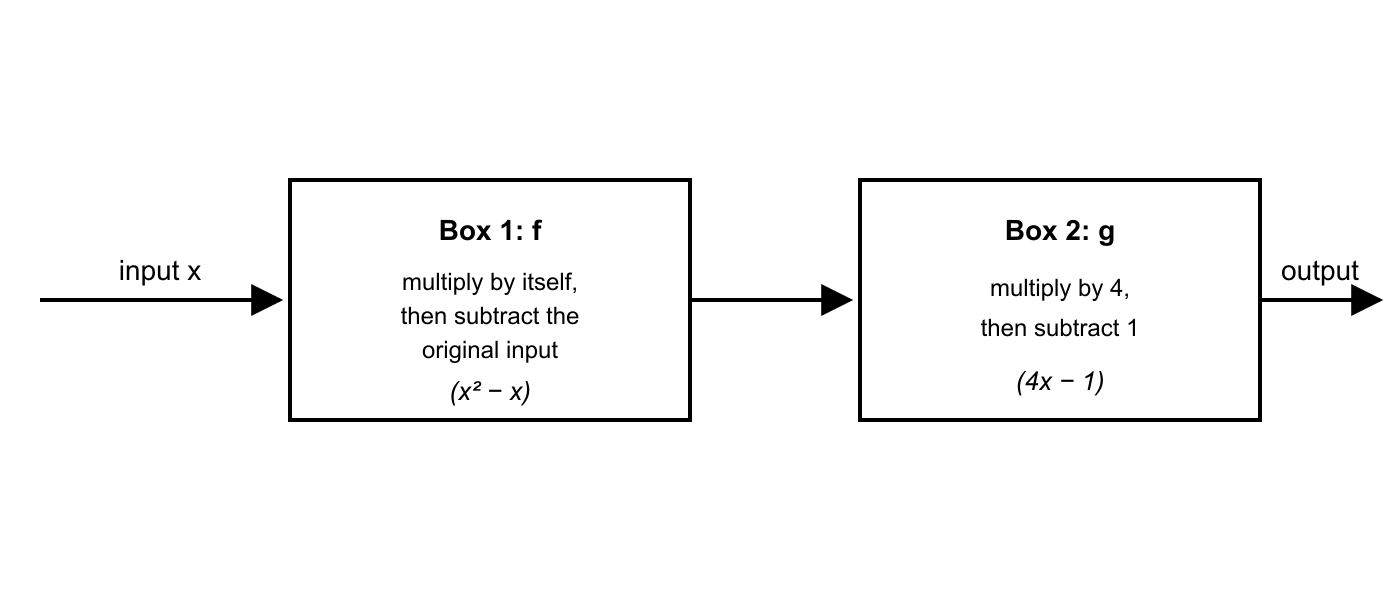
A 'machine' function diagram is shown in the figure below. The output of the first machine becomes the input of the second. If the initial input is x=4, what is the final output?
SHSAT Math Quiz
Practice Applying Function Rules in SHSAT Math with focused quiz questions that help you check what you know, review explanations, and build confidence with test-style prompts.
This quiz focuses on Applying Function Rules, giving you a quick way to practice the rules, question types, and explanations that matter most for SHSAT Math.
Try each quiz question before looking at the correct answer. Use the explanations to review missed ideas, then come back to similar questions until the pattern feels familiar.
A 'machine' function diagram is shown in the figure below. The output of the first machine becomes the input of the second. If the initial input is x=4, what is the final output?
The graph of y=f(x) is shown below. If g(x)=2f(x−1)+3, what is the value of g(3)?
The graph of the function f is shown on the coordinate plane below. What is the value of f(f(−2))?
The graphs of y=f(x) and y=g(x) are shown on the coordinate plane below. What is the value of f(g(−1))⋅g(f(2))?
The sequence an is defined recursively as shown in the figure below. What is the value of a5?
The function f is defined by the rule shown in the table. If f(f(f(2)))=k, what is the value of k?
The functions f and g are defined by the tables shown below. What is the value of f(g(2))−g(f(2))?
The function f is defined by f(x)=ax+b where a and b are constants. Selected values of f are shown in the table. What is the value of f(10)?
The figure below shows the rule for function T, which takes any positive integer n and applies the given process. What is T(T(T(12)))?
The sequence shown in the figure below follows the pattern cn=cn−1+cn−2 for n≥3. What is the value of c8?
A sequence is defined by an=2n−1 for n≥1. If the sum of three consecutive terms equals 63, what is the middle term?
A function p satisfies p(x)=3p(x−1)+2 for all integers x≥2, and p(1)=4. What is the value of p(4)?
The function f is defined by the rule shown below. For how many integer values of x with −3≤x≤3 is f(x) a positive integer?
The rule for the function h is given in the figure below. What is the value of h(−3)?
The function g is defined piecewise as shown in the figure below. What is the value of g(−2)+g(3)+g(5)?
The sequence {bn} is defined by the rule shown in the figure below. What is the value of b1+b2+b3+b4?
If g(x)=2x+7, what is g(−3)?
The function f is defined by f(x)=x2+kx+3 where k is a constant. If f(2)=f(−1), what is the value of f(0)?
The function g is defined by g(x)=x−1x+3 for all real numbers x=1. What is the value of g(g(2))?