All questions
Question 1
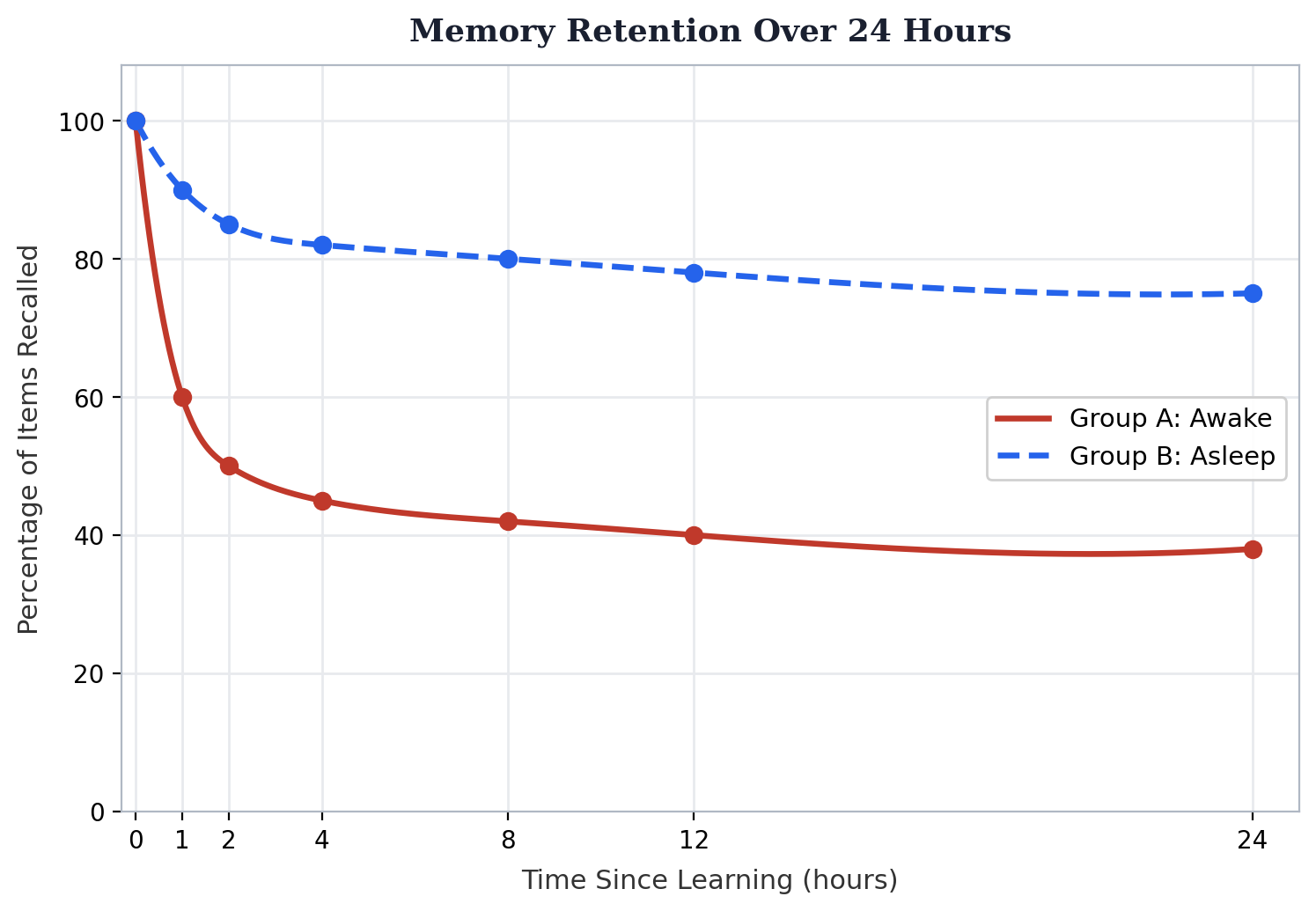
The graph shown illustrates the results of an experiment modeled after the work of Jenkins and Dallenbach (1924), where two groups learned a list of words and were tested at various intervals. The significant difference in recall between Group A and Group B is best attributed to the reduction of what in Group B?
- Retroactive interference (correct answer)
- Proactive interference
- Memory decay
- Retrieval failure
Explanation: The correct answer is A. The graph shows that the group that slept (Group B) forgot much less than the group that remained awake (Group A). During waking hours, individuals are constantly processing new information and having new experiences. This new information creates retroactive interference, hindering the recall of the word list learned at the beginning of the period. The sleeping group is largely protected from this new sensory input, resulting in less retroactive interference and better memory consolidation. Proactive interference (B) would stem from experiences before the study and should affect both groups equally. Decay theory (C) is contradicted by the data, as equal time passed for both groups. There is no reason to assume a difference in retrieval cues (D).
Question 2
In a paired-associate learning task, a group first learns List A (e.g., 'cat-7'), then learns List B (e.g., 'dog-4'), and is finally tested on their memory for List A. The finding that this group performs worse on List A than a control group that only learned List A demonstrates retroactive interference. If, during recall of List B, a participant mistakenly says '7' when prompted with 'dog', this specific error would be an example of:
- a failure of the retrieval cue 'dog'.
- output interference during the recall process.
- the continued effect of retroactive interference.
- proactive interference from List A. (correct answer)
Explanation: When you encounter questions about memory interference, focus on the timing and direction of the interference effect. This question tests your ability to distinguish between different types of interference based on when they occur and what interferes with what.
The key insight here is identifying what's interfering with what during the recall error. When the participant says "7" (from List A) while trying to recall List B, the previously learned information (List A) is interfering with the current recall task (List B). This is the hallmark of proactive interference - old learning disrupts new learning or its recall. The error shows that "cat-7" from List A is intruding into the recall of List B, making the participant incorrectly associate "7" with "dog."
Option A is wrong because the retrieval cue "dog" is working fine - it's successfully prompting a response, just the wrong one. Option B misidentifies the mechanism; output interference refers to competition between multiple correct responses during recall, not intrusion from a different list. Option C confuses the direction of interference - retroactive interference occurs when List B learning impairs List A recall, but here we see the opposite: List A is disrupting List B recall.
Remember this pattern: proactive interference flows forward in time (old → new), while retroactive interference flows backward (new → old). When earlier learning intrudes into later recall, it's always proactive interference, regardless of which list you're currently trying to remember.
Question 3
A man is trying to recall the name of an actor. He can picture the actor's face, remember several movies he was in, and is certain the name begins with 'B,' but he cannot produce the name. He feels extreme frustration, as if the name is just out of reach. This experience is a clear example of all the following EXCEPT:
- retrieval failure.
- the tip-of-the-tongue phenomenon.
- memory decay. (correct answer)
- cue-dependent forgetting.
Explanation: The correct answer is C. The scenario is a textbook description of the tip-of-the-tongue (TOT) phenomenon (B), which is a form of retrieval failure (A). The fact that he can recall related information (movies, first letter) shows that the memory is present but inaccessible without the right cues, which also makes it an instance of cue-dependent forgetting (D). The experience is NOT an example of memory decay. Decay theory implies the memory trace has faded or disappeared; the man's ability to access partial information and his strong feeling of knowing contradict this idea.
Question 4
During an oral exam, a student is asked to name the five stages of psychosexual development. He knows that he learned them, can almost 'feel' the answer, and even recalls that the third stage's name begins with 'P,' but he cannot produce the word 'Phallic.' This experience is a classic example of:
- source amnesia, because he has forgotten the textbook page where he originally learned the stages.
- proactive interference, because some prior learning is actively blocking retrieval of the stage names.
- the tip-of-the-tongue phenomenon, which is a specific form of retrieval failure. (correct answer)
- anterograde amnesia, because he failed to transfer the names of the stages to long-term memory.
Explanation: The correct answer is C. The tip-of-the-tongue (TOT) phenomenon is characterized by the feeling that a memory is available but not quite retrievable, often accompanied by the recall of partial information (like the first letter). This is a specific manifestation of retrieval failure. Choice A, source amnesia, is forgetting the origin of a memory, not the memory itself. Choice B is too general; while interference can cause retrieval failure, TOT describes this specific subjective experience. Choice D is incorrect because the information is clearly in long-term memory, as evidenced by the partial recall and feeling of knowing; the issue is access, not storage.
Question 5
An expert typist switches from a standard QWERTY keyboard, which she used for 20 years, to a new Dvorak layout. After six months of exclusively using the Dvorak keyboard, she attempts to type on a QWERTY keyboard and finds her speed and accuracy are severely diminished, with her fingers often moving to the Dvorak key locations. This loss of skill on the QWERTY keyboard is best explained by:
- decay of the procedural memory for QWERTY typing due to a period of simple disuse.
- retrieval failure due to the absence of the specific computer on which she originally learned to type.
- proactive interference from the old QWERTY habits on her current Dvorak typing ability.
- retroactive interference from the newly learned and now dominant Dvorak motor program. (correct answer)
Explanation: When you encounter questions about forgetting or skill loss, focus on identifying what type of interference is occurring and in which direction it flows between old and new learning.
This scenario demonstrates retroactive interference, where newly acquired information disrupts the recall of previously learned material. The expert typist's six months of intensive Dvorak practice created strong new motor patterns that now interfere with her ability to recall the old QWERTY movements. Her fingers automatically move to Dvorak positions even when facing a QWERTY keyboard because the newer, more recently practiced skill has become dominant and is "overwriting" access to the older skill.
Option A incorrectly suggests simple decay from disuse, but the typist's problem isn't just weakness from lack of practice—her fingers are actively moving to the wrong (Dvorak) positions, indicating active interference rather than passive forgetting. Option B focuses on environmental context, but keyboard layout interference operates at the motor skill level, not environmental cuing. The specific computer isn't relevant here. Option C describes proactive interference, which would mean her old QWERTY habits were interfering with learning Dvorak—but the question describes the opposite problem: her new Dvorak skills interfering with QWERTY performance.
Remember that interference direction matters: proactive interference occurs when old learning disrupts new learning, while retroactive interference occurs when new learning disrupts old learning. Pay attention to the timeline and what's interfering with what.
Question 6
An elderly veteran who was a bomber pilot can still recall the complex, multi-step pre-flight checklist for his aircraft with near-perfect accuracy, despite not having flown in 50 years. He struggles, however, to remember what he had for breakfast this morning. His ability to recall the checklist most directly challenges which theory of forgetting?
- Interference theory, because older memories are typically more susceptible to interference from a lifetime of experiences.
- Decay theory, because the memory trace has not faded despite a long period of disuse and no rehearsal. (correct answer)
- Retrieval failure, because relevant cues for the checklist are no longer present in his daily life.
- Motivated forgetting, because the checklist is a neutral memory not associated with trauma that would warrant repression.
Explanation: The correct answer is B. Decay theory posits that memories fade and disappear over time if they are not rehearsed or used. The veteran's vivid recall of a complex, unrehearsed memory after 50 years is a powerful counterexample to the idea that time alone is the primary cause of forgetting. Choice A is incorrect; while interference occurs, this scenario doesn't directly challenge the theory. Choice C is incorrect because his ability to recall the information despite a lack of cues is what makes it notable, challenging the idea that cues are always necessary. Choice D is irrelevant as there is no information to suggest motivated forgetting.
Question 7
A student crams for a history exam. The next day, during the test, he cannot recall a specific treaty date. After the exam, a friend mentions the name of a general involved in the treaty, and the student instantly remembers the date. This sequence suggests the initial forgetting was primarily caused by:
- memory decay, as the memory trace for the date had permanently faded overnight.
- retrieval failure, as the information was available but temporarily inaccessible. (correct answer)
- retroactive interference, as information learned after cramming erased the date from memory.
- encoding failure, as the crammed information was never transferred to long-term memory.
Explanation: The correct answer is B. The fact that the student could recall the date when provided with a relevant cue (the general's name) indicates that the memory existed (it was available) but could not be accessed without the cue. This is the definition of retrieval failure. Choice A is incorrect because if the memory had decayed, it would be gone permanently and a cue would not help. Choice D is incorrect for the same reason; if it was never encoded into LTM, it could not be retrieved. Choice C is a possible contributor to the initial difficulty, but the successful recall with a cue points most directly and specifically to retrieval failure as the immediate cause of the forgetting.
Question 8
A cybersecurity expert changes her primary password every 90 days. After creating a new password last week, she finds she can vividly recall her password from six months ago but struggles to remember the one she used just prior to the current one. Her difficulty in recalling the immediately preceding password is best explained by:
- proactive interference from the password used six months ago.
- retroactive interference from the newest, current password. (correct answer)
- memory decay due to the three-month passage of time.
- retrieval failure due to a lack of appropriate environmental cues.
Explanation: The correct answer is B. Retroactive interference occurs when newly learned information hinders the recall of older information. In this scenario, the learning and frequent use of the newest password interfere with the ability to recall the password that was used immediately before it. Choice A is incorrect because proactive interference would involve older memories (like the password from six months ago) interfering with newer ones. Choice C is incorrect because decay theory would predict that the even older password would be forgotten more, yet it is recalled vividly. Choice D is less precise; while it could be considered a type of retrieval failure, retroactive interference is the specific mechanism causing the failure in this context.
Question 9
A software developer worked exclusively with the Python programming language for two years. For the past six months, she has worked exclusively with Java. When she tries to help a colleague with a Python script, she finds herself repeatedly typing Java syntax (e.g., using semicolons where they are not needed in Python). This error pattern is best described as an instance of:
- proactive interference, because her earlier Python knowledge is disrupting her current Java work.
- retroactive interference, because her more recent Java knowledge is disrupting the recall of Python syntax. (correct answer)
- encoding failure, because she never sufficiently differentiated the syntax of the two languages.
- memory decay, because her procedural memory for Python has faded from six months of disuse.
Explanation: The correct answer is B. Retroactive interference (RI) occurs when more recently learned information interferes with the recall of older information. The developer's recent, intensive work with Java is hindering her ability to access her previously well-learned Python knowledge. Choice A describes proactive interference, which would be the opposite situation (e.g., her Python knowledge making it difficult to learn Java initially). Choice C is unlikely given her two years of exclusive Python work. Choice D is less likely than RI; while some decay may have occurred, the active intrusion of specific, competing habits points strongly to interference.
Question 10
To minimize retroactive interference while preparing for final exams in the similar subjects of psychology and sociology, which of the following strategies would be most effective, according to principles of cognitive psychology?
- Study the two subjects in one long, alternating session to encourage neural connections between them.
- Study the subject you find more difficult first, followed immediately by the easier subject.
- Study one subject, take a significant break for an unrelated activity like exercise, then study the second subject. (correct answer)
- Cram for both subjects immediately before the exams to ensure the information is fresh.
Explanation: The correct answer is C. Retroactive interference is strongest when similar materials are learned in close temporal succession. Introducing a break with an unrelated activity separates the learning events, reducing the likelihood that learning the second subject will interfere with the memory of the first. Choice A would maximize interference. Choice B does not address the core issue of interference between similar subjects. Choice D (cramming) may lead to high levels of both proactive and retroactive interference and is generally an ineffective long-term strategy.
Question 11
A scuba diver memorizes a list of words while on the beach and a different list of words while 20 feet underwater. She is later tested for recall of both lists in a library. Research on context-dependent memory suggests she will likely recall the list learned on the beach more effectively than the list learned underwater. Which phenomenon provides the best explanation for this outcome?
- State-dependent forgetting, as her physiological state in the library differs from her state underwater.
- Proactive interference, as the beach list was learned first and interfered with the underwater list.
- Retrieval failure due to a mismatch of environmental cues between encoding and retrieval. (correct answer)
- Memory decay, as the synaptic connections for the underwater list weakened more rapidly.
Explanation: The correct answer is C. This scenario describes context-dependent memory, a form of retrieval failure where recall is better when the external environment (context) during retrieval matches the environment during encoding. The library's environment is more similar to the beach than to being underwater, providing more effective retrieval cues for the beach list. Choice A is incorrect because state-dependent forgetting refers to internal physiological or psychological states (e.g., mood, intoxication), not the external environment. Choice B is incorrect as interference does not account for the context-specific recall differences. Choice D is incorrect because decay theory would not explain why one list is recalled better than the other based on the learning environment.
Question 12
During an oral exam, a student is asked to name the five stages of psychosexual development. He knows that he learned them, can almost 'feel' the answer, and even recalls that the third stage's name begins with 'P,' but he cannot produce the word 'Phallic.' This experience is a classic example of:
- source amnesia, because he has forgotten the textbook page where he originally learned the stages.
- proactive interference, because some prior learning is actively blocking retrieval of the stage names.
- the tip-of-the-tongue phenomenon, which is a specific form of retrieval failure. (correct answer)
- anterograde amnesia, because he failed to transfer the names of the stages to long-term memory.
Explanation: The correct answer is C. The tip-of-the-tongue (TOT) phenomenon is characterized by the feeling that a memory is available but not quite retrievable, often accompanied by the recall of partial information (like the first letter). This is a specific manifestation of retrieval failure. Choice A, source amnesia, is forgetting the origin of a memory, not the memory itself. Choice B is too general; while interference can cause retrieval failure, TOT describes this specific subjective experience. Choice D is incorrect because the information is clearly in long-term memory, as evidenced by the partial recall and feeling of knowing; the issue is access, not storage.
Question 13
After witnessing a staged theft, a research participant is asked a leading question: 'How fast was the red car going when it smashed into the bus?' (The car was actually blue). Weeks later, the participant confidently recalls the car as being red. The original memory of the blue car has been forgotten, most likely as a result of:
- proactive interference from the participant's prior experiences with red cars.
- motivated forgetting, as the participant unconsciously represses the true color of the car.
- decay of the memory for the car's color over the course of several weeks.
- retroactive interference from the misleading post-event information. (correct answer)
Explanation: This question tests your understanding of memory interference, particularly how new information can disrupt previously stored memories. When you encounter scenarios involving eyewitness testimony or post-event questioning, think about how later information might contaminate original memories.
The participant's memory demonstrates retroactive interference, where new information (the misleading question about a "red car") interferes with previously encoded information (the actual blue car). The post-event suggestion didn't just add false information—it actually replaced the original memory trace. This is a classic example of the misinformation effect studied by Elizabeth Loftus, showing how leading questions can permanently alter what people remember.
Let's examine why the other options don't fit: Option A describes proactive interference, where old memories interfere with new ones—but here, new information (the red car suggestion) is interfering with an old memory (blue car), making this retroactive interference instead. Option B suggests motivated forgetting or repression, but there's no emotional reason why the participant would unconsciously want to forget the car's color. Option C points to simple memory decay over time, but this doesn't explain why the participant specifically remembers red rather than simply forgetting the color entirely.
Remember this pattern: when post-event information changes what someone remembers about an earlier experience, you're looking at retroactive interference. The key clue is that misleading information presented after the original event has overwridden the initial memory. This is crucial for understanding eyewitness reliability and memory reconstruction.
Question 14
Which of the following hypothetical findings would provide the strongest evidence for the physiological basis of memory decay theory?
- A patient with bilateral hippocampal damage is unable to form new declarative memories.
- A patient's memory for a traumatic event is suppressed but can be recovered through therapy, showing changes in amygdala activation.
- An individual who learned two similar languages shows competing patterns of neural activation when trying to speak one of them.
- A researcher observes that synaptic connections representing a specific memory gradually weaken in the absence of rehearsal or retrieval. (correct answer)
Explanation: Memory decay theory proposes that forgetting occurs because memory traces naturally deteriorate over time due to physiological changes in the brain. To find the strongest evidence for this theory's physiological basis, you need to look for direct observation of biological memory mechanisms weakening without interference.
Option D provides exactly this evidence by showing synaptic connections that represent a specific memory gradually weakening when not reinforced through rehearsal or retrieval. This directly demonstrates the biological substrate of memory decay - the actual neural pathways storing information are physically deteriorating over time. This is the most direct physiological evidence possible for decay theory.
Option A describes anterograde amnesia from hippocampal damage, which demonstrates the brain regions involved in memory formation but doesn't show decay of existing memories over time. Option B illustrates memory suppression and recovery involving the amygdala, but this represents interference or motivated forgetting rather than natural decay - the memory wasn't lost due to time but due to psychological mechanisms. Option C shows interference between competing memories (retroactive interference), where similar information creates neural competition, but again this isn't evidence of natural time-based decay.
When studying memory theories, remember that decay theory specifically claims memories fade due to time and biological deterioration, while interference theory claims memories are disrupted by other information. Look for evidence that isolates time-based biological changes from other factors like brain damage, emotional suppression, or competing information to identify true decay mechanisms.
Question 15
After moving to a new home, a person frequently takes a wrong turn and starts driving toward their old home. After several months, this habit subsides. Years later, when asked for their old address, they struggle to remember it. The initial, incorrect turning is a result of , while the later difficulty recalling the old address is best explained by .
- proactive interference; retroactive interference (correct answer)
- retroactive interference; proactive interference
- procedural memory persistence; memory decay
- retrieval failure; encoding failure
Explanation: The correct answer is A. The initial incorrect turning is an example of proactive interference: the old, well-learned habit of driving to the old house interferes with the new task of driving to the new house. Years later, the frequent use and rehearsal of the new address has interfered with the ability to recall the old, less-used address. This is an example of retroactive interference, where new learning hinders the recall of old information. The other pairings incorrectly match the phenomena to the scenarios.
Question 16
A student studying for a vocabulary test learns the definition of 'enervate' (to weaken) and later learns the definition of 'innervate' (to supply with nerves). On the test, when asked for the definition of 'enervate,' he writes 'to supply with nerves.' This is a classic example of forgetting due to:
- decay of the memory for 'enervate'.
- retrieval failure caused by a lack of context cues.
- retroactive interference from the definition of 'innervate'. (correct answer)
- proactive interference from previously known, similar words.
Explanation: The correct answer is C. Retroactive interference occurs when new learning interferes with the recall of older information. Learning the second, similar-sounding word ('innervate') interfered with the student's ability to recall the definition of the first word ('enervate'). The similarity between the items increases the likelihood of interference. Choice A is incorrect because the student provides a specific, incorrect answer, not a blank, suggesting interference rather than fading. Choice B is less likely, as the test provides a direct cue. Choice D is incorrect because the interference comes from material learned after the target word.
Question 17
A cybersecurity expert changes her primary password every 90 days. After creating a new password last week, she finds she can vividly recall her password from six months ago but struggles to remember the one she used just prior to the current one. Her difficulty in recalling the immediately preceding password is best explained by:
- proactive interference from the password used six months ago.
- retroactive interference from the newest, current password. (correct answer)
- memory decay due to the three-month passage of time.
- retrieval failure due to a lack of appropriate environmental cues.
Explanation: The correct answer is B. Retroactive interference occurs when newly learned information hinders the recall of older information. In this scenario, the learning and frequent use of the newest password interfere with the ability to recall the password that was used immediately before it. Choice A is incorrect because proactive interference would involve older memories (like the password from six months ago) interfering with newer ones. Choice C is incorrect because decay theory would predict that the even older password would be forgotten more, yet it is recalled vividly. Choice D is less precise; while it could be considered a type of retrieval failure, retroactive interference is the specific mechanism causing the failure in this context.
Question 18
An elderly veteran who was a bomber pilot can still recall the complex, multi-step pre-flight checklist for his aircraft with near-perfect accuracy, despite not having flown in 50 years. He struggles, however, to remember what he had for breakfast this morning. His ability to recall the checklist most directly challenges which theory of forgetting?
- Interference theory, because older memories are typically more susceptible to interference from a lifetime of experiences.
- Decay theory, because the memory trace has not faded despite a long period of disuse and no rehearsal. (correct answer)
- Retrieval failure, because relevant cues for the checklist are no longer present in his daily life.
- Motivated forgetting, because the checklist is a neutral memory not associated with trauma that would warrant repression.
Explanation: The correct answer is B. Decay theory posits that memories fade and disappear over time if they are not rehearsed or used. The veteran's vivid recall of a complex, unrehearsed memory after 50 years is a powerful counterexample to the idea that time alone is the primary cause of forgetting. Choice A is incorrect; while interference occurs, this scenario doesn't directly challenge the theory. Choice C is incorrect because his ability to recall the information despite a lack of cues is what makes it notable, challenging the idea that cues are always necessary. Choice D is irrelevant as there is no information to suggest motivated forgetting.
Question 19
The famous Jenkins and Dallenbach (1924) study demonstrated that participants who slept after learning a list of nonsense syllables recalled more than participants who stayed awake for the same duration. This result provides strong evidence against which concept as the sole cause of forgetting?
- Decay that is independent of intervening experiences. (correct answer)
- Interference from subsequent mental activity.
- Retrieval failure due to a lack of proper cues.
- Encoding failure during the initial learning phase.
Explanation: The correct answer is A. If forgetting were solely due to decay over time, both the sleeping and waking groups should have forgotten the same amount of information, as the time interval was identical. The fact that the waking group forgot more suggests that the mental activities they engaged in created interference. This result strongly supports interference theory and argues against a simple decay theory where time is the only variable. The result directly supports the role of interference (B), so it cannot be the answer. The study did not manipulate retrieval cues (C) or encoding (D).
Question 20
In a proactive interference experiment, participants' recall of word lists worsens as they are given successive lists from the same semantic category (e.g., four lists of fruits). If the fifth list is switched to a new category (e.g., professions), what is the most likely outcome for recall of this fifth list?
- Recall performance will be even lower than for the fourth list due to the cumulative effect of interference.
- Recall performance will significantly improve, approaching the level of the first list. (correct answer)
- Recall performance will remain poor and similar to the fourth list, as interference is based on list position, not content.
- Recall performance will be poor due to retroactive interference from the first four lists.
Explanation: The correct answer is B. This phenomenon is known as 'release from proactive interference.' The decline in recall across the first four lists occurs because the similar (fruit) items interfere with each other. When the category is switched, the new items (professions) are distinct from the old ones, and the proactive interference that has built up is 'released,' leading to a rebound in recall performance. Choice A is incorrect because the category shift mitigates, rather than increases, the interference. Choice C is incorrect because interference is shown to be highly dependent on semantic content. Choice D incorrectly identifies the direction of interference; the interference is from old lists onto the new one (proactive).