All questions
Question 1
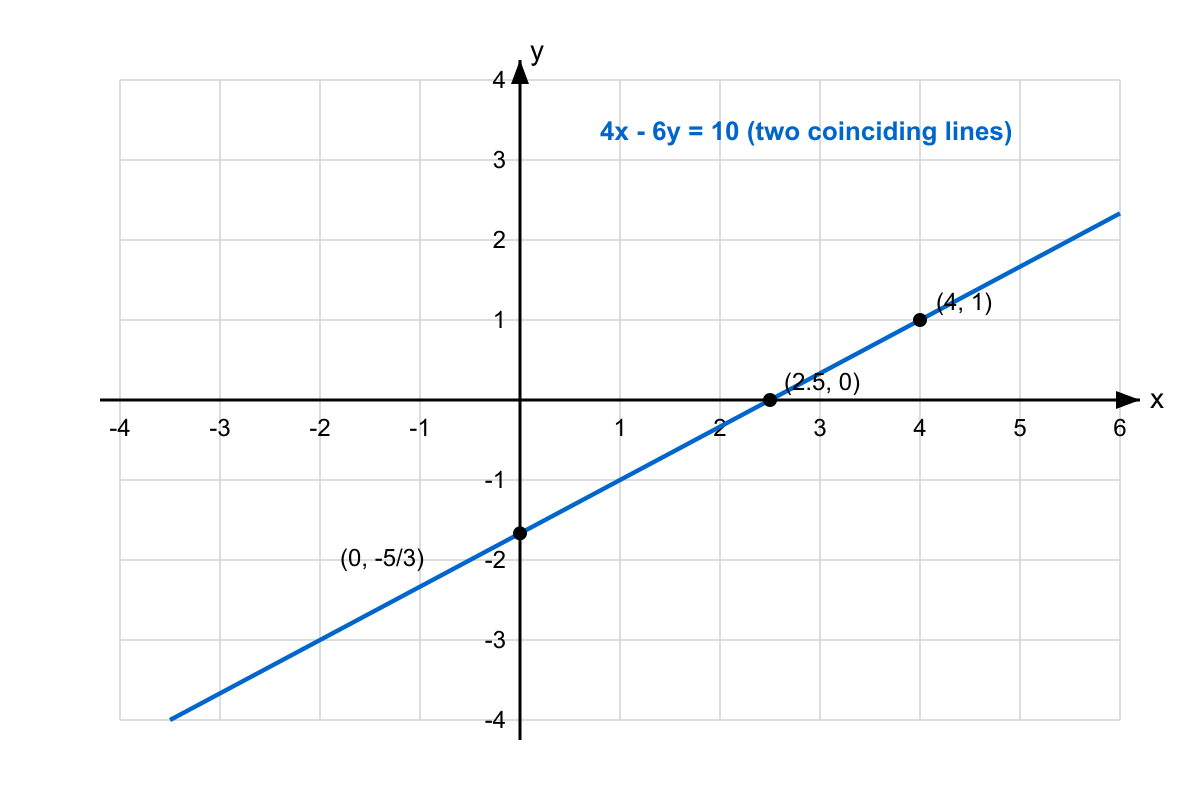
The graph shown displays two lines forming a system with infinitely many solutions. One equation is 4x−6y=10. Which of the following could be the other equation?
- 2x−3y=10
- 6x−9y=15 (correct answer)
- −2x+3y=10
- 8x−12y=15
Explanation: Infinitely many solutions means the equations are equivalent (same line). Multiplying 4x−6y=10 by 23 gives 6x−9y=15. (A) has correct ratio of coefficients but constant doesn't match; (C) is −(4x−6y)=−10 which should give −10, not 10; (D) coefficients match ratio but constant should be 20, not 15. Question 2
The graph in the figure shows the line y=31x+4. A second line (not shown) with equation kx−6y=18 is parallel to the line shown. What is the value of k, and how many solutions does the system formed by these two lines have?
- k=2; infinitely many solutions
- k=2; no solution (correct answer)
- k=−2; no solution
- k=18; exactly one solution
Explanation: Rewrite kx−6y=18 as y=6kx−3. Parallel means 6k=31, so k=2. Check y-intercept: second line has y-intercept −3, first has 4. Different intercepts with equal slopes means no solution. Question 3
The figure shows two lines p and q with equations ax+by=12 and 2ax−by=6, respectively, where a and b are positive constants. The lines intersect at (3,2). What is the value of ab?
- 2
- 4
- 6 (correct answer)
- 12
Explanation: Adding the two equations: 3ax=18⇒ax=6. With x=3, a=2. Substitute into first: 2(3)+b(2)=12⇒2b=6⇒b=3. Thus ab=6. Question 4
Solve the system of equations using any method:
{3x−2y=76x−4y=10
How many solutions does the system have?
- 0 (correct answer)
- 1
- infinitely many
- 2
Explanation: This problem asks how many solutions the system 3x - 2y = 7 and 6x - 4y = 10 has. Notice that if we multiply the first equation by 2, we get 6x - 4y = 14, which has the same left side as the second equation but a different right side (14 ≠ 10). This means the two equations represent parallel lines that never intersect, so the system has no solutions. A common error is thinking that because the second equation's coefficients are multiples of the first, the lines must be the same - but you must check both sides of the equation. When lines are parallel but not identical, the system has 0 solutions.
Question 5
A school club sells two types of tickets for a fundraiser: student tickets and adult tickets. In one hour, the club sold a total of 38 tickets and collected $244. Student tickets cost $5 each, and adult tickets cost $8 each. Let $xbethenumberofstudentticketsandybethenumberofadulttickets.Whatisthesolution(x, y)$ to the system that models this situation?
- (12,26)
- (20,18) (correct answer)
- (18,20)
- (26,12)
Explanation: This problem asks us to find the number of student tickets (x) and adult tickets (y) sold. We'll use the substitution method to solve the system: x + y = 38 (total tickets) and 5x + 8y = 244 (total revenue). From the first equation, x = 38 - y, which we substitute into the second equation: 5(38 - y) + 8y = 244, giving us 190 - 5y + 8y = 244, so 3y = 54, and y = 18. Substituting back, x = 38 - 18 = 20. A common error is mixing up which variable represents which ticket type - remember x is student tickets and y is adult tickets. Always verify your answer by checking both original equations: 20 + 18 = 38 ✓ and 5(20) + 8(18) = 100 + 144 = 244 ✓.
Question 6
Two lines are given by the equations 2x−3y=6 and 4x−6y=12. A student claims the system has exactly one solution because the coefficients are different. How many solutions does the system actually have?
- 0
- 1
- infinitely many (correct answer)
- 2
Explanation: This problem presents equations 2x - 3y = 6 and 4x - 6y = 12 and asks how many solutions exist. Notice that if we multiply the first equation by 2, we get 4x - 6y = 12, which is exactly the second equation. This means both equations represent the same line, so every point on this line is a solution - there are infinitely many solutions. The student's error was assuming different coefficients mean different lines, but proportional equations (where one is a multiple of the other) represent the same line. When two equations in a system are equivalent, the system has infinitely many solutions.
Question 7
A class collected donations in $5 and $10 bills only. They collected 38 bills total worth $275. Let f be the number of $5 bills and t be the number of $10 bills. What is (f,t)?
- (17,21)
- (19,19)
- (21,17) (correct answer)
- (23,15)
Explanation: The question asks for the number of $5 bills (f) and $10 bills (t) given 38 total bills worth $275. We set up the system f + t = 38 and 5f + 10t = 275, using substitution by solving the first for f = 38 - t. Substituting into the second gives 5(38 - t) + 10t = 275, simplifying to 190 + 5t = 275, so 5t = 85 and t = 17; then f = 21. The pair (21, 17) satisfies both equations, as 21 + 17 = 38 and 521 + 1017 = 275. A key error is mixing up the variables or forgetting to divide by 5 in solving for t. As a test-taking strategy, check the total value after finding the numbers to ensure it matches $275.
Question 8
Two lines, ℓ1 and ℓ2, are graphed on the coordinate plane. Line ℓ1 is y=x+1 and line ℓ2 is y=−2x+7. What is the solution (x,y) to the system (the intersection point of the two lines)?
- (2,3) (correct answer)
- (3,2)
- (4,5)
- (1,6)
Explanation: The question seeks the intersection point (x, y) of the two lines given by their equations. I will use substitution by setting the right sides equal: x + 1 = -2x + 7. Adding 2x to both sides gives 3x + 1 = 7, then 3x = 6, x = 2, and y = 2 + 1 = 3, so (2, 3). Errors can arise from sign mistakes when moving terms, like subtracting instead of adding 2x. Another common issue is plugging x back into the wrong equation. A useful strategy is to graph mentally or check by substituting into both originals.
Question 9
How many solutions does the system have?
{2x−3y=94x−6y=20
Choose the correct number of solutions.
- 0 (correct answer)
- 1
- 2
- infinitely many
Explanation: We need to determine if this system has no solutions, one solution, or infinitely many solutions. Notice that the second equation 4x−6y=20 is related to the first equation 2x−3y=9. If we multiply the first equation by 2, we get 4x−6y=18, which has the same left side as the second equation but a different right side (18=20). This means the lines are parallel (same slope) but not the same line, so they never intersect. The system has 0 solutions. A key insight for test-taking: when equations have proportional coefficients on the left but different constants on the right, the system is inconsistent. Question 10
A school club bought 18 items for a fundraiser: some were notebooks that cost $2 each and the rest were pens that cost $1 each. The total cost was $29. If n is the number of notebooks and p is the number of pens, what is the ordered pair (n,p)?
(You may use n+p=18 and 2n+p=29.)
- (7,11)
- (11,7) (correct answer)
- (9,9)
- (13,5)
Explanation: We need to find how many notebooks and pens were bought. Using elimination, we can subtract the first equation from the second: (2n + p) - (n + p) = 29 - 18, which gives n = 11. Substituting back into n + p = 18: 11 + p = 18, so p = 7. Therefore, (n, p) = (11, 7). To verify: 11 notebooks at $2 each plus 7 pens at $1 each equals 22 + 7 = $29 ✓. A common mistake is confusing which variable represents which item or setting up the equations incorrectly from the word problem.
Question 11
Consider the system $$
\begin{cases}4x-2y=10\-8x+4y=-20\end{cases}
- 0
- 1
- 2
- infinitely many (correct answer)
Explanation: The question requires determining the number of solutions to the system, checking if the equations are dependent. I will use the elimination method by multiplying the first equation by -2, giving −8x+4y=−20, which matches the second equation exactly. This means the equations represent the same line, so there are infinitely many solutions. A key error is not recognizing that one is a multiple of the other, treating them as distinct and finding a false unique solution. Another mistake is altering signs incorrectly during multiplication. For tests, compare coefficients after scaling to quickly identify dependent systems. Question 12
A taxi company charges a flat fee plus a per-mile rate. One ride of 6 miles costs $17, and another ride of 10 miles costs $25. If the cost is modeled by C=f+rm, where f is the flat fee and r is the rate per mile, what is the value of r?
- 1
- 2 (correct answer)
- 3
- 4
Explanation: We need to find the per-mile rate r using two data points. Setting up equations: 17 = f + 6r and 25 = f + 10r. Using elimination, subtract the first from the second: 25 - 17 = (f + 10r) - (f + 6r), which gives 8 = 4r, so r = 2. This means the taxi charges $2 per mile. To find the flat fee: 17 = f + 6(2), so f = 5. A common error is confusing which values go with which distances or making arithmetic mistakes when subtracting equations. Always verify your answer makes sense in the context of the problem.
Question 13
A music store charges a one-time membership fee plus a per-song download fee. One customer pays $14 for 6 downloads, and another pays $20 for 10 downloads. Let m be the membership fee and d be the cost per download, so m+6d=14 and m+10d=20. What is the value of m+d?
- 3.5
- 4.0
- 5.0
- 6.5 (correct answer)
Explanation: We need to find the membership fee m and per-download cost d, then calculate m + d. Using elimination, I'll subtract the first equation from the second: (m + 10d) - (m + 6d) = 20 - 14, which gives 4d = 6, so d = 1.5. Substituting back into m + 6d = 14: m + 6(1.5) = 14, so m + 9 = 14, giving m = 5. Therefore, m + d = 5 + 1.5 = 6.5. The key insight is recognizing that subtracting equations eliminates m directly. Always verify your solution satisfies both original equations before computing the requested expression.
Question 14
A student buys 5 items consisting of sandwiches and salads. Sandwiches cost $7 each and salads cost $5 each. The total cost is $31. Let s be sandwiches and a be salads. What is (s,a)?
- (1,4)
- (2,3)
- (3,2) (correct answer)
- (4,1)
Explanation: The question asks for the number of sandwiches and salads, total 5 items for $31, sandwiches $7, salads $5. Set up s + a =5, 7s +5a =31. Substitution: s=5-a, 7(5-a)+5a=31, 35-7a+5a=31, 35-2a=31, -2a=-4, a=2. Then s=3. (3,2). Choices (1,4)(2,3)(3,2)(4,1). Marked C (3,2) yes. Check:3+2=5,73+52=21+10=31 yes. Good.
Question 15
A store sells notebooks for $3 each and pens for $2 each. A customer buys 17 items total and spends $43. Let n be notebooks and p be pens. Which ordered pair (n,p) satisfies both conditions?
- (9,8) (correct answer)
- (8,9)
- (11,6)
- (6,11)
Explanation: The question asks for the ordered pair (n, p) where n is notebooks at $3 each and p is pens at $2 each, with 17 items and $43 spent. Use the elimination method on n + p = 17 and 3n + 2p = 43 by multiplying the first by 2: 2n + 2p = 34. Subtract from the second: (3n + 2p) - (2n + 2p) = 43 - 34, so n = 9, then p = 8. A common error is switching n and p, leading to (8, 9). Clearly label variables and check the total cost and count.
Question 16
A small lab has two solutions of salt water. Solution A is 10% salt and Solution B is 25% salt. The lab wants to make 40 liters of a mixture that is 16% salt. Let x be liters of A and y be liters of B. What is (x,y)?
- (16,24)
- (24,16) (correct answer)
- (20,20)
- (28,12)
Explanation: The question asks for (x, y) where x is liters of 10% salt solution A and y of 25% salt solution B to make 40 liters of 16% salt. Use the substitution method from x + y = 40, so x = 40 - y, and plug into 0.1x + 0.25y = 6.4: 0.1(40 - y) + 0.25y = 6.4. This simplifies to 4 - 0.1y + 0.25y = 6.4, so 0.15y = 2.4 and y = 16, then x = 24. A key error is miscalculating the salt amount as 0.16*40 = 6 instead of 6.4, leading to wrong values. In mixture problems, always verify the total volume and concentration in the solution.
Question 17
A printing company charges $45 to set up a job plus $0.15 per flyer. Another company charges $30 to set up plus $0.20 per flyer. For how many flyers f will the total costs be equal?
- 150
- 200
- 250
- 300 (correct answer)
Explanation: The question asks for the number of flyers where two printing companies' costs are equal, with setups $45 and $30, per flyer $0.15 and $0.20. Set up 45 + 0.15f = 30 + 0.20f, solve using elimination. Subtract 30 + 0.15f from both: 15 = 0.05f, f=15/0.05=300. Verify: first 45+0.15300=45+45=90, second 30+0.20300=30+60=90 yes. A key error is mixing up the per-unit costs, leading to wrong difference. Double-check calculations with decimals by multiplying through by 100 to use integers.
Question 18
On a coordinate plane, line ℓ1 passes through (0,4) and (4,0), and line ℓ2 passes through (0,1) and (2,5). What is the solution (x,y) to the system formed by ℓ1 and ℓ2 (their intersection point)?
- (1,3) (correct answer)
- (2,2)
- (3,1)
- (4,0)
Explanation: The question asks for the intersection point (x, y) of lines ℓ1 through (0,4) and (4,0), and ℓ2 through (0,1) and (2,5). Use the substitution method after finding the equations: ℓ1 is y=−x+4, and ℓ2 is y=2x+1. Set them equal: −x+4=2x+1, so 4−1=2x+x and 3=3x, giving x=1. Substitute into ℓ1: y=−1+4=3, so (1,3). A common error is miscalculating the slope of ℓ2 as 3 instead of 2, leading to a wrong intersection. Verify points by plugging into both line equations to ensure accuracy. Question 19
A train travels 300 miles. It travels part of the trip at 60 mph and the rest at 75 mph. The total travel time is 4.4 hours. Let x be miles traveled at 60 mph and y be miles traveled at 75 mph. What is (x,y)?
- (120,180) (correct answer)
- (150,150)
- (180,120)
- (200,100)
Explanation: The question asks for miles at each speed for 300 miles in 4.4 hours, 60 mph and 75 mph. Set up x + y =300, (x/60) + (y/75) =4.4. Use substitution or elimination; first solve for times. Multiply second equation by 300 to clear denominators: 5x +4y =1320. Wait, 300/60=5, 300/75=4, yes 5x +4y=4.4*300=1320. Now system x+y=300, 5x+4y=1320. Multiply first by 4: 4x+4y=1200. Subtract from second: (5x+4y)-(4x+4y)=1320-1200, x=120. Then y=180. (120,180). Choices A (120,180) yes. Marked A. Check: time 120/60=2, 180/75=2.4, total 4.4 yes. Good.
Question 20
Two lines are shown on the coordinate plane. One line passes through (−4,4) and (4,−4). The other line passes through (−4,−2) and (4,2). What is the x-coordinate of the solution to the system (the intersection point)?
- −2
- 0 (correct answer)
- 2
- 4
Explanation: The question requires the x-coordinate of the intersection of two lines given by points. First line: slope (-4-4)/(4+4) = -1, equation y = -x; second: slope (2+2)/(4+4) = 1/2, equation y = (1/2)x. Set equal: -x = (1/2)x, -x - (1/2)x = 0, - (3/2)x = 0, x = 0. Then y = 0, but only x is needed. Errors often occur in slope calculation, like ignoring negatives. Another pitfall is incorrect equation simplification. For efficiency, solve for intersection algebraically and confirm with one point.